
The state of Missouri represents a fascinating transition zone for arachnid ecology, bridging eastern deciduous forests, Ozark cave systems, and western tallgrass prairies. This geographic confluence fosters a rich biodiversity of arthropods. While the overwhelming majority of Missouri spiders are ecologically beneficial apex predators that regulate insect populations, encountering them around residential structures in Kansas City, St. Louis, or rural outcroppings naturally prompts questions regarding identification, safety, and taxonomy.
(Reference: Identification Guide to Common Spiders in Nebraska)Distinguishing harmless garden dwellers from medically significant species requires moving past superficial descriptions and examining specific morphological keys, ocular configurations, behavioral patterns, and microhabitat preferences. This guide establishes a comprehensive framework for identifying Missouri spiders, detailing anatomical structures, web-building versus hunting strategies, and proper handling of encounters within the domestic sphere.
Explore our detailed breakdown on Types Of House Spiders (Complete Field Identification).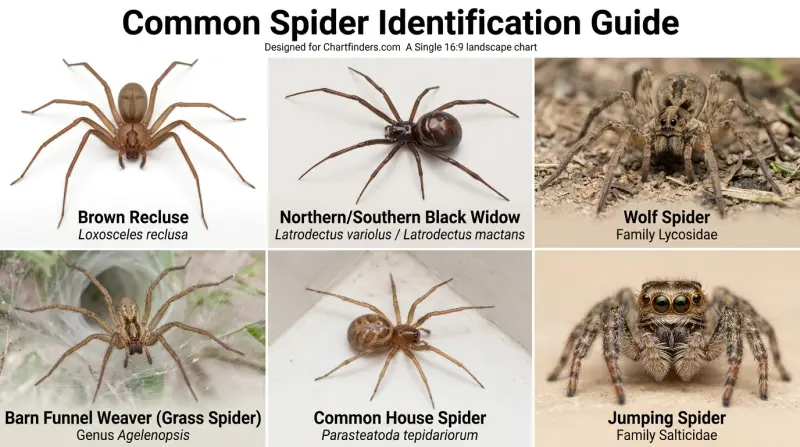
Missouri Spiders Identification Chart
- Medically Significant Taxa: Missouri is home to two primary genera of medical concern: Loxosceles (recluses) and Latrodectus (widows).
- Ocular Arrangement as a Diagnostic Tool: The brown recluse possesses precisely six eyes arranged in three distinct dyads (pairs), diverging from the typical eight-eyed pattern of most true spiders.
- Behavioral Dichotomy: Web-weaving taxa (like Theridiidae and Agelenidae) remain stationary in architectural traps, whereas wandering hunters (Lycosidae, Salticidae) actively stalk or ambush prey without silken snares.
- Cephalothorax Markings: The classic violin-shaped sclerite marking on Loxosceles reclusa points toward the posterior abdomen, though verifying ocular count remains the definitive diagnostic test.
- Habitat Specialization: Recluses seek dark, desiccated, undisturbed environments (attacks often occur when individuals are pressed against skin in shoes or clothing), while wolf spiders favor ground-level leaf litter and turfgrass.
The following identification matrix details the most commonly encountered and medically relevant spider taxa throughout Missouri. It synthesizes morphological descriptions, ocular configurations, web architectures, and behavioral traits to aid in accurate classification.
| Common Name | Scientific Name | Size (Body Length) | Diagnostic Markings & Coloration | Ocular Arrangement | Web Architecture / Behavior | Medical Significance |
|---|---|---|---|---|---|---|
| Brown Recluse | Loxosceles reclusa | 1/4 to 3/4 inch | Uniform tan to brown; dark violin shape on cephalothorax with neck pointing backward; no abdominal patterns or spines. | 6 eyes in 3 pairs (dyads); unique among common Missouri species. | No capture web; erratic silk sheets in dark voids; nocturnal hunter. | High; necrotic venom causing dermonecrotic lesions. |
| Northern/Southern Black Widow | Latrodectus variolus / Latrodectus mactans | 1/3 to 1/2 inch (females) | Glossy jet black; female features red/orange hourglass marking ventrally (or spot patterns on northern variants). | 8 small eyes arranged in two parallel rows. | Irregular, 3D scaffolding webs close to ground level in dark recesses. | High; neurotoxic venom causing systemic latrodectism. |
| Wolf Spider | Family Lycosidae | 1/4 to 2 inches | Robust, mottled brown, gray, or black; longitudinal stripes on cephalothorax; stout legs with heavy setae. | 8 eyes in 3 rows; massive posterior median eyes and small anterior row. | No web; active ground runner, nocturnal hunter; females carry egg sacs on spinnerets. | Low/None; mechanical bite may cause localized pain, non-necrotic. |
| Barn Funnel Weaver (Grass Spider) | Genus Agelenopsis | 3/4 to 1 inch | Grayish-brown with two dark longitudinal bands on cephalothorax; prominent, elongated spinnerets. | 8 eyes in two curved rows. | Horizontal sheet web terminating in a tubular funnel retreat. | Low/None; shy, flees when disturbed. |
| Common House Spider | Parasteatoda tepidariorum | 1/4 to 3/8 inch | Mottled brown and dirty white; globular abdomen with chevron or spot patterns. | 8 eyes in two rows surrounding a dark clypeus. | Tangled, cobweb-style scaffold webs in corners, basements, and eaves. | Negligible; timid, occasional minor localized reaction. |
| Jumping Spider | Family Salticidae | 1/8 to 3/4 inch | Compact, hairy, often brightly colored or metallic; stocky legs adapted for leaping. | 8 eyes; massive forward-facing anterior median eyes providing acute stereoscopic vision. | No capture web; active daytime stalker; uses dragline silk for safety tethers. | Negligible; docile unless tightly cornered against skin. |
Analyzing this matrix emphasizes that coloration alone can be misleading, as many harmless spiders mimic the rustic brown hues of the brown recluse. Verifying anatomical specifics—such as ocular counts and spinneret structure—prevents misidentification.
Anatomical Foundations of Arachnid Identification
To accurately interpret any spider identification chart, one must understand basic external morphology. Spiders possess two main tagmata: the cephalothorax (prosoma) and the abdomen (opisthosoma), joined by a narrow pedicel.
The cephalothorax houses the central nervous system, venom glands, chelicerae (jaws), pedipalps, and walking appendages. On its dorsal surface, pattern variations provide primary visual cues. For example, the brown recluse exhibits an acrid violin shape where the “neck” of the violin extends toward the posterior pedicel. However, biological variation can render this mark faint or ambiguous. Therefore, entomologists rely heavily on the ocular arrangement.
While most spiders possess eight simple eyes (ocelli) arranged in two rows across the clypeus, the family Sicariidae (which includes Loxosceles reclusa) possesses exactly six eyes arranged in distinct pairs or dyads: one median pair and two lateral pairs. Conversely, family Lycosidae (wolf spiders) display a distinctive ocular triad layout featuring four small eyes in a front row, two massive posterior median eyes facing forward, and two posterior lateral eyes positioned on the sides of the head capsule.
Comparative Analysis of Missouri’s Primary Spider Families
Understanding how different spider groups compare across physical traits, hunting modes, and preferred habitats helps clarify why certain species are found in specific home zones while others remain outdoors.
| Taxonomic Group | Primary Habitat | Hunting / Foraging Strategy | Web Presence | Active Time | Defensive Behavior |
|---|---|---|---|---|---|
| Recluses (Sicariidae) | Indoor dark voids, closets, boxes, woodpiles | Active nocturnal stalking in tight crevices | No (erratic silk retreats only) | Nocturnal | Flees into darkness; bites only when trapped against skin. |
| Widows (Theridiidae) | Crawl spaces, sheds, under rocks, meter boxes | Stationary ambush waiting for prey entanglement | Yes (3D irregular scaffold) | Nocturnal / Crepuscular | Typically curls into a ball or flees; bites defensively when compressed. |
| Wolf Spiders (Lycosidae) | Lawns, leaf litter, fields, basements | Active ground running and visual ambush | No | Nocturnal / Crepuscular | Runs rapidly away; rears up and displays chelicerae if cornered. |
| Jumping Spiders (Salticidae) | Sunny exterior walls, garden foliage, windowsills | Stalking, calculating distance, and leaping | No (uses dragline silk) | Diurnal | Jumps away rapidly; tracks movement with large eyes. |
Medically Significant Species in Missouri
Out of the hundreds of species inhabiting the state, only two groups possess venom capable of inducing systemic clinical manifestations or significant localized tissue breakdown in humans: the brown recluse and black widows.
The Brown Recluse (Loxosceles reclusa)
The brown recluse is endemic to the central and southern regions of Missouri, frequently colonizing human domiciles in Kansas City, Springfield, and St. Louis. True to their common name, they inhabit dark, dry, undisturbed microhabitats—behind baseboards, inside cardboard storage boxes, within unused ductwork, and deep inside stacked firewood.
- Morphology: Monochromatic fawn to dark brown; legs are uniformly pale brown without spines, banding, or distinct striping. Total body length ranges from 6 to 20 millimeters.
- Abdominal Features: The abdomen is covered in fine, short hairs and lacks any chevrons, spots, or dorsal stripes.
- Venom Action: The venom contains sphingomyelinase D, an enzyme that triggers a cascade of inflammatory responses, platelet aggregation, and localized vasoconstriction, frequently resulting in a dermonecrotic ulcer requiring extended medical management.
Black Widow Species (Latrodectus genus)
Both the Northern Black Widow (Latrodectus variolus) and the Southern Black Widow (Latrodectus mactans) occur within Missouri. Unlike recluses, widows prefer low-to-ground, humid, sheltered locations such as crawl spaces, stone walls, meter boxes, and dense brush piles.
- Morphology: Females are robust, shiny jet-black spiders with a globose abdomen. The signature red or orange hourglass marking is located on the ventral (underside) surface of the abdomen, though northern variants may exhibit broken red spots or lateral striping.
- Web Architecture: They construct irregular, highly tensile three-dimensional scaffolding webs composed of exceptionally strong silk threads.
- Venom Action: Widow venom contains alpha-latrotoxin, a potent neurotoxin that causes massive presynaptic release of neurotransmitters. Envenomation results in severe muscle cramps, abdominal rigidity, diaphoresis, and systemic distress (latrodectism).
Wandering Hunters and Beneficial Garden Spiders
The vast majority of spiders encountered in Missouri yards and homes pose zero medical risk and perform essential ecological functions by consuming agricultural and structural insect pests.
Wolf Spiders (Family Lycosidae)
Often mistaken for tarantulas or recluses due to their large size and brown coloration, wolf spiders are robust nocturnal hunters that do not spin webs to capture prey. Instead, they chase down insects across turfgrass and forest floors.
- Identification Clues: Heavy build, distinct vertical striping on the cephalothorax, and exceptionally keen eyesight driven by their prominent posterior median eyes.
- Reproductive Behavior: Female wolf spiders exhibit unique maternal care, constructing a silken egg sac attached to their spinnerets and subsequently carrying dozens of newly hatched spiderlings on their dorsal abdomen.
Jumping Spiders (Family Salticidae)
Salticids are easily recognized by their compact, stocky frames, rapid jerky movements, and oversized anterior median eyes that grant them exceptional stereoscopic color vision.
- Behavior: They are diurnal hunters that stalk and leap upon insect prey from several times their own body length. They are remarkably curious and completely harmless to humans.
Funnel Weavers and Grass Spiders (Genus Agelenopsis)
These large, fast-moving web builders construct dense, flat horizontal sheet webs in lawns and foundation landscaping, terminating in a tubular retreat where the spider waits for vibrations from passing insect prey.
- Identification Clues: Grayish-brown coloration with dark longitudinal stripes on the cephalothorax and noticeably elongated posterior spinnerets projecting from the rear of the abdomen.
Common Identification Mistakes and Misconceptions
Misidentifying Missouri spiders frequently leads to unnecessary panic or improper pest management strategies. Several persistent myths surround local arachnid populations.
- The “Every Brown Spider is a Recluse” Fallacy: Countless harmless species—including male nursery web spiders (Pisauridae), funnel weavers (Agelenidae), and ground spiders (Gnaphosidae)—share brown color palettes. Confirming the six-eye arrangement and uniform leg structure is mandatory before suspecting Loxosceles reclusa.
- Geographic Range Misconceptions: Homeowners outside the core southern and central range of the brown recluse often panic upon seeing any brown spider. While populations exist statewide, high-density infestations are tightly correlated with older, climate-controlled structural environments offering ample undisturbed harborage.
- Confusion Over Wolf Spider Bites: Wolf spiders possess robust chelicerae capable of piercing human skin if trapped against the body, but their venom is strictly designed for invertebrate prey and lacks dermonecrotic or systemic neurotoxic properties in humans.
Practical Prevention and Exclusion Framework
Managing encounters with medically significant spiders relies on environmental modification and structural exclusion rather than indiscriminate chemical applications.
- Seal Structural Access Points: Caulk utility penetrations, repair torn window screens, and install tight-fitting door sweeps to prevent wandering species from entering living spaces.
- Declutter Storage Areas: Eliminate corrugated cardboard boxes in basements and attics, replacing them with sealed plastic bins that prevent recluses from establishing harborage.
- Personal Protective Protocols: Shake out shoes, work gloves, and stored garments left undisturbed in garages or closets before donning them. Wear heavy leather gloves when handling stacked firewood, lumber, or stored stone pavers.
- Manage Moisture and Vegetation: Trim tall grasses, ivy, and shrubbery away from exterior foundations to reduce microhabitats favored by wolf spiders and black widows.
Frequently Asked Questions
No. Loxosceles reclusa are notoriously reclusive and non-aggressive. Bites almost exclusively occur defensively when a spider is inadvertently trapped, squeezed, or compressed against human skin inside clothing, bedding, or footwear.
Wolf spiders are large, hairy, fast-moving hunters with eight eyes and often striped legs. Brown recluses are smaller, smooth-looking, light brown to tan with uniform legs, a violin mark on the cephalothorax, and precisely six eyes arranged in three pairs.
Yes. Both the northern and southern black widow species inhabit Missouri. They are less common inside heavily trafficked interior living spaces and prefer protected exterior zones like woodpiles, crawl spaces, and dark corners of outbuildings.
Wash the bite site thoroughly with soap and water, apply a cold compress to minimize swelling, and monitor the area. If you experience severe localized pain, spreading redness, ulceration, systemic cramping, or difficulty breathing, seek immediate medical evaluation. If possible, safely capture or photograph the spider for professional identification.
Sticky insect boards placed along baseboards can capture wandering hunters like wolf spiders and recluses, but they do not eliminate breeding populations hidden inside wall voids or boxes. Comprehensive integrated pest management requires decluttering, structural sealing, and targeted elimination of primary insect food sources.
Proper identification remains the of safe coexistence with Missouri’s native arachnid populations. By relying on objective morphological keys—such as ocular counts and spinneret structure—homeowners can accurately distinguish harmless ecological allies from medically significant species, ensuring both personal safety and environmental preservation.