
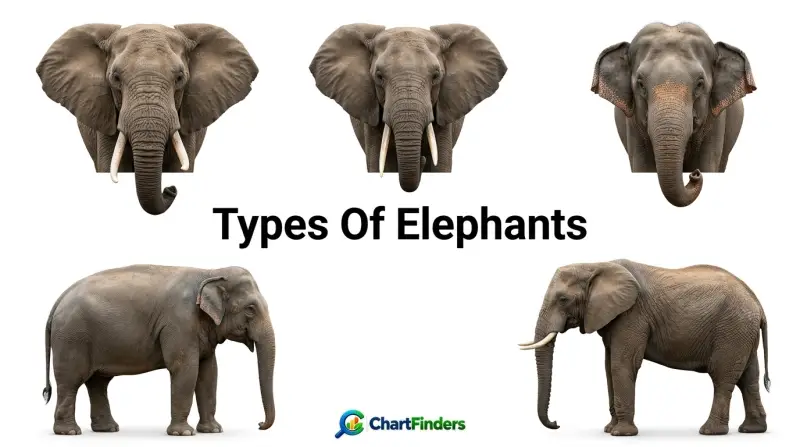
The family Elephantidae represents the sole surviving lineage of the once-diverse order Proboscidea. As Earth’s largest living terrestrial mammals, these charismatic megafauna command immense ecological, behavioral, and evolutionary interest. However, phenotypic plasticity, localized adaptations, and historical taxonomic conflation have frequently obscured the precise boundaries between distinct populations. Understanding the structural, genetic, and ecological classifications of modern elephants requires looking beyond superficial traits to examine skeletal morphology, dental specializations, and distinct genetic lineages.
Modern conservation biology recognizes that preserving these species requires parsing their distinct ecological niches, ranging from the humid equatorial rainforests of Central Africa to the vast arid savannas and the fragmented subtropical forests of South and Southeast Asia. This master reference examines the anatomical adaptations, taxonomic history, population metrics, and conservation status of the world’s surviving elephant species.
Types Of Elephants
- Taxonomic consensus divides extant proboscideans into three distinct species: Loxodonta africana, Loxodonta cyclotis, and Elephas maximus.
- African savanna elephants (Loxodonta africana) are designated as Endangered, numbering approximately 350,000 to 380,000 individuals.
- African forest elephants (Loxodonta cyclotis) are Critically Endangered, with populations estimated between 35,000 and 40,000 due to severe habitat fragmentation and poaching.
- Asian elephants (Elephas maximus) feature distinct subspecies (E. m. indicus, E. m. maximus, E. m. sumatranus) characterized by a single dorsal trunk “finger” and dome-shaped crania.
- Anatomical differentiations extend to ear morphology, vertebral counts, toenail tallies, and lamellar enamel folding patterns within their molar dentition.
The taxonomic framework of Elephantidae has evolved significantly over the last two decades. For generations, naturalists grouped all African populations under a single species (Loxodonta africana) with various subspecies, contrasting them with the singular Asian species (Elephas maximus). Comprehensive mitochondrial and nuclear DNA sequencing, combined with morphometric analysis of osteological specimens, confirmed that African savanna and African forest elephants represent deeply divergent, reproductively isolated lineages that split millions of years ago.
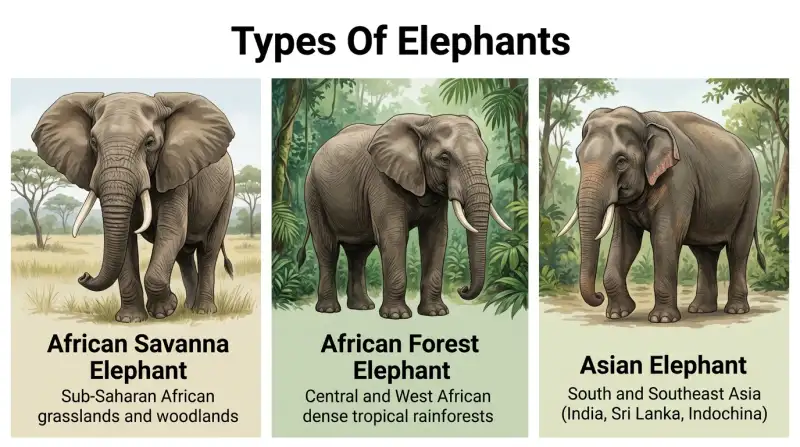
| Common Name | Scientific Name | IUCN Red List Status | Estimated Global Population | Primary Geographic Distribution | Distinct Morphological Marker |
|---|---|---|---|---|---|
| African Savanna Elephant | Loxodonta africana | Endangered | 350,000 – 380,000 | Sub-Saharan African grasslands and woodlands | Large, fan-shaped ears pointing downward; two prehensile trunk fingers |
| African Forest Elephant | Loxodonta cyclotis | Critically Endangered | 35,000 – 40,000 | Central and West African dense tropical rainforests | Smaller stature; darker, denser hair; straight, downward-pointing tusks |
| Asian Elephant | Elephas maximus | Endangered | 40,000 – 50,000 | South and Southeast Asia (India, Sri Lanka, Indochina) | Twin-domed forehead; single prehensile trunk finger; smaller, rounded ears |
The table above outlines the core biological and demographic parameters of the three recognized species. Interpreting these data points requires analyzing how selective pressures in vastly different biomes have sculpted each species’ distinct physiological blueprint.
1. African Savanna Elephant (Loxodonta africana)
The African savanna elephant (Loxodonta africana), frequently termed the African bush elephant, is the largest living land mammal. Adult bulls (males) can attain shoulder heights exceeding 3.5 to 4 meters and body masses scaling up to 6,000 kilograms or more. Cows (females) are appreciably smaller, though still massive by mammalian standards.
Anatomical and Physiological Specializations
- Pinnae (Ears): Massive, fan-shaped ears that extend over the shoulders. These are heavily vascularized with an extensive rete mirabile to facilitate thermoregulation via heat dissipation.
- Tusks: Both sexes grow prominent, outward-curving ivory tusks derived from elongated upper incisors.
- Trunk Morphology: The proboscis terminates in two distinct, opposing finger-like processes (dorsal and ventral) optimized for grasping grasses, stripping bark, and tearing branches.
- Dental Architecture: Molars feature low, lozenge-shaped enamel loops (loxodont pattern) specialized for grinding abrasive, silica-rich C4 grasses and woody browse.
Habitat and Behavioral Ecology
Inhabiting open savannas, arid scrublands, acacia woodlands, and gallery forests, L. africana operates as a keystone ecosystem engineer. Their feeding habits suppress woody encroachment, maintaining open grasslands that support a diverse suite of ungulates and predators. They maintain complex, matriarchal social structures led by experienced older cows, whereas mature bulls typically lead solitary lives or form transient bachelor coalitions.
2. African Forest Elephant (Loxodonta cyclotis)
Long conflated as a mere geographical variant or subspecies of the savanna elephant, the African forest elephant (Loxodonta cyclotis) is genetically distinct, having diverged from the savanna lineage an estimated 2 to 6 million years ago. Adapted to the dense, low-light understory of the Congo Basin and fragmented West African rainforests, its morphology reflects selective pressures entirely distinct from open-country proboscideans.
Anatomical and Physiological Specializations
- Stature and Skeletal Build: Considerably smaller in stature, rarely exceeding 2.5 meters in height. Their skeletal structure is notably more compact and gracile.
- Tusk Morphology: Tusks are characteristically thinner, straighter, and point directly downward. This vertical orientation prevents entanglement in dense, tangled rainforest vines and lianas. They also exhibit a pinkish or reddish tint due to the hardness of the ivory and dietary soil minerals.
- Integumentary System: Skin is darker, smoother, and sparsely covered with coarser, darker hair that protects against biting insects and dense undergrowth. Ears are significantly more rounded and smaller than those of their savanna counterparts.
- Hoof Structure: Forest elephants possess five toenails on their forefeet and four on their hind feet (compared to the 4/3 configuration typical of savanna elephants), an adaptation suited for navigating muddy, slippery rainforest soils.
Ecological Role
Loxodonta cyclotis serves an indispensable ecological function as a primary seed disperser for numerous old-growth tropical tree species whose seeds cannot germinate without passing through the pachyderm’s digestive tract. Their reliance on mineral licks (bais) provides essential calcium and sodium. Due to slow reproductive rates and intense poaching pressures for ivory, their population trajectory remains precarious, categorized as Critically Endangered.
3. Asian Elephant (Elephas maximus)
The Asian elephant (Elephas maximus) represents the sole surviving representative of the genus Elephas. Distinct from their African relatives, Asian elephants are more closely related to the extinct woolly mammoth (Mammuthus primigenius) than to African elephants. They are distributed across fragmented ranges in 13 range states, spanning India, Sri Lanka, Indochina, and the Sundaic islands.
Anatomical and Physiological Specializations
- Cranial Morphology: The cranium features a distinctive twin-domed forehead with a central depression, creating a profile starkly different from the single continuous slope of African elephants.
- Trunk and Appendages: The proboscis terminates in a single, highly sensitive dorsal “finger” used to pluck delicate shoots and forage. They possess smaller, folded ears that do not extend significantly over the shoulder blades.
- Skeletal Frame: Backs often exhibit a distinct convex or level profile. They possess 20 pairs of ribs (compared to 21 in African species) and distinct skeletal proportions suited for forested and hilly terrains.
- Dental Configuration: Molar enamel loops feature a compressed, ribbon-like or flattened lamellar pattern specialized for a mixed diet of grasses, cultivated crops, palm fronds, and tree bark.
Recognized Subspecies of Elephas maximus
Taxonomists typically recognize three primary extant subspecies of Asian elephants, separated by geographic isolation and slight morphological divergence:
- Sri Lankan Elephant (Elephas maximus maximus): The largest of the Asian subspecies, characterized by depigmented patches (depigmentation depôts) on the ears, face, and trunk, and a high incidence of tuskless males (makhnas).
- Indian/Continental Elephant (Elephas maximus indicus): Ranging across mainland Asia from India to Southeast Asia and southern China. Slightly smaller than the Sri Lankan subspecies with a grayer skin tone and intermediate tusk frequencies in males.
- Sumatran Elephant (Elephas maximus sumatranus): The smallest of the Asian subspecies, native to the island of Sumatra. Possesses lighter skin coloration and a higher relative proportion of secondary secondary traits suited for dense tropical environments.
Comparative Osteology and Identification Clues
Field identification and osteological classification rely on a consistent set of diagnostic traits. When analyzing cranial remains, field researchers and osteologists examine specific sutures, dental plates, and overall dimensions.
| Anatomical Feature | African Savanna Elephant (L. africana) | African Forest Elephant (L. cyclotis) | Asian Elephant (E. maximus) |
|---|---|---|---|
| Max. Shoulder Height | Up to 4.0 meters | Up to 2.5 meters | Up to 3.0 meters |
| Fore/Hind Toenail Count | 4 / 3 | 5 / 4 | 5 / 4 (sometimes 5/5) |
| Back Profile | Saddle-backed (concave) | Relatively straight or arched | Convex or flat |
| Trunk Prehensile Fingers | Two (upper and lower) | Two (upper and lower) | One (upper only) |
| Tusk Characteristics | Large, curved outward | Thin, straight, downward-pointing | Present in males; females usually tuskless (makhnas) |
The comparative matrix above illustrates that while African forest and Asian elephants share certain superficial similarities (such as smaller stature and adaptations to closed-canopy forests), their fundamental skeletal and genetic heritage places them in distinct evolutionary branches.
Conservation Status and Extinction Pressures
The survival of all three elephant species is threatened by anthropogenic pressures. While the biological drivers differ slightly between regions, the core threats remain habitat loss, fragmentation, human-wildlife conflict, and illegal poaching.
- Poaching for Ivory: Driven by illicit international trade networks, despite the international CITES ban on commercial ivory enacted in 1989. Forest elephants suffered catastrophic declines, losing over 80% of their population across multiple decades.
- Habitat Fragmentation: Agricultural expansion, infrastructure development (such as railways and highways), and logging isolate populations, resulting in genetic bottlenecks and inbreeding depression.
- Human-Elephant Conflict (HEC): As human settlements encroach on historical migratory corridors, elephants raid crops, leading to retaliatory killings, trapping, and poisoning.
Frequently Asked Questions
How can you tell an African elephant from an Asian elephant?
The most reliable field indicators are ear size and shape (African elephants have massive, fan-shaped ears that cover the shoulders; Asian elephants have smaller, rounded ears), forehead shape (Asian elephants have a twin-domed forehead; African elephants have a continuous slope), and the number of finger-like processes on the tip of the trunk (African elephants have two; Asian elephants have one).
Are African savanna and forest elephants the same species?
No. Extensive genetic sequencing and morphological studies have confirmed that African savanna elephants (Loxodonta africana) and African forest elephants (Loxodonta cyclotis) are distinct species that diverged millions of years ago and do not normally interbreed in the wild.
Do female Asian elephants have tusks?
Unlike African elephants where both sexes grow prominent tusks, female Asian elephants generally do not grow visible external tusks. Instead, they possess small, non-projecting teeth known as tushes. Even among male Asian elephants, a significant percentage (varying by region, up to 90% in Sri Lanka) are naturally tuskless, known as makhnas.
Why are African forest elephants harder to study than savanna elephants?
African forest elephants inhabit dense, humid equatorial rainforests with thick understories and limited visibility. Their elusive behavior, coupled with the logistical challenges of tracking them in difficult terrain, makes direct visual observation rare, requiring researchers to rely heavily on genetic analysis of dung samples (dung DNA) and acoustic monitoring.
What is the evolutionary relationship between mammoths and modern elephants?
Woolly mammoths (Mammuthus primigenius) and modern Asian elephants (Elephas maximus) share a more recent common ancestral lineage than either shares with the African elephant genera (Loxodonta). DNA extraction from ancient mammoth specimens confirms that their closest living relative is the Asian elephant.
Conclusion
The family Elephantidae represents an evolutionary triumph of megafaunal adaptation, bridging ancient proboscidean lineages with modern terrestrial ecosystems. Recognizing the distinct classification of the African savanna elephant, the African forest elephant, and the Asian elephant is not merely an academic exercise; it is a foundational requirement for targeted conservation. As these majestic species face unprecedented demographic and environmental pressures, preserving their genetic integrity and remaining habitats remains an urgent imperative for global biodiversity.