
Plumbing maintenance can quickly become a frustrating endeavor when an unexpected leak, stiff handle, or fluctuating water temperature forces you to open up a shower wall. Moen is one of the most trusted names in residential plumbing, and one of their greatest engineering strengths—interchangeability and lasting valve designs—can also be a source of confusion during a repair. Because Moen has manufactured millions of shower valves over several decades, many cartridges look remarkably similar at a glance, yet they perform entirely different functions within the valve body.
(Reference: How to Identify Your Moen Shower Valve [2026] | Plumbing by the Book)Attempting to force the wrong replacement part into a valve body can result in severe leaks, ruined O-rings, or complete failure of the pressure-balancing mechanism. This comprehensive master guide examines the mechanics of Moen shower valves, providing the detailed context, diagnostic markers, and structural comparisons necessary to accurately identify your cartridge before you ever pick up a wrench. By understanding the visual signatures of Posi-Temp, Moentrol, Standard, 1234, and two-handle series cartridges, you can eliminate guesswork and complete your plumbing repair safely and efficiently.
Explore our detailed breakdown on Types Of Flying Ants (Complete Field Identification).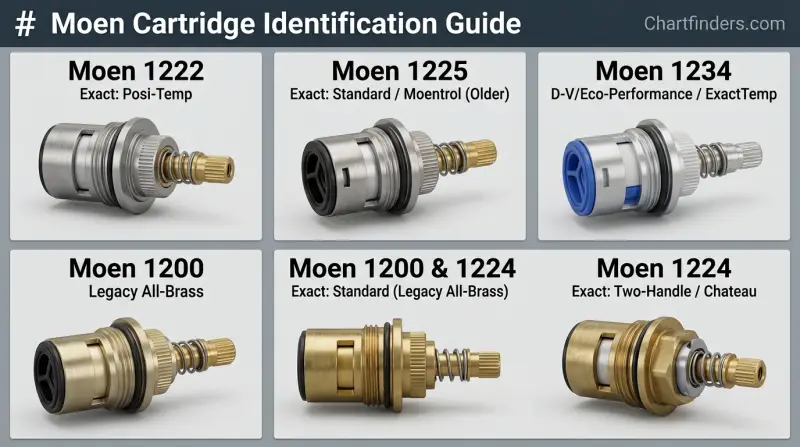
Moen Shower Cartridge Identification Chart
- Always shut off the main water supply and relieve system pressure before removing any retaining clips or cartridge stems.
- Single-handle Moen valves typically house either the 1225 (Standard) or 1222 (Posi-Temp) cartridge, which differ fundamentally in handle rotation and pressure-balancing capabilities.
- Two-handle Moen tub and shower configurations utilize distinct hot and cold stem assemblies (often 1224 series) that are side-specific.
- Visual identification relies on stem length, brass versus plastic construction, the presence of balancing spools, and the retention clip style.
- Utilizing a Moen cartridge puller tool is frequently necessary to remove calcified or seized cartridges without damaging the delicate inner walls of the brass valve body.
Navigating the various generations of Moen shower valves requires a systematic approach. The identification process is structured around handle behavior, physical dimensions, and internal valving mechanics. The following matrix outlines the primary Moen shower and tub-shower cartridges currently found in residential homes, detailing their primary design traits and application parameters.
| Cartridge Model | Valve Type | Handle Operation | Key Visual & Structural Markers | Primary Application |
|---|---|---|---|---|
| Moen 1222 | Posi-Temp | Single-handle (Rotates for temperature, pulls out for volume) | Plastic body, brass stem with cross-pin slot, distinct balancing spool inside valve. | Modern pressure-balancing single-handle tub/showers. |
| Moen 1225 | Standard / Moentrol (Older) | Single-handle (Rotates for temperature, pulls out for volume) | All-brass or brass-and-plastic stem with a symmetrical cylindrical body; lacks Posi-Temp cross-pin. | Older single-handle tub/showers and kitchen faucets. |
| Moen 1234 | D-V/Eco-Performance / ExactTemp | Single-handle thermostatic or dual-control | Brass shaft with a distinct D-shaped profile or multiple flat planes, ceramic disc internal architecture. | Thermostatic and high-end custom shower systems. |
| Moen 1224 | Two-Handle / Chateau | Two-handle (Independent hot and cold rotation) | Narrow brass or plastic stem, side-specific threading or stop tabs, sold in hot and cold pairs. | Two-handle garden tubs, bathroom sinks, and older showers. |
| Moen 1200 | Standard (Legacy All-Brass) | Single-handle | Heavy all-brass construction with a brass cage and rubber seals. (Largely succeeded by 1225). | Legacy Moen single-handle rough-in valves. |
Understanding the distinctions in this table is the first step toward diagnosing a leaking or malfunctioning valve. However, because internal wear and mineral buildup can obscure fine details, it is helpful to explore the structural anatomy of each major family.
Anatomy of Moen Single-Handle Systems
Single-handle Moen valves dominate the residential market. They are engineered to control both water volume and temperature through a single lever or knob. Despite external similarities in trim kits, the internal architecture splits primarily into two categories: the Posi-Temp platform and the Standard/Moentrol platform.
The Posi-Temp Valve (Cartridge 1222)
Introduced to meet strict anti-scald building codes (such as ASSE 1016), the Posi-Temp system automatically regulates water pressure fluctuations. If someone flushes a toilet or runs a washing machine while you are in the shower, the Posi-Temp valve shifts instantly to maintain a safe water temperature ratio.
- Handle Operation: Rotates roughly from the 6 o’clock position (off) counterclockwise through 90 degrees (warm) to 120 degrees (hot), while also pulling outward to adjust flow rate.
- Cartridge Characteristics: The 1222 cartridge features a rugged plastic body molded around a brass stem. A distinct horizontal slot or cross-pin runs through the brass stem to accept the handle adapter.
- Identification Tip: If your single-handle shower features a plastic sleeve body and a brass inner core, and the handle rotates in a complete sweeping arc while pulling out for volume, it is almost certainly a Posi-Temp 1222.
The Standard and Moentrol Valves (Cartridge 1225 & 1200)
Before Posi-Temp became standard, Moen relied on the 1225 (and its all-brass predecessor, the 1200) for single-handle applications. Moentrol valves added a volume control ring behind the handle trim, allowing users to adjust water pressure independently of temperature.
- Handle Operation: Rotates side-to-side and pulls out for volume, operating on a similar geometric plane to the Posi-Temp.
- Cartridge Characteristics: The 1225 features a symmetrical cylindrical body. It lacks the specific balancing spool features built into the Posi-Temp architecture. It can be constructed of brass or high-grade engineering polymers.
- Identification Tip: Measure the overall length and inspect the brass stem. If the stem does not feature the Posi-Temp cross-pin slot and the outer shell is entirely smooth and cylindrical without pressure-balancing chambers, you are looking at a 1225 series.
Anatomy of Two-Handle Moen Systems
Two-handle tub and shower configurations do not use a single central mixing cartridge. Instead, they rely on two separate stem assemblies—one for hot water and one for cold water. These are designated as side-specific parts because the internal rubber seals and directional stops are mirrored.
Two-Handle Cartridges (Cartridge 1224)
The 1224 cartridge series is standard across many traditional two-handle Moen tub and shower faucets, as well as widespread bathroom sinks.
- Handle Operation: Traditional rotational handles that turn roughly a quarter-turn or half-turn to open and close.
- Cartridge Characteristics: Slender, cylindrical brass stems with exterior O-rings and a threaded or notched collar at the base. They are sold distinctly as “Hot” (often turning clockwise to close) and “Cold” (turning counter-clockwise to close).
- Identification Tip: If your shower has two separate handles and water leaks from the handle base or spout when the respective valve is closed, you will pull a 1224 series cartridge. Pay strict attention to whether the removed stem came from the hot or cold side before purchasing a replacement.
Advanced and Specialty Cartridges
Modern custom shower systems often incorporate thermostatic controls or multi-port diverters. These require specialized engineering that differs from standard Posi-Temp or two-handle designs.
ExactTemp and Thermostatic Systems (Cartridge 1234)
ExactTemp valves maintain water temperature to within one degree Fahrenheit, utilizing wax-thermocouple technology or ceramic disc stacks.
- Handle Operation: Often paired with a digital interface or a dedicated thermostatic dial separate from the volume control.
- Cartridge Characteristics: Distinct geometric brass shafts featuring a D-shape or multi-faceted spline designed to lock precisely into digital or thermostatic trim gears.
- Identification Tip: If your luxury shower system allows you to dial in an exact digital temperature or features a multi-port thermostatic rough-in valve, it likely uses the 1234 cartridge series. Always verify the part number stamped on the old brass housing if accessible.
Step-by-Step Cartridge Removal and Visual Verification
Visual inspection on paper can only take you so far; sometimes, you must extract the old part to confirm its exact identity. Because mineral deposits (hard water scale) can weld brass cartridges into the valve body over time, following a methodical extraction sequence prevents catastrophic plumbing damage.
Preparation and Safety Measures
- Shut Off Main Water: Locate your home’s main water shutoff valve and turn it completely off. If your shower has integrated service stops (screwdriver stops built into the rough-in valve), you can turn those off instead.
- Drain the Line: Open the shower handle to drain any remaining water trapped in the risers. Plug the tub drain with a washcloth to prevent tiny screws, clips, or O-rings from sliding down the drain.
- Remove Trim Components: Pry off any decorative caps on the handle, loosen the set screw using an Allen wrench (hex key), and slide off the handle lever and sleeve. Remove the escutcheon (faceplate) if necessary to gain a clear view of the valve body and retaining clip.
Extracting the Retaining Clip and Cartridge
- Remove the Retaining Clip: Look at the top of the brass valve body. You will see a U-shaped wire retainer clip holding the cartridge in place. Grab the pull-tab of this clip with needle-nose pliers and pull it straight up and out. Caution: Do not drop this clip down the open wall cavity.
- Inspect the Exposed Stem: With the clip removed, look closely at the exposed end of the cartridge. If you see a prominent plastic shell with a brass core and a cross-pin slot, it is a 1222. If it is a smooth, all-brass or uniform polymer cylinder, it is likely a 1225.
- Use a Cartridge Puller: Do not use excessive force with standard pliers, as snapping the brass stem off inside the valve body turns a simple 20-minute repair into a major plumbing replacement. Screw a Moen cartridge puller tool onto the stem, thread the extraction screw down against the valve body, and slowly turn the nut to pull the cartridge straight out of the housing.
Comparison of Moen Cartridge Families
To further assist in identification, the following comparative table contrasts key technical attributes across Moen’s most popular cartridge lines, highlighting structural and performance differences:
| Feature | Moen 1222 (Posi-Temp) | Moen 1225 (Standard) | Moen 1224 (Two-Handle) | Moen 1234 (ExactTemp) |
|---|---|---|---|---|
| Handles Served | Single-handle | Single-handle | Two-handle (Hot or Cold) | Thermostatic / Custom |
| Body Material | Engineered Polymer & Brass | Brass & Engineered Polymer | Brass with Rubber/Plastic Seals | Brass & Ceramic Discs |
| Pressure Balancing | Built-in spool balancing | None (Standard mixing) | None | Thermostatic wax element |
| Retention Method | U-shaped wire clip | U-shaped wire clip | Threaded collar / Retaining nut | Flanged plate / Screws |
Common Identification Mistakes and Edge Cases
Even experienced DIYers occasionally misidentify Moen cartridges due to visual similarities, manufacturing updates, or aftermarket replacement parts installed by previous owners. Being aware of these pitfalls saves time and prevents multiple trips to the hardware store.
Confusing the 1222 (Posi-Temp) with the 1225 (Standard)
Because both cartridges fit into single-handle housings that look remarkably similar from the outside of the wall, homeowners frequently buy a 1225 when their shower actually requires a 1222.
- The Mistake: Relying solely on the shape of the handle trim rather than pulling the cartridge first.
- The Reality: A Posi-Temp (1222) valve body is explicitly cast with the words “Posi-Temp” stamped onto the brass housing or integrated with pressure-balancing loops. A standard 1225 valve body lacks these features. Inserting a 1225 into a Posi-Temp valve will result in uncontrolled water flow and a complete failure of temperature regulation.
Overlooking Aftermarket or Universal Replacements
If a previous owner or contractor installed a third-party universal replacement cartridge, the color, material, and stamped markings may not match original Moen specifications. When dealing with an unknown aftermarket part, rely on precise physical measurements: overall length, stem diameter, and the exact placement of O-rings and locking tabs.
Frequently Asked Questions
Observe the range of motion of your shower handle. If the handle rotates counterclockwise from the 6 o’clock position to roughly the 7 o’clock or 8 o’clock position for warm water, and continues around to approximately 10 or 11 o’clock for hot water (a total arc of roughly 100 to 120 degrees), it is almost certainly a Posi-Temp system. Standard Moen single-handle valves generally rotate through a full 180-degree or greater arc.
Yes. Moen offers a legendary lifetime limited warranty on its cartridges and mechanical components for original homeowners. If your genuine Moen cartridge is leaking, stiff, or failing, you can contact Moen customer support with photos of the part, and they will typically ship a replacement cartridge free of charge.
Yes, and it is strongly recommended. Always use the packet of plumbers’ waterproof silicone grease included with your replacement cartridge. Apply a thin film to the rubber O-rings and the body of the cartridge before sliding it into the brass valve. Never use petroleum-based lubricants (such as Vaseline or mineral oil), as they will degrade the rubber seals and cause premature failure.
Stiffness is almost always caused by mineral scale (calcium and lime) buildup accumulating between the outer cartridge body and the inner walls of the brass rough-in valve, or drying out of the internal factory lubricants. Replacing the cartridge and thoroughly cleaning the interior valve body with a wire brush and white vinegar will restore smooth, effortless operation.
If the stem shears off, do not panic. You can still remove the remaining plastic or brass body by using a dedicated cartridge extraction tool, or by carefully collapsing the plastic core inward with a flathead screwdriver and needle-nose pliers. Take extreme care not to scratch or gouge the interior brass walls of the valve body, as deep scratches will prevent the O-rings on the new cartridge from forming a watertight seal.
Conclusion
Accurately identifying a Moen shower cartridge is the of a successful plumbing repair. By examining handle operation, inspecting physical structural markers like brass stems and retention clips, and understanding the core differences between Posi-Temp, Standard, and two-handle platforms, you can bypass frustration and select the exact replacement part required. Always remember to shut off the water supply, utilize the correct extraction tools to protect your valve body, and apply fresh silicone grease during reassembly to ensure years of leak-free performance.