
Quick Answer: The lifespan of a moth varies dramatically depending on the species, environmental conditions, and life stage, typically ranging from a few weeks to nearly a year as a total life cycle. Adult moths of many common species live only a week to several months, focusing exclusively on reproduction since some lack functional mouthparts. However, certain larger species and overwintering (diapause) forms can persist for many months.
(Reference: Field Guide to the Moths of Great Britain and Ireland: Third Edition – Paul Waring, Martin Townsend – Google Books)The lifespan of a moth is rarely a straightforward metric. It is shaped by a profound metamorphosis encompassing four distinct phases: egg, larva (caterpillar), pupa (chrysalis or cocoon), and adult (imago). In many instances, the adult phase represents only the final, fleeting chapter of a life that may have spent months hidden underground, beneath bark, or inside silken cases. , recent ecological shifts—including changing climatic conditions and earlier seasonal emergences documented by modern entomological research—are rewriting how these timelines unfold across natural and urban habitats alike.
This master guide provides a comprehensive, field-experienced examination of moth lifespan. It breaks down biological mechanisms, environmental variables, life-stage durations, and the fascinating adaptations that allow certain species to defy standard insect longevity rules.
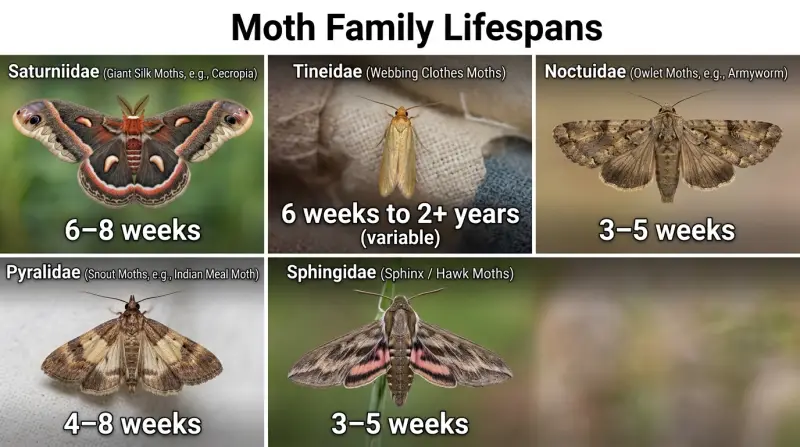
Moth Lifespan
- Adult Longevity Varies Widely: While many adult moths live only 1 to 2 weeks, species equipped with functional mouthparts or those undergoing overwintering diapause can survive for several months.
- The Larval Stage Dictates Total Time: The vast majority of a moth’s total lifespan is spent in the caterpillar phase, where active feeding, growth, and multiple instars occur.
- Adults of Some Species Do Not Feed: Prominent families like Saturniidae (giant silk moths) emerge entirely without functional mouthparts or digestive tracts, living strictly off stored lipid reserves accumulated during their larval stage.
- Environmental Phenology is Shifting: Modern ecological data reveals that many moth species are emerging earlier in the calendar year and experiencing increased voltinism (more broods per year) due to changing environmental conditions.
- Diapause Pauses the Clock: Environmental stressors trigger a physiological state of suspended animation known as diapause, allowing pupae or caterpillars to survive harsh winter months and artificially extending total lifespan.
- Metabolic Rate Determines Pace: Smaller micro-moths typically cycle through generations rapidly, whereas large macro-moths often follow strict, seasonal single-generation patterns.
To fully grasp the dynamics of moth lifespan, one must avoid treating the adult stage as the entirety of the organism’s existence. In entomology, lifespan refers to the total duration from oviposition (egg-laying) to natural mortality across all developmental stages. The table below illustrates how different moth families allocate their time across these stages, highlighting the vast divergence between fast-cycling pest species and long-lived or overwintering specialists.
| Moth Family / Common Example | Egg Stage | Larval (Caterpillar) Stage | Pupa Stage | Adult Lifespan | Total Lifecycle Duration |
|---|---|---|---|---|---|
| Saturniidae (Giant Silk Moths, e.g., Cecropia) | 1–2 weeks | 6–8 weeks | Overwintering (8–9 months) | 1–2 weeks (non-feeding) | 10–12 months |
| Tineidae (Webbing Clothes Moths) | 4–10 days | 6 weeks to 2+ years (variable) | 8–25 days | 2–4 weeks | 2 months to multiple years |
| Noctuidae (Owlet Moths, e.g., Armyworm) | 3–7 days | 3–5 weeks | 10–20 days | 2–6 weeks | 2–3 months (multi-brooded) |
| Pyralidae (Snout Moths, e.g., Indian Meal Moth) | 3–7 days | 4–8 weeks | 7–14 days | 1–2 weeks | 6–10 weeks per generation |
| Sphingidae (Sphinx / Hawk Moths) | 3–10 days | 3–5 weeks | 2–3 weeks (or overwintering pupa) | 1–4 weeks (active nectar feeders) | 2–3 months (or up to 10 months if overwintering) |
As detailed in the comparison above, the allocation of time varies drastically. A clothes moth larva can delay pupation for years if conditions are unfavorable, whereas a silk moth operates on a rigid, seasonal clock. Analyzing each stage of development provides essential context for why these timelines differ so profoundly.
The Four Distinct Stages of Moth Development
Every moth undergoes complete metamorphosis, known scientifically as holometabolism. This biological strategy divides labor across specialized forms: the larva is specialized for consumption and growth, while the adult is specialized for dispersal and reproduction.
1. The Egg Stage (Embryonic Development)
Moth eggs are remarkably diverse, ranging from spherical and ribbed to flattened discs deposited meticulously on host plant leaves, bark, or crevices. Depending on the ambient temperature, embryonic development generally takes between 3 to 14 days. In temperate climates, eggs laid in late summer or autumn often enter an embryonic diapause, remaining dormant through the winter until rising spring temperatures signal hatching.
2. The Larval Stage (The Feeding Engine)
The caterpillar is the growth engine of the moth’s life. As it feeds, it must periodically shed its rigid exoskeleton—a process called ecdysis—passing through several developmental milestones known as instars (typically five to six). The duration of this stage is highly variable. While warm-weather species may complete larval growth in under a month, species facing scarce resources or cold climates may extend this phase for many months, or in extreme indoor pest cases like clothes moths, for over a year.
3. The Pupa Stage (Transformation and Metamorphosis)
Once larval growth is complete, the caterpillar spins a silken cocoon, constructs an earthen cell beneath the soil surface, or fastures itself in bark crevices to pupate. Inside the pupal casing, larval tissues undergo histolysis—breaking down into a nutrient-rich cellular soup—before reorganizing via imaginal discs into the adult body plan. This stage can last anywhere from two weeks in warm summer broods to eight to nine months for species that overwinter as pupae.
4. The Adult Stage (The Imago)
Upon eclosion, the adult moth pumps hemolymph into its crumpled wings, waits for them to expand and dry, and takes flight. The adult phase is intensely focused on finding a mate and, for females, depositing eggs for the next generation. For many species, this is a race against time governed by energy reserves and predation pressures.
The Paradox of Non-Feeding Adult Moths
One of the most remarkable evolutionary adaptations in the insect world is the complete reduction of mouthparts in entire moth families, most notably the Saturniidae (which includes Polyphemus, Luna, and Cecropia moths) and the Lasiocampidae (tent caterpillars).
When these moths emerge from their cocoons, their proboscis is either entirely absent or atrophied, and their digestive tracts are non-functional. They possess zero capacity to eat or drink. Consequently, their adult lifespan is strictly limited by the metabolic reserves—fats and lipids—accumulated during their time as caterpillars. To conserve energy, these moths minimize unnecessary flight, relying on sensitive feathery antennae that males use to detect female pheromones across miles. Once mating and egg-laying conclude, these adults exhaust their metabolic capital and die within 7 to 14 days.
Conversely, adult moths that possess functional mouthparts—such as Sphinx moths (Sphingidae) that hover like hummingbirds to drink flower nectar, or fruit-piercing Noctuidae—extend their adult lifespans to several weeks or even months by continuously fueling their metabolic demands.
Environmental Drivers and Ecological Phenology Shifts
Moth lifespans do not occur in a vacuum; they are tightly coupled with environmental cues. Temperature acts as a primary catalyst for metabolic rate. In warm weather, biochemical reactions accelerate, shortening larval development and adult lifespans while increasing the number of broods (voltinism) a species can complete in a single year.
Recent long-term ecological research highlights significant shifts in moth phenology. Studies tracking century-long insect datasets indicate that many moth communities are emerging earlier in the calendar year than they did a century ago. Spring-emerging species are responding to rising ambient temperatures by breaking winter diapause sooner. This earlier emergence alters predator-prey dynamics, synchronizing moth life cycles with shifts in host plant leaf-out and flowering periods.
, photoperiod (day length) acts as a calendar for insects. As autumn days shorten, decreasing light levels and cooling temperatures trigger hormonal signals that induce diapause—a state of arrested development that protects the insect from freezing temperatures. Without diapause, many temperate moth species would be unable to survive harsh winters.
Comparative Analysis: Micro-Moths vs. Macro-Moths
To fully understand moth longevity, it is helpful to categorize species broadly into micro-moths and macro-moths, as their life strategies diverge significantly.
Micro-moths (such as clothes moths, pyralid grain moths, and leafminers) are generally smaller, reproduce rapidly, and thrive in protected micro-environments like pantries, wardrobes, or leaf tissue. Because they experience stable temperatures indoors or sheltered environments, their lifespans can be erratic. An indoor clothes moth may cycle through multiple generations a year, with total lifespans dictated entirely by food availability and humidity.
Macro-moths (such as underwings, cutworms, owlet moths, and silk moths) typically experience strict seasonal pressures. Most macro-moths follow a rigid univoltine (one generation per year) or bivoltine (two generations per year) lifecycle. Their survival depends heavily on synchronizing their short adult windows with optimal weather conditions and abundant host plants.
Practical Observation and Management Implications
Understanding moth lifespan is not merely an academic exercise; it has practical applications for pest management, conservation, and ecological monitoring. Recognizing how long each life stage persists allows homeowners, agriculturalists, and conservationists to intervene effectively.
For household and agricultural pests, timing interventions to the most vulnerable life stage is critical:
- Targeting the Egg and Larval Stages: Adult moths often cause no direct damage to fabrics, stored grains, or crops (other than reproduction). The damage is exclusively caused by the hungry larvae. Therefore, controlling adult moths with traps reduces future populations, but eliminating active infestations requires targeting the egg and larval phases.
- Disrupting the Pupa Phase: Deep cleaning, vacuuming cracks and crevices, and disturbing dark undisturbed areas (such as wool storage or pantry corners) helps destroy pupating cocoons before adults emerge.
- Pheromone Trap Longevity: Pheromone traps designed to catch male adult moths operate on the principle of the moth’s brief adult window. Because adult males have only days or weeks to find a mate, intercepting them before mating occurs suppresses the next generation’s egg production.
Comparison Between Moth and Butterfly Lifespan
When comparing the temporal parameters of Lepidoptera, moths generally exhibit a wider spectrum of lifespans than butterflies. While most adult butterflies survive for several weeks, many adult moths live for only a few days because they lack functional mouthparts and rely entirely on stored larval energy. However, the total lifecycle of a moth often outlasts that of a butterfly due to extended larval phases and overwintering diapause capabilities. Certain moth species stretch their development across many months or even years indoors.
Conversely, butterflies maintain a more standardized, warm-season trajectory with predictable adult phases. Environmental triggers dictate these timelines significantly. Moths frequently adapt to harsh conditions by suspending cellular activity in pupal or larval forms, a survival strategy rarely matched with the same geographic versatility in butterfly families. This physiological flexibility allows specific moth lineages to persist far longer overall despite having fleeting adult flights.
Frequently Asked Questions
No. Even under optimal laboratory conditions or protected indoor environments, no true moth species lives for several years as an adult. While certain pest larvae (like clothes moth caterpillars) can prolong their larval stage for over a year when food or temperature conditions are poor, the adult moth itself invariably dies within a few weeks of emergence.
Adult moths belonging to families like Saturniidae evolved a specialized lifecycle where the caterpillar consumes enough energy to sustain the entire organism through metamorphosis and adulthood. Because their sole adult purpose is finding a mate and reproducing quickly within a couple of weeks, investing biological resources into maintaining a functional digestive system is evolutionary redundant.
Moths survive winter by entering diapause, a genetically controlled physiological dormancy. Depending on the species, they overwinter as eggs, caterpillars, or pupae. Many species produce natural cryoprotectants—essentially biological antifreeze compounds like glycerol—in their hemolymph to prevent ice crystal formation from destroying cellular structures.
Determining the exact age of an adult moth in the wild requires examining wing wear and scale loss. Freshly emerged moths possess pristine, vibrant, fully scaled wings with sharp margins. As an adult ages, flies through vegetation, and evades predators, it rubs off scales, resulting in transparent patches on the wings and frayed edges.
Climate change is not necessarily lengthening the individual lifespan of a moth; rather, it is altering their phenology and voltinism. Warmer temperatures allow some species to complete an extra generation (brood) per year, speeding up individual development rates while shifting emergence times earlier into the spring season.
Conclusion
The lifespan of a moth is a remarkable study in evolutionary economy and biological adaptation. From the subterranean or silken sanctuary of the caterpillar to the frantic, fleeting flight of the non-feeding adult, every phase of a moth’s existence is finely tuned to environmental cues and survival imperatives. Whether examining ancient evolutionary strategies like adult aphagy or observing modern phenological shifts in response to a changing climate, these insects demonstrate extraordinary resilience. By understanding the timelines governing moth development, we gain a deeper appreciation for these vital nocturnal components of global ecosystems.