
The night skies and porch lights of late spring and summer reveal a staggering diversity of winged insects that far outnumber their diurnal butterfly relatives. Yet, for many naturalists, gardeners, and citizen scientists, peering at a nocturnal visitor perched on a screen door often ends in a frustrating shrug. Moths are notoriously variable, cryptic, and diverse. A single species can exhibit multiple color morphs, and thousands of look-alike micro-moths can easily blend into a uniform visual blur. A reliable moth identification chart cuts through this confusion by establishing an orderly framework for sorting specimen traits, transforming an overwhelming visual puzzle into a manageable, step-by-step diagnostic process.
(Reference: The NHBS Guide to Common UK Moth Identification)Mastering moth identification requires moving beyond casual observation and learning to read the anatomical clues left on wings, bodies, and antennae. From massive, unmistakable Saturniidae silkmoths to minuscule, leaf-mining Gelechiidae, each family exhibits distinct behavioral and structural signatures. This guide explores the foundational elements of moth morphology, family-level taxonomies, modern reference literature, and step-by-step diagnostic workflows designed to elevate your field identification skills.
Explore our detailed breakdown on Types Of Dolphins Identification Chart.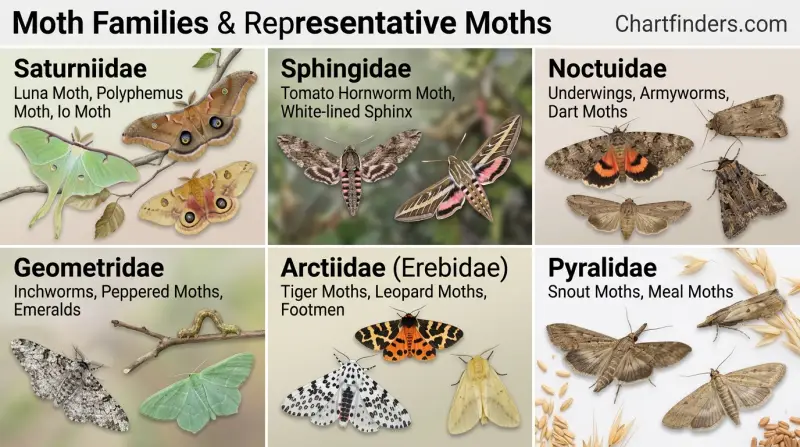
Moth Identification Chart
- Moth identification relies on a combination of wing patterns, resting posture, antennal structure, and seasonal timing rather than coloration alone.
- The Lepidoptera order is divided into numerous families, ranging from large, non-feeding Saturniidae to economically significant Noctuidae and Pyralidae.
- Modern field resources, such as regional checklists and specialized identification guides, offer thousands of verified species profiles to cross-reference difficult specimens.
- Examining specific wing markings—such as the reniform, orbicular, and claviform spots—is critical for distinguishing among closely related owlet moths.
- Understanding sexual dimorphism and color polymorphism prevents misidentifications caused by natural variation within a single species.
To accurately identify an unknown moth, observers must systematically examine key anatomical markers. The following comprehensive reference table breaks down the primary macro-moth and micro-moth families, highlighting their distinct morphological characteristics, resting postures, and typical behavioral traits.
| Family Name | Common Examples | Key Identification Traits | Resting Posture | Typical Habitat / Behavior |
|---|---|---|---|---|
| Saturniidae | Luna Moth, Polyphemus Moth, Io Moth | Large to massive size; feathery antennae; reduced mouthparts; often feature eyespots on wings. | Wings held flat against surfaces or tented over the body. | Deciduous forests; nocturnal, heavily attracted to high-output light sources. |
| Sphingidae | Tomato Hornworm Moth, White-lined Sphinx | Streamlined, torpedo-shaped bodies; narrow, swept-back wings; powerful, fast fliers. | Wings folded sharply roof-like over the abdomen. | Open fields and gardens; frequently hover at flowers at dusk like hummingbirds. |
| Noctuidae | Underwings, Armyworms, Dart Moths | Robust bodies; muted forewings with diagnostic kidney/round spots; colorful, hidden hindwings in some genera. | Forewings folded flat over the back, overlapping like a roof. | Ubiquitous; agricultural fields, forests, and suburban yards; strongly nocturnal. |
| Geometridae | Inchworms, Peppered Moths, Emeralds | Slender bodies; broad, fragile wings often featuring wavy lines that match across fore and hindwings. | Wings held flat, wide open against bark or leaves to maximize camouflage. | Woodlands and shrublands; larvae travel by looping their bodies. |
| Arctiidae (Erebidae) | Tiger Moths, Leopard Moths, Footmen | Bright, contrasting warning colors (aposematism); hairy or woolly caterpillars; robust thoraxes. | Wings wrapped tightly around the cylindrical body or held tent-like. | Meadows and open forests; many species produce ultrasonic clicks to deter bats. |
| Pyralidae | Snout Moths, Meal Moths | Extended labial palps forming a “snout”; narrow forewings; triangular resting silhouette. | Wings rolled tightly around the body or held flat in a distinct triangle. | Agricultural storage, grasslands, and wetlands; various larval habits. |
Analyzing this table demonstrates that family-level classification depends heavily on physical proportions and wing geometry. For instance, while a Sphinx moth is easily recognized by its aerodynamic torpedo shape, a Geometrid moth is instantly flagged by its broad, flat-resting wings adorned with continuous transverse lines.
To further contextualize the vast scope of North American moth diversity, consider the following distribution of estimated species counts across major families, reflecting data compiled by regional checklists and digital inventories like BAMONA:
| Taxonomic Group | Estimated NA Species Range | Primary Diagnostic Challenge |
|---|---|---|
| Noctuidae (Owlet Moths) | 3,000+ species | Subtle ground color variations and overlapping transverse line patterns. |
| Geometridae (Geometers) | 1,400+ species | Fragile scales easily rubbed off; highly variable melanic morphs. |
| Pyralidae & Crambidae (Snout/Grass Moths) | 1,300+ species | Extremely small micro-moth size requiring magnification or dissection. |
| Tortricidae (Leafroller Moths) | 1,200+ species | Bell-shaped resting silhouette and minute size. |
| Erebidae (Tiger, Lined, and Litter Moths) | 1,100+ species | Diverse subfamilies ranging from bright aposematic tiger moths to cryptic litter moths. |
Anatomical Landmarks Used in Moth Identification
When working through an identification chart, casual field marks must be supplemented by an understanding of specific wing veins, spots, and structures. Lepidopterists divide the moth wing into distinct zones and marking areas that serve as a universal language for keys and guidebooks.
Forewing Maculation and Spots
The forewing carries the majority of diagnostic markings. On owlet moths (Noctuidae), three specific spots are vital for identification:
- Orbicular Spot: A small, roughly circular or oval marking located toward the center-base of the forewing.
- Reniform Spot: A kidney- or bean-shaped marking positioned closer to the outer margin of the central cell.
- Claviform Spot: A less common, finger-like dash extending outward from the inner margin toward the orbicular spot.
Lines and Bands
Most moth wings are crossed by a series of transverse lines named relative to their position from the body outward: the basal line, antemedial line, postmedial line, and subterminal line. The space between the antemedial and postmedial lines is known as the median area, which frequently contrasts in color or shade with the rest of the wing.
Antennal Structures and Sexual Dimorphism
The antennae of a moth provide immediate clues regarding its taxonomy and sex. Males of many species—particularly within Saturniidae, Lasiocampidae, and Lymantriidae—evolved highly branched, bipectinate (feather-like) antennae designed to capture microscopic pheromone molecules released by females miles away. Conversely, females often possess simple, thread-like (filiform) or lightly serrate antennae. Observing antennal thickness and structure is frequently the fastest method to distinguish between male and female specimens of the same species.
The Evolution of Moth Field Guides and Digital Tools
Moth identification has experienced a technological and publishing renaissance. While early naturalists relied solely on dense museum monographs, contemporary observers benefit from a wealth of regional literature and expansive online databases. Landmark resources such as the Peterson Field Guide to Moths of Northeastern North America, Jim Sogaard’s regional guides (such as Moths and Caterpillars of Minnesota, Wisconsin, and Michigan), and comprehensive state checklists like the Minnesota DNR’s inventory encompassing over 2,500 species have revolutionized field study by providing crisp photographic plates paired with diagnostic text callouts.
Concurrently, digital repositories like Butterflies and Moths of North America (BAMONA) and specialized citizen science platforms host hundreds of thousands of verified species profiles and gallery images. These tools allow field researchers to cross-reference regional checklists, ensuring that identifications account for geographic range restrictions and seasonal flight windows.
Step-by-Step Diagnostic Workflow for Field Identification
When confronted with an unidentified moth at a light sheet or bait station, rushing to guess the species often leads to error. Follow this systematic four-step identification workflow to narrow down candidates efficiently:
- Assess Size and Body Proportions: Measure or estimate the wingspan. Is it a tiny micro-moth (under 15mm), a medium-sized noctuid, or a massive silkmoth? Note whether the body is heavy-set and furry or slender and sleek.
- Observe Resting Posture: How are the wings held? Are they spread flat against the surface, wrapped tightly around the abdomen in a cylinder, or tented roof-like over the back? Posture immediately eliminates entire families.
- Check Antennas and Palps: Look closely at the head. Are the antennae feathery, thread-like, or clubbed? Do the labial palps project forward like a snout?
- Examine Wing Patterns and Markings: Identify key structural lines, terminal bands, and central spots (reniform and orbicular). Compare these against regional photographic charts or field guide plates.
Common Pitfalls and Identification Challenges
Even experienced lepidopterists encounter specimens that resist quick identification. Recognizing common traps prevents persistent misclassifications.
Color Polymorphism and Wear
Many moth species exhibit extreme color variation. A species that is pale gray in one population may be dark charcoal or reddish-brown in another (industrial melanism being a classic historical example). , older adult moths that have flown for weeks lose scales from their wings, turning vibrant patterns into translucent, featureless patches that obscure diagnostic lines.
Cryptic Look-Alikes
The sheer diversity of the order means that hundreds of species are virtually identical to the naked eye. Genera such as Xestia or Euxoa contain multiple species whose forewing patterns overlap significantly. In these instances, definitive identification requires microscopic examination of internal genitalia by specialists, reminding us that visual charts have practical limitations in the field.
Frequently Asked Questions
While exceptions exist, most moths can be distinguished from butterflies by their antennae (moths often have feathery, thread-like, or comb-like antennae without terminal clubs), their resting posture (moths typically hold wings flat or tented, whereas butterflies hold them vertically over their backs), and their predominantly nocturnal activity patterns.
Basic moth-watching requires an external light source (such as a mercury vapor bulb, UV blacklight, or standard porch light), a white bedsheet hung vertically as a collection screen, a macro-enabled camera or smartphone for high-resolution photos, and a reliable regional field guide or digital database.
Feathery (bipectinate) antennae dramatically increase the surface area exposed to the air. This adaptation allows male moths to detect minute concentrations of female sex pheromones from great distances, sometimes up to several miles away.
Not all species are drawn to artificial lighting. While phototaxis draws thousands of species to light sheets, many moths are entirely non-responsive or rely instead on scent-based cues. Using sugar bait—a mixture of fermented fruit, molasses, and beer painted on tree trunks—attracts numerous species that ignore lights entirely.
When examining a worn or scale-denuded moth, focus on structural constants rather than color. Check the shape of the wing margins, the placement of major cross-lines (which often leave faint pigment tracks), antennal structure, and bodily proportions rather than relying strictly on vibrant coloration plates.
Conclusion
Moth identification bridges the gap between casual observation and rigorous biological science. By utilizing a structured identification chart and learning to analyze anatomical features such as wing maculation, resting posture, and antennal morphology, naturalists can unlock the hidden diversity of the nocturnal insect world. Whether you are managing a backyard checklist or contributing data to large-scale citizen science initiatives, methodical observation transforms an overwhelming array of nocturnal visitors into a rewarding study of biodiversity.