
Encountering a spider in a home, garage, or garden instantly triggers a mix of curiosity and caution. While the vast majority of spiders are harmless, beneficial predators that help control insect populations, a small number of medically significant species demand absolute precision in identification. However, studying spiders can be deceptively tricky. Coloration is notoriously variable within a single species, immature spiders often look entirely different from their adult counterparts, and male and female specimens of the same species can diverge drastically in size and pattern. To cut through this biological variability, urban pest control specialists, field biologists, and entomologists rely on structured identification charts and taxonomic keys.
This master guide breaks down the anatomy, family characteristics, visual features, classification protocols, and practical comparison tools needed to accurately identify spiders. From web-weavers to active hunters, understanding the structural building blocks of arachnid identification ensures you can safely distinguish common household species from medically significant threats without resorting to guesswork.
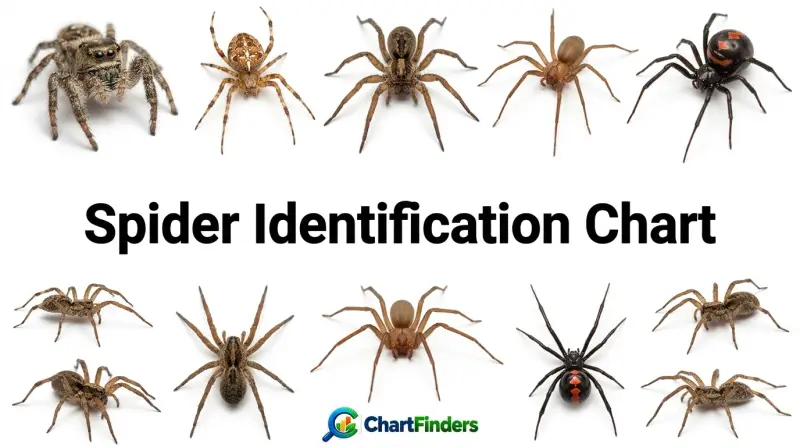
Spider Identification Chart
- Look Beyond Color: Coloration and markings shift significantly across age, sex, and maturation stages; rely on anatomy and web structure instead.
- Anatomical Markers: Eye arrangement, pedipalp shape, and spinneret position serve as the most reliable diagnostic markers for family-level identification.
- Sexual Dimorphism: Adult males are often significantly smaller than females and feature swollen pedipalps resembling boxing gloves used for sperm transfer.
- Web Architecture: Orb webs, irregular cobwebs, funnel sheets, and underground burrows immediately narrow down the potential spider family.
- Medically Significant Species: In North America, only the Black Widow and Brown Recluse (along with close regional relatives) pose genuine medical concerns.
- Habitat Context: Knowing whether a spider was found in a dark, undisturbed corner versus an open outdoor garden significantly streamlines identification.
A comprehensive spider identification chart functions by organizing arachnids into recognizable groups based on shared physical and behavioral traits. Rather than memorizing thousands of individual species, pest control professionals group spiders into families. Each family shares distinct physical configurations that remain constant regardless of minor color variations.
When using a chart, observation must follow a logical sequence. First, examine the web or resting environment. Second, evaluate body proportions—such as leg length relative to the body or the presence of a flattened body style adapted for tight crevices. Third, examine close-up structural details like eye count and placement. The following reference table contrasts the defining traits of the most commonly encountered spider families in North American residential and urban environments.
| Spider Family | Common Name | Web / Habitat Type | Eye Arrangement | Key Physical Features | Medical Significance |
|---|---|---|---|---|---|
| Theridiidae | Cobweb Spiders (includes Black Widow) | Irregular, tangled 3D webs in dark, undisturbed corners | 8 eyes in two rows of four | Rounded, bulbous abdomen; comb-like bristles on hind tarsi | High (Black Widow genus Latrodectus carries neurotoxic venom) |
| Sicariidae | Six-Eyed Spiders (includes Brown Recluse) | No formal web; irregular silken retreat in dark voids | 6 eyes arranged in three dyads (pairs) | Uniform tan to dark brown; violin-shaped dorsal marking on cephalothorax | High (Brown Recluse genus Loxosceles causes necrotic dermonecrosis) |
| Salticidae | Jumping Spiders | No web; active day-hunter utilizing silk safety dragline | 8 eyes dominated by two massive front-facing lenses | Compact, furry body; square-ish carapace; exceptional stereoscopic vision | None (harmless, docile unless severely provoked) |
| Lycosidae | Wolf Spiders | Ground-dwelling hunters; burrowing or surface-roaming | 8 eyes in three rows (4 small bottom, 2 large middle, 2 medium top) | Robust, hairy, mottled brown/gray camouflage; females carry egg sac on spinnerets | Low (painful bite comparable to a bee sting, but non-toxic) |
| Agelenidae | Funnel Web Weavers (Grass Spiders) | Horizontal sheet web ending in a tubular retreat | 8 eyes in two slightly curved rows | Long, prominent spinnerets extending past the rear abdomen; striped carapace | None (common grass spider species are entirely harmless) |
| Araneidae | Orb-Weavers | Symmetrical, wheel-like spiral webs constructed in open spaces | 8 eyes in two rows, lateral pairs often touching | Varying abdominal shapes (triangular, rounded, spiny); robust legs | None (venom is specialized for insect prey; harmless to humans) |
Interpreting this table requires understanding that family-level classification immediately separates benign outdoor inhabitants from indoor risk factors. For instance, finding a sprawling funnel web in backyard grass points directly to the Agelenidae family—a harmless grass spider—whereas an irregular, sticky, messy web in a low basement corner demands closer inspection for Theridiidae.
Anatomical Foundations of Spider Identification
Every true spider (order Araneae) shares a foundational body plan divided into two primary segments connected by a narrow pedicel: the cephalothorax (fusion of the head and thorax) and the abdomen (opisthosoma). Attached to the cephalothorax are eight legs, two pedipalps, and specialized mouthparts called chelicerae tipped with fangs.
When examining a specimen for identification, field specialists focus on specific anatomical zones:
- Eye Patterns: The number, size, and spatial arrangement of eyes are among the most stable taxonomic characters. While most spiders possess eight eyes, some cave-dwelling or subterranean species have six, four, or even zero. Recluse spiders (Sicariidae) are instantly identifiable by their unique arrangement of six eyes split into three distinct pairs.
- Pedipalps: These sensory appendages sit beside the fangs. In mature males, the terminal segments enlarge significantly into bulbous structures resembling boxing gloves. These modified palps are exclusively used to transfer sperm during mating and are a foolproof indicator of an adult male spider.
- Spinnerets: Located at the rear underside of the abdomen, spinnerets secrete silk. Their length, number, and positioning—such as the elongated, highly visible spinnerets of grass spiders—help differentiate families instantly.
- Chelicerae and Fangs: The orientation of the fangs separates major sub-orders. Mygalomorphs (such as tarantulas) have parallel fangs that strike downward, while araneomorphs (the vast majority of common spiders) have fangs that pinch together sideways.
The Challenges of Color Variation and Dimorphism
Relying on color alone is the single most common pitfall in spider identification. Within a single species, environmental factors, diet, temperature, and age can drastically alter pigmentation. For example, crab spiders (family Thomisidae) possess the ability to slowly shift their body color between white, yellow, and pink to match the specific flower petals they hunt upon.
, sexual dimorphism plays a massive role in visual confusion. In many orb-weaver and cobweb spider species:
- Females are exceptionally larger, possess heavy, rounded abdomens stuffed with eggs, and maintain sedentary lives centered around webs.
- Males are miniature, long-legged, nimble wanderers that abandon web-weaving entirely upon maturity to seek out females, often bearing entirely different color patterns or striping.
- Juveniles frequently lack the definitive adult markings described in field guides, rendering color-chart matching unreliable for immature specimens.
Web Architecture and Habitat Clues
Because spiders spend a significant portion of their lives interacting with their constructed environments, the geometry and placement of a web provide powerful diagnostic evidence. Observing how and where a spider builds can narrow down its identity long before the animal is ever captured or visually inspected.
Classic Orb Webs
Constructed primarily by the Araneidae family, classic orb webs are masterpieces of engineering consisting of radial spokes and sticky spiral capture threads. These webs are typically suspended vertically or at a slight angle in open outdoor spaces, gardens, and between structural overhangs. The spider usually hangs head-down at the center or waits in a nearby retreat connected by a signal thread.
Irregular Cobwebs
Unlike the neat geometry of orb webs, cobwebs are chaotic, three-dimensional tangles of non-sticky silk. Built by Theridiidae (cobweb spiders), these webs are anchored in dark, protected micro-habitats such as basement corners, crawl spaces, behind stored boxes, inside hollow landscape timber, and around undisturbed utility meters. If a messy web is found low to the ground near a dark structural void, caution is warranted.
Sheet and Funnel Webs
Built by Agelenidae and Linyphiidae, sheet webs consist of a dense, flat, horizontal mat of non-sticky silk that terminates in a tubular funnel. The spider lurks inside the narrow end of the funnel, rushing out instantly when an insect lands on the horizontal sheet above. These are commonly spotted stretching across lawn grass on dewy mornings or tucked into rocky retaining walls.
Hunting Pods and Burrow Silks
Active hunters—such as wolf spiders (Lycosidae), jumping spiders (Salticidae), and wandering spiders—do not spin webs to catch prey. Wolf spiders either roam open ground or line vertical underground burrows with silk. Jumping spiders construct temporary silken retreat sacs under loose tree bark, siding, or window frames where they molt, sleep, or lay eggs, but they hunt entirely by stalking and leaping.
Distinguishing Medically Significant Spiders
The primary concern for homeowners conducting spider identification is separating harmless urban wildlife from the two medically significant groups native to North America: widow spiders and recluse spiders. Misidentification often leads to unnecessary panic or, conversely, dangerous complacency.
Widow Spiders (Genus Latrodectus)
The Black Widow and its regional cousins (Brown Widow, Red Widow) belong to the Theridiidae family.
- Visual Markers: Adult females are glossy jet-black, spherical, and feature a distinctive red or orange hourglass marking on the ventral (underside) of the abdomen. (Note: Some species or regional variations may feature red spots or broken bands instead).
- Behavior: They inhabit low, dark, dry places—woodpiles, stone walls, under patio furniture, and inside meter boxes. They are non-aggressive and bite only when trapped directly against human skin.
- Venom Effects: Latrodectus venom is a potent neurotoxin (alpha-latrotoxin) that causes severe muscle cramping, abdominal rigidity, sweating, and systemic pain requiring medical evaluation.
Recluse Spiders (Genus Loxosceles)
The Brown Recluse and related species belong to the Sicariidae family.
- Visual Markers: Uniform light brown to dark brown coloration with no prominent abdominal patterns, stripes, or multicolored bands. The definitive anatomical marker is a dark, violin-shaped marking on the dorsal cephalothorax, with the neck of the violin pointing backward toward the abdomen. They also possess six eyes arranged in three pairs rather than the standard eight.
- Behavior: True to their name, they are exceptionally reclusive, hiding in undisturbed dark areas like closets, attics, cardboard storage boxes, and behind furniture.
- Venom Effects: Loxosceles venom contains hemotoxic and necrotic enzymes that can cause localized tissue destruction (dermonecrosis), resulting in slow-healing open lesions requiring professional medical treatment.
Geographic Note: The true Brown Recluse (Loxosceles reclusa) has a defined geographic range primarily spanning the Midwestern and South-Central United States. Sightings reported in northern or coastal regions outside this range are almost invariably misidentified cellar spiders (Pholcidae), grass spiders, or wolf spiders.
Comparative Analysis of Common Spider Groups
To help resolve close identification calls between look-alike families, the following matrix contrasts key behavioral and morphological boundaries across major groups:
| Comparison Metric | Cobweb Spiders (Theridiidae) | Recluse Spiders (Sicariidae) | Wolf Spiders (Lycosidae) | Cellar Spiders (Pholcidae) |
|---|---|---|---|---|
| Primary Habitat | Low, dark corners, basements, undisturbed boxes | Warm, dry, dark voids, closets, wood storage | Open ground, lawns, under rocks, mulch beds | Upper room corners, damp cellars, crawlspaces |
| Web Presence | Messy, 3D tangled cobweb | No formal web; irregular retreat silk only | None; roams actively to hunt | Loose, chaotic tangled space webs |
| Leg Structure | Medium length, comb-like bristles on rear tarsi | Long, delicate, uniformly colored | Robust, muscular, heavily spined | Extremely long, fragile, thread-like |
| Medical Risk | High (Widow species) | High (Brown Recluse) | Low (Non-toxic mechanical bite) | None (Completely harmless) |
Step-by-Step Spider Identification Protocol
When confronted with an unknown spider in an urban or residential setting, follow this systematic evaluation protocol to determine its identity and potential risk level:
- Assess Location and Environment: Note where the spider was discovered. Was it spinning an open outdoor orb web, roaming an open floor, hiding in a dark basement corner, or tucked inside an indoor storage box?
- Inspect Web Structure (If Applicable): Determine if the web is a symmetrical wheel (orb-weaver), a messy 3D tangle (cobweb weaver), or a flat sheet ending in a funnel (grass spider). If no web exists, it is likely an active hunter (wolf spider, jumping spider, or recluse).
- Examine Body Proportions and Hairiness: Is the body smooth and glossy (widow)? Furry and robust (wolf spider or tarantula)? Compact and square-headed with large forward eyes (jumping spider)? Uniform brown with long, delicate legs (cellar spider or recluse)?
- Check Specific Diagnostic Markers (Safely): Using a magnifying glass or macro camera lens (never handle an unknown spider directly), check for the six-eye grouping of a recluse or the red ventral hourglass of a widow.
- Determine Action Threshold: If the specimen matches a medically significant profile in an area where those species are established, implement targeted pest control and exclusion measures. If it matches a beneficial predator (like a jumping spider or cellar spider), safely relocate it outdoors or leave it in place.
Common Identification Mistakes and Look-Alikes
Urban pest control technicians frequently encounter misidentifications driven by common visual misconceptions. Recognizing these look-alikes prevents false alarms and unnecessary chemical applications.
Cellar Spiders vs. Brown Recluse
Long-bodied cellar spiders (family Pholcidae, often colloquially called “daddy longlegs”) are frequently mistaken for Brown Recluses due to their tan coloration and preference for indoor corners and basements. However, cellar spiders possess extremely long, fragile legs, lack the violin marking, have eight eyes arranged differently, and vibrate rapidly in their webs when disturbed. They are entirely harmless to humans.
Wolf Spiders vs. Brown Recluse
Large, mottled brown wolf spiders roaming across basement floors or carpets are frequently misidentified as giant recluses. Wolf spiders are heavily patterned, extremely hairy, fast-moving ground hunters that lack the violin mark and possess eight distinct eyes. While large wolf spiders can deliver a defensive bite if stepped on, their venom is not medically significant.
Grass Spiders vs. Hobo Spiders
European hobo spiders (Tegenaria agrestis) gained an exaggerated reputation as dangerous biters, but modern arachnological research has largely debunked their medical significance. , they are frequently confused with native, harmless grass spiders (Agelenidae) that build identical funnel webs in lawns and foundations.
Frequently Asked Questions
How can I tell if a spider is poisonous without touching it?
Entomologists prefer the term venomous rather than poisonous, as spiders inject venom rather than being toxic to ingest. To evaluate risk visually from a safe distance, look for the definitive markers of the two medically significant North American genera: the glossy black body with a red ventral hourglass (Black Widow) or the uniform tan-to-brown body with a dorsal violin marking and six eyes (Brown Recluse). If neither set of markers is present, the spider is virtually guaranteed to be harmless.
Why do immature spiders look so different from adults?
Spiders undergo a series of molts (ecdysis) as they grow, shedding their rigid exoskeletons multiple times. Juvenile spiders often lack the fully developed pigment patterns, abdominal designs, and proportional body shapes seen in adults. Additionally, male spiders often undergo a radical morphological transformation during their final molt, developing swollen palps and altered colorations that help them travel in search of mates.
Are cellar spiders (“daddy longlegs”) dangerous?
No. Cellar spiders are completely harmless to humans. An old urban legend claims they possess the most potent venom of any spider but lack fangs long enough to puncture human skin; this is scientifically false. Their fangs are fully capable of piercing human skin, but their venom has virtually no toxic effect on mammals, and they rarely bite unless severely crushed.
What should I do if I find a suspected Brown Recluse in my house?
First, remain calm—recluses are non-aggressive and bite only when pressed directly against skin inside clothing, shoes, or bedding. Trap the spider safely under a clear glass or container if you need positive verification, or photograph it safely from a distance. Reduce clutter in storage areas, shake out shoes before wearing them, pull beds away from walls, and contact a licensed pest control professional if an infestation is suspected.
Do all spiders spin webs to catch food?
No. While web-weaving is a hallmark spider trait, a large percentage of spider families are active hunting specialists. Families such as Salticidae (jumping spiders), Lycosidae (wolf spiders), Thomisidae (crab spiders), and Sparassidae (huntsman spiders) hunt by stalking, ambushing, or running down prey on foot, utilizing silk only for egg sacs, safety draglines, or temporary sleeping retreats.
Conclusion
Accurate spider identification requires looking beyond superficial traits like color and focusing on reliable anatomical structures, web architecture, and habitat preferences. By understanding the diagnostic markers of major families—such as the distinct eye arrangements of recluses, the comb-like bristles of cobweb weavers, and the active hunting strategies of wolf and jumping spiders—you can reliably distinguish beneficial urban predators from medically significant species. Armed with a structured identification approach, property owners can manage pest encounters safely, rationally, and effectively.