
The Commonwealth of Virginia exhibits a broad ecological spectrum, stretching from the coastal plains of the Tidewater region through the rolling Piedmont to the high-elevation ridges of the Appalachian Mountains. This rich geographic diversity supports hundreds of spider species belonging to various taxonomic families. For homeowners, encountering an unfamiliar arachnid often triggers concern, particularly given the historical anxiety surrounding medically significant species. However, distinguishing between a benign garden dweller and a venomous recluse or widow requires careful anatomical examination rather than panic-driven extermination.
Navigating Virginia’s spider population requires moving past generalized rules of thumb and utilizing systematic identification. This comprehensive manual breaks down the morphology, behavioral habits, and medical significance of the commonwealth’s most frequently encountered spiders. By understanding the structural taxonomy—ranging from cheliceral color to eye configuration—homeowners and naturalists alike can accurately catalog these arthropods, manage genuine encounters safely, and appreciate their ecological value.
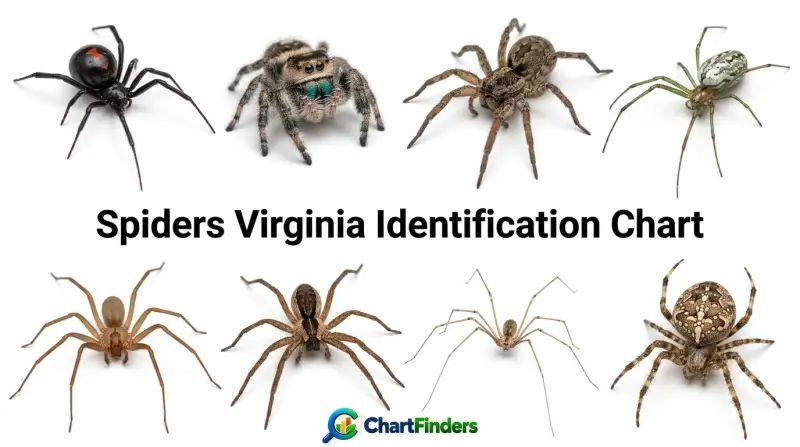
Spiders Virginia Identification Chart
- Only two spider genera in Virginia possess venom of clinical significance to humans: Latrodectus (widows) and Loxosceles (recluses).
- Wolf spiders (Lycosidae) are large, ground-dwelling hunters frequently mistaken for recluses due to their coloration, but they lack the characteristic violin pattern and eye arrangement.
- Jumping spiders (Salticidae) feature distinctive, forward-facing ocular arrays and iridescent chelicerae, making them easily identifiable and entirely harmless.
- Orb weavers (Araneidae) construct elaborate, geometric wheel webs outdoors and exhibit wide variations in abdominal shape and coloration.
- Brown recluses (Loxosceles reclusa) have a restricted native range primarily limited to specific southwestern counties in Virginia, contrary to widespread belief regarding statewide infestations.
To assist in field and residential identification, the following matrix categorizes the primary spider groups found across Virginia. This layout summarizes morphological indicators, preferred habitats, web architecture, and venom profiles.
| Common Name | Scientific Classification | Key Visual Identifiers | Web / Habitat Type | Medical Significance |
|---|---|---|---|---|
| Black Widow | Latrodectus spp. | Shiny jet-black body; red or orange hourglass marking on ventral abdomen. | Irregular, messy scaffolding webs near ground level, dark crevices. | High (Neurotoxic venom; requires medical evaluation). |
| Brown Recluse | Loxosceles reclusa | Uniform tan-to-brown color; dark violin-shaped marking dorsal to cephalothorax. | Loose, irregular retreat webs in undisturbed, dry woodpiles or basements. | High (Necrotic venom; requires immediate medical attention). |
| Wolf Spider | Family Lycosidae | Robust, hairy, mottled brown/gray; prominent eyes with large posterior median pair. | No web; active ground hunter found in lawns, leaf litter, and basements. | Low (Painful bite, mild local swelling, non-necrotic). |
| Daring Jumping Spider | Phidippus audax | Compact, velvet-black body; white abdominal spots; metallic green/blue chelicerae. | No web; uses silk shelter for molting/eggs; hunts via stalking and leaping. | Low (Docile; rarely bites unless trapped or severely provoked). |
| Yellow Garden Spider | Argiope aurantia | Large; black and bright yellow abdominal markings; stabilizes web with a zig-zag stabilimentum. | Large, circular orb webs spun in tall grass, gardens, and shrubbery. | Low (Benign; venom causes mild, localized irritation). |
| Fishing Spider | Dolomedes spp. | Very large, sprawling legs; mottled gray-brown camouflage; often found near water. | No web; hunts on aquatic surfaces, piers, and tree trunks. | Low (Non-aggressive; bite is comparable to a minor bee sting). |
| Common House Spider | Parasteatoda tepidariorum | Mottled brown-and-white spherical abdomen; longer rear legs. | Tangled, messy cobwebs in upper corners of rooms, attics, and garages. | Low (Extremely timid; minor local reaction if bitten). |
Analyzing this data reveals that while numerous Virginia spiders possess imposing appearances or robust sizes, the vast majority pose no chemical threat to humans. The following sections explore each major group in anatomical and ecological detail to refine identification skills.
Medically Significant Spiders in Virginia
When evaluating structural pests in the commonwealth, pest control operators and entomologists prioritize separating nuisance species from those requiring clinical intervention. In Virginia, medical concern is restricted strictly to two groups: widow spiders and the brown recluse.
The Widow Spiders (Genus Latrodectus)
Two species of widow spiders occur in Virginia: the Northern Black Widow (Latrodectus varians / Latrodectus variolus) and the Southern Black Widow (Latrodectus mactans). Both species share fundamental physiological characteristics.
- Morphology: Adult females are easily recognized by their globose, highly polished jet-black abdomens. The ventral side typically displays a distinct red or orange hourglass shape, though northern species may feature broken red spots or lateral bars. Males are significantly smaller, lighter in color, and adorned with red and white banding, rendering them entirely harmless due to underdeveloped chelicerae.
- Habitat & Behavior: Widows prefer dark, undisturbed, low-level microhabitats. Outdoors, this includes woodpiles, stone walls, dense ornamental shrubbery, and hollow tree stumps. Indoors, they migrate to unfinished basements, crawlspaces, and garage corners. Their webs are notably chaotic, constructed of immensely strong silk woven in a three-dimensional scaffolding arrangement rather than a neat geometric pattern.
- Venom Dynamics: Female black widows inject a potent neurotoxin known as alpha-latrotoxin. This toxin triggers massive acetylcholine release at nerve terminals, causing severe muscle cramping, abdominal rigidity, diaphoresis, and hypertension. While rarely fatal with modern antivenom and supportive care, a bite mandates professional medical evaluation.
The Brown Recluse (Genus Loxosceles)
The brown recluse (Loxosceles reclusa) is frequently blamed for every unexplained necrotic skin lesion in Virginia, yet its true distribution within the state is heavily misunderstood.
- Geographic Range in Virginia: Native populations of the brown recluse are largely restricted to extreme southwestern counties and occasional introduced specimens transported via freight into urban ports like Richmond or Hampton Roads. Statewide, widespread household encounters are exceedingly rare.
- Morphology: Recluses are uniformly yellowish-brown to dark brown, lacking the distinct stripes, spots, or heavy hairiness seen in wolf or grass spiders. The definitive anatomical marker is a dark, violin-shaped pattern on the dorsal surface of the cephalothorax, with the “neck” of the violin pointing backward toward the abdomen. , whereas most spiders possess eight eyes, recluses possess six eyes arranged in distinct pairs (dyads) forming a semicircle.
- Habitat & Behavior: True to their common name, these spiders inhabit secluded, dry, dark environments. They do not build aerial webs; instead, they spin loose, erratic retreats behind stored boxes, inside rarely worn shoes, beneath baseboards, or within undisturbed clothing piles.
- Venom Dynamics: Recluse venom contains sphingomyelinase D, an enzyme that destroys cell membranes and triggers localized tissue destruction. Bites often present initially as painless or mildly stinging, progressing over 24 to 72 hours into deep, necrotic ulcers that heal slowly and frequently require surgical management.
Roaming Ground Hunters: Wolf Spiders, Fishing Spiders, and Grass Spiders
Many Virginia homeowners encounter large, fast-moving spiders traversing floors, baseboards, or lawns. These roaming predators do not construct webs to capture prey; instead, they actively hunt using acute vision and tactile sensitivity.
Wolf Spiders (Family Lycosidae)
Wolf spiders represent one of the most common families encountered in Virginia households, particularly during autumn when cooling temperatures drive them indoors.
- Identification Clues: Robust bodies, stout legs, and a dense covering of hair distinguish wolf spiders. Their coloration ranges from mottled gray to dark brown with longitudinal stripes. Ocular arrangement is the primary diagnostic feature: they possess a distinct row of four small eyes along the lower face, two very large eyes directed forward on top of the head, and two medium eyes set further back. Additionally, female wolf spiders carry their egg sacs attached to their spinnerets and subsequently transport hundreds of hatched spiderlings on their dorsal abdomen.
- Ecological Role: As apex invertebrate predators in garden ecosystems, wolf spiders consume vast quantities of agricultural pests, crickets, and cockroaches. Their bite is mechanically painful due to large chelicerae, but the venom is mild, causing localized redness and swelling similar to a mosquito bite.
Fishing Spiders (Genus Dolomedes)
Often confused with wolf spiders due to their massive leg spans, fishing spiders are semi-aquatic inhabitants of Virginia’s wetlands, streamside rocks, and damp woodland structures.
- Identification: These are among the largest spiders in the commonwealth, with leg spans frequently exceeding three inches. They feature sprawling, lateral leg orientations and subtle gray-brown disruptive camouflage patterns.
- Behavior: They hunt along the margins of ponds and slow-moving streams, detecting microscopic surface-tension vibrations caused by small fish, tadpoles, and aquatic insects. Despite their intimidating size, fishing spiders are exceptionally timid and will flee across the water surface or dive beneath the meniscus rather than bite.
Grass Spiders (Genus Agelenopsis)
Grass spiders are funnel-web weavers belonging to the family Agelenidae. They are frequently observed blanketing lawns and low shrubs with dense, sheet-like webs that terminate in a tubular retreat.
- Identification: Slender bodies featuring distinctive longitudinal brown stripes running down the cephalothorax. They possess prominent, elongated spinnerets protruding from the rear of the abdomen, which they use to rapidly lay down structural silk.
Web-Building Architects: Orb Weavers and Cobweb Spiders
When homeowners discover , symmetrical webs suspended across porches, gardens, or window frames, they are observing the handiwork of web-weaving guilds.
Orb Weavers (Family Araneidae)
Orb weavers construct the classic, highly symmetrical wheel-shaped webs typically associated with spiders.
- Common Virginia Representatives: This family includes the Yellow Garden Spider (Argiope aurantia), the Marbled Orb Weaver (Araneus marmoreus), and the Orchard Spider (Leucauge venusta). Females often exhibit bright, complex abdominal colorations featuring yellow, black, orange, or white geometric patterns.
- Behavioral Traits: Many species construct a dense, zigzag vertical silk structure through the center of the web known as a stabilimentum. They sit head-down in the center of the web awaiting flying insect prey. Orb weavers are entirely docile; their venom is specialized exclusively for insect immobilization and holds zero medical relevance to humans.
Cobweb Spiders (Family Theridiidae)
Beyond the infamous black widow, the Theridiidae family includes numerous harmless cobweb spiders, such as the Common House Spider (Parasteatoda tepidariorum).
- Identification: These spiders feature bulbous, spherical abdomens, fragile legs, and mottled brownish-gray colorations. They hang upside down in messy, three-dimensional cobwebs constructed in structural corners, basements, and crawlspaces. They act as efficient biological vacuum cleaners, consuming flies, gnats, and small beetles.
Jumping Spiders: Curiosity and Exceptional Vision
Jumping spiders (Salticidae) are among the most charismatic and easily recognizable arachnids found throughout Virginia.
The Daring Jumping Spider (Phidippus audax) serves as the quintessential example. Sporting a compact, velvety black body accented by stark white abdominal markings and brilliant, metallic iridescent green or blue chelicerae, these spiders are active diurnal hunters. Unlike web-builders, jumping spiders possess extraordinarily acute stereoscopic vision facilitated by large, forward-facing principal eyes that track human movement with bird-like attentiveness.
Equipped with specialized hydraulic leg mechanisms, jumping spiders can leap up to fifty times their body length to capture prey. Despite their predatory efficiency, they are remarkably curious, docile toward humans, and rarely bite unless pinned directly against bare skin. Their presence in home gardens is highly beneficial for suppressing pest populations.
Step-by-Step Spider Identification Protocol
When an unfamiliar spider is encountered within a Virginia residence or yard, applying a systematic evaluation protocol prevents unnecessary alarm and ensures accurate categorization.
- Examine Web Architecture and Location:
- Is it a neat, geometric wheel web in an open garden? Likely an Orb Weaver (Family Araneidae).
- Is it a messy, three-dimensional scaffolding web near the floor or in a dark basement corner? Check closely for a Black Widow (Latrodectus).
- Is there no web, with the spider actively running across the floor or lawn? Likely a Wolf Spider (Lycosidae) or Jumping Spider (Salticidae).
- Is it an erratic, flat sheet web with a funnel retreat in grass? Grass Spider (Agelenidae).
- Analyze Morphological Markers:
- Does the abdomen feature a bright red or orange hourglass on the underside? Definitive Black Widow indicator.
- Is the body uniform tan with a distinct violin shape on the cephalothorax, combined with a six-eye arrangement? Suspect Brown Recluse (Loxosceles reclusa) — confirm geographic location in southwestern VA.
- Is the spider exceptionally hairy, mottled brown, with two large forward-facing eyes dominating the face? Wolf Spider.
- Is the body compact and velvet-black with metallic green mouthparts? Daring Jumping Spider.
- Evaluate Behavioral Response:
- Does the spider freeze or attempt to flee rapidly into a dark crevice? Standard defensive behavior for harmless species.
- Does it rear up on its hind legs or aggressively display chelicerae? Typical of disturbed funnel-weavers or large wandering spiders, though rarely escalating to a strike unless handled.
Common Identification Mistakes and Misconceptions
Arachnological identification is frequently clouded by persistent myths and misdiagnoses. Understanding these errors prevents improper treatment and unwarranted pesticide applications.
- The “Brown Recluse Everywhere” Fallacy: Many residents across northern or coastal Virginia assume any brown spider is a recluse. In reality, the vast majority of these sightings are male southern house spiders (Kukulcania hibernalis), nursery web spiders (Pisauridae), or wolf spiders. True brown recluses are geographically restricted within the state.
- Confusing Wolf Spiders with Recluses: Because wolf spiders are large, brown, and frequently enter homes during autumn, they are routinely misidentified as recluses. However, wolf spiders feature heavy body hair, distinct striping, and lack both the violin marking and the eye arrangement of Loxosceles.
- Misattributing Skin Lesions: Medical literature indicates that numerous conditions—including MRSA infections, shingles, chemical burns, and tick-borne illnesses—are frequently misdiagnosed as “brown recluse bites” by patients and general practitioners alike. True necrotic spider envenomation is statistically rare outside the core native ranges of recluse spiders.
- Assuming All Web-Builders Are Dangerous: Homeowners often eradicate harmless cellar spiders (Pholcidae—commonly known as daddy longlegs) and cobweb spiders out of fear, disrupting natural pest control networks inside the home.
Frequently Asked Questions
Are daddy longlegs the most venomous spiders in Virginia?
No. This is an urban legend with no scientific basis. Cellar spiders (Pholcidae) possess short fangs capable of piercing human skin, but their venom is exceedingly weak and harmless to humans. , harvestmen (true daddy longlegs, which are arachnids but not spiders) possess no venom glands or silk glands at all.
How can I keep venomous spiders out of my Virginia home?
Exclusion is the most effective management strategy. Seal cracks around foundation walls, install tight-fitting weather stripping on exterior doors and basement windows, reduce clutter in basements and garages, and clear heavy vegetation, woodpiles, and leaf litter away from the immediate perimeter of the foundation.
What should I do if I am bitten by a spider in Virginia?
Wash the bite site thoroughly with soap and water, apply an antiseptic, and use a cold compress to reduce localized swelling. If you suspect a black widow or brown recluse bite—or if systemic symptoms such as muscle rigidity, severe pain, or spreading skin necrosis develop—seek immediate professional medical attention. Capture or photograph the spider if safe to do so to assist medical personnel with species identification.
Conclusion
Encountering spiders in Virginia is an inevitable aspect of living alongside the commonwealth’s diverse natural habitats. While urban legends and fearful generalizations often cast all spiders as threats, a structured approach to identification reveals that the vast majority are ecologically beneficial, docile neighbors. By familiarizing yourself with the distinct anatomical markers, web structures, and habitat preferences detailed in this identification chart, you can easily separate harmless hunters and orb weavers from Virginia’s true medically significant species—the black widow and the brown recluse—ensuring both home safety and environmental appreciation.