
The world of Swiss Army Knives (SAKs) spans over a century of meticulous engineering, manufacturing evolution, and subtle design changes. For collectors, historians, and everyday carry enthusiasts, identifying a specific pocket knife can feel like a high-stakes puzzle. Two knives that look identical at a glance might hail from different decades, possessing distinct steel alloys, tang stamp markings, or scale materials that drastically alter their collector value and utility. Without a structured methodology, decoding these multi-tools is prone to error.
This comprehensive guide serves as your definitive master reference. It explores the anatomy of Swiss Army Knives, details how to cross-reference physical traits using an identification framework, examines historical production eras, and breaks down the core structural components that separate a common model from a rare collector’s piece. By understanding how layers, tool variants, and tang stamps interact, you can accurately place any Victorinox or Wenger knife into its proper historical context.
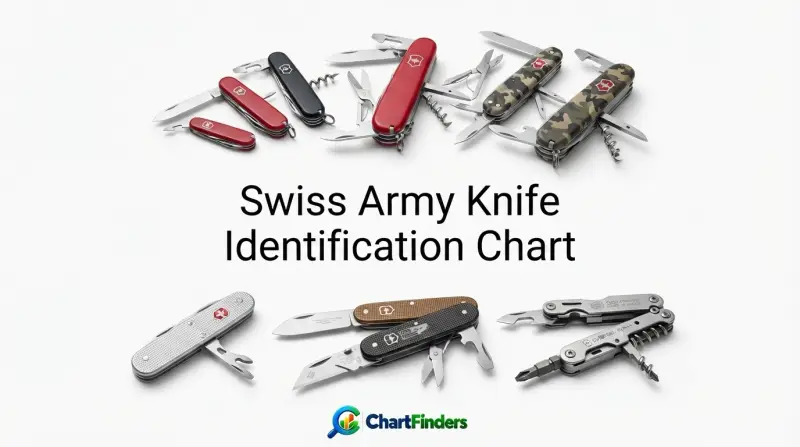
Swiss Army Knife Identification Chart
- Layer Count and Tool Stacking: The foundation of any SAK identification chart starts with counting the functional layers between the scales, which dictates the core model type.
- Tang Stamps and Steel Evolution: Blade tang stamps provide vital chronological markers, shifting from early “Elinox” markings to modern “VICTORINOX SWITZERLAND STAINLESS” stamps.
- Scale Material Transitions: Cellidor (red plastic), Alox (ribbed aluminum), wood, and horn materials correspond heavily to specific production decades and model tiers.
- Evolutionary Milestones: Small structural changes—such as the transition from a non-locking to a locking main blade, or the addition of a multi-purpose hook—act as hard dating termini.
- Wenger vs. Victorinox Distinction: Before the 2005 acquisition and subsequent integration, Wenger and Victorinox utilized different can opener designs, scissor springs, and tang logos.
The primary utility of a Swiss Army Knife identification chart lies in its ability to break down a complex multi-tool into easily verifiable attributes. When examining an unknown knife, collectors follow a strict hierarchical checklist. Below is a comprehensive reference matrix detailing how major model families, layer configurations, and structural markers align across production history.
| Model Family | Standard Closed Length | Standard Layers | Key Identifying Tools | Typical Era / Date Clues | Scale Material Options |
|---|---|---|---|---|---|
| Classic / Rambler | 58 mm | 1 to 2 layers | Blade, nail file, scissors, toothpick, tweezers | 1958–Present (Evolves with scissor screw vs. rivet) | Cellidor, Alox, Precious Metals |
| Officer’s (Vintage Compact) | 84 mm | 2 to 4 layers | Smaller main blade, small pen blade, can opener | Discontinued or limited modern production; prevalent pre-1980s | Cellidor, Horn, Wood |
| Standard Officer’s | 91 mm | 2 to 8 layers | Main blade, corkscrew/phillips, scissors, multi-purpose hook | 1897–Present (The quintessential Swiss Army Knife) | Cellidor, Alox, Wood, Onyx |
| Alox Pioneer / Electrician | 93 mm | 1 to 3 layers | Reamer/awl with sharp edge, solid brass liners | 1961–Present (Stiff ribbing, heavy-duty build) | Alox (Ribbed Aluminum) |
| Large Ranger / Forester | 111 mm | 1 to 4 layers | Locking blade, wood saw, one-hand opening variants | 1980s–Present (Modern locking era) | Polyamide, Dual-Density, Alox |
| Wenger Standard | 85 mm | 2 to 5 layers | Lever-design can opener, Wenger scissors with-screw spring | Pre-2005 (Wenger independent era) | Cellidor, Evolution contour scales |
To read this chart effectively, you must first measure the closed length of the knife handle in millimeters, which immediately narrows the search down to major frame sizes (e.g., 58mm, 84mm, 91mm, 93mm, 111mm). From there, counting the functional layers—each distinct plane of tools pivoting on shared brass pins—identifies the exact model tier within that size category.
Chronological Evolution of Swiss Army Knife Features
Swiss Army Knives are not static designs; they have undergone continuous refinement since Karl Elsener patented the original Officer’s and Sports Knife in 1897. Tracing these design changes provides a foolproof timeline for dating an unknown piece.
- Pre-1950s Era: Characterized by nickel-silver scales, exposed rivets, carbon steel blades (often prone to patina), and the absence of toothpicks and tweezers in many basic models. Tang stamps typically feature early company names like “Elsener Schwyz” or “Victoria.”
- The Cellidor Revolution (1950s–1970s): The introduction of bright red Cellidor plastic scales standardized the modern aesthetic. Tweezers gained top-notch plastic heads instead of flat metal folded strips, and the toothpick became ubiquitous.
- The Hook and In-line Era (1980s–1990s): The addition of the multi-purpose hook behind the back-layer corkscrew (introduced around 1991) is a definitive marker for modern post-1990 knives. Similarly, the transition of the Phillips screwdriver from the back spring to an in-line position on larger models altered layer thickness.
- The Locking Blade Era (2000s–Present): The absorption of Wenger in 2005 consolidated production under Victorinox, while 111mm lock-blade models introduced double-density scales and one-handed opening mechanisms.
Tang Stamps and Metallurgical Markers
The metal tang of the main master blade is the single most reliable piece of forensic evidence on a Swiss Army Knife. Manufacturers stamped corporate names, patent numbers, and steel types directly onto the ricasso.
Early Victorinox knives utilized stamps such as “ELSENER SCHWYZ” or “VICTORINOX” in an arch over “SWITZERLAND.” Between the mid-20th century and 2005, stamps evolved to include “VICTORINOX SWITZERLAND STAINLESS” in varying font styles and capitalizations. Modern lasers and high-precision stamping machines now produce crisp, block-lettered logos that resist wear.
, the shift from carbon steel to high-grade stainless chromium-molybdenum steel (Inox) in the mid-20th century eliminated active rusting issues. If a knife possesses a magnetic carbon steel blade without a stainless stamp, it almost certainly dates prior to the 1950s.
Anatomy of a Layer: How to Count and Classify
Identification charts rely heavily on the concept of “layers.” A layer is defined as a single tier of tools sharing a common pivot pin axis. Understanding tool stacking is vital because adding or removing a single tool usually requires an entirely different back spring and rivet configuration.
When using an identification chart, inspect the knife from the spine while it is closed:
- Back Tools: Examine the tools mounted against the back springs (corkscrew, Phillips screwdriver, reamer/awl, parcel hook, and toothpick/tweezers in the scale slots).
- Main Layers: Count the parallel plates separating the primary folding implements. A standard Spartan has two layers; a Huntsman has four layers.
- Specialized Implement Placement: Note whether tools like magnifying glasses or pliers share a layer with other instruments or occupy an independent dedicated tier.
Comparative Analysis: Victorinox vs. Wenger (The Pre-2005 Divide)
Before Victorinox acquired Wenger in 2005 (and eventually phased out the Wenger brand name in 2013), both companies held contracts to supply the Swiss Armed Forces. While their knives looked remarkably similar, structural differences are immediately apparent on an identification chart.
| Feature / Component | Victorinox (Pre-2005 & Modern) | Wenger (Pre-2005 Independent Era) |
|---|---|---|
| Can Opener Design | Curved cutting edge with integrated small flathead screwdriver tip on end. | Curved hook shape with a distinctive safety notch near the base. |
| Scissor Mechanism | Robust single-piece spring operating on a central pivot pin. | Patented spring design utilizing a fine wire lever attached to the moving blade. |
| Scale Logo & Shape | Shield outline enclosing a symmetrical cross. Standard flat block scales. | Rounded square or diamond cross logo. Often featured ergonomic “Evolution” contouring. |
| Awl / Reamer | Round-based awl with a sewing eyelet located near the tip. | Sharp triangular reamer, typically lacking a sewing eye. |
Step-by-Step Practical Identification Framework
When faced with an unidentified Swiss Army Knife in the wild or in a collection, execute this systematic diagnostic process to pin down its exact model and production window:
- Step 1: Measure Closed Length. Use calipers or a ruler to measure the handle from end to end. Common sizes include 58mm, 74mm, 84mm, 91mm, 93mm (Alox), and 111mm.
- Step 2: Inspect Scale Material and Color. Determine if the scales are red Cellidor, ribbed Alox, smooth wood, stag horn, or modern polyamide. Note whether the Victorinox shield is metal-inlaid, printed, or stamped.
- Step 3: Count the Layers. Look down at the spine and count the distinct operational levels.
- Step 4: Read the Tang Stamp. Open the master blade and examine the text stamped on the base of the steel. Note spelling, font style, and the presence of words like “Stainles,” “Elinox,” or “Officer.”
- Step 5: Check Back Tools and Innovations. Verify the presence or absence of the multi-purpose hook, sewing eye on the awl, corkscrew vs. back-spring Phillips, and nail file cut patterns.
- Step 6: Cross-Reference. Match your findings against an authoritative Victorinox identification matrix to isolate the model name and production years.
Common Identification Pitfalls and Misleading Clues
Even experienced collectors fall prey to deceptive modifications or historical anomalies. Keep these cautionary points in mind:
- Swapped Scales: Cellidor scales are easily removed and replaced. A vintage knife frame might wear modern scales, or vice versa, creating a false impression of its age. Always rely on internal tool construction over scale condition.
- Custom Modifications (“Franken-Knives”): Enthusiasts frequently disassemble multiple donor knives to build custom layer combinations (e.g., adding scissors to a model that never officially featured them). Look for tool pairings that violate factory manufacturing standards.
- Commemorative and Advertising Overruns: Special runs for corporate clients or military regiments often feature unique blade etchings or custom shield emblems that do not appear in standard consumer catalogs.
Frequently Asked Questions
How do I know if my Swiss Army Knife is vintage?
Vintage status generally applies to knives produced before the 1990s. Key indicators include older tang stampings (such as “Elinox” or early “Victoria” scripts), nickel-silver shield logos inlaid rather than hot-stamped, carbon steel blades, and the absence of the multi-purpose back hook introduced in 1991.
What does the word “Inox” mean on a Victorinox blade?
“Inox” is an abbreviation for the French term inoxydable, which means stainless steel. Its presence on a tang stamp confirms that the blade is crafted from rust-resistant alloy steel, marking production from the mid-20th century onward.
Why do some Swiss Army Knives have a small hole in the master blade?
The small hole near the spine of the master blade on certain models (such as the 111mm One-Hand Sentinel series) is designed to accommodate thumb placement, allowing the user to open the heavy-duty locking blade smoothly with a single hand.
Are Alox Swiss Army Knives older than Cellidor models?
Not necessarily. While ribbed aluminum (Alox) scales were introduced in the mid-20th century for military models (like the 1961 Swiss Soldier knife), both Cellidor (plastic) and Alox scales have been manufactured concurrently for decades across different product lines.
Can I date a Swiss Army Knife by its toothpick and tweezers?
Partially. Very old knives featured no tweezers or toothpicks, or used folded metal tweezers. The transition from metal tweezers to plastic-headed white tweezers occurred in the mid-1970s. , the inclusion of a pin slot behind the corkscrew dates a knife to 1990 or later.
Mastering Swiss Army Knife identification transforms an ordinary pocket tool into a historical artifact. By methodically evaluating scale materials, layer counts, tang stamps, and minor structural variations, you can decode the provenance of any Victorinox or Wenger knife with absolute precision.