
The structural integrity of timber-framed infrastructure worldwide is perpetually threatened by wood-destroying xylophagous insects, chief among them being the order Isoptera (now classified infraorder Isoptera under Blattodea). Detecting an active infestation requires far more than casual observation; it demands a rigorous entomological breakdown of morphological structures, caste variations, and behavioral frass signatures. Because structural remediation costs escalate dramatically based on the specific genus and species involved, pest management professionals and property owners must utilize a reliable diagnostic framework. Misidentifying a subterranean invader as a drywood species can result in entirely ineffective treatment protocols, compounding structural damage and economic loss.
This master guide provides a comprehensive anatomical, behavioral, and ecological breakdown of wood-destroying termites. By examining specific structural anomalies, wing venation patterns, and environmental moisture dependencies, this resource equips readers with the diagnostic expertise required to distinguish among major families, including Rhinotermitidae, Kalotermitidae, and Termopsidae. Understanding these biological distinctions is the foundational first step toward executing targeted, scientifically sound eradication and prevention strategies.
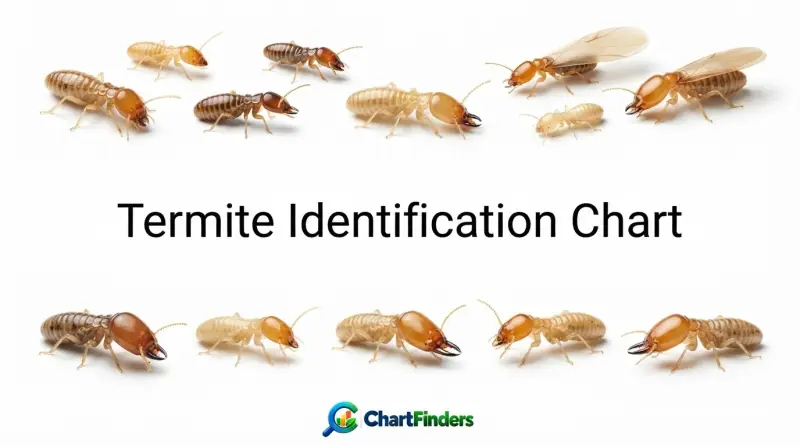
Termite Identification Chart
- Ants vs. Termites: Termites feature straight antennae, broad waists, and equal-length wings; ants possess elbowed antennae, constricted pedicels (waists), and unequal wing sizes.
- Caste Specialization: Colonies are divided into reproductives (alates/swarmers), soldiers (defense), and workers (pseudergates or true workers), each exhibiting unique morphological markers.
- Subterranean Vectors: Genera such as Reticulitermes and Heterotermes require ground moisture and construct earthen mud tubes to bridge gaps between soil and structural timber.
- Drywood Vectors: Family Kalotermitidae (e.g., Incisitermes) nests directly inside dry, sound wood without soil contact, expelling distinct hard, six-sided fecal pellets.
- Dampwood Vectors: Family Termopsidae targets decaying, high-moisture timber, producing large alates and soldiers with disproportionately massive, dark mandibles.
- Venation Diagnostics: Wing vein structures in swarmers provide definitive taxonomic keys, especially the presence or absence of heavy anterior veins like the radius and media.
To accurately diagnose an infestation, one must look beyond external damage and inspect the physical specimens—or the castoff evidence—left behind. The following diagnostic matrix outlines the core anatomical and ecological parameters that separate the primary termite groups from one another and from common look-alikes like carpenter ants.
| Taxonomic Group / Look-Alike | Antennae Shape | Waist Morphology | Wing Characteristics | Nesting Habitat | Frass / Evidence |
|---|---|---|---|---|---|
| Subterranean Termites (Rhinotermitidae) | Straight, bead-like (moniliform) | Broad, uniform width (no constriction) | Equal length, translucent, delicate, shorter than body | Subterranean soil; galleries packed with mud/soil | Mud tubes, shelter tubes, carton material |
| Drywood Termites (Kalotermitidae) | Straight, bead-like | Broad, uniform width | Equal length, smoky or clear, distinct heavy veins near leading edge | Dry, sound wood above ground; no soil contact | Hard, elongated fecal pellets with six concave sides |
| Dampwood Termites (Termopsidae) | Straight, bead-like | Broad, uniform width | Large, membranous, very pronounced reticulate venation | High-moisture, decaying logs, stumps, or wet structural wood | Coarse, damp, barrel-shaped fecal pellets |
| Carpenter Ants (Formicidae – Look-Alike) | Elbowed (geniculate) | Pinched, narrow pedicel | Unequal length (forewings longer than hindwings) | Wood cavities (prefer damp/decaying wood) | Frass resembles coarse sawdust mixed with insect parts (no pellets) |
The comparative data above highlights that external morphology offers immediate exclusion criteria. When inspecting an infestation site, verifying the antennae and waist configuration eliminates non-termite wood-boring insects instantly, narrowing the diagnostic scope to specific subterranean, drywood, or dampwood lineages.
Anatomical Breakdown: The Three Primary Castes
A termite colony is a complex, eusocial superorganism operating through functional castes. Correct identification requires analyzing whichever caste is currently visible, as soldiers, alates, and workers exhibit vastly different sclerotization, pigmentation, and head capsule geometries.
1. Alates (Swarmers / Reproductives)
Alates represent the dispersal phase of the colony. When environmental conditions—such as humidity, temperature, and barometric pressure—align, mature colonies produce winged males and females that emerge en masse to establish new nests.
- Morphology: Unlike workers, alates possess fully pigmented, sclerotized exoskeletons (usually dark brown, black, or reddish-brown) and compound eyes.
- Wings: They bear four wings of identical length that extend well beyond the tip of the abdomen. These wings feature a specialized basal fracture line (suture) allowing the insects to snap them off easily after mating flights.
- Diagnostic Value: Because worker termites lack distinct species-level markers, entomologists rely heavily on alate wing venation and pronotum shape to identify specimens down to the genus or species level.
2. Soldiers
The soldier caste is exclusively defensive, charged with protecting the colony against predators, most notably ants. Soldiers do not forage for food or feed themselves directly; their mouthparts are modified to the extent that they depend on workers for nutrition via trophallaxis (the exchange of gut fluids).
- Head Capsule: Soldiers are easily recognized by their massive, heavily sclerotized, amber-to-dark-brown head capsules equipped with elongated, sickle-shaped or toothed mandibles.
- Body: The thorax and abdomen remain pale, soft, and unpigmented.
- Taxonomic Utility: Mandible serration, fontanelle presence (a pore on the front of the head in Rhinotermitidae used to secrete defensive fluids), and head proportions serve as primary identification metrics in professional keys.
3. Workers (and Pseudergates)
Workers constitute the vast majority of the colony biomass. They perform all labor-intensive tasks: excavating galleries, tending to eggs and nymphs, feeding reproductives, and foraging for cellulose.
- Appearance: Workers are soft-bodied, blind, wingless, and creamy-white to translucent in appearance.
- Distinction: In true subterranean termites (Rhinotermitidae), true workers exist. In drywood and dampwood colonies, the population consists of “pseudergates”—immature nymphs that can remain in a working state or molt into soldiers and alates.
- Identification Challenge: Because workers lack hard structures, species identification using workers alone is exceptionally difficult and usually requires molecular (DNA) analysis or the recovery of soldier/alate castes from the same gallery system.
Major Termite Families and Diagnostic Profiles
Taxonomic classification separates wood-destroying Isoptera into distinct families characterized by specific ecological niches, geographical distributions, and morphological traits. Recognizing these families dictates the appropriate structural remediation methodology.
Family Rhinotermitidae: Subterranean Termites
Rhinotermitidae represents the most economically destructive family of wood-destroying insects globally. These subterranean vectors nest beneath the frost line or within moist soil environments, requiring continuous access to ground moisture to prevent desiccation.
Key genera within this family include Reticulitermes, Heterotermes, and Coptotermes. Within the southeastern United States and broader North American regions, species such as Reticulitermes virginicus (dark southern subterranean termite) and Reticulitermes hageni (light southeastern subterranean termite) are prevalent. Morphologically, rhinotermitid soldiers feature a distinct circular pore on the anterior portion of the head called a fontanelle, through which they expel a sticky, defensive latex when disturbed.
Diagnostic Signatures of Rhinotermitidae:
- Mud Tubes: Flattened, pencil-to-finger-width earthen tunnels constructed from soil, saliva, and fecal matter. These tubes protect workers from dry air and predators as they traverse concrete foundations to reach structural wood.
- Gallery Pattern: Wood is consumed along the grain, with softer springwood being hollowed out while harder summerwood rings are left intact. Galleries are typically packed with grayish-brown frass and dried mud.
- Swarming Dynamics: Many subterranean species swarm during daylight hours in spring or autumn, often following rain events.
Family Kalotermitidae: Drywood Termites
Kalotermitids do not require contact with the soil or any external moisture source; they extract all necessary metabolic water from the dry, sound timber they consume. Consequently, they can infest structural lumber, attic framing, and even antique furniture far above ground level.
Drywood colonies are comparatively small—often numbering in the low thousands—and develop slowly over several years. They do not produce mud tubes or carton material.
Diagnostic Signatures of Kalotermitidae:
- Frass Accumulation: The absolute diagnostic indicator of a drywood infestation is the presence of kick-out holes. Workers push fecal pellets out of tiny circular openings in the wood. These pellets accumulate in small, geometric mounds resembling coarse sand or coffee grounds. Under magnification, each pellet exhibits six distinct, concave sides with rounded ends.
- Wood Damage: Drywood galleries cut across both soft and hard wood grains indiscriminately, often leaving a clean, sandpaper-smooth interior finish that appears swept or polished.
Family Termopsidae: Dampwood Termites
Termopsidae comprises the largest dampwood termites, adapted exclusively to high-humidity, decaying, or water-logged timber. They are predominantly found in coastal regions, the Pacific Northwest, and tropical zones.
Because they lack the survival mechanisms needed to withstand dry conditions, dampwood termites are rarely found in modern, climate-controlled residential structures unless there is an active, unaddressed plumbing leak, chronic roof rot, or structural wood resting directly on damp soil.
Diagnostic Signatures of Termopsidae:
- Caste Demographics: Dampwood colonies lack a true worker caste; all labor is performed by large immature nymphs (pseudergates). Soldiers are exceptionally large with dark, elongated mandibles.
- Excrement: Fecal pellets are elongated, barrel-shaped, and moist, lacking the hard, faceted structure of drywood pellets.
- Wood Texture: Infested timber feels spongy, damp, and swollen, often featuring large, cavernous excavation chambers packed with damp frass.
Morphological Differentiation: Termites vs. Flying Ants
Property owners frequently mistake swarming ants for termites during seasonal flight events. Confusing these two groups leads to severe misallocations of time and capital, as chemical treatments designed for ants will fail to stop a termite infestation.
The diagnostic contrast between alate termites and flying ants rests on three foundational anatomical axes:
| Anatomical Feature | Isoptera (Termite Alates) | Formicidae (Flying Ants) |
|---|---|---|
| Antenna Structure | Straight, bead-like (moniliform) segments of uniform width | Elbowed (geniculate) with a distinct bent scape |
| Abdominal Pedicel | Broad waist; thorax and abdomen join smoothly without constriction | Pinched, narrow waist (petiole) connecting thorax and abdomen |
| Wing Dimensions | Four wings of identical length and shape | Forewings noticeably longer and larger than hindwings |
| Wing Longevity | Wings break off easily along a basal suture, leaving tiny stub scales | Wings remain firmly attached unless forcefully torn off |
This structural differentiation provides an infallible sorting mechanism. If a specimen displays elbowed antennae and a narrow, pinched waist, it is definitively a hymenopteran (ant), regardless of whether wings are present or shed.
Diagnostic Field Protocol: Step-by-Step Identification
When conducting an on-site structural inspection, field entomologists and pest control technicians follow a systematic diagnostic sequence to identify the pest organism and map the extent of the infestation.
- Visual Perimeter Sweep: Inspect the foundation exterior for subterranean mud tubes bridging concrete or brick foundations. Check crawlspaces, sill plates, and joists for discoloration or sagging timber.
- Acoustic Sounding: Tap suspect wooden members with a heavy screwdriver or sounding mallet. Solid wood produces a sharp, resonant knock; hollowed galleries beneath a thin veneer yield a dull, papery thud.
- Frass and Debris Collection: Vacuum or sweep up any particulate matter beneath suspect timber. Examine the debris under a 10x to 20x hand lens. Cylindrical, six-sided pellets confirm drywood termites; mud, carton, or fine dust indicates subterranean activity; coarse sawdust without pellets points to carpenter ants.
- Specimen Extraction: Pry open a small section of damaged wood to expose the gallery interior. Look for live workers, nymphs, or soldiers. If alate swarmers are present, collect them in an ethanol vial for microscopic examination of wing venation and pronotum structure.
- Moisture Mapping: Use a pinless moisture meter to check structural timbers. Readings exceeding 20% moisture content indicate vulnerability to dampwood termites, fungal decay, and subterranean foraging vectors.
Common Diagnostic Mistakes and Pitfalls
Even experienced inspectors occasionally misinterpret wood-destroying organism (WDO) evidence due to overlapping symptoms or deceptive environmental conditions.
- Confusing Frass Types: Sweeping up drywood pellets and mistaking them for subterranean soil or boring beetle dust. Always verify pellet geometry under magnification to confirm the distinct six concave sides characteristic of Kalotermitidae.
- Ignoring Structural Look-Alikes: Assuming that hollow wood is exclusively termite damage. Powderpost beetles (Lyctidae) and old-house borers (Hylotrupes bajulus) also hollow out structural members, but they leave packed, powdery frass and perfectly circular or oval exit holes rather than clean galleries.
- Misidentifying Swarm Seasonality: Assuming termites only fly in spring. While many subterranean species peak in spring, specific drywood and subterranean species swarm during late summer, autumn, or even indoors during winter months when heated structures stimulate colony activity.
- Overlooking Formicidae Activity: Treating structural damage caused by moisture-loving carpenter ants with termiticides, which leaves the underlying fungal rot and ant colonies unaddressed.
Frequently Asked Questions
How can I tell the difference between termite wings and ant wings?
Termite wings are equal in length, delicate, translucent, and break off cleanly along a basal fracture line. Ant wings are unequal in size—the forewings are noticeably longer than the hindwings—and they do not possess a natural basal fracture line, meaning they remain firmly attached unless damaged.
Do subterranean termites ever nest entirely above ground?
Yes, under specific circumstances known as “above-ground subterranean termite infestations.” If a colony has continuous access to a moisture source, such as a severe roof leak or condensation pipe, combined with a wood-to-ground contact point or a structural bridge, they can maintain an active colony without direct contact with soil.
What does termite frass look like?
Termite frass depends entirely on the species group. Drywood termites produce hard, dry, elongated fecal pellets featuring six concave sides. Subterranean termites do not produce dry pellet frass; instead, they pack their galleries with mud, digested wood, and saliva to form a grayish carton material.
Are winged insects indoors always a sign of an active infestation?
Not always, but they must be treated as a major warning sign. If dozens of alates are found crawling near windowsills or light fixtures indoors, it strongly indicates an active, mature colony established within the structural framing of the building. However, if only a few dead swarmers are found near an exterior door during spring, they may have flown in from an outdoor stump or neighboring tree.
Can I identify termite species by looking at worker termites?
Generally, no. Worker termites across different subterranean genera (such as Reticulitermes and Coptotermes) look almost identical—they are soft-bodied, pale, and unpigmented. Accurate species-level identification requires examining the physical traits of soldier head capsules, alate pronotum shapes, or wing venation patterns.
Conclusion
Accurate termite identification is the of effective structural pest management. By systematically evaluating morphological markers—such as straight antennae, broad waists, wing venation, and distinct frass pellets—property owners and technicians can definitively differentiate between subterranean, drywood, and dampwood vectors, as well as harmless structural look-alikes like carpenter ants. Recognizing these biological nuances ensures that remedial treatments are properly targeted, protecting capital investments and preserving the structural integrity of timber-framed architecture.