

When most people picture a dolphin, a sleek gray silhouette leaping through ocean waves usually comes to mind. Yet, this mental image captures only a fraction of a remarkably diverse biological order. Cetaceans encompass an astonishing evolutionary array, ranging from tiny, coastal species weighing less than a hundred pounds to massive apex predators like the orca, which commands the top of the marine food web. Understanding the various types of dolphins requires looking past popular media portrayals to examine taxonomy, anatomical adaptations, ecological niches, and the pressing conservation challenges facing these intelligent marine mammals.
This master guide explores the complex taxonomy of dolphins, contrasting oceanic and freshwater river species, examining behavioral adaptations, and reviewing the status of endangered populations. By breaking down species classifications, geographic distributions, and physiological differences, this article provides a comprehensive reference for researchers, conservationists, and wildlife enthusiasts alike.
Types Of Dolphins
- Taxonomic Diversity: There are over 40 recognized dolphin species, all belonging to the order Cetacea and suborder Odontoceti (toothed whales).
- Oceanic vs. River Distribution: The vast majority of dolphin species are marine (Delphinidae), while a small, highly specialized group comprises true river dolphins adapted to freshwater habitats.
- Size Spectrum: Species size varies wildly, from the tiny Maui dolphin and Hector’s dolphin up to the orca (killer whale), which is the largest oceanic dolphin.
- Social Structures: Many dolphin species live in complex, hierarchical social groups known as pods, utilizing sophisticated communication and echolocation.
- Conservation Realities: Numerous dolphin populations face severe threats from bycatch, habitat degradation, boat strikes, and chemical pollution, leading to intensive international monitoring and protection efforts.
To understand the diversity of dolphins, one must first navigate their classification. Scientifically, dolphins are aquatic mammals that split into several distinct families within the suborder Odontoceti. The family Delphinidae accounts for oceanic dolphins, while freshwater river dolphins belong to several distinct superfamilies, reflecting independent evolutionary paths into freshwater environments.
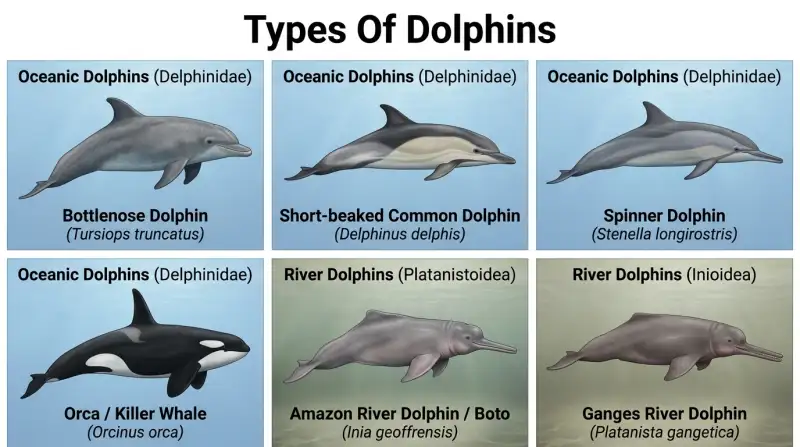
| Family / Group | Key Representative Species | Primary Habitat | Distinguishing Physical Traits |
|---|---|---|---|
| Oceanic Dolphins (Delphinidae) | Bottlenose Dolphin (Tursiops truncatus) | Coastal and warm temperate oceans | Robust body, short stubby rostrum, highly adaptable |
| Oceanic Dolphins (Delphinidae) | Short-beaked Common Dolphin (Delphinus delphis) | Open ocean and coastal convergence zones | Distinct hourglass color pattern on flanks |
| Oceanic Dolphins (Delphinidae) | Spinner Dolphin (Stenella longirostris) | Deep tropical and subtropical waters | Slender body, long thin beak, famous for aerial spins |
| Oceanic Dolphins (Delphinidae) | Orca / Killer Whale (Orcinus orca) | All world oceans, from polar to tropical | Massive size, distinct black-and-white coloration, tall dorsal fin |
| River Dolphins (Platanistoidea) | Amazon River Dolphin / Boto (Inia geoffrensis) | Amazon and Orinoco river basins | Flexible neck vertebrae, pinkish hue, long downward-curved snout |
| River Dolphins (Inioidea) | Ganges River Dolphin (Platanista gangetica) | Ganges-Brahmaputra river system | Functionally blind, navigates entirely by echolocation, rigid dorsal ridge |
The table above illustrates the fundamental division in the cetacean world. While oceanic dolphins have streamlined bodies built for high-speed swimming and open-water navigation, river dolphins exhibit flexible anatomy—such as unfused cervical vertebrae—allowing them to maneuver through flooded forests and winding river channels.
Major Categories of Oceanic Dolphins (Delphinidae)
The family Delphinidae is the largest and most familiar group of cetaceans. Comprising over 30 species, oceanic dolphins inhabit every ocean on Earth, exploiting niches from shallow coastal estuaries to the deep pelagic zone.
Bottlenose Dolphins (Tursiops)
Perhaps the most famous type of dolphin, bottlenose dolphins are instantly recognizable by their curved mouthlines, which give them a permanent “smile.” They are exceptionally adaptable, thriving in harbors, bays, gulfs, and open coastal waters. Research has demonstrated their complex fission-fusion social structures, tool use (such as marine sponges used for foraging), and sophisticated vocal signatures.
Common Dolphins (Delphinus)
Split into short-beaked and long-beaked species, common dolphins are renowned for their incredible speed and acrobatic leaps. They are easily identified by the unique yellowish-tan hourglass pattern along their sides. These animals frequently form massive schools numbering in the thousands, often associating with other marine mammals and seabirds to corral schooling fish.
Spinner and Spotted Dolphins (Stenella)
Inhabiting tropical and subtropical waters worldwide, species in the genus Stenella are sleek, agile swimmers. Spinner dolphins earned their name from their breathtaking habit of leaping high into the air and rotating along their longitudinal axis before splashing back down. Pantropical and Atlantic spotted dolphins develop characteristic dark spots as they mature from calves into adults.
Apex Oceanic Dolphins: Orcas and Pilot Whales
Though common parlance often separates killer whales (orcas) from “dolphins,” taxonomically they are the largest members of the Delphinidae family. Orcas display remarkable cultural transmission, with distinct ecotypes specializing in specific prey items, ranging from marine mammals to specific fish populations. Similarly, long-finned and short-finned pilot whales—often called “blackfish”—exhibit strong social bonds and matrilineal pod structures.
Freshwater River Dolphins
River dolphins represent some of the most specialized and threatened mammals on Earth. Evolving independently to conquer turbid freshwater systems, these cetaceans face intense anthropogenic pressures, including dam construction, heavy boat traffic, and industrial pollution.
Amazon River Dolphin (Boto)
The boto is the largest river dolphin species. Famed for its distinctive pink coloration—which deepens with age and physical activity—the boto possesses cervical vertebrae that are not fused, allowing it to turn its head 90 degrees to navigate submerged tree trunks in flooded rainforests.
South Asian River Dolphins (Ganges and Indus)
These blind river dolphins navigate entirely through echolocation in murky glacial runoff. Lacking a true crystalline eye lens, they can only perceive the direction of light. Their long, bristly snouts are packed with sensitive mechanoreceptors used to probe muddy riverbeds for crustaceans and bottom-dwelling fish.
The Critically Endangered Vaquita and Maui Dolphin
While technically marine or estuarine rather than riverine, small porpoise-like and coastal dolphins face extreme extinction risks. The vaquita, a tiny porpoise endemic to the northern Gulf of California, numbers fewer than twenty individuals. Similarly, New Zealand’s Maui dolphin—a subspecies of Hector’s dolphin—remains critically endangered due to gillnet entanglement.
Anatomical and Behavioral Adaptations Across Species
Survival in aquatic environments requires extraordinary physiological adaptations. Dolphins exhibit specialized respiratory, sensory, and thermoregulatory systems that allow them to dive deep, swim efficiently, and communicate across vast aquatic landscapes.
Echolocation and Sensory Systems
All toothed whales (Odontocetes) rely on biosonar, or echolocation, to navigate and hunt. By emitting high-frequency clicks through nasal passages and focusing them through a fatty organ in the forehead known as the melon, dolphins receive returning echoes. This auditory feedback allows them to determine the distance, size, shape, density, and texture of objects in pitch-black or turbid water.
Thermoregulation and Blubber Layers
Maintaining a mammalian body temperature in cold ocean waters requires a thick layer of subcutaneous adipose tissue, known as blubber. Additionally, dolphins utilize specialized counter-current heat exchange systems in their flukes, dorsal fins, and flippers. Arteries carrying warm blood are closely wrapped by veins carrying cooled blood back from the skin’s surface, minimizing heat loss in frigid polar or deep-sea environments.
Social Dynamics and Communication
Dolphins are exceptionally gregarious animals. Communication occurs via a complex repertoire of whistles, clicks, and burst-pulse sounds. Bottlenose dolphins, for instance, develop a unique signature whistle used for individual identification and maintaining contact within murky waters. Cooperative hunting strategies—such as bubble-net feeding, strand-feeding, and coordinated fish-herding—demonstrate high cognitive function and cultural learning passed down through generations.
Conservation Status and Global Threats
Despite their widespread cultural appeal, dolphin populations face mounting anthropogenic pressures across marine and freshwater habitats. International bodies, regional agreements (such as ASCOBANS), and conservation NGOs continuously monitor populations to implement protective frameworks.
| Threat Category | Impact on Dolphin Populations | Primary Affected Species | Mitigation Strategy |
|---|---|---|---|
| Bycatch in Fisheries | Accidental entanglement in gillnets, trawl nets, and longlines causes mass mortality. | Common dolphins, Hector’s dolphins, vaquita | Acoustic deterrents (pingers), modified gear, fishery closures |
| Habitat Degradation | Dam construction, heavy boat traffic, and underwater noise pollution disrupt communication and migration. | River dolphins (Amazon, Ganges), coastal bottlenose pods | Protected marine areas, speed restrictions, river basin management |
| Chemical Pollution | Bioaccumulation of heavy metals, PCBs, and microplastics suppresses immune systems and reproductive success. | Orcas, coastal apex predators | Industrial runoff regulations, water quality remediation |
| Direct Exploitation | Direct hunting for bait meat, traditional use, or live capture for aquariums. | Small cetaceans in parts of Asia and South America | Enforcement of anti-poaching laws, international treaties, ecotourism development |
Mitigating these threats requires international cooperation. For example, regional agreements like the Agreement on the Conservation of Small Cetaceans of the Baltic, North East Atlantic, Irish and North Seas (ASCOBANS) regularly convene member states, researchers, and fisheries organizations to coordinate conservation action plans, assess bycatch mortality rates, and enforce protective legislation.
Common Mistakes in Dolphin Identification and Classification
When studying or observing dolphins in the wild, enthusiasts and even amateur researchers often fall into specific identification traps. Recognizing these nuances prevents common classification errors.
- Confusing Dolphins and Porpoises: Though physically similar, dolphins and porpoises belong to different taxonomic families (Delphinidae vs. Phocoenidae). Porpoises generally possess spade-shaped teeth, shorter rounded beaks, and triangular dorsal fins, whereas dolphins typically have conical teeth, distinct curved beaks (rostrums), and curved dorsal fins.
- Assuming Orcas Are Whales: Because of their common name (“killer whale”), orcas are frequently mistaken for baleen whales. Taxonomically, they are the largest dolphins in the Delphinidae family.
- Treating River Dolphins as a Single Group: River dolphins do not form a single monophyletic clade. Instead, they represent distinct lineages that adapted to freshwater systems independently, making morphological similarities a result of convergent evolution rather than close kinship.
- Overlooking Coloration Shifts: Many dolphin species undergo dramatic color and pattern changes between infancy and adulthood. Relying solely on juvenile markings often leads to misidentification.
Frequently Asked Questions
How many species of dolphins are there?
There are over 40 recognized species of dolphins. This total includes roughly 30+ species of oceanic dolphins within the Delphinidae family and several surviving species of freshwater river dolphins.
What is the largest type of dolphin?
The orca, commonly known as the killer whale (Orcinus orca), is the largest member of the oceanic dolphin family. Adult males can reach lengths exceeding 30 feet and weigh up to 11 tons.
Do all dolphins live in the ocean?
No. While the vast majority of dolphin species are marine, a specialized group of river dolphins lives exclusively in freshwater river systems, such as the Amazon, Orinoco, Ganges, and Indus basins.
How do dolphins breathe underwater if they are mammals?
Dolphins are mammals, meaning they have lungs and breathe air rather than extracting oxygen from water via gills. They surface at regular intervals to inhale and exhale air through a single blowhole located on top of their heads.
Why do spinner dolphins spin in the air?
While scientists debate the exact evolutionary purpose, spinner dolphins likely leap and spin to remove external parasites, communicate social intent, signal mating readiness, or simply engage in play.
Conclusion
The diversity encapsulated within the types of dolphins—ranging from pelagic common dolphins darting through open ocean swells to elusive river dolphins navigating murky rainforest tributaries—highlights the remarkable evolutionary adaptability of cetaceans. Protecting these intelligent, highly social mammals requires sustained global cooperation, rigorous fisheries management, and dedicated habitat preservation. By understanding the distinct physiological traits, ecological requirements, and conservation needs of each species, humanity can better safeguard the future of these remarkable aquatic inhabitants.