
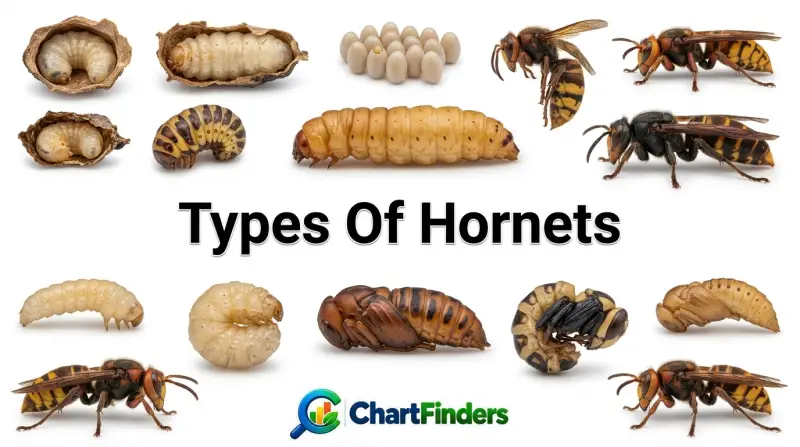
Few insects evoke as much immediate caution and misunderstanding as the hornet. Often conflated with paper wasps, yellowjackets, and even large carpenter bees, true hornets represent a distinct evolutionary branch of social wasps possessing complex colony structures, formidable stingers, and powerful predatory capabilities. Understanding the various types of hornets is vital not only for pest management and outdoor safety but also for ecological conservation, as many species play specialized roles in regulating local insect populations across their native and introduced ranges.
The study of hornets requires separating biological taxonomy from colloquial terminology. While everyday conversation often labels any large, stinging, buzzing insect as a “hornet,” entomologists reserve the term strictly for species within the genus Vespa. These insects build paper nests, undergo complete metamorphosis, and operate under strict caste systems featuring queens, workers, and drones. Recent ecological shifts, global trade, and climate adaptations have further heightened public interest in tracking native and invasive hornet populations worldwide.
Types Of Hornets
- True hornets belong exclusively to the genus Vespa, whereas insects like the bald-faced hornet are technically aerial yellowjackets.
- The European hornet (Vespa crabro) is the only true hornet established in North America, known for its reddish-brown head and thorax and nocturnal activity.
- Invasive species such as the northern giant hornet (Vespa mandarinia) and the yellow-legged hornet (Vespa velutina) present severe ecological threats to managed honeybee populations and local ecosystems.
- Hornet colonies are annual; fertilized queens overwinter alone, while workers and males die off with the first hard frosts.
- Unlike honeybees, hornets possess smooth stingers that allow them to sting repeatedly without dying, making nest disturbance dangerous.
- Accurate identification depends on examining morphological markers such as facial coloration, abdominal banding patterns, and overall size.
To navigate the taxonomy and field identification of these insects, one must examine the key traits that separate true hornets from look-alikes, as well as the distinct geographical distributions, behavioral profiles, and foraging strategies of each major species. The following sections break down the categorization of hornets and provide an exhaustive breakdown of individual species.
| Common Name | Scientific Name | Average Size | Primary Range | Distinctive Marking / Color | Nesting Preference |
|---|---|---|---|---|---|
| European Hornet | Vespa crabro | 0.75 – 1.4 inches | Europe, Asia, North America | Reddish-brown head/thorax, yellow-and-black abdomen | Hollow trees, wall voids, dark cavities |
| Northern Giant Hornet | Vespa mandarinia | 1.5 – 2.0 inches (Queens) | East and Southeast Asia, Pacific Northwest | Massive orange head, dark brown/orange striped abdomen | Subterranean burrows, tree roots |
| Yellow-Legged Hornet | Vespa velutina | 0.8 – 1.2 inches | Southeast Asia, Europe | Dark velvet-brown body, bright yellow lower legs | High tree canopies, architectural structures |
| Oriental Hornet | Vespa orientalis | 0.8 – 1.4 inches | Southern Europe, Middle East, North Africa | Reddish-brown body with a distinct bright yellow abdominal band | Subterranean cavities, dry masonry |
| Bald-Faced Hornet | Dolichovespula maculata | 0.5 – 0.78 inches | North America | Black body with distinct white/ivory facial markings | Hanging aerial nests in trees and shrubs |
This comparison highlights the diversity within and outside the strict Vespa genus. While size and geographic range vary dramatically, understanding these baseline specifications prevents misidentification during pest management operations.
The Taxonomy of Hornets vs. Similar Wasps
The word “hornet” suffers from widespread colloquial misuse. In North America, the term is frequently applied to any large wasp, particularly yellowjackets. Scientifically, the true hornets belong to the genus Vespa within the family Vespidae. There are approximately 22 recognized species of true hornets worldwide, native primarily to the Old World (Europe, Asia, and Africa), with only one species intentionally introduced and established in North America.
True hornets differ structurally from paper wasps (genus Polistes) and yellowjackets (genera Vespula and Dolichovespula). Hornets generally possess a rounded, robust abdomen and a broad head behind the compound eyes. Their nests are constructed from chewed wood pulp mixed with saliva, resulting in a durable, papery envelope that typically covers multiple horizontal comb tiers.
Major Species of True Hornets (Genus Vespa)
The European Hornet (Vespa crabro)
The European hornet is the largest social wasp native to Europe and the sole true hornet established in North America, having been introduced in the mid-19th century. Workers measure between 0.75 and 0.98 inches, while queens can reach up to 1.38 inches. Visually, they are easily distinguished from yellowjackets by their warm reddish-brown head and thorax, combined with a yellow abdomen marked with dark, teardrop-shaped spots along the margins.
Unlike most stinging insects that strictly adhere to diurnal schedules, European hornets are notably active at night. They are frequently drawn to outdoor porch lights and window panes during late summer evenings. Their nests are typically established in protected cavities such as hollow tree trunks, abandoned rodent burrows, wall voids, or old barns. While they are docile unless their nest is directly threatened, their sting is notoriously painful due to the depth of penetration and chemical composition of the venom.
The Northern Giant Hornet (Vespa mandarinia)
Previously known commonly as the Asian giant hornet and colloquially dubbed the “murder hornet,” Vespa mandarinia is the world’s largest species of hornet. Queens can exceed two inches in length with a wingspan stretching over three inches. They feature a striking, oversized orange-yellow head, prominent dark eyes, and a sharply banded dark brown and yellow abdomen.
Native to temperate and tropical regions of East and Southeast Asia, this species gained global attention following detections in the Pacific Northwest of North America. The northern giant hornet is infamous for its devastating attacks on honeybee colonies. A small group of scouting hornets can execute a “slaughter phase,” decapitating thousands of honeybees in a matter of hours to harvest the protein-rich brood larvae. Their subterranean nesting habits—usually underground in abandoned rodent holes or rotting root systems—make ground excavation and colony eradication particularly hazardous.
The Yellow-Legged Hornet (Vespa velutina)
Also referred to as the Asian hornet (not to be confused with the northern giant hornet), Vespa velutina is a highly adaptable invasive species native to Southeast Asia that has successfully established populations across large parts of Western Europe. Workers range from 0.8 to 1.0 inches in length, featuring a dark velvet-black thorax and abdomen banded with fine yellow-orange lines. Their defining feature is their bright yellow lower legs (tarsi), which contrast sharply with their dark bodies.
The yellow-legged hornet poses a severe economic and ecological threat primarily because of its specialized predation strategy on honeybees. Rather than waiting at hive entrances, these hornets hawk outside hives, hovering in mid-air to intercept returning foragers. They construct massive, pear-shaped aerial nests high up in tree canopies or on man-made structures, making nest detection and removal exceptionally difficult during leaf-heavy summer months.
The Oriental Hornet (Vespa orientalis)
Adapted to arid and semi-arid environments, the Oriental hornet is native to Southeast Europe, Southwest Asia, and parts of North Africa. It has also established populations in parts of southern Europe and the Middle East. Measuring between 0.8 and 1.4 inches, this species is easily recognized by its reddish-brown body accented by a wide, bright yellow band wrapping around the middle of its abdomen, as well as distinct yellow markings on its head.
The Oriental hornet possesses a unique evolutionary trait: its yellow abdominal segments contain xanthopterin pigments that act as a biological solar cell, absorbing sunlight and converting it into electrical energy. This physiological adaptation allows them to remain active during peak daylight hours when other insects seek shade. They frequently build subterranean nests in dry soil or wall cavities and are considered agricultural pests due to their habit of damaging ripening fruit and raiding managed bee apiaries.
Commonly Misidentified “Hornets”
Many insects carrying the “hornet” moniker are taxonomically misclassified. The most prominent example in North America is the bald-faced hornet (Dolichovespula maculata).
The Bald-Faced Hornet (Dolichovespula maculata)
Despite its common name, the bald-faced hornet is not a true hornet; it is actually a species of aerial yellowjacket. Workers measure between 0.5 and 0.78 inches, characterized by a predominantly black body with striking, contrasting white or ivory markings across the face, thorax, and terminal abdominal segments.
Bald-faced hornets are famous for constructing large, football-to-basketball-sized, papery enclosed nests suspended high in the branches of trees, utility poles, or the eaves of buildings. They are fiercely defensive of their aerial colonies and will readily swarm anyone who approaches within several feet of the nest structure. While their sting is painful, their presence provides natural pest control by preying on flies, caterpillars, and other garden pests.
Life Cycle and Colony Dynamics
Understanding the seasonal progression of a hornet colony is essential for evaluating risks and determining appropriate management strategies. Unlike social bees that maintain multi-year hives, true hornet colonies follow an annual cycle governed by temperature and photoperiod.
In early spring, a single fertilized queen that successfully overwintered beneath loose bark, in a log, or within soil cavities emerges to establish a new colony. She constructs a rudimentary paper nest, lays her first batch of eggs, and provisions the initial larvae herself until they emerge as sterile female workers. Once the worker force is established, the queen remains inside the nest, dedicating her entire life to egg-laying.
As summer progresses, the colony expands rapidly, reaching peak population numbers in late summer and early autumn. At this zenith, a mature nest may house several hundred to over a thousand individuals. During this period, food preferences shift; early in the season, colonies require high protein (other insects) to feed the developing brood, but by late summer, workers shift toward carbohydrates, scavenging fallen fruit, nectar, and human sweet foods, which often increases human-hornet conflict.
In mid-to-late autumn, the colony produces fertile males (drones) and new queens. These sexual castes leave the nest to mate. Once the autumn temperatures drop, the old queen, all workers, and the males die off. Only the newly mated young queens survive the winter by entering diapause, sheltering in protected microhabitats to restart the cycle the following spring.
Ecological Role and Behavioral Characteristics
While human interactions with hornets typically focus on the sting hazard, these predators play a critical role in maintaining ecological balance. As apex insectivores, hornets hunt vast quantities of agricultural and garden pests, including caterpillars, grasshoppers, flies, and beetles. A single active colony can consume kilograms of pest insects over the course of a single season.
However, when invasive species enter non-native ecosystems, this predatory drive becomes destructive. Native honeybee populations in Europe and North America lack the evolutionary defensive behaviors developed by Asian honeybees—such as “heat-balling,” where hundreds of bees surround an invading hornet and vibrate their flight muscles to cook the predator to death. Consequently, invasive hornets can decimate local apiaries with devastating environmental consequences.
Behaviorally, hornets communicate via chemical pheromones. If a nest is disturbed, alarm pheromones are released into the air, triggering an immediate, highly aggressive defensive response from the entire worker force. Unlike honeybees, which leave their barbed stinger and venom sac embedded in human skin and subsequently die, hornets possess smooth stingers. This anatomical difference allows a single hornet to sting a perceived threat multiple times without sustaining fatal injury.
Identification and Safety Guidelines
Proper identification of hornet species versus beneficial pollinators or non-threatening wasps ensures that environmental conservation efforts are balanced with human safety. If you encounter a nest or individual hornets, adhere to the following practical guidelines:
- Observe from a distance: Do not swat or swing at foraging hornets. Sudden movements trigger defensive biting and stinging responses.
- Examine nest structure: Hanging pear-shaped paper nests in trees typically indicate bald-faced hornets or yellow-legged hornets, while ground cavities or dark hollows suggest European or northern giant hornets.
- Check lighting habits: If large reddish-brown wasps are attracted to exterior house lights after dark, they are almost certainly European hornets.
- Professional remediation: Never attempt to knock down, burn, or seal active hornet nests—particularly large subterranean or high aerial colonies—without proper protective gear and professional pest control equipment.
Frequently Asked Questions
Are all hornets aggressive toward humans?
No. Most foraging hornets hunting for insects or nectar away from their nest are docile and will ignore humans unless directly trapped or handled. However, hornets become extremely aggressive and defensive when their nest is approached, vibrated, or damaged. Species like the bald-faced hornet and northern giant hornet are particularly quick to defend their colony perimeter.
What is the difference between a hornet and a yellowjacket?
While both belong to the family Vespidae, true hornets (genus Vespa) are generally larger, feature distinct coloration (often featuring reddish-brown or large orange heads), and build large papery nests in trees or cavities. Yellowjackets (genera Vespula and Dolichovespula) are typically smaller, exhibit bright yellow-and-black chevron striping, and frequently nest underground or in structural wall voids.
Do hornets die after they sting?
No. Unlike honeybee workers, which have barbed stingers that tear away from their abdomen upon stinging mammals, hornet stingers are smooth. This anatomical feature allows them to withdraw the stinger and deliver multiple stings during a single defensive encounter.
How can I discourage hornets from nesting near my home?
Preventative measures include sealing gaps in siding, repairing torn window screens, capping chimney flues, and properly sealing outdoor garbage cans. Additionally, inspecting eaves, porches, and outbuildings in early spring allows you to spot and remove nascent queen nests before a large worker population develops.
Are hornets beneficial to the environment?
Yes. Despite their fearsome reputation, hornets act as essential natural predators that regulate populations of garden pests, crop-damaging caterpillars, and flies. Their ecological function mirrors that of birds of prey or predatory mammals within the insect kingdom.
Conclusion
The world of hornets is vastly more complex than simple public perception suggests. Spanning true representatives of the genus Vespa like the European and northern giant hornets, alongside frequently misidentified species like the bald-faced hornet, these social insects occupy a critical intersection of pest control, invasive ecology, and wildlife management. Recognizing the distinct morphological characteristics, behavioral traits, and nesting habits of each type allows homeowners, naturalists, and pest professionals to manage risks safely while respecting the ecological balance these powerful predators maintain.