
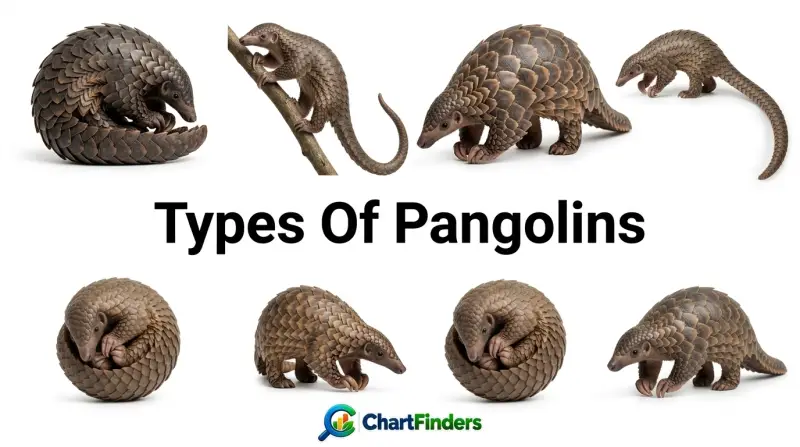
Pangolins—often mischaracterized as scaly anteaters—represent one of the most evolutionarily distinct and heavily specialized mammalian lineages on Earth. Belonging to the order Pholidota, these solitary, nocturnal creatures are entirely covered in overlapping, keratinous scales that act as a formidable armor against predators. Despite superficial similarities to armadillos, sloths, and anteaters, genetic studies confirm that pangolins are closer relatives to carnivorans. As global conservation frameworks evolve, understanding the nuances between the various types of pangolins is more critical than ever. Biologists, field researchers, and conservationists rely on precise taxonomic distinctions, morphological adaptations, and geographic distributions to design targeted protection strategies for these elusive mammals.
This master guide provides an authoritative, field-informed breakdown of the eight pangolin species, exploring their physical characteristics, behavioral adaptations, geographic strongholds, and conservation statuses. Whether you are studying wildlife trade dynamics, analyzing mammalian evolution, or researching field identification, this comprehensive resource covers everything you need to know about the types of pangolins.
The Diversity and Taxonomy of Types Of Pangolins
- There are eight recognized species of pangolins globally, split equally between the African continent and Asia.
- African species belong to the genera Phataginus (tree pangolins) and Smutsia (ground pangolins).
- Asian species all belong to the single genus Manis and generally possess distinct pinnae (external ear flaps) and terminal scale rows on their tails.
- Three Asian species—the Chinese, Sunda, and Philippine pangolins—are officially classified by the IUCN as Critically Endangered, facing imminent risk of extinction.
- Pangolins lack teeth, relying instead on a specialized acidic stomach, coarse keratinous spines lining the pyloric region, and sticky tongues that can extend beyond the length of their bodies.
- Illegal wildlife trafficking for traditional medicine and luxury bushmeat remains the single greatest existential threat to all eight species.
The family Manidae represents the sole surviving family within the order Pholidota. For decades, taxonomic classifications shifted as morphological traits were re-evaluated against molecular phylogenetics. Today, mammalogists recognize two subfamilies and three extant genera: Manis in Asia, and Phataginus and Smutsia in Africa. This evolutionary split occurred millions of years ago, resulting in distinct ecological niches, behavioral patterns, and physical adaptations.
Morphologically, pangolins range dramatically in size. The smallest species, the Black-bellied pangolin, weighs as little as 1.6 kilograms, whereas the Giant ground pangolin can exceed 33 kilograms. Their defining feature—keratin scales—accounts for roughly 20% of their total body weight. These scales are modified hair follicles composed of alpha-keratin, the same protein found in human fingernails and rhinoceros horns. As scales wear down, they continuously sharpen or shed, though they do not regenerate in the manner of claws or hair.
| Common Name | Scientific Name | Region | Primary Habitat | IUCN Status | Avg. Weight Range |
|---|---|---|---|---|---|
| White-bellied Pangolin | Phataginus tricuspis | Africa | Forest / Arboreal | Endangered | 1.8 – 3.6 kg |
| Black-bellied Pangolin | Phataginus tetradactyla | Africa | Forest / Arboreal | Vulnerable | 1.6 – 2.5 kg |
| Giant Ground Pangolin | Smutsia gigantea | Africa | Savanna / Forest | Endangered | 20 – 33 kg |
| Temminck’s Ground Pangolin | Smutsia temminckii | Africa | Savanna / Grassland | Vulnerable | 7 – 18 kg |
| Chinese Pangolin | Manis pentadactyla | Asia | Forest / Grassland | Critically Endangered | 2 – 7 kg |
| Sunda Pangolin | Manis javanica | Asia | Forest / Plantation | Critically Endangered | 2 – 10 kg |
| Indian Pangolin | Manis crassicaudata | Asia | Forest / Scrubland | Endangered | 8 – 18 kg |
| Philippine Pangolin | Manis culionensis | Asia | Forest / Scrubland | Critically Endangered | 2 – 7 kg |
The table above highlights the basic biological parameters separating the eight species. Understanding these baseline classifications allows field researchers to narrow down geographic ranges and identify species during anti-poaching and wildlife seizure investigations.
The Four African Pangolin Species
African pangolins occupy habitats ranging from dense equatorial rainforests to open arid savannas. They are generally distinguished from Asian species by the absence of external ear pinnae (though some have tiny folds of skin) and the lack of terminal scale rows beneath their tails. The African lineage is split neatly into arboreal tree pangolins (Phataginus) and terrestrial ground pangolins (Smutsia).
1. White-bellied Pangolin (Phataginus tricuspis)
Also known as the three-cusped pangolin, the White-bellied pangolin is the most common and widespread pangolin species in Africa. It is heavily arboreal, spending its days resting in hollow tree trunks, canopy tangles, or dense foliage. Its tail is long and prehensile, featuring a bare underside patch that acts as a tactile anchor when climbing.
- Identification Clues: Each scale typically features three distinct points or cusps (hence tricuspis), though these wear down with age. The underbelly is sparsely covered with pale, whitish fur.
- Behavior: Strictly nocturnal and solitary. When threatened, it rolls into a tight, nearly impenetrable sphere and can emit a foul-smelling liquid from anal glands to deter predators.
2. Black-bellied Pangolin (Phataginus tetradactyla)
As the smallest of all extant pangolin species, the Black-bellied pangolin is an absolute specialist of the West and Central African swamp forests and lowland rainforests. It possesses an exceptionally long tail—often making up more than half of its total body length—which is uniquely adapted for navigating slender vines and high canopy branches.
- Identification Clues: Features a remarkably long, tapering tail with roughly 30 to 35 rows of scales, dark blackish-brown fur on the belly and limbs, and four prominent digits on the forefeet.
- Behavior: Unlike other pangolins that are strictly nocturnal, the Black-bellied pangolin exhibits crepuscular tendencies and is occasionally active during daylight hours near slow-moving water sources where it hunts arboreal ants.
3. Giant Ground Pangolin (Smutsia gigantea)
Reaching lengths of up to 1.8 meters and weights exceeding 33 kilograms, the Giant ground pangolin is the largest living pangolin species. Restricted to the primary and secondary rainforests and mosaic savannas of Central and West Africa, this terrestrial powerhouse requires vast home ranges to sustain its immense caloric needs.
- Identification Clues: Massive physical stature, heavy brown to reddish-brown scales, and long, powerful front claws designed for tearing open reinforced termite mounds. It also has a thick, heavy tail that drags behind it, leaving distinctive tracks in forest soil.
- Behavior: Highly elusive and terrestrial. It constructs deep underground burrows, often utilizing abandoned warps of other large mammals. It relies heavily on an acute sense of smell to locate subterranean colonies of ants and termites.
4. Temminck’s Ground Pangolin (Smutsia temminckii)
Often referred to as the Cape pangolin or steppe pangolin, Temminck’s ground pangolin is the only species found widely across the dry, open savannas and arid woodlands of East and Southern Africa. It avoids dense rainforests entirely, preferring sandy soils and rocky outcrops where it can dig extensive subterranean burrows.
- Identification Clues: Broad, yellowish-brown to dark-brown scales with a distinctly robust body shape and shorter tail relative to its body mass. The forehead features naked skin patches.
- Behavior: Terrestrial and strictly solitary. Unlike forest species, Temminck’s ground pangolins frequently walk on their hind legs while using their heavy tails and front limbs for balance—a striking bipedal locomotion style when moving quickly across open terrain.
The Four Asian Pangolin Species
Asian pangolins belong exclusively to the genus Manis. They are readily differentiated from African counterparts by the presence of visible external ear pinnae, hairs protruding from between their scales, and distinct terminal scales located on the underside of their tails. Due to intense historical and contemporary poaching pressures driven by demand in traditional Asian medicine and luxury meat markets, all four Asian species face severe population declines.
1. Chinese Pangolin (Manis pentadactyla)
Distributed across southern China, northern India, Nepal, Bhutan, Myanmar, and parts of the Indochinese peninsula, the Chinese pangolin is heavily adapted to temperate and subtropical broadleaf forests. It is renowned for its ability to hibernate during cold winter months in deep, self-excavated burrows.
- Identification Clues: Olive-brown to yellowish-gray scales, relatively short tails compared to body length, and prominent external ear flaps. It typically displays five distinct claws on all feet.
- Behavior: Both terrestrial and capable of climbing. They construct complex, spiral-shaped burrow systems that can extend several meters underground, providing thermal insulation during chilly winter cycles.
2. Sunda Pangolin (Manis javanica)
The Sunda pangolin (also known as the Malayan pangolin) inhabits Southeast Asia, including Thailand, Malaysia, Indonesia, Singapore, Brunei, and numerous regional islands such as Borneo and Sumatra. It thrives in primary and secondary tropical rainforests, as well as rubber and oil palm plantations.
- Identification Clues: Lighter gray-brown coloration, a massive and heavy tail, small head, and coarse hairs sprouting between the scale plates. Front claws are noticeably shorter and more curved than those of its mainland relatives.
- Behavior: Highly adaptable to modified agricultural landscapes, though populations are constantly suppressed by rampant illegal collection for international wildlife syndicates. It is an adept climber, spending significant time foraging in tree hollows.
3. Indian Pangolin (Manis crassicaudata)
The Indian pangolin (or thick-tailed pangolin) is native to the Indian subcontinent, encompassing India, Pakistan, Sri Lanka, and parts of Bangladesh and Nepal. It prefers arid plains, low-scrub forests, rocky hillocks, and agricultural grasslands rather than dense tropical rainforests.
- Identification Clues: Exceptionally thick, heavy tail, large yellowish-gray to dark-brown scales, and powerful digging claws on the forefeet that can measure up to 5 centimeters in length.
- Behavior: Terrestrial and fossorial. It creates deep subterranean burrows with reinforced nesting chambers. When cornered, it emits a loud, hissing snort and rolls into a ball so tight that predators like leopards and tigers rarely manage to unroll them.
4. Philippine Pangolin (Manis culionensis)
Endemic exclusively to the Palawan province in the Philippines, this micro-endemic species is restricted to primary and secondary forests, grasslands, and brushlands within the Palawan faunal region. It represents one of the most geographically restricted and vulnerable mammal species on Earth.
- Identification Clues: Smaller overall size than the Sunda pangolin, smaller scales, a shorter snout, and a more slender body profile.
- Behavior: Strictly nocturnal and solitary. Because of its isolated island distribution, it has evolved in the absence of many large mainland carnivores, making it particularly vulnerable to direct exploitation by humans.
Comparative Analysis of African vs. Asian Pangolins
To fully grasp the taxonomy of types of pangolins, researchers must examine the deep structural divergences separating African and Asian clades. These differences reflect millions of years of geographic isolation and evolutionary divergence.
While all pangolins share fundamental traits—such as edentate jaws, vermiform tongues, and keratin armor—their skeletal structures and external morphologies tell distinct stories. For instance, Asian pangolins possess hair follicles protruding from the skin between their scales, a feature entirely absent in African species. Additionally, the tail structure varies significantly: Asian species feature a terminal scale on the underside tip of the tail, whereas African species lack this specific scale plate.
| Comparative Trait | African Pangolins (Phataginus & Smutsia) | Asian Pangolins (Manis) |
|---|---|---|
| External Ears (Pinnae) | Absent or reduced to tiny skin folds | Present as distinct fleshy flaps |
| Inter-scale Hair | Absent | Present (coarse hairs emerge between scales) |
| Tail Tip Morphology | No terminal scale on underside | Presence of a terminal scale on underside tip |
| Genera Represented | Phataginus (tree), Smutsia (ground) | Manis (all Asian species) |
| Hibernation Ability | None (tropical/subtropical year-round activity) | Present in northern species (e.g., Chinese pangolin) |
This anatomical split aids conservation forensic scientists. When law enforcement intercepts confiscated scales or skin fragments in international trade hubs, genetic sequencing combined with morphological inspection of scale matrices can immediately pinpoint whether the contraband originated from African or Asian populations.
Field Identification and Morphological Markers
Identifying pangolin species in the field or during wildlife trafficking interdictions requires a systematic approach to morphological markers. Because juveniles and adults vary significantly in scale coloration and weight, field biologists rely on fixed anatomical metrics.
Key Diagnostic Features for Field Identification
- Scale Count and Shape: Transverse scale rows vary by species. Counting scale rows across the mid-body and checking for tricuspid (three-pointed) versus smooth edges instantly separates species like the White-bellied pangolin from ground-dwelling variants.
- Claw Proportions: The ratio of front claw length to hind foot length provides clues about fossorial versus arboreal habits. Terrestrial species like the Giant and Indian pangolins possess massive, sickle-shaped digging claws, whereas arboreal species have shorter, tightly curved claws optimized for gripping bark.
- Tail-to-Body Ratio: Black-bellied pangolins exhibit extreme tail elongation, whereas Indian and Chinese pangolins have broad, heavy, blunt-tipped tails.
Conservation Status and Global Threats
The conservation status of all eight pangolin species is precarious. Historically overlooked by mainstream conservation campaigns, pangolins are now widely recognized as the most heavily trafficked mammals in the world. Hundreds of thousands of individuals are poached annually from the wild to supply illicit black markets.
The primary drivers of this illicit trade are twofold:
- Traditional Medicine: Pangolin scales are dried, roasted, and ground into powders used in traditional Asian medicine systems to purportedly treat ailments ranging from inflammation and skin conditions to lactation deficiencies. There is zero scientific or pharmacological evidence supporting these medicinal claims, as scales are made entirely of keratin—identical to human fingernails.
- Luxury Dining: Pangolin meat is consumed as a luxury delicacy in parts of Asia, where high-status consumers pay exorbitant prices for wild game dishes. Additionally, dried skins and whole stuffed specimens are sold as curiosities or decorative items.
Beyond direct harvesting, habitat destruction poses a catastrophic secondary threat. Logging, agricultural expansion, oil palm and rubber plantations, and infrastructure development fragment remaining forests, isolating populations and drastically reducing wild insect prey densities.
Frequently Asked Questions
How many species of pangolins are there in the world?
There are eight recognized species of pangolins globally. Four species are native to Africa (White-bellied, Black-bellied, Giant ground, and Temminck’s ground pangolins) and four are native to Asia (Chinese, Sunda, Indian, and Philippine pangolins).
Which pangolin species is most endangered?
Currently, all three Asian mainland and island species—the Chinese pangolin, Sunda pangolin, and Philippine pangolin—are classified as Critically Endangered by the IUCN Red List. The remaining five species are listed as either Endangered or Vulnerable, meaning every single type of pangolin faces high extinction risk.
Do pangolins have teeth?
No, pangolins are completely edentate (toothless). They lack teeth entirely. Instead, they ingest small stones and sand (gastroliths) into their muscular stomachs to help grind down the ants and termites they consume, aided by specialized keratinous spines lining their pyloric stomach chambers.
Are pangolins related to anteaters or armadillos?
Superficially, yes, because they share similar diets and defensive shell armor. However, genetically, pangolins are not closely related to anteaters (which are xenarthrans). Recent genetic sequencing places pangolins in the clade Ferae, making them evolutionary cousins to carnivorans like cats, dogs, and bears.
Can pangolins be kept as pets?
No. Keeping a pangolin as a pet is strictly illegal under international and domestic wildlife protection laws, including CITES Appendix I, which bans all commercial international trade in wild pangolins. , pangolins have specialized diets consisting exclusively of specific wild ant and termite species, making them impossible to properly nourish or keep alive in standard captive or domestic environments.
Conclusion
The eight types of pangolins represent an irreplaceable branch of mammalian evolution. From the tiny, canopy-dwelling Black-bellied pangolin of West African swamps to the heavy, burrowing Giant and Indian ground pangolins, these creatures play vital ecological roles as natural pest controllers, consuming millions of ants and termites annually. However, relentless illegal poaching, international trafficking, and rapid habitat destruction threaten to erase these ancient mammals from the wild. Protecting the remaining populations requires rigorous enforcement of international trade bans, comprehensive habitat conservation, and sustained public awareness campaigns to eliminate the demand for pangolin products.