
Owls command a unique place in the natural world. Combining exceptional predatory adaptations with secretive habits, these raptors have fascinated humans for millennia. Yet, looking beyond the popular image of a generic hooting bird reveals a staggering degree of evolutionary diversity. From the palm-sized Elf Owl nesting in desert cacti to the formidable Great Gray Owl navigating deep boreal snowpacks, the breadth of form and function across the order Strigiformes is immense. Understanding this diversity requires examining how scientists categorize these birds, what traits define each lineage, and where different species fit into regional ecosystems.
This comprehensive guide explores the taxonomy, behavioral traits, physical characteristics, and ecological distributions of North American owls. By breaking down the major genera, highlighting identification clues, analyzing sensory mechanics, and addressing common misconceptions, this resource provides an authoritative framework for birders, researchers, and wildlife enthusiasts alike.
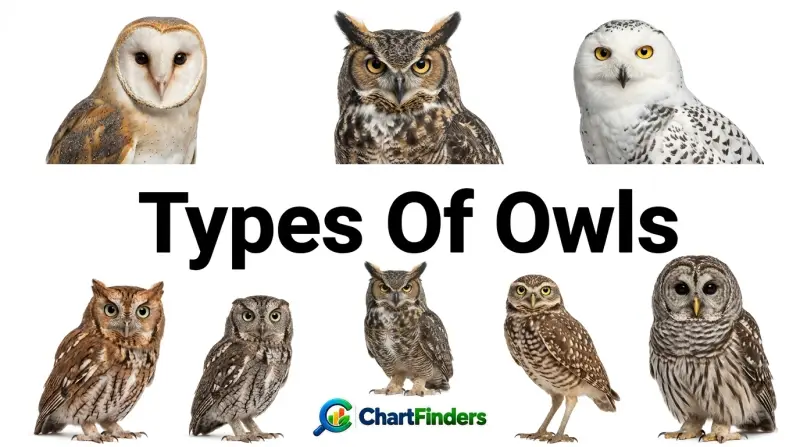
Types Of Owls
- North America hosts 19 resident and migratory owl species divided across two distinct families: Strigidae (typical owls) and Tytonidae (barn owls).
- Wood owls (genus Strix) lack ear tufts and rely heavily on acute auditory tracking to hunt small mammals in dense forest interiors.
- Forest owls (genus Aegolius) are small, elusive nocturnal residents of northern and montane coniferous ecosystems featuring asymmetrical ear structures.
- Screech owls (genus Megascops) feature prominent ear tufts, complex trilling vocalizations, and remarkable cryptic plumage with distinct color morphs.
- Specialized northern and open-country species, such as the Snowy Owl, Short-eared Owl, and Northern Hawk Owl, exhibit diurnal or crepuscular hunting behaviors adapted to extreme environments.
To understand the diversity of owls, it is essential to look at how ornithologists classify them. Taxonomy provides a map of evolutionary relationships, grouping species with shared anatomical and genetic traits. In North America, all 19 species fall into two major families. Below is a comparative overview summarizing key groupings, representative species, and primary diagnostic traits.
| Taxonomic Group / Genus | Representative Species | Distinctive Features | Primary Habitat |
|---|---|---|---|
| Tytonidae (Barn Owls) | Barn Owl (Tyto alba) | Heart-shaped facial disc, long legs, mottled golden-brown plumage, screeching call | Open country, agricultural lands, grasslands |
| Strix (Wood Owls) | Barred Owl, Spotted Owl, Great Gray Owl | Rounded heads, lack of ear tufts, dark eyes (except Great Gray’s yellow eyes), deep barring/mottling | Mature deciduous and coniferous forests |
| Aegolius (Forest Owls) | Boreal Owl, Northern Saw-whet Owl | Very small size, large rounded heads, asymmetrical ear openings for sound localization | Boreal and high-elevation mountain forests |
| Megascops (Screech Owls) | Eastern Screech-Owl, Western Screech-Owl | Small size, prominent ear tufts, yellow eyes, complex tonal trills and whinnies | Woodlands, suburban parks, riparian corridors |
| Bubo (Horned & Snowy Owls) | Great Horned Owl, Snowy Owl | Large size, powerful talons, prominent ear tufts (Great Horned) or pure white plumage (Snowy) | Diverse biomes from deep forests to arctic tundra |
| Asio (Eared Owls) | Long-eared Owl, Short-eared Owl | Slender builds, long wings, prominent vertical ear tufts, highly migratory | Open grasslands, shrub-steppe, dense thickets |
| Surnia / Athene / Micrathene | Northern Hawk Owl, Burrowing Owl, Elf Owl | Specialized diurnal habits (Hawk Owl), subterranean nesting (Burrowing), micro-sizing (Elf) | Open taiga, arid prairies, saguaro deserts |
Analyzing this taxonomic spread helps clarify why certain species share behavioral or morphological traits. The structural differences between a barn owl’s heart-shaped face and a great horned owl’s feather tufts reflect millions of years of evolutionary specialization tailored to specific prey bases and hunting microhabitats.
Family Tytonidae: The Barn Owls
The family Tytonidae represents a distinct evolutionary lineage separate from typical owls. The sole representative in North America is the Barn Owl (Tyto alba). Instantly recognizable by its stark white, heart-shaped facial disc and dark, obsidian eyes, this species possesses specialized auditory adaptations that allow it to locate rodents in absolute pitch darkness.
Unlike typical owls, Barn Owls do not hoot; instead, they produce a harsh, drawn-out hiss or screech. Their long legs and wings adapted for buoyant, silent flight make them premier predators of agricultural pests, hunting primarily over open fields, marshes, and farmlands. Their facial disc acts as a high-gain acoustic reflector, concentrating sound waves into ear openings positioned asymmetrically on the skull.
Family Strigidae: Typical Owls
The vast majority of North American species belong to the family Strigidae, known colloquially as typical owls. This family encompasses a wide array of sizes, from the tiny Elf Owl to the massive Great Gray Owl. Typical owls are characterized by rounded heads, forward-facing eyes fixed in their sockets, and varied plumages designed for exceptional camouflage.
Genus Strix: The Wood Owls
The genus Strix includes some of the most emblematic forest dwellers in North America. These medium-to-large owls lack ear tufts and feature heavily barred or spotted plumage patterns that blend into tree bark. Species in this group include:
- Barred Owl (Strix varia): Highly adaptable and expanding its range eastward and westward, recognized by its horizontal barring on the neck and chest and vertical streaks on the belly.
- Spotted Owl (Strix occidentalis): A sensitive old-growth forest specialist distinguished by spotted rather than barred underparts.
- Great Gray Owl (Strix nebulosa): The largest North American owl by length, featuring a massive facial disc, concentric grey rings, and piercing yellow eyes, capable of plunging through thick crusts of snow to capture subterranean voles.
Genus Aegolius: The Forest Owls
Comprising miniaturized, highly secretive forest residents, the genus Aegolius features the Northern Saw-whet Owl and the Boreal Owl. These birds have disproportionately large heads and specialized skull structures with asymmetrical ear openings. This asymmetry allows them to pinpoint the precise elevation and horizontal direction of a mouse moving beneath a thick blanket of leaves or snow.
Genus Megascops: The Screech Owls
Screech owls are small, agile predators inhabiting wooded habitats across the continent. Distinguished by flexible ear tufts that can be raised or lowered, these birds rely on disruptive coloration. Their grey and red morphs provide camouflage against tree bark. Despite their common name, their vocalizations rarely sound like screeches; instead, they produce descending whinnies and rhythmic bouncing-ball trills.
Genus Bubo: The Heavyweight Predators
The genus Bubo contains apex avian predators. The Great Horned Owl (Bubo virginianus) is the quintessential “hunted” of the night, featuring powerful gripping strength, prominent feather tufts, and a deep, resonant hoot. The Snowy Owl (Bubo scandiacus), sharing taxonomic lineage, is a visitor from the arctic tundra. Unlike most owls, Snowy Owls are frequently diurnal, hunting lemmings across open, windswept snowfields during daylight hours.
Genus Asio: The Open-Country Eared Owls
The Long-eared Owl and Short-eared Owl make up the genus Asio. Named for their closely set feather tufts that resemble mammalian ears, these birds possess slender bodies and long wings built for nomadic, migratory lifestyles. The Short-eared Owl is particularly notable for its erratic, moth-like flight pattern over open grasslands and marshes.
Additional Specialized Genera
Several North American owls occupy unique monotypic or small genera with distinct behavioral traits:
- Northern Hawk Owl (Surnia ulula): A diurnal, northern taiga resident with a long tail and pointed wings, resembling a falcon or hawk in flight.
- Burrowing Owl (Athene cunicularia): A small, long-legged open-country dweller that nests underground in burrows abandoned by prairie dogs or badgers.
- Elf Owl (Micrathene whitneyi): The smallest owl in North America, insectivorous, migrating to desert scrublands to nest in saguaro cactus cavities.
Anatomical and Sensory Adaptations
To fully appreciate the diversity of owl types, one must examine the specialized evolutionary tools that enable their survival. Owls possess sensory equipment finely tuned for nocturnal predation.
Vision is a primary adaptation. An owl’s eyes are not true spheres but elongated tubes held rigidly in bone sockets by sclerotic rings. Because they cannot rotate their eyes, owls have evolved neck vertebrae flexibility that allows them to rotate their heads up to 270 degrees in either direction. Their retinas are packed with light-sensitive rod cells, providing exceptional night vision, though they rely heavily on hearing to capture prey in complete darkness.
Hearing in many species is aided by facial discs that act like satellite dishes, funneling sound waves directly into ear openings situated at asymmetrical heights on the skull. This anatomical offset creates a micro-delay in sound reaching each ear, enabling the brain to construct a three-dimensional acoustic map of the environment.
, the leading edges of an owl’s primary flight feathers feature a specialized comb-like fringe that muffles air turbulence, rendering their flight virtually silent to unsuspecting prey. Downy barbs across the rest of the feather surface further absorb acoustic energy, eliminating the swishing sound generated by standard avian flight.
Habitat Distribution and Ecological Roles
The 19 species of North American owls occupy distinct ecological niches across diverse biomes. Competition is minimized through resource partitioning—differences in preferred prey size, hunting time, and habitat structure.
- Arctic and Tundra Biomes: Dominated by the Snowy Owl, which relies on cyclic populations of lemmings and ptarmigan.
- Boreal and Coniferous Forests: Home to specialized residents like the Boreal Owl, Great Gray Owl, and Northern Hawk Owl, which navigate deep winter snowpacks.
- Deciduous and Mixed Woodlands: Supported by Barred Owls, Great Horned Owls, and Eastern Screech-Owls, which utilize tree cavities and dense canopy cover.
- Arid Deserts and Scrublands: Inhabited by the Elf Owl—the world’s smallest owl, which nests inside saguaro cactus cavities—and the Burrowing Owl, which lives underground in abandoned mammal burrows.
As apex or secondary predators, owls play an indispensable regulatory role in managing small mammal populations, preventing rodent overpopulation that could otherwise destabilize agricultural and forest ecosystems.
Common Identification Mistakes
Distinguishing between similar owl species in the field can be challenging, even for experienced birders. Recognizing common pitfalls prevents misidentification.
A frequent error involves confusing the Barred Owl with the Spotted Owl where their ranges overlap in the Pacific Northwest. While both lack ear tufts and possess dark eyes, the Barred Owl features prominent vertical streaking on the lower belly and horizontal barring on the upper chest, whereas the Spotted Owl exhibits distinct white spots across its entire underparts.
Another common mistake is misidentifying the calls of nocturnal mammals or other birds as owls. For instance, the territorial call of a Barred Owl is often mistaken for human voices or the vocalizations of corvids. Similarly, the high-pitched trill of a Northern Saw-whet Owl can be confused with insect sounds or mechanical equipment.
Finally, observers often assume all owls are strictly nocturnal. Species such as the Short-eared Owl, Snowy Owl, and Northern Hawk Owl routinely hunt during daylight hours, leading birders to misidentify them as hawks or falcons if they rely solely on time of day rather than flight silhouette.
Frequently Asked Questions
How many species of owls live in North America?
There are 19 recognized owl species that regularly occur in North America, encompassing both permanent residents and regular migratory visitors across the continent.
Do all owls hoot?
No. While species like the Great Horned Owl and Barred Owl produce classic hoots, many other owls communicate through entirely different vocalizations. Screech owls make trills and whinnies, Barn Owls hiss and shriek, and Saw-whet owls emit repetitive, mechanical toots.
Are owls blind during daylight?
This is a widespread myth. Owls have excellent vision in daylight, though their eyes are optimized for low-light conditions. Their pupils can contract to control the amount of light entering the eye, allowing them to see clearly during the day.
Why do owls have ear tufts?
The prominent tufts on species like the Great Horned Owl and Long-eared Owl are not ears at all, but specialized feathers. Ornithologists believe these tufts serve as visual camouflage to break up the bird’s silhouette against tree bark and play a role in communication and territorial signaling.
What is the smallest owl in North America?
The Elf Owl (Micrathene whitneyi) is the smallest North American owl, measuring only about 5 to 6 inches in length—roughly the size of a sparrow. They inhabit desert regions of the Southwest and nest primarily in abandoned woodpecker holes within saguaro cacti.
Conclusion
The 19 species of owls inhabiting North America represent a masterclass in evolutionary adaptation. From the silent flight feathers of the Barred Owl to the acoustic precision of the Boreal Owl and the open-country resilience of the Snowy Owl, these birds occupy vital roles as top-tier predators. By understanding their distinct taxonomic groupings, anatomical specializations, and ecological requirements, observers gain a deeper appreciation for the complex biodiversity sustaining forest, desert, and grassland biomes across the continent.