
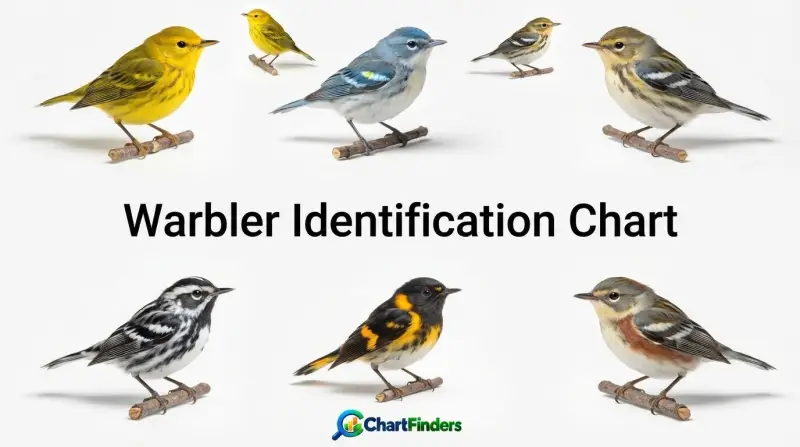
North American wood-warblers (Family Parulidae) represent one of the most exciting yet notoriously challenging groups of birds for field ornithologists and birders alike. With dozens of migratory species sharing similar body shapes, overlapping breeding ranges, and frequent seasonal plumage shifts, identifying them requires moving past simple color matching. Modern field techniques integrate micro-morphological field marks, behavioral nuances, foraging zones, and acoustical analysis. Whether you are sorting through spring canopy migrants or tracking late-autumn transients along coastal corridors, mastering warbler identification demands a systematic approach that utilizes visual charts, behavioral contexts, and vocalizations.
Warbler Identification Chart
- Rump coloration, such as the bright yellow rump of the Yellow-rumped Warbler, provides an instant diagnostic field mark on both breeding and wintering grounds.
- Tail patterns—including contrasting tail bases, white or yellow outer feathers, and dark terminal bands—are critical for separating tricky species like the American Redstart, Magnolia Warbler, and Palm Warbler.
- Underparts and undertail coverts (such as the distinct yellow undertail coverts of the Palm Warbler or the arrow spotting of the Black-and-white Warbler) offer definitive clues when birds are viewed from below.
- Wing bars and crown stripes separate superficially similar species, requiring careful observation of contrasting patterns rather than relying on overall body color.
- Acoustic identification through songs, chip notes, and nocturnal flight calls often confirms species identity long before a visual look is secured.
The complexity of wood-warbler morphology has driven the development of specialized visual matrices, often structured around anatomical “quick finders” that isolate specific body regions—such as the face, rump, and undertail coverts. By breaking down the bird into reliable visual zones, observers can narrow down candidates rapidly, even under difficult lighting conditions in dense deciduous or coniferous canopies.
Anatomical Focus Areas for Field Identification
When analyzing an unfamiliar warbler in the field, systematic scanning of specific plumage tracts prevents misidentifications caused by variable lighting or juvenile plumages. The most diagnostic anatomical zones include:
- Rump and Lower Back: A bright yellow rump patch instantly flags the Yellow-rumped Warbler (along with its western counterpart, the Audubon’s subspecies) and the Cape May Warbler (though the latter features a more restricted yellow collar).
- Tail Base and Vent: The contrast between dark tail tips and pale or bright bases is essential. For instance, the American Redstart displays flashing orange (male) or yellow (female) patches at the base of its dark tail.
- Undertail Coverts: Coloration beneath the tail separates species with otherwise similar upperparts. Palm Warblers feature bright yellow undertail coverts, whereas Canada Warblers show a crisp white vent contrasting with a gray breast band.
- Wing Bars and Edging: The presence, width, and number of wing bars—such as the prominent double wing bars of the Palm Warbler or the absence thereof in species like the Swainson’s Warbler—help separate genera and species pairs.
| Species | Key Rump & Tail Field Marks | Underparts & Undertail Coverts | Distinctive Head & Wing Patterns | Primary Foraging Microhabitat |
|---|---|---|---|---|
| Yellow-rumped Warbler | Bright yellow rump patch; dark tail with white spots on inner webs. | White to streaked underparts; white undertail coverts. | White throat (Myrtle) or yellow throat (Audubon’s); bold white wing patches. | Coniferous and mixed canopies; open air sallying. |
| Palm Warbler | Dark tail with white spots on outer corners; yellowish wash at base. | Yellow undertail coverts; pale yellow or whitish belly with soft streaking. | Rufous crown; yellow supercilium; distinct double wing bars. | Low shrubs, ground foraging, tail-pumping behavior. |
| American Redstart | Tail with orange (male) or yellow (female) base and black/dark gray tip. | White belly; pale breast with salmon-orange (male) or yellow (female) flank patches. | Black head and body (male) or gray head with olive back (female); flashing wing patches. | Active mid-story canopy; flycatching sallies. |
| Magnolia Warbler | White base of tail with a broad black terminal band. | Bright yellow underparts with heavy black streaking; white vent and undertail coverts. | Gray crown; white supercilium wrapping around black ear patch; white wing patch. | Lower to middle strata of dense coniferous growth. |
| Black-and-white Warbler | Striped black-and-white pattern throughout; no distinct rump patch. | White undertail coverts marked with distinct black “arrow” spotting. | Strong black-and-white head stripes; white median crown stripe. | Creeping vertically along tree trunks and major limbs. |
| Canada Warbler | Plain dark gray tail and rump without contrasting patches. | Bright yellow belly, white vent and undertail coverts; distinctive necklace of dark streaks. | Gray head with bold yellow “spectacles” running from bill to eye. | Dense understory, damp thickets, and lower shrubs. |
The comparative matrix above illustrates how morphological traits overlap across different genera while maintaining unique diagnostic combinations. Observers should never rely on a single field mark; instead, cross-referencing head patterns with undertail characteristics ensures robust identification.
Advanced Plumage Variation and Seasonal Shifts
Warbler identification is further complicated by dramatic plumage changes across seasonal cycles and age classes. Many species undergo complete or partial prebasic molts on their wintering grounds or breeding territories, resulting in significantly different appearances between spring (alternate) and autumn (basic) plumages.
Spring Alternate vs. Autumn Basic Plumages
In spring, breeding males exhibit their most vibrant, high-contrast coloration. Field marks such as chestnut capes on Bay-breasted Warblers, bold yellow throats on Blackburnian Warblers, and striking black masks on Yellowthroats are crisp and unmistakable. By late summer and autumn, however, many species transition into basic plumage.
- Fall Dullness: Species like the Blackpoll Warbler and Bay-breasted Warbler transition from distinctive breeding males into drab, greenish-yellow “fall baypolls/blackpolls” that challenge even seasoned observers. In these cases, leg color (yellowish legs in Blackpoll) and faint undertail coloration become primary separators.
- First-Year Immatures: Juvenile warblers often possess skull ossification cues, narrower rectrices with pointed tips, and un-worn plumage that differs from adult basic wear. Examining the freshness of wing feathers helps distinguish hatch-year birds from older adults.
- Sexual Dimorphism: Females are frequently duller, lacking the stark contrasts of males. For instance, female American Redstarts replace the striking black-and-orange male plumage with olive-gray and yellow tones, requiring reliance on tail-pattern geometry rather than body color.
Behavioral Cues and Foraging Microhabitats
When visual field marks are obscured by dense foliage or poor lighting, behavioral observations provide reliable secondary confirmation. Different warbler species have evolved specialized foraging niches within the forest strata, reducing interspecific competition and offering predictable behavioral keys.
Stratification and Movement Styles
- Trunk Creepers: The Black-and-white Warbler and Prothonotary Warbler (where present) move systematically up and down tree trunks and large limbs like miniature nuthatches, keeping their bodies parallel to the bark.
- Flycatchers and Salliers: The American Redstart and Northern Parula frequently sally out from branches to snap insects mid-air, often dropping back to a perch with cocked tails that flash their contrasting tail patterns.
- Tail Pumpers: The Palm Warbler and Prairie Warbler exhibit a characteristic, continuous tail-pumping or tail-wagging motion while foraging on or near the ground, a behavioral tic that separates them from similarly sized ground-hoppers.
- Tip-of-the-Branch Gleaners: Species like the Cape May Warbler and Blackburnian Warbler focus heavily on the outermost tips of coniferous needles and deciduous leaves high in the upper canopy.
Acoustical Identification: Songs, Chip Notes, and Flight Calls
Because warblers spend much of their time concealed in thick foliage, mastering their vocalizations is essential. Acoustical identification falls into three distinct categories: breeding songs, daily chip notes, and nocturnal flight calls (NFCs).
Deciphering Songs and Chip Notes
Breeding songs are typically delivered with species-specific cadence, pitch, and buzz qualities. Field guides often categorize songs into mnemonics:
- Accending/Descending Trills: Species like the Yellow-rumped Warbler deliver a clean, trilled song that accelerates or flattens at the end, while the Pine Warbler produces a musical trill reminiscent of a Chipping Sparrow.
- Ending Upticks: The Chestnut-sided Warbler’s song is famously translated as “Pleased, pleased, pleased to meet ya,” with an upward inflection on the final note.
- Chip Notes: Daily contact chips are often sharper and more diagnostic than complex songs. A high, thin metallic tik separates certain waterthrushes and small wood-warblers from local sparrows and kinglets.
- Nocturnal Flight Calls (NFCs): During migration, warblers utter brief, high-frequency flight calls overhead at night. Analyzing these calls via sound visualization software has revolutionized migration monitoring, revealing hidden movements of nocturnal transients.
Common Identification Pitfalls and Look-Alike Species
Even experienced birders encounter identification traps when dealing with cryptic warbler complexes. Recognizing these common pitfalls prevents frequent misdeterminations in the field.
- Over-reliance on Color Alone: Lighting conditions in shaded understories can distort green and yellow tones, making dull Yellow Warblers look like immature fall Empidonax flycatchers or vireos. Always check bill shape (warblers have fine, pointed, insectivorous bills) and structural field marks.
- Confusing Fall Warblers with Vireos: Vireos tend to be chunkier, move more deliberately, possess heavier hooked bills, and lack the fine streaking typical of many warbler species.
- Overlooking Hybridization: Certain warbler pairs—such as Golden-winged and Blue-winged Warblers—hybridize regularly, producing offspring like “Brewster’s” and “Lawrence’s” warblers that display intermediate plumage combinations not found in standard identification charts.
Frequently Asked Questions
How can I tell the difference between a female American Redstart and a female Magnolia Warbler in autumn?
While both species feature yellow patches on dark tails, their distribution differs significantly. Female Magnolia Warblers show a white base of the tail with a broad black terminal band and heavily streaked yellow underparts. Female American Redstarts display yellow patches at the base of a dark tail, lack heavy ventral streaking, and possess distinct yellow flank patches with a clean white belly.
What is the easiest way to identify a Yellow-rumped Warbler year-round?
The bright yellow rump patch is diagnostic across all plumages, ages, and subspecies. In addition, listen for their sharp, distinctive check-note and look for white patches on the sides of the breast in breeding plumage or duller brownish-gray tones with a yellowish hint on the flanks in winter.
Why do Palm Warblers constantly pump their tails?
Tail-pumping is a characteristic behavioral tic of the Palm Warbler across all seasons and habitats. While the exact evolutionary driver is debated, it serves as an immediate behavioral field mark that separates the Palm Warbler from other ground-foraging or shrub-dwelling warblers.
Are nocturnal flight calls reliable for identifying migrating warblers?
Yes, though challenging. Nocturnal flight calls are species-specific acoustic signatures uttered by migrants overhead. Specialized acoustical monitoring and sonogram libraries allow researchers and advanced recordists to identify species flying past in total darkness, though visual confirmation is impossible without specialized thermal or directional gear.
How do warbler bills differ from those of vireos and kinglets?
Warbler bills are fine, pointed, and slender, adapted for gleaning small insects from foliage. Vireo bills are noticeably heavier, deeper, and feature a distinct downward hook at the tip. Kinglets are much smaller, shorter-tailed, and possess extremely slender, needle-like bills paired with distinct behavioral hovering habits.
Mastering wood-warbler identification is an ongoing pursuit that bridges careful structural observation, behavioral context, and acoustic attunement. By utilizing targeted identification charts, cross-referencing plumage tracts like rumps and undertail coverts, and paying close attention to foraging microhabitats, observers can reliably decode even the most challenging migratory flocks.