
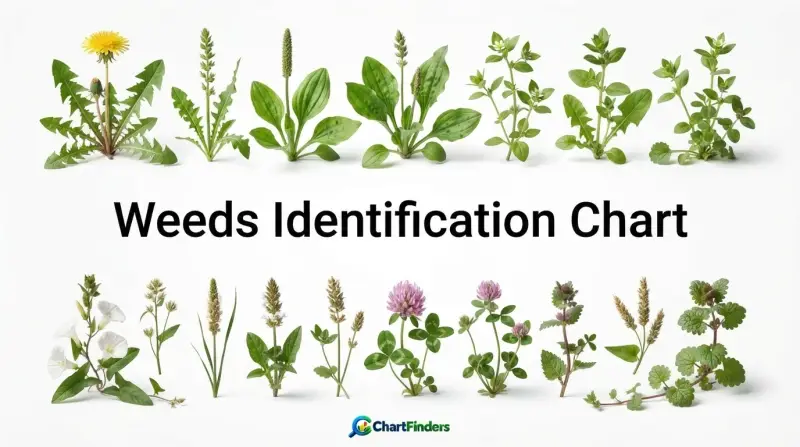
Accurately identifying unwanted vegetation is the foundational step of any successful weed management program, whether managing a pristine home lawn, an intensive commercial turf facility, or a multi-thousand-acre agricultural enterprise. Without correct identification, control efforts frequently fail, wasting financial resources, damaging desirable plants, and accelerating herbicide resistance.
Weed populations are remarkably diverse, adapting rapidly to microclimates, soil conditions, and management practices. Utilizing a structured weeds identification chart allows land managers, agronomists, and homeowners to bypass guesswork, turning complex botanical variations into clear, actionable classifications. This guide explores the core taxonomy, physiological structures, and practical application methods needed to diagnose and manage weed infestations effectively.
Weeds Identification Chart
- Weed identification relies heavily on vegetative traits: leaf arrangement (alternate, opposite, whorled), venation (netted or parallel), and cotyledon shape.
- Broadleaves (dicots) possess two seed leaves and netted leaf veins, whereas grasses (monocots) have a single seed leaf, parallel veins, and hollow or round stems.
- Sedges are easily distinguished from grasses and broadleaves by their characteristically triangular stems and three-ranked leaf arrangements.
- Life cycles dictate control timing; summer annuals, winter annuals, biennials, and perennials each require distinct management windows.
- Combining visual identification charts with mode-of-action data prevents control failures and mitigates herbicide resistance development.
To use an identification chart successfully, one must understand how botanical keys are structured. Most professional reference guides utilize dichotomous branching or matrix grids that narrow down candidate species based on observable physical characteristics. The following comprehensive classification table outlines the major plant groups, their diagnostic markers, and representative species commonly encountered in field and turf environments.
| Weed Category | Primary Identification Traits | Stem & Root Characteristics | Life Cycle Variations | Common Representative Species |
|---|---|---|---|---|
| Broadleaves (Dicots) | Two cotyledons upon germination; netted leaf veins; often feature showy flowers and broad leaf blades. | Taproot or fibrous root systems; stems can be square, round, woody, or herbaceous. | Summer annual, winter annual, biennial, or perennial. | Dandelion, Ground Ivy, Common Ragweed, White Clover. |
| Grasses (Monocots) | One seed leaf; parallel leaf veins; narrow, strap-shaped leaves with ligules and auricles at the collar region. | Round or flattened stems (often hollow between nodes); fibrous or stoloniferous/rhizomatous root systems. | Summer annual, winter annual, or perennial. | Large Crabgrass, Annual Bluegrass, Quackgrass, Bermudagrass. |
| Sedges | Narrow, grass-like leaves, but strictly distinct botanical structure; leaves emerge in three ranks. | Solid triangular stems (no nodes); extensive underground tubers (nutlets), rhizomes, or fibrous roots. | Mostly perennial (some annual); thrive in damp or poorly drained soils. | Yellow Nutsedge, Purple Nutsedge, Kyllinga species. |
Understanding these fundamental divisions prevents a manager from applying the wrong class of herbicide—such as using a non-systemic grass herbicide on a perennial broadleaf, which would leave the weed’s extensive root system unharmed.
Anatomical Markers Used in Identification Charts
When consulting a visual identification chart, you must examine specific anatomical parts of the plant. Seedling characteristics offer the earliest window for intervention, before deep root systems or mature reproductive structures develop.
- Cotyledons (Seed Leaves): The first leaves to appear from a germinating seed. Broadleaf cotyledons vary from round to lanceolate, while grass seedlings emerge with a single, slender, blade-like cotyledon.
- True Leaves: Leaves that develop after the cotyledons. Their arrangement on the stem—whether alternate (one per node), opposite (two per node), or whorled (three or more per node)—is a primary diagnostic sorting tool.
- Leaf Venation: Netted (reticulate) veins indicate a broadleaf plant, whereas parallel veins running from the base to the tip of the leaf blade point to grasses or sedges.
- Collar Region (Grasses): The area where the leaf blade meets the sheath. Inspecting the ligule (a membranous or hairy appendage inside the collar) and auricles (clasping lobes at the base of the blade) is essential for identifying grass weeds.
Categorization by Life Cycle
A complete identification chart also accounts for a weed’s lifespan. Control strategies that work exceptionally well on annuals will often fail entirely against established perennials.
Summer Annuals germinate in the spring, grow actively through the summer months, produce seed, and die before or during the first hard frost. Examples include crabgrass, pigweed, and common ragweed. Management is most effective in early spring before germination occurs (using pre-emergent herbicides) or when seedlings are very young.
Winter Annuals germinate in late summer or autumn, overwinter as low-growing rosettes, flower and set seed in the spring, and then die as temperatures rise. Common examples include annual bluegrass, chickweed, and henbit. Fall is the optimal window for targeted control.
Biennials require two full growing seasons to complete their life cycle. The first year is spent producing a vegetative rosette near the ground; the second year involves bolting, flowering, seed production, and plant death. Bull thistle and wild carrot are classic examples. Control must happen during the rosette stage of year one or early bolting of year two.
Perennials live for multiple years, reproducing via seeds as well as vegetative structures such as rhizomes, stolons, tubers, and bulbs. Even if the topgrowth is destroyed, these plants regenerate from underground energy reserves. Examples include dandelion, Canada thistle, and yellow nutsedge. Systemic herbicides or persistent mechanical removal are required.
Comparative Analysis of Weed Categories
To further refine diagnostic accuracy, evaluating the structural and physiological differences across weed types highlights why blanket management strategies fail. The matrix below contrasts key agronomic traits, reproductive habits, and standard chemical sensitivities across the three primary divisions.
| Feature / Trait | Broadleaves (Dicots) | Grasses (Monocots) | Sedges (Cyperaceae) |
|---|---|---|---|
| Seed Leaves (Cotyledons) | Two | One | One (resembles grass seedling) |
| Leaf Vein Pattern | Netted / Reticulate | Parallel | Parallel |
| Stem Shape | Round, square, or woody | Round or flattened, hollow between nodes | Solid, triangular (3-sided) |
| Growing Point Location | Multiple axillary buds and terminal shoots | Meristem protected at or below soil surface | Base of plant and underground tubers/rhizomes |
| Typical Herbicide Class | Synthetic auxins (e.g., 2,4-D, dicamba) | ACCase inhibitors or ALS inhibitors specific to grasses | ALS inhibitors specific to sedges (e.g., halosulfuron) |
Diagnostic Procedures: How to Read and Apply a Weed Chart
Navigating an identification chart efficiently requires a step-by-step investigative process. Rushing to a conclusion based on a single glance often leads to misidentification and ineffective control applications.
- Examine the Habitat and Soil Conditions: Note whether the weed is thriving in compacted turf, shaded garden beds, cultivated agricultural rows, or saturated, poorly drained soils. Certain weeds act as biological indicators of specific soil deficiencies or management flaws.
- Inspect Overall Growth Habit: Is the plant upright, sprawling, mat-forming, or climbing? Does it form a tight basal rosette?
- Check for Specialized Structures: Look for thorns, spines, milky sap, square stems, or underground nutlets. Crushing certain leaves may also reveal distinct odors that confirm identity (such as wild garlic or onion).
- Cross-Reference with Regional Guides: Regional extension services (such as university agricultural extension publications from Maryland, Nebraska, Arkansas, and surrounding agricultural hubs) publish localized weed lists updated annually to reflect regional weed shifts and herbicide resistance patterns.
- Match Botanical Descriptions: Trace the physical observations through the chart’s branching logic until a single species or tight genus is identified.
Common Challenges and Misidentification Risks
Even experienced field scouts occasionally encounter diagnostic pitfalls. Recognizing these common errors prevents costly management mistakes.
Juvenile vs. Mature Morphology: Many weeds look drastically different as seedlings compared to their mature, flowering forms. For instance, a broadleaf seedling with tiny, rounded cotyledons may develop deeply lobed, jagged leaves as it matures. Charts that only picture mature specimens can render seedling identification difficult.
Look-Alike Species: Several noxious weeds closely mimic benign turfgrasses or native wildflowers during their early vegetative stages. For example, young nimblewill or orchardgrass can easily be mistaken for desirable turf species until their seedheads or ligule structures are closely inspected under magnification.
Environmental Plasticity: Plants often alter their growth form in response to environmental stress, mowing height, or soil fertility. A weed that typically grows upright might adopt a prostrate, low-slung growth habit when subjected to frequent close mowing in a managed turf setting.
Frequently Asked Questions
What is the difference between a grassy weed and a grass-like weed (sedge)?
True grasses belong to the Poaceae family and feature round or flattened hollow stems with alternate leaves in two ranks. Sedges belong to the Cyperaceae family and are characterized by solid, triangular stems with leaves emerging in three distinct ranks. Sedges also frequently thrive in saturated or poorly drained soils where true grasses struggle.
Why is knowing the weed life cycle just as important as knowing its visual appearance?
Life cycles determine when a weed is most vulnerable to control measures. Pre-emergent herbicides must be applied before annual weed seeds germinate, whereas perennial weeds require systemic post-emergent herbicides capable of traveling down into underground root structures, rhizomes, or tubers to prevent regeneration.
Can soil type influence which weeds appear on an identification chart?
Yes. Soil pH, compaction, drainage, and organic matter content directly dictate weed pressures. For example, weeds like prostrate knotweed and goosegrass thrive in severely compacted, high-traffic soils, while mosses and certain sedges indicate waterlogged, acidic conditions. Correcting the underlying soil environment often reduces weed pressure naturally.
How do cotyledons help in early weed identification?
Cotyledons are the embryonic leaves inside a seed. Because they appear immediately upon germination long before true leaves develop, agronomists use their shape, size, and attachment style to identify weed species at the earliest possible growth stage, allowing for timely, cost-effective intervention.
Where can I find reliable, regionally updated weed identification charts?
University extension services and land-grant agricultural departments regularly publish updated weed management guides, digital photo galleries, and printable field charts. These resources are tailored to specific geographical regions, accounting for local climate zones, cropping systems, and regional herbicide resistance profiles.
Conclusion
Mastering weed identification requires patience, keen observation, and the right reference tools. A well-constructed weeds identification chart bridges the gap between raw botanical complexity and practical, real-world management. By systematically analyzing vegetative structures, life cycles, and environmental indicators, land managers can move away from generalized guessing and implement precise, effective, and sustainable control strategies.