
Quick Answer: Accurate wasp nest identification relies on examining nest material, structural architecture, and geographic location. Common aerial nests are typically made of papery wood pulp (built by paper wasps, hornets, or yellowjackets), while subterranean or wall-void nests are hidden underground or within cavities. Early spring is the optimal window for detection and professional removal before colonies expand.
Encountering a newly formed wasp nest near an entryway, patio, or roofline instantly shifts a peaceful outdoor space into a zone of heightened caution. Because stinging insect colonies present genuine safety hazards—particularly for individuals with venom sensitivities—understanding the physical composition and architecture of these structures is essential. Yet, casual observation often leads to dangerous misidentifications. Confusing a docile colony of native paper wasps with an aggressive underground yellowjacket network can result in painful stings or ineffective pest management outcomes. This comprehensive guide provides a rigorous field entomological framework for distinguishing between various vespid structures, mapping out behavioral traits, and safely managing insect populations around residential and commercial properties.
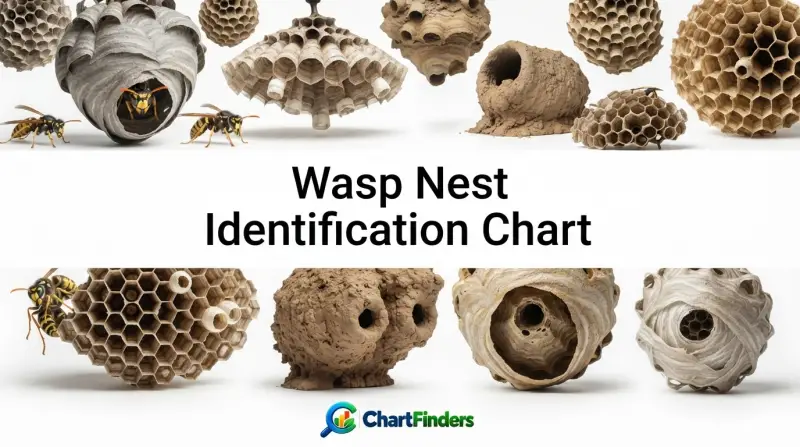
Wasp Nest Identification Chart
- Wasp nest architecture varies distinctly by species, ranging from open-comb paper structures to enclosed, multi-tiered spherical envelopes.
- Nest location serves as a primary diagnostic indicator: aerial nests hang from eaves or branches, while yellowjackets prefer subterranean voids and bald-faced hornets favor high tree branches.
- Early spring represents the critical biological window when founding queens build small, golf-ball-sized primary nests before worker populations explode.
- Construction materials consist of chewed cellulose mixed with insect saliva, resulting in varied textures from brittle, grey cardboard to durable, weathered papier-mâché.
- Professional pest control intervention is strongly advised for large, mature nests, subterranean colonies, or nests located within enclosed structural wall voids.
Field identification requires systematic evaluation of physical and structural attributes. To assist property owners and pest management professionals, the following data synthesis outlines the structural characteristics, construction materials, primary locations, and behavioral defense thresholds of the primary stinging insect species encountered in North America.
| Species | Nest Shape & Structure | Building Material | Primary Location | Colony Size (Peak) | Aggression Level |
|---|---|---|---|---|---|
| Paper Wasps (Polistes spp.) | Open, umbrella-shaped comb with exposed hexagonal cells; no protective outer envelope. | Chewed wood pulp and saliva; brittle, grey-to-brown paper texture. | Sheltered aerial spots: porch ceilings, tree branches, window frames, deck overhangs. | 20 to 250 individuals | Moderate (defensive when nest is directly disturbed) |
| Yellowjackets (Vespula spp.) | Enclosed, multi-tiered paper combs wrapped in a layered outer paper envelope; spherical or pear-shaped. | Fine, rotted wood mixed with soil and saliva; papery to fragile texture. | Subterranean (abandoned rodent burrows), hollow logs, wall voids, attics. | 1,000 to 5,000+ individuals | High (highly defensive, swarm readily when disturbed) |
| Bald-Faced Hornets (Dolichovespula maculata) | Large, tear-shaped or oval enclosed paper structure with a single bottom entrance hole. | Coarse grey wood fibers chewed into thick, durable, weather-resistant paper. | High aerial locations: tree branches, utility poles, tall building eaves. | 400 to 700 individuals | Very High (aggressive defenders of nest perimeter) |
| European Hornets (Vespa crabro) | Large, fragile, irregular envelope covering multi-tiered combs; often built inside cavities. | Coarse, dark brown or reddish wood pulp; very brittle. | Tree hollows, wall voids, abandoned barns, occasionally high branches. | 200 to 400 individuals | Moderate-High (nocturnal foragers, attracted to porch lights) |
| Mud Daubers (Sceliphron spp.) | Clusters of smooth or fluted tubular mud cylinders; no paper involved. | Wet mud or clay collected from soil and shaped with mandibles. | Protected vertical surfaces: brick walls, under eaves, garage interiors. | Solitary (1 female per mud cell) | Low (rarely sting unless trapped against skin) |
Interpreting this matrix requires looking closely at both the physical shell and the surrounding environment. While a mud dauber nest is easily identified by its hard, clay-like pipe organ structure, differentiating between aerial yellowjacket nests and bald-faced hornet structures requires checking the entrance hole position and the height of the hanging site.
Biological Foundations of Wasp Nest Construction
To understand why nests appear the way they do, one must examine the life cycle and biological drives of social wasps. Unlike honeybees, which store honey and overwinter as an established colony, the vast majority of social wasps experience an annual lifecycle.
The Overwintering Queen and Spring Emergence
In temperate climates, fertilized young queens spend the winter months in diapause—hidden beneath loose bark, inside rotting logs, or tucked away in structural wall voids. When spring temperatures consistently rise, these queens emerge to seek suitable nesting sites. The spring period is biologically pivotal: the queen acts as a solitary worker, foraging for building materials, constructing a primary nest, laying eggs, and feeding the first brood of sterile female workers entirely on her own.
During this phase, the nest is exceptionally small—often no larger than a walnut or golf ball—and typically contains fewer than a dozen cells. Because the queen is focused entirely on brood rearing and is isolated from defensive worker forces, early spring removal is both safest and most effective.
Cell Architecture and Material Chemistry
All social vespid nests are engineered from cellulose. Wasps actively scrape weathered wood fibers from fences, dead trees, and unpainted lumber using their powerful mandibles. They mix these wood scrapings with salivary secretions containing enzymatic proteins that break down the lignin. When applied to the building site, this masticated pulp dries into a lightweight, resilient paper matrix.
The hexagonal cell architecture is an evolutionary marvel, providing maximum structural integrity and storage capacity while minimizing the expenditure of raw building materials. In paper wasp nests, these combs remain entirely open to the elements, suspended downward. In contrast, hornets and yellowjackets construct successive interior tiers before encasing the entire comb assembly within multi-layered protective outer envelopes that insulate the brood and regulate internal humidity.
Detailed Identification Guide by Species
Different stinging insect species exhibit distinct architectural signatures, geographic preferences, and colony behaviors. Proper identification prevents mismatched pest control strategies.
1. Paper Wasps (Genus Polistes)
Paper wasps are among the most frequently encountered stinging insects around human habitations. Their nests are instantly recognizable by their single, exposed comb structure:
- Visual Cues: Resembles an inverted umbrella or a small honeycomb hanging downward from a single central petiole (stalk). Individual hexagonal cells are fully open and visible from below, often containing developing white larvae or pupae capped with silk.
- Color and Texture: Grey, tan, or brownish paper with a papery, brittle consistency resembling a dried papier-mâché project.
- Common Locations: Horizontal or angled overhangs, porch ceilings, branching twigs of shrubs, outdoor light fixtures, and behind shutters.
- Behavioral Notes: Paper wasps are generally docile unless their immediate nest zone is threatened. Their colonies remain relatively small, rarely exceeding a few hundred individuals at seasonal peak.
2. Yellowjackets (Genus Vespula)
Yellowjackets are notoriously defensive social wasps capable of delivering multiple painful stings. Their nesting habits make them particularly hazardous during late summer:
- Visual Cues: Enclosed, spherical or pear-shaped structures with layered outer paper envelopes. Unlike paper wasps, the combs are entirely hidden inside the shell, with only a small circular entrance hole typically located at the bottom or side.
- Color and Texture: Variable grey, tan, or mottled paper made from rotted wood pulp and soil.
- Common Locations: Subterranean locations are most common (utilizing abandoned chipmunk or mouse burrows). However, yellowjackets frequently build secondary nests inside structural wall voids, attic spaces, and crawlspaces.
- Behavioral Notes: Subterranean nests are easily triggered by lawnmowers, foot traffic, or vibrations. Colony populations swell dramatically by late summer, resulting in aggressive foraging behavior around human food and trash.
3. Bald-Faced Hornets (Dolichovespula maculata)
Despite their common name, bald-faced hornets are technically a large species of aerial yellowjacket. They construct some of the most impressive and conspicuous nests in the insect world:
- Visual Cues: Massive, pear-shaped or oval enclosures that can grow to the size of a basketball or larger. The outer wall consists of multiple overlapping paper layers, and a single small entrance hole sits near the lower third of the structure.
- Color and Texture: Thick, durable grey paper composed of large wood fibers that withstand heavy wind and rain.
- Common Locations: Suspended high in deciduous trees, utility poles, high rooflines, and dense thickets.
- Behavioral Notes: Bald-Faced Hornets are fiercely protective of their aerial domain. They will aggressively pursue anyone who approaches within several feet of the nest structure.
4. European Hornets (Vespa crabro)
As the only true hornet species established in North America, Vespa crabro is notably larger than native yellowjackets:
- Visual Cues: Large, fragile, irregular paper envelopes covering multi-tiered combs. Because they frequently nest inside pre-existing cavities, the outer envelope is often incomplete, molded to fit the contours of the void.
- Color and Texture: Distinctive coarse, dark brown or reddish-orange wood pulp.
- Common Locations: Hollow tree trunks, structural wall voids, barns, attics, and abandoned chimneys.
- Behavioral Notes: European hornets are unique for their nocturnal activity. Workers actively forage after dark and are frequently attracted to exterior porch lights and illuminated windows.
5. Mud Daubers (Order Hymenoptera, Family Sphecidae)
While frequently grouped under general pest concerns, mud daubers are solitary wasps that do not live in traditional social colonies:
- Visual Cues: Clusters of smooth, tubular mud cylinders resembling tiny organ pipes. Once eggs and paralyzed spiders are sealed inside, the female smooths the exterior mud surface.
- Color and Texture: Hardened grey, brown, or red clay-like mud.
- Common Locations: Protected vertical surfaces, garage walls, under eaves, bridge undersides, and brickwork.
- Behavioral Notes: Mud daubers are exceptionally docile. They lack a social colony to defend and rarely sting humans unless physically squeezed against the skin.
Seasonal Progression and Colony Dynamics
Understanding how wasp colonies evolve across the calendar year provides essential context for timing inspections and intervention strategies. The lifecycle of social vespids follows a predictable seasonal arc.
During early spring (March to May), lone queens emerge from overwintering sites. This is the foundation phase where primary nests are built and initial broods are reared. Populations are microscopic, and defensive aggression is virtually non-existent.
As summer arrives (June to July), the first generation of worker wasps emerges and assumes all foraging and nest-expansion duties. The queen remains inside the nest, exclusively laying eggs. Nest volume expands rapidly to accommodate hundreds of new larvae.
By late summer to early autumn (August to October), colonies reach their peak biological capacity. Worker populations number in the thousands. Natural prey (such as caterpillars and garden insects) begins to dwindle, while the colony’s nutritional needs shift toward carbohydrates. This physiological shift drives yellowjackets and hornets into aggressive scavenging behavior around picnic sites, trash receptacles, and outdoor dining areas. At this stage, defensive thresholds are extremely low.
With the onset of late autumn (November onward), declining temperatures trigger the production of new reproductive males and fertile queens. These future queens mate and depart the nest to find overwintering shelter, while the original colony—including the founding queen and all workers—dies off with the first hard frost. Old paper nests disintegrate over winter and are rarely reoccupied the following year.
Practical Nest Removal and Safety Framework
Determining whether a wasp nest can be managed independently or requires professional intervention depends on several critical risk factors. Attempting to remove a large yellowjacket or bald-faced hornet nest without proper protective gear or chemical formulations is dangerous.
DIY vs. Professional Removal Guidelines
- DIY Candidate: Small, newly established paper wasp nests (golf-ball size or smaller) located in accessible open areas during early spring or cool evening hours when insects are completely dormant.
- Professional Intervention Required: Large subterranean yellowjacket nests, massive aerial hornet nests located high in trees or near second-story rooflines, nests hidden inside structural wall voids, and any situation where building occupants possess known allergies to insect venom.
Step-by-Step Safe Mitigation Protocol
If proceeding with the removal of a small, accessible paper wasp nest, follow this structured safety sequence:
- Timing: Perform the procedure at night or during pre-dawn hours. Cooler nocturnal temperatures render wasps sluggish and ensure the maximum number of foragers are inside the nest structure.
- Personal Protective Equipment (PPE): Wear heavy-duty clothing, including thick denim, leather gloves, closed-toe boots, and a professional bee veil or hood to protect the face and neck. Avoid wearing loose clothing or sweet fragrances.
- Application: Utilize a commercial, EPA-registered wasp and hornet aerosol spray featuring a long-range jet stream. Stand 10 to 15 feet away from the nest as directed by the product label.
- Soaking: Thoroughly saturate the nest entrance and exterior paper envelope, allowing the active ingredients to penetrate the interior cells. Wait a minimum of 24 hours to confirm all adult activity has ceased before attempting physical removal.
- Disposal: Wear gloves, knock the detached nest down into a heavy-duty trash bag, seal it securely, and dispose of it in an outdoor receptacle.
Common Identification Mistakes and Edge Cases
Homeowners frequently misinterpret environmental clues, leading to misguided treatments or overlooked hazards. Recognizing common edge cases prevents ineffective pest control.
Confusing Paper Wasps with Honeybees
A frequent error involves mistaking clustering honeybees for a wasp nest. Honeybees are stout, fuzzy, amber-and-brown insects that store honey in vertical wax combs. They are generally peaceful unless provoked. Wasps possess smooth, bright yellow-and-black or dark brown bodies with narrow waists, construct papery wood-pulp nests, and exhibit defensive behavior. If a swarm of honeybees clusters temporarily on a tree branch, contact a local beekeeper for safe live removal rather than applying chemical sprays.
Differentiating Active vs. Inactive Nests
An old, grey, papery nest found hanging from a rafter in mid-winter is frequently dead and abandoned. Because social wasps do not reuse old nests the following year, an empty nest poses no stinging threat. To determine status, observe the structure from a safe distance for 20 to 30 minutes during warm midday hours. If no insect traffic enters or exits the opening, the nest is inactive and can be safely scraped away.
Structural Wall Voids
When wasps are observed constantly flying in and out of a small gap in brickwork or siding without an external nest visible, the colony has established itself inside a wall void. Never seal the exterior entry hole while active foraging is occurring. Trapped inside, desperate workers will chew through drywall, electrical outlet plates, and interior insulation to enter living spaces.
Frequently Asked Questions
Do wasps reuse their old nests the following year?
No. Social wasp colonies die out completely each winter, leaving only newly mated queens to survive the cold in sheltered diapause. These queens start completely fresh in spring, constructing new nests from scratch. While an old paper nest might occasionally serve as a physical windbreak for a new foundation, it is never reoccupied by a surviving colony.
What is the best time of day to treat or remove a wasp nest?
The optimal time for removal is after sunset or before sunrise. During nocturnal hours, cooler temperatures reduce metabolic activity, and virtually all foraging workers have returned to the interior of the nest, ensuring maximum contact with treatment methods.
How can I discourage wasps from building nests on my property?
Preventative exclusion involves sealing exterior cracks, caulking gaps around window frames, keeping outdoor trash cans tightly covered, and painting or staining exposed wooden structures. Wasps prefer raw, weathered wood for pulp harvesting; treated lumber significantly deters architectural attempts.
Are ground-nesting yellowjackets the same as ground bees?
No. Yellowjackets are aggressive social wasps that build multi-tiered paper nests underground (often in abandoned rodent tunnels). Ground bees are solitary, beneficial native pollinators that dig individual tunnels in bare soil without building paper structures or exhibiting aggressive defense mechanisms.
What should I do if I accidentally disturb a subterranean yellowjacket nest?
Run immediately away from the disturbance zone in a straight line. Yellowjackets release alarm pheromones that incite surrounding colony members to sting repeatedly. Cover your face with your hands and seek shelter inside a building or enclosed vehicle. Do not jump into water, as wasps will hover above the surface waiting for you to resurface.
Conclusion
Proper wasp nest identification bridges the gap between effective pest management and unnecessary danger. By systematically evaluating structural materials, nest placement, and seasonal colony behaviors, property owners can accurately distinguish between docile native pollinators, solitary mud daubers, and highly defensive social vespids like yellowjackets and bald-faced hornets. Recognizing that early spring provides the safest window for intervention—and understanding when to call licensed professional pest control for large subterranean or structural infestations—ensures that homes and outdoor living spaces remain safe and protected throughout the active stinging insect season.