
The history of cutlery manufacturing in the American West and broader Western hemisphere represents a rich heritage of rugged utility, master craftsmanship, and industrial evolution. For collectors and outdoor enthusiasts, encountering vintage or antique Western-branded knives often leads to a complex puzzle: determining the exact era of manufacture, assessing the grade of steel, evaluating historical handle configurations, and separating authentic pieces from modern reproductions or misattributed relics. Because iconic makers like the Western Cutlery Company underwent numerous relocations, ownership changes, and stamping modifications over nearly a century of production, a generalized visual guess is rarely enough to establish provenance, authenticity, or value.
This master guide provides a comprehensive framework for mastering Western knife identification. By dissecting the nuances of tang stamps, blade geometry, handle material transitions, metallurgy, and pattern taxonomy, you will gain the field-tested knowledge required to accurately date, evaluate, and care for historic Western knives. Whether you are cataloging a pristine WWII-era fixed blade, appraising a vintage stockman pocketknife, or curating a growing collection, this resource serves as your definitive manual.
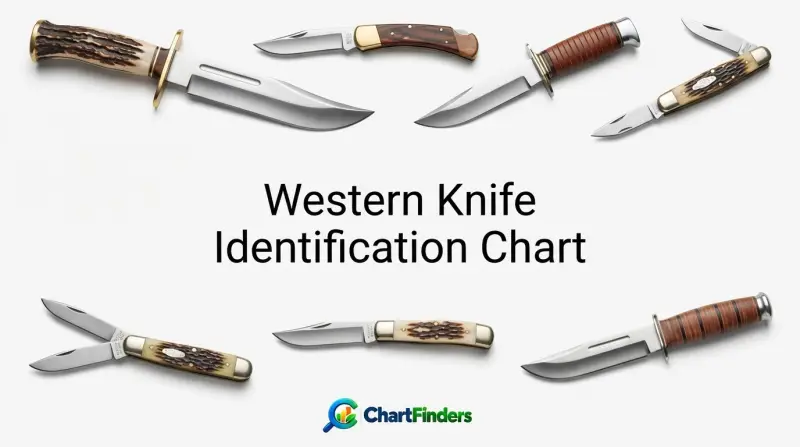
Western Knife Identification Chart
- Tang Stamps Are King: The primary diagnostic tool for dating a Western knife is its tang stamp font, placement, and accompanying letter/number codes.
- Geographic Evolution: Production shifted significantly from Boulder, Colorado (and earlier locations in Texas) to subsequent manufacturing plants under later corporate umbrellas like Coleman and Camillus.
- Steel Transitions Matter: Older Western knives relied on high-carbon tool steels that patina over time, whereas later models transitioned toward modern stainless alloys and advanced stock removal techniques.
- Handle Materials Indicate Era: Natural materials like genuine bone, stag, and leather washers dominate pre-1970s builds, while molded plastics and synthetic Delrin became standard in later decades.
- Pattern Numbers Dictate Style: Western used systematic model numbering systems (such as the L66, 74, or 532 series) that reveal blade configurations and intended uses at a glance.
To successfully navigate the complexities of Western knife identification, you must evaluate the object across multiple distinct dimensions. No single feature tells the complete story; instead, authentic identification requires cross-referencing physical markers against historical production records.
Below is a foundational data matrix outlining the primary diagnostic categories used to classify and date classic Western knives:
| Identifier Category | Early Era (Pre-1950s) | Mid Era (1950s–1970s) | Late Era (Post-1970s / Modern) |
|---|---|---|---|
| Primary Manufacturing Hub | Boulder, Colorado / Salt Lake City, Utah / Winfield, Kansas | Boulder, Colorado (Peak Production Era) | Longmont, Colorado / Ellenville, New York (Schrade/Camillus era) |
| Tang Stamp Characteristics | Block lettering, “WESTERN / BOULDER, COLO.” or early script variations; hand-stamped variations. | Standardized block roll-stamps, addition of date codes (letter/number combinations introduced in the late 1970s). | Laser etching or crisp modern machine stamps; inclusion of corporate parent markings or stainless designations. |
| Blade Metallurgy | High-carbon tool steel (superior edge retention, prone to active oxidation and staining). | High-carbon chrome-vanadium steels and early stainless variants. | Modern stainless steels, advanced high-alloy formulations, and specialized tactical blade coatings. |
| Handle Construction | Stacked compressed leather washers, genuine bovine bone, genuine stag, and heavy brass/nickel-silver guards. | Delrin synthetic stag, jigged bone, laminated wood, and phenolic resin (Micarta) spacers. | Engineered polymers, textured synthetic scales, rubberized grips, and modern carbon fiber. |
| Sheath / Packaging | Heavy stitched saddle leather with brass snap fasteners or riveted belt loops; stamped Western logos. | Molded leather sheaths with keeper straps, featuring gold-foil or embossed Western branding. | Nylon tactical sheaths, Kydex press-fit holders, and blister packaging for retail distribution. |
This comparative baseline illustrates how material science, industrial geography, and branding evolved hand-in-hand. Understanding these macro-trends allows collectors to immediately narrow down a knife’s age bracket before examining finer micro-details.
Decoding Tang Stamps: The of Western Knife Dating
The tang stamp—the manufacturer’s mark struck into the base of the blade near the bolster or handle—is the single most reliable piece of physical evidence for dating a Western knife. The Western Cutlery Company and its predecessors modified their stamps frequently as ownership changed, plants relocated, and equipment was upgraded.
When analyzing a tang stamp, examine the following elements under magnification:
- Font Style and Lettering: Early 20th-century stamps often feature curved, arched, or serif-heavy lettering. Mid-century stamps transitioned to clean, uniform sans-serif block letters.
- Geographic Location Markers: Look for city and state designations. “Boulder, COLO.” is a hallmark of the classic Colorado era, whereas earlier stamps may reference Texas or Utah, and later production lines moved under corporate conglomerates.
- Date Code Systems: Beginning in the late 1970s (specifically around 1977 under Coleman ownership), Western implemented a letter-and-number date-coding system stamped onto the tang. For example, a specific letter corresponds to a manufacturing year, allowing precise chronological tracking down to the exact year of production.
- Trademark Emblems: The inclusion of specific logos, such as the stylized “W” inside a diamond or circle, helps differentiate authentic factory issues from contract pieces or subsequent brand revivals.
Blade Patterns, Geometry, and Numbering Systems
Western produced a massive catalog of fixed-blade hunting knives, camp knives, kitchen cutlery, and folding pocketknives. Each pattern was assigned a specific model number, which is often stamped on the reverse side of the tang or etched onto the blade flat.
Fixed-blade hunting knives are particularly famous, exemplified by iconic designs like the Western L46, L66, and the legendary Shark series. The blade geometry typically follows functional utility forms:
- Clip Point: Common in Bowie-style hunting knives, offering a fine, controlled point for detailed game processing while maintaining a robust belly for slicing.
- Drop Point: A versatile, strong profile where the spine slopes downward toward the tip, maximizing downward cutting pressure and reducing accidental punctures.
- Skinner Blades: Characterized by an exaggerated, sweeping curve that provides maximum cutting edge length relative to the overall blade size, optimized for skinning hides without cutting the meat.
- Traditional Folding Patterns: Multi-blade pocketknives follow classic American pocketknife taxonomy, including stockman, trapper, jackknife, and utility configurations.
Handle Materials and Ergonomics
The evolution of handle materials on Western knives provides an unmistakable chronological footprint. Collectors can frequently date a knife simply by examining how the handle was constructed and what materials were utilized.
Stacked leather washer handles represent one of Western’s most enduring contributions to outdoor cutlery. Introduced heavily in the mid-20th century—and famously utilized in military-issued fighting knives during World War II—these handles consist of dozens of individual leather discs compressed under high pressure between a heavy brass or aluminum pommel and guard, then shaped and polished. Over decades, these leather washers darken, shrink slightly, or develop a rich patina that signals authentic age.
In contrast, folding knives and later fixed blades made extensive use of genuine bone (often jigged to resemble stag), genuine stag antler, and wood. As manufacturing costs shifted in the post-WWII consumer boom, Western pioneered the use of synthetic materials, most notably Delrin—a durable, textured thermoplastic molded to mimic jigged bone or stag while offering superior resistance to moisture, cracking, and shrinkage.
Advanced Identification and Authentication Strategies
Beyond basic tang stamps and handle inspection, advanced identification requires an understanding of metallurgy, military contracts, and common manufacturing anomalies. Knowing how to read subtle factory variations separates casual observers from expert appraisers.
Military Contracts and WWII Production
During World War II, the Western Cutlery Company (then operating out of Boulder, Colorado) played a in supplying combat and utility knives to the United States Armed Forces. Because standard government-issue knives like the Mark 2 combat knife were in high demand, Western produced both direct military contract knives and civilian-market hunting knives purchased privately by servicemen.
Identifying a WWII-era Western knife involves looking for specific clues:
- Blackened Hardware: Many wartime knives featured parkerized, blued, or black-oxide-treated guards and pommels to prevent light reflection in combat environments.
- Rigid Specifications: Fixed blades from this era typically feature stacked leather washer grips, heavy pinned pommels, and thick stock blades built to withstand extreme abuse.
- Sheath Markings: Military-issued or privately purchased theater knives often arrived in heavy leather sheaths stamped with military insignia, owner initials, or specialized rigging for web belts.
Distinguishing Originals from Counterfeits and Reproductions
As vintage Western knives have appreciated in collector value, the market has seen an influx of modern reproductions, brand revivals, and occasional outright counterfeits. To protect your collection, keep the following diagnostic principles in mind:
- Stamp Depth and Clarity: Genuine factory roll-stamps leave deep, clean impressions with sharp edges. Counterfeits or poorly executed modern recreations often feature shallow, laser-etched markings or uneven lettering where the metal was insufficiently compressed.
- Hardware Consistency: Authentic vintage Western knives display hand-finished guard alignments, secure pommel pins, and tight washer stacks. Loose fittings, modern Phillips-head screws on vintage models, or modern synthetic resins where organic materials should be are immediate red flags.
- Steel Aging and Patina: High-carbon steel from the mid-20th century naturally develops gray, brown, or speckled patina over decades. Artificially induced chemical aging on fake patina blades usually looks uniform, smell-tested (acid etching odors), or lacks the micro-scratches consistent with honest historical use.
Maintenance, Care, and Preservation of Vintage Western Knives
Proper care is essential for maintaining the historical integrity, structural stability, and financial value of collectible Western knives. Over-restoration—such as aggressive power-buffing of blades or heavy sanding of stacked leather handles—can destroy collector value instantly.
Cleaning and Rust Mitigation
Historic high-carbon blades are vulnerable to active red rust, which pits the steel and degrades the blade over time. To halt corrosion without harming the knife:
- Inspect the blade under bright lighting to distinguish stable gray/black patina (which should be preserved) from flaky red rust (which must be removed).
- Apply a non-corrosive mineral oil or specialized gun/knife protectant to loosen rust spots.
- Gently rub affected areas using ultra-fine bronze wool or a soft brass brush. Never use coarse sandpaper or powered grinding wheels on vintage blades.
- Wipe the blade completely clean and apply a micro-thin layer of Renaissance Wax or high-grade mineral oil to seal the steel from atmospheric moisture.
Conditioning Leather and Natural Handles
Stacked leather washers and genuine bone handles require specialized care to prevent drying, cracking, and shrinkage.
- Leather Maintenance: Clean accumulated dirt from leather washer grips using a damp cloth and mild saddle soap. Once dry, treat the leather with pure neatsfoot oil or microcrystalline wax to restore flexibility without softening the grip excessively. Avoid petroleum-based greases that rot organic fibers.
- Bone and Stag Care: Natural bone and stag can dry out and split in low-humidity environments. A light application of mineral oil helps stabilize the material and maintain its natural luster.
Common Mistakes in Western Knife Identification
Even experienced collectors occasionally misidentify knives due to common analytical pitfalls. Avoiding these errors ensures accurate cataloging:
- Confusing Brand Revivals with Original Eras: The “Western” brand name has passed through multiple corporate owners. A knife bearing a Western stamp manufactured under modern corporate ownership is structurally and chronologically distinct from a Boulder-era classic, even if the model number is identical.
- Overlooking Pattern Number Re-use: Manufacturers frequently recycled popular model numbers across different decades while altering blade steels or handle materials. Always cross-reference the model number with the tang stamp font and handle composition rather than relying on the number alone.
- Aggressive Polishing: Buffing away original tang stamps or removing the authentic darkened patina from a vintage high-carbon blade drastically reduces its historical value and collectible appeal.
Frequently Asked Questions
How can I determine the exact year my Western knife was made?
Determining the exact year depends heavily on decoding the tang stamp. Knives manufactured before the late 1970s must be dated by analyzing font styles, city stamps (such as Boulder, Colo.), and historical production shifts. Knives produced from the late 1970s onward often feature specific letter-and-number date codes stamped directly onto the tang, corresponding to factory production logs.
Are Western knives made of stainless steel or carbon steel?
Vintage Western knives produced prior to the 1970s predominantly utilized high-carbon tool steel, which is prized for its edge retention and toughness but requires regular oiling to prevent rust and staining. Later production runs and modern iterations introduced stainless steel alloys and specialized high-alloy formulations to improve corrosion resistance.
What is the significance of the stacked leather handle on Western hunting knives?
Stacked leather washer handles were pioneered for their durability, shock absorption, and secure grip in wet or cold weather. They became a signature feature of Western fixed-blade hunting knives and wartime military utility knives throughout the mid-20th century. Their presence is a strong indicator of a pre-1970s manufacturing window.
How do I know if my vintage Western knife is authentic or a reproduction?
Authentication requires evaluating tang stamp depth, font accuracy, hardware fit and finish, and material aging. Authentic vintage pieces feature deep, crisp roll-stamps and organic wear patterns consistent with their era. Reproductions often display shallow laser-etched markings, modern screw fasteners, or synthetic materials inconsistent with historical manufacturing specs.
Should I polish the blade and handle of my collectible Western knife?
You should generally avoid aggressive polishing. A natural gray or dark patina on a vintage high-carbon blade is considered desirable by collectors and proves its historical age. Stripping the patina or buffing away tang stamps significantly diminishes the knife’s historical integrity and market value. Clean active rust gently, but preserve the natural signs of age.
Conclusion
Mastering the Western Knife Identification Chart requires patience, an eye for detail, and an appreciation for the historical industrial landscape of American cutlery. By systematically evaluating tang stamps, blade patterns, handle compositions, and metallurgical transitions, you transform an unidentified vintage find into a documented piece of cutlery history. Whether you are preserving a family heirloom, building a specialized collection of Boulder-era fixed blades, or studying military-issued utility knives, applying these rigorous identification principles ensures your collection is accurately understood, valued, and preserved for generations to come.