

Wood is one of the most versatile and enduring materials known to humanity, yet understanding its internal architecture remains a formidable challenge even for experienced craftspeople. Two pieces of timber harvested from the same botanical species can look radically different depending on how the log was milled, the growing conditions of the tree, and the specific angle at which the grain is viewed. When restoring antique furniture, grading structural lumber, or sourcing exotic hardwoods for fine cabinetry, visual estimation alone is rarely enough. A systematic Wood Grain Identification Chart bridges the gap between superficial appearance and definitive botanical identification.
To master wood grain identification, one must look beyond surface stains and finishes to analyze the underlying biological signature of the tree. Timber is fundamentally a complex bundle of microscopic tubes, storage cells, and structural fibers. The arrangement, size, and distribution of these cellular elements dictate not only how a board looks when planed and sanded, but also how it reacts to moisture, how it accepts adhesives, and how it behaves under mechanical stress. This article explores the anatomy of wood grain, details the structural classifications used in identification charts, compares key identification features across major hardwood and softwood species, analyzes common diagnostic pitfalls, and provides a foolproof, step-by-step framework for diagnosing mystery timber in the workshop.
Wood Grain Identification Chart
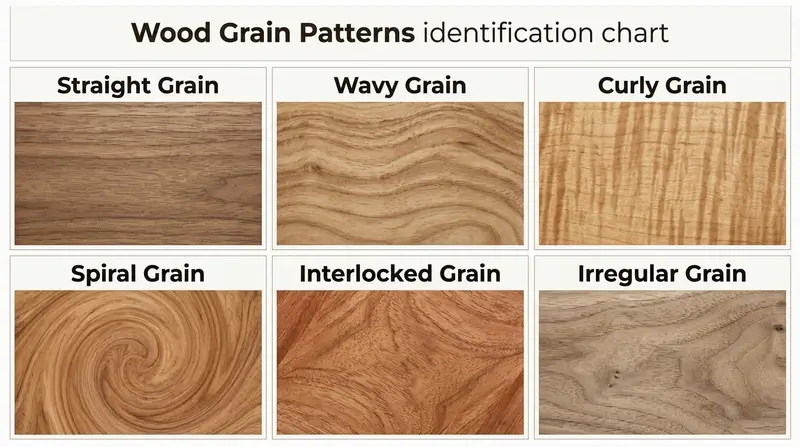
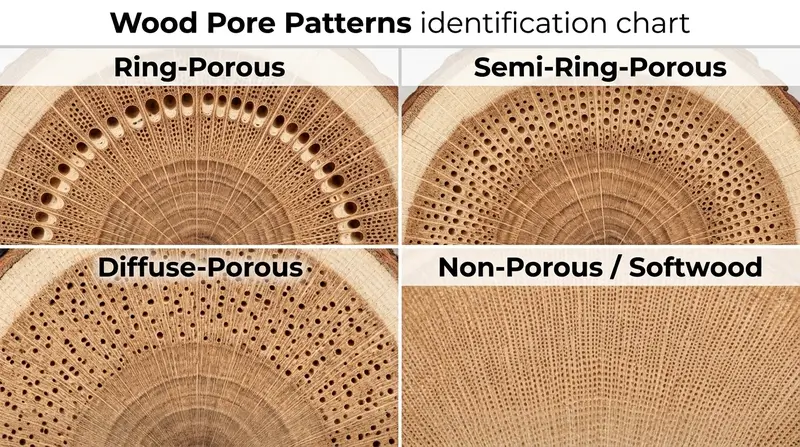
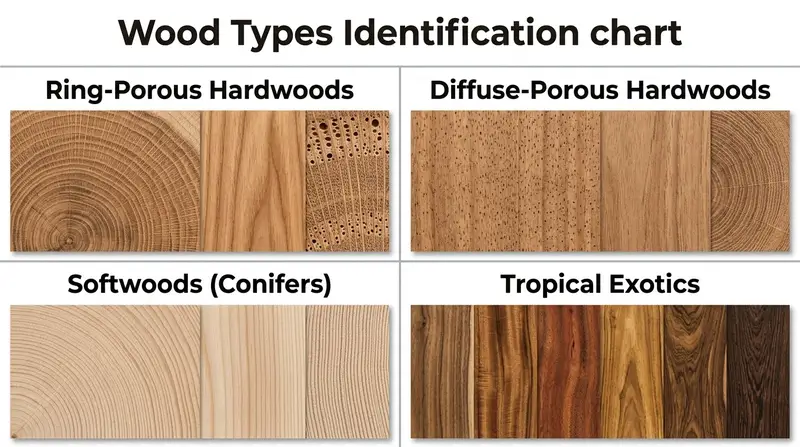
- Wood grain identification relies on evaluating three distinct structural planes: transverse (end grain), radial (quarter-sawn), and tangential (flat-sawn).
- Hardwoods are classified by pore arrangement into ring-porous, diffuse-porous, and semi-ring-porous categories, which serve as primary diagnostic markers.
- Softwoods lack pores entirely, relying instead on the transition between earlywood (springwood) and latewood (summerwood) to define their visual grain.
- Milling angle fundamentally alters surface grain appearance; quarter-sawn boards display stability and straight lines, while flat-sawn boards show prominent cathedral arches.
- Common identification errors stem from confusing surface figure (such as burl or curly grain) with underlying anatomical markers like ray flecks or pore size.
An effective wood grain identification chart operates on a hierarchical system, moving from macroscopic visual features visible to the naked eye or a hand lens down to microscopic cellular arrangements. Whether consulting a printed field guide or analyzing a digital reference table, woodworkers must evaluate several core structural dimensions simultaneously to arrive at an accurate classification.
| Grain / Anatomical Feature | Primary Structural Characteristic | Visual Appearance | Common Species Example | Key Identification Clue |
|---|---|---|---|---|
| Ring-Porous | Large earlywood pores form a distinct ring at the start of each growth increment. | Sharp, well-defined bands of large holes visible on the end grain without magnification. | Red Oak, White Oak, Ash | Distinct separation between fast spring growth and dense summer growth. |
| Diffuse-Porous | Pores are roughly uniform in size and evenly distributed throughout the annual growth ring. | Fine, subtle texture across the board with less pronounced growth ring boundaries. | Hard Maple, Birch, Cherry | Pores require a 10x hand lens to distinguish clearly on end grain. |
| Semi-Ring-Porous | Gradual transition from larger earlywood pores to smaller latewood pores. | Moderate distinctness of growth rings, falling between ring-porous and diffuse-porous. | Black Walnut, Butternut, Hickory | Earlywood pores are larger but do not form a single uninterrupted line. |
| Softwood (Non-Porous) | Composed primarily of tracheids; lacks vessel elements (pores) completely. | Even linear grain with visible shifts between soft earlywood and hard latewood. | Douglas Fir, Southern Yellow Pine, Redwood | Complete absence of vessel holes on end grain; resin canals may be present. |
| Interlocked Grain | Wood fibers spiral in alternating directions from one growth layer to the next. | Striated ribbon or stripe pattern on quartersawn faces; highly resistant to splitting. | Mahogany, Sapele, Elm | Tearing during planing even when moving in the apparent direction of the grain. |
| Spiral Grain | Wood fibers grow at an angle winding around the longitudinal axis of the tree trunk. | Twisted appearance along the length of the board; prone to severe warping. | Red Gum, various conifers | Check alignment of surface scratches or checking relative to board edges. |
Reading the table above requires understanding that wood anatomy is not random; it is the botanical record of a tree’s life cycle responding to seasonal changes, environmental stress, and genetic programming. The following sections break down these anatomical layers in detail.
To further contextualize the physical differences between major commercial groupings, consider the broad distribution of pore structures and density profiles across common North American and exotic timber groups. The breakdown below illustrates how structural classification correlates with weight, working characteristics, and dimensional stability.
| Wood Category | Density Range (lbs/cu ft) | Typical End-Grain Pore Visibility | Primary Commercial Uses | Dimensional Stability |
|---|---|---|---|---|
| Ring-Porous Hardwoods | 38 – 50+ | Visible to naked eye (large vessel openings) | Flooring, heavy furniture, exterior construction | Moderate to Low (moves significantly with humidity) |
| Diffuse-Porous Hardwoods | 30 – 48+ | Requires 10x–20x magnification | Fine cabinetry, turnery, interior millwork | High to Moderate (stable once properly dried) |
| Softwoods (Conifers) | 22 – 42 | Absent (tracheid matrix only) | Structural framing, siding, decking | Variable (dependent on flat vs. quarter-sawing) |
| Tropical Exotics | 45 – 75+ | Extremely variable; often plugged with tyloses or deposits | Marine applications, decking, musical instruments | Very High (natural oils resist moisture exchange) |
Anatomy of Wood Grain: Planes and Directions
Accurate identification requires examining wood across three mutually perpendicular planes. A common mistake among beginners is looking only at the face of a board, ignoring the crucial diagnostic data locked inside the end grain.
The Three Principal Planes of Wood
Wood is an anisotropic material, meaning its mechanical and visual properties change depending on the directional axis being observed. Every piece of lumber exhibits three distinct anatomical planes:
- Transverse Plane (End Grain): The cross-section of the tree or board, perpendicular to the longitudinal axis. This plane reveals annual growth rings as concentric circles (in logs) or parallel lines (in boards), along with pore distribution, ray lines, and resin canals. It is the single most important plane for definitive identification.
- Radial Plane: A longitudinal section cut parallel to the radius of the log, passing directly through the pith. On this plane, growth rings appear as straight, parallel lines running vertically, often displaying “ray fleck” patterns where medullary rays intersect the surface.
- Tangential Plane: A longitudinal section cut tangent to the annual growth rings, missing the pith. This plane produces the classic “cathedral” or flame-shaped arches characteristic of standard flat-sawn lumber.
Grain Direction and Fiber Alignment
Beyond the cutting plane, the overall alignment of the wood fibers dictates how a board handles structural loads and machine tools. Straight grain—where fibers run parallel to the edges of the board—provides maximum tensile strength and predictable machining behavior. However, deviations from straight grain are common and serve as critical markers for identifying certain species:
- Interlocked Grain: Occurs when the spiral direction of wood fibers reverses periodically from left to right over successive growth years. This creates striking ribbon stripes when quarter-sawn but can cause catastrophic tear-out during hand planing.
- Wavy and Curly Grain: Caused by undulating fiber alignments that refract light differently, creating a three-dimensional chatoyant effect prized in musical instruments and decorative veneers.
- Diagonal and Spiral Grain: Results from improper milling relative to the tree’s natural growth axis or twisted growth patterns, leading to structural weakness and high movement during seasonal humidity shifts.
Hardwood vs. Softwood Grain Characteristics
One of the most persistent misconceptions in woodworking is that “hardwood” refers to the physical density of the lumber and “softwood” refers to its softness. In botanical taxonomy, these terms have nothing to do with density; they describe reproductive systems and cellular architecture.
Hardwood Anatomy: Pores and Vessels
Hardwoods (angiosperms, typically broad-leaved deciduous trees) feature complex cellular structures containing specialized water-conducting tubes called vessels, which appear as pores on the end grain. Identifying hardwoods relies heavily on analyzing how these pores are arranged within the annual growth ring:
- Ring-Porous Species: Trees like oak, ash, chestnut, and elm produce large-diameter vessels during the rapid spring growth phase, followed by much smaller vessels during summer. This creates a distinct band of large holes visible to the naked eye on the transverse plane.
- Diffuse-Porous Species: Species such as hard maple, yellow birch, cherry, and basswood distribute pores evenly throughout the entire growth ring. The rings are often delineated only by a fine line of flattened latewood cells rather than a dramatic shift in pore size.
- Semi-Ring-Porous Species: Walnut, butternut, and hickory represent a middle ground, where earlywood pores are noticeably larger than latewood pores but transition gradually rather than abruptly.
Softwood Anatomy: Tracheids and Resin Canals
Softwoods (gymnosperms, typically cone-bearing conifers such as pines, firs, spruces, and cedars) evolved earlier than hardwoods and possess a simpler, highly uniform cellular structure. They contain no vessel elements or pores. Instead, their wood is composed almost entirely of elongated water-conducting cells called tracheids.
When examining softwood grain on a chart, the visual texture is defined entirely by the contrast between earlywood (thin-walled, light-colored cells formed in spring) and latewood (thick-walled, dense, dark cells formed in summer). Some softwoods, such as pine, spruce, and larch, also feature microscopic resin canals—intercellular tubes that secrete pitch, which can sometimes be seen as small dark flecks or dots on clean end-grain cuts.
Diagnostic Identification Guide for Common Timber Species
When applying a wood grain identification chart in the field, professionals look for specific combinations of macroscopic markers. Below is an analysis of how major commercial groups present themselves across structural planes.
Oak (Quercus spp.) — Ring-Porous Benchmark
Both red and white oak are classic ring-porous hardwoods, making them exceptionally easy to identify at the end-grain level.
- End Grain: Large, open springwood pores visible without magnification, often arranged in radial flames or multiple rows. Broad medullary rays radiate outward from the center like spokes on a wheel.
- Radial Face: Prominent silver ray flecks (tiger stripping) appear when quarter-sawn.
- Tangential Face: Bold cathedral arches with heavy texture. White oak can be distinguished from red oak by the presence of tyloses (bubble-like cellular growths) that plug the earlywood pores, making white oak water-resistant and non-porous to air pressure testing.
Walnut (Juglans nigra) — Semi-Ring-Porous Elegance
American black walnut is prized for its rich chocolate-brown heartwood and subtle grain transitions.
- End Grain: Semi-ring-porous to diffuse-porous, with small to medium pores that are individually visible with a 10x lens. White deposits (crystals) are occasionally visible inside the pore lumens.
- Surface Texture: Generally straight-grained, though stumpwood and root flares yield highly figured burl, crotch, and wavy patterns.
- Distinguishing Feature: Smooth, satiny luster on freshly planed surfaces with a characteristic muted aroma when freshly cut.
Hard Maple (Acer saccharum) — Diffuse-Porous Density
Hard maple (sugar maple) offers a dense, uniform canvas with minimal grain distraction.
- End Grain: Diffuse-porous with extremely tiny pores that require close magnification to resolve. Growth rings are marked by fine, dark lines of terminal parenchyma.
- Surfaces: Typically straight-grained, but famous for genetic variations including birdseye, curly (tiger), and fiddleback grain patterns.
- Distinguishing Feature: High density, very pale creamy-white sapwood, and a fine, closed texture that burns easily if dull router bits or saw blades are used.
Pine (Pinus spp.) — Conifer Uniformity
Softwoods like Southern Yellow Pine or Eastern White Pine present entirely different diagnostic challenges.
- End Grain: Complete absence of pores. Instead, regular rows of rectangular tracheid cells are visible under magnification. Sharp contrast between soft, light earlywood and hard, dark latewood.
- Surfaces: Straight grain with occasional knot clusters where branches joined the main trunk. Resin odor is typically present, particularly in yellow pine species.
- Distinguishing Feature: Softness under a fingernail (in white pine) or extreme weight and resinous feel (in southern yellow pine), combined with zero vessel elements.
Step-by-Step Wood Grain Identification Workflow
To successfully identify an unknown piece of wood using physical inspection, follow this rigorous, systematic troubleshooting workflow:
- Prepare a Fresh Cut: Never attempt identification on a dusty, sanded, or factory-finished surface. Use a razor-sharp utility knife or chisel to pare away a clean, crisp slice across the end grain (transverse plane).
- Inspect the End Grain Under Magnification: Using a 10x or 20x jeweler’s loupe, examine the freshly cut end grain. Ask the primary diagnostic question: Are there visible holes (pores/vessels)?
- If YES, the wood is a Hardwood. Proceed to Step 3.
- If NO, the wood is a Softwood. Proceed to Step 5.
- Classify Hardwood Pore Arrangement: Look closer at how the pores are distributed across the annual ring:
- Are the springwood pores dramatically larger and grouped in a distinct band? (Ring-Porous: Oak, Ash, Elm).
- Are the pores uniform in size and scattered evenly across the entire ring? (Diffuse-Porous: Maple, Cherry, Birch).
- Are the pores intermediate, tapering gradually from large to small? (Semi-Ring-Porous: Walnut, Hickory).
- Examine Medullary Rays and Inclusions: Look for ray lines radiating from the center. Are they exceptionally broad and visible to the naked eye (Oak, Plane tree)? Are there colored deposits, tyloses, or gum ducts inside the pores?
- Analyze Softwood Characteristics (If Non-Porous): For softwoods, evaluate the transition width between earlywood and latewood bands. Check for resin canals (small dots visible under magnification) and test the wood’s density and odor.
- Correlate with Face Grain and Physical Properties: Confirm your anatomical findings by checking color, weight, hardness, aroma, and reaction to machining against established reference charts.
Common Mistakes and Limitations in Wood Identification
Even with a comprehensive identification chart, wood identification is an empirical science fraught with potential pitfalls. Recognizing these common errors prevents costly misidentifications in restoration and woodworking projects.
Mistaking Surface Figure for Botanical Species
A frequent error is attempting to identify wood species based solely on decorative surface patterns. Terms like “curly,” “burl,” “birdseye,” and “quilted” describe figure—abnormal grain formations caused by stress, injury, or genetic variation—rather than distinct botanical species. Sugar maple, white ash, and even mahogany can all exhibit curly figures; relying on the figure alone will lead to incorrect classification.
Ignoring Density and Weight Anomalies
Environmental factors significantly alter wood density. A fast-grown specimen of a normally heavy species may produce wide growth rings with low density, while a slow-grown conifer from a harsh mountain environment can produce dense, heavy lumber that mimics a hardwood. Always cross-reference pore structure with physical weight.
Stained, Bleached, and Aged Finishes
UV exposure, chemical treatments, and pigmented stains alter the surface color of timber. Cherry darkens dramatically from a pale pink to a deep reddish-brown when exposed to sunlight; old walnut can be mistaken for mahogany under aged, ambered shellac finishes. Always pare down to bare, unexposed interior wood before making a final determination.
Frequently Asked Questions
What is the difference between flat-sawn and quarter-sawn grain on an identification chart?
Flat-sawn (plain-sawn) lumber is milled tangent to the growth rings, producing classic cathedral arches on the face and making the board prone to cupping. Quarter-sawn lumber is milled radially at roughly a 90-degree angle to the growth rings, resulting in straight, parallel grain lines, superior dimensional stability, and decorative ray flecks in species like oak.
Can I identify wood species without cutting the end grain?
While experienced woodworkers can often guess a species based on face grain, color, and weight, definitive identification without examining the end grain is unreliable. The end grain contains the transverse cellular architecture—such as pore size, pore arrangement, and ray structures—that separates look-alike species.
How do I distinguish between Red Oak and White Oak using a grain chart?
On the end grain, white oak features tyloses (membranous growths) that plug the open springwood vessels, making the wood impervious to liquid. Red oak lacks tyloses, leaving its large pores completely open and hollow. Under a microscope or air-pressure test, air or water easily passes through red oak end grain but is blocked in white oak.
Why do some hardwoods tear out during planing regardless of feed direction?
This is caused by interlocked grain, where wood fibers spiral in alternating directions from one growth layer to the next. When a hand plane travels with one layer of fibers, it is inherently cutting against the adjacent underlying layer, causing the grain to lift and tear rather than slice cleanly.
Are exotic tropical hardwoods harder to identify than domestic species?
Yes, tropical hardwoods present unique identification challenges because tropical climates often lack distinct seasonal growth rings. Without reliable annual rings, identifiers must rely heavily on microscopic pore distributions, mineral deposits, color variations, fluorescence under UV light, and extractive aromas.
Conclusion
Mastering a Wood Grain Identification Chart is an indispensable skill that transforms guesswork into empirical science. By looking past surface finishes, decorative figure, and aging, woodworkers and scientists can decode the hidden architecture of timber through its structural planes and cellular geometry. Whether distinguishing ring-porous hardwoods from non-porous softwoods or analyzing pore arrangements with a hand lens, a methodical approach ensures accurate species identification, superior project planning, and the preservation of historic timber.