
The nocturnal habits of owls, combined with their exceptional camouflage, have long fascinated naturalists and birders. Successfully identifying these raptors in the field requires moving past superficial assumptions and examining structural architecture and auditory signatures. Whether scanning a dense coniferous forest at dusk for the subtle silhouette of a forest owl or trying to separate a cryptic screech-owl species by its trembling trill, understanding the taxonomy and physical markers of each species is essential.
(Reference: Peterson Reference Guide to Owls – Scott Weidensaul)This comprehensive guide examines the 19 distinct owl species inhabiting North America. By analyzing genus-level groupings, specialized anatomical traits, and geographical variations, field observers can transition from uncertain visual glimpses to confident identifications. The following sections break down taxonomy, visual metrics, vocal behaviors, and comparative diagnostics to serve as an authoritative reference for field ornithologists and dedicated birders alike.
Explore our detailed breakdown on Sparrow Identification Chart (Complete Data Matrix).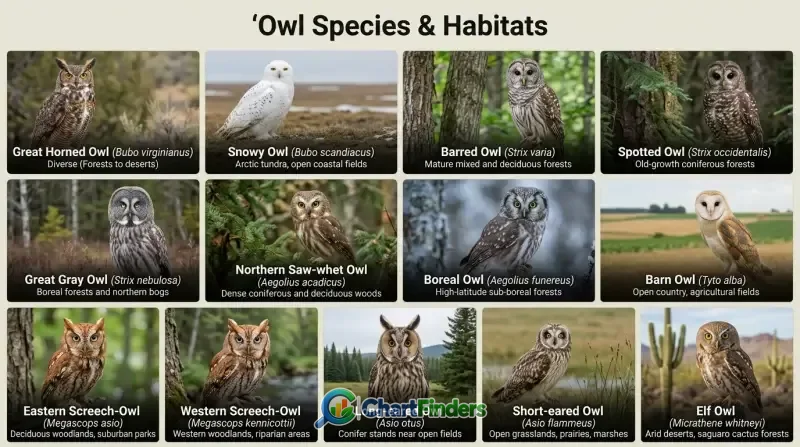
Owl Identification Chart
- North America hosts exactly 19 owl species distributed across four primary taxonomic genera: Strix, Aegolius, Megascops, and others including Bubo, Asio, and Tyto.
- Head ornamentation—specifically the presence, absence, and shape of feathered ear tufts—serves as a primary initial diagnostic filter.
- Facial disc completeness and concentric ring patterns immediately separate wood owls (Strix) from forest and barn owls.
- Vocalizations often provide a more reliable identification method than visual sightings, given the secretive, nocturnal nature of most species.
- Geographic range overlap creates complex identification challenges, particularly between similar species like the Barred and Spotted Owl, or Western and Eastern Screech-Owls.
When approaching owl identification, field researchers utilize standardized morphological categories to quickly narrow down potential candidates. The chart below provides a comprehensive comparative framework of representative North American owl genera and key diagnostic features across the entire continental diversity.
| Genus / Species | Average Length | Ear Tufts | Primary Habitat | Key Visual Identifier |
|---|---|---|---|---|
| Great Horned Owl (Bubo virginianus) | 18–25 inches | Prominent | Diverse (Forests to deserts) | White throat patch, massive yellow eyes, heavily barred underparts. |
| Snowy Owl (Bubo scandiacus) | 20–28 inches | None (Very small hidden) | Arctic tundra, open coastal fields | Heavy white plumage with variable dark barring, striking yellow eyes. |
| Barred Owl (Strix varia) | 17–21 inches | None | Mature mixed and deciduous forests | Horizontal barring on neck/chest, vertical streaking on belly, dark eyes. |
| Spotted Owl (Strix occidentalis) | 16–19 inches | None | Old-growth coniferous forests | White spotting and barring across entire underparts, dark eyes. |
| Great Gray Owl (Strix nebulosa) | 22–27 inches | None | Boreal forests and northern bogs | Massive size, facial disc with concentric dark rings, yellow eyes, small bill. |
| Northern Saw-whet Owl (Aegolius acadicus) | 7–8 inches | None | Dense coniferous and deciduous woods | Tiny size, brownish head with white streaking, lack of tufts, pale bill. |
| Boreal Owl (Aegolius funereus) | 9–10 inches | None | High-latitude sub-boreal forests | Flecked white spots on a dark crown, pale border to facial disc, yellow bill. |
| Barn Owl (Tyto alba) | 14–20 inches | None | Open country, agricultural fields | Heart-shaped white facial disc, long legs, golden-buff upperparts. |
| Eastern Screech-Owl (Megascops asio) | 7–10 inches | Prominent | Deciduous woodlands, suburban parks | Small size, yellow eyes, red or grey color morphs, ear tufts. |
| Western Screech-Owl (Megascops kennicottii) | 7–10 inches | Prominent | Western woodlands, riparian areas | Dark bill, grey or brown overall tones, prominent ear tufts. |
| Long-eared Owl (Asio otus) | 13–16 inches | Prominent (long, close) | Conifer stands near open fields | Long central ear tufts, orange-buff facial disc, slender posture. |
| Short-eared Owl (Asio flammeus) | 13–17 inches | Prominent (short, wide) | Open grasslands, prairies, marshes | Diurnal/crepuscular habits, buffy underwings with black wrist patches. |
| Elf Owl (Micrathene whitneyi) | 5–6 inches | None | Arid deserts, saguaro cactus forests | Extremely tiny, short tail, yellow eyes, white eyebrows. |
Reading this table requires evaluating proportional relationships and habitat overlap. While size provides a general baseline, structural anomalies such as ear tufts and bill coloration offer definitive separation between morphologically similar groups.
Taxonomic Groupings of North American Owls
North American owls are divided into distinct genera based on skeletal morphology, feather structure, and evolutionary lineage. Understanding these genera simplifies the identification process by clustering species with shared behavioral and physical traits.
Genus Strix (Wood Owls)
The genus Strix comprises medium to very large owls that lack ear tufts entirely. Their facial discs are large and rounded, accentuated by concentric rings of dark and light feathers that enhance their acute hearing. In North America, this genus includes the Barred Owl, Spotted Owl, and the colossal Great Gray Owl. Species in this group typically inhabit heavily forested regions, utilizing their broad wings and rounded tails for maneuvering through dense canopies.
Genus Aegolius (Forest Owls)
Representative of smaller forest-dwelling raptors, the genus Aegolius includes the Northern Saw-whet Owl and the Boreal Owl. These birds possess relatively large heads lacking ear tufts, short tails, and disproportionately large facial discs relative to their body mass. Their plumage is heavily patterned with spots and streaks, providing disruptive camouflage against tree bark. They are primarily nocturnal, relying heavily on auditory hunting techniques beneath dense coniferous cover.
Genus Megascops (Screech-Owls)
Screech-owls are small, compact raptors distinguished by prominent, movable ear tufts and striking yellow or dark eyes depending on the species. The genus includes the Eastern Screech-Owl and Western Screech-Owl, which are nearly identical visually and are best separated by their distinct vocal trills and geographic ranges. Many screech-owl species exhibit distinct color morphs, occurring in both a rufous (reddish-brown) phase and a grey phase.
Genus Bubo (Horned and Snowy Owls)
Representing some of the largest and most powerful owls on the continent, the genus Bubo includes the ubiquitous Great Horned Owl and the nomadic Arctic-breeding Snowy Owl. These apex avian predators feature robust frames, exceptionally strong talons, and aggressive territorial defense behaviors. While Great Horned Owls sport massive, feathery ear tufts, Snowy Owls show virtually no external tufts, adapted to sweep winds across open tundra landscapes.
Genus Asio (Eared Owls)
The genus Asio includes medium-sized, slender raptors characterized by distinct ear tufts and specialized hunting behaviors. The Long-eared Owl relies heavily on dense coniferous cover adjacent to open hunting grounds, while the Short-eared Owl is a nomadic, ground-nesting open-country specialist frequently observed hunting during daylight hours over marshes and grasslands.
Anatomical Markers Used in Field Identification
Accurate field identification of owls depends on analyzing specific anatomical features under varied lighting conditions. Because many species are encountered only as silhouettes at dawn or dusk, structural markers take precedence over fine plumage details.
Head Profile and Ear Tufts
The presence or absence of ear tufts—feather groups that can be raised or lowered depending on mood or state of alertness—is the fastest method for splitting owl families. Birds with prominent tufts include the Great Horned Owl, Long-eared Owl, Short-eared Owl, and screech-owls. Species lacking tufts feature smooth, rounded head profiles, characteristic of the Strix and Aegolius genera, as well as the Barn Owl.
Facial Disc Architecture
The facial disc acts as a parabolic reflector, channeling high-frequency sounds to asymmetrical ear openings. Examining the border of this disc reveals crucial identification clues. The Barn Owl features an unmistakable, rigid, heart-shaped white disc edged in dark brown. The Great Gray Owl displays pronounced dark concentric rings emanating from bright yellow eyes. Smaller forest owls often have dark borders that frame the sides of the face, creating a distinct mask-like appearance.
Eye Coloration and Orbital Sockets
Eye color varies across species and remains remarkably consistent within adult populations. Yellow eyes are characteristic of the Great Horned Owl, Great Gray Owl, Short-eared Owl, Snowy Owl, and both Aegolius species. Dark brown or nearly black eyes are found in the Barred Owl, Spotted Owl, and Barn Owl. Screech-owls vary, with Eastern and Western species displaying yellow eyes, while other regional variants show dark irises.
Comparative Analysis of Cryptic Look-Alike Species
Certain North American owl species exhibit such high levels of morphological convergence that field identification presents significant challenges. Differentiating these look-alikes requires examining fine structural details and geographical boundaries.
Barred Owl versus Spotted Owl
The Barred Owl (Strix varia) and the Spotted Owl (Strix occidentalis) share similar body dimensions, dark eyes, and rounded heads without ear tufts. However, their chest and belly feather patterns differ distinctly:
- Barred Owl: Features bold, horizontal barring across the upper breast and neck, transitioning to distinct vertical dark streaks down a pale belly.
- Spotted Owl: Displays white spotting and barring across the entire underparts, creating a blocky, checkered appearance rather than clean vertical streaks.
- Range Considerations: Historically allopatric, their ranges now overlap significantly across the Pacific Northwest and parts of California, making vocalization analysis essential for verification.
Long-eared Owl versus Short-eared Owl
Both medium-sized, slender owls with ear tufts, these two species occupy different ecological niches:
- Long-eared Owl: Possesses long, closely-set ear tufts positioned near the center of the crown. It features striking orange-buff facial disks and heavily barred underparts, preferring dense conifer stands adjacent to open hunting fields.
- Short-eared Owl: Features very short, inconspicuous ear tufts placed far apart on the head. It is a diurnal and crepuscular open-country specialist, hunting over marshes and grasslands with a buoyant, moth-like flight style, showing bold black wrist patches on the underwing.
Eastern Screech-Owl versus Western Screech-Owl
These two small screech-owl species are nearly identical visually, sharing prominent ear tufts, yellow eyes, and dual color morphs. Separating them in areas of potential overlap requires noting subtle plumage tone differences—Western Screech-Owls typically display heavier, darker barring and a dark bill, while Eastern Screech-Owls have a more greenish-horn or pale bill. Definitive identification relies on listening to their distinct descending whinny versus bouncing-ball trills.
Vocalizations as Diagnostic Tools
Because visual encounters with owls are often fleeting, field ornithologists rely heavily on auditory identification. Each species has evolved specific territorial calls, courtship hoots, and contact notes that remain distinct within their respective ecosystems.
For instance, the territorial hoot of a Great Horned Owl is a deep, rhythmic series of four to five syllables delivered with a characteristic cadence: hoo-hooloo, hoo, hoo. In contrast, the Barred Owl delivers the iconic nine-syllable call phonetically translated as “Who cooks for you, who cooks for you-all?”, ending with a dramatic downward-pitched trailing note.
Smaller forest species utilize rapid, monotonous series. The Northern Saw-whet Owl emits a continuous, mechanical whistling toot-toot-toot that can resemble the sound of a backing truck or a sharpening saw blade. Screech-owls utilize a descending whinny or a bouncing-ball trill, which serves as the definitive diagnostic feature separating morphologically identical sibling species.
Frequently Asked Questions
Juvenile owls frequently retain fluffy down feathers around their head and neck, and their wing and tail feathers may appear shorter and less developed than those of adults. Many young owls also emit loud, high-pitched begging screeches that sound entirely different from adult territorial calls.
While most owls are strictly nocturnal or crepuscular, a few species regularly hunt during daylight hours. The Northern Hawk Owl and the Short-eared Owl are well-documented daytime hunters, while Burrowing Owls are active throughout the day in open grassland and desert ecosystems.
The Elf Owl (Micrathene whitneyi) is the smallest owl in North America, measuring a mere 5 to 6 inches in length—roughly the size of a sparrow. It resides primarily in the arid southwestern deserts and nests in abandoned woodpecker cavities within giant saguaro cacti.
Yes, in many species, eye color changes progressively during the first year of life. For example, young Burrowing Owls and some screech-owls transition from dark or greyish eyes in their nestling plumage to bright yellow irises as mature adults.
The external ear tufts are simply specialized feathers used for communication and camouflage, helping to break up the round silhouette of the head against tree bark. Actual ear openings are hidden beneath the facial disc feathers on the sides of the skull, and are asymmetrical to assist with precise sound localization.
Mastering North American owl identification requires patience, an understanding of taxonomic relationships, and careful attention to structural details like facial disc patterns and head profiles. By combining visual cues with auditory tracking, observers can accurately identify even the most cryptic forest-dwelling species across diverse North American habitats.