
Maintaining adequate electrolyte balance is a of long-term metabolic health, and among all dietary minerals, potassium plays a uniquely vital physiological role. It works in constant tandem with sodium across cell membranes to maintain the electrochemical gradients necessary for nerve impulse transmission, skeletal muscle contraction, and cardiovascular stability. While bananas and citrus fruits often dominate public conversations about potassium, vegetables frequently offer significantly higher nutrient density per serving with far fewer simple sugars. Understanding how to navigate a comprehensive potassium vegetables chart allows individuals to optimize their nutritional profile, support healthy blood pressure ranges, and make informed dietary modifications tailored to specific health goals.
However, translating raw nutritional data into practical daily meals is rarely straightforward. Vegetable potassium content varies dramatically depending on whether the item is consumed raw, steamed, boiled, or baked. , agricultural factors, regional soil composition, and preparation techniques—such as water leaching—can alter final nutrient availability. This guide provides an exhaustive analysis of potassium-rich vegetables, categorization frameworks, physiological mechanisms, comparative analyses, practical preparation methods, and important clinical considerations for special populations.
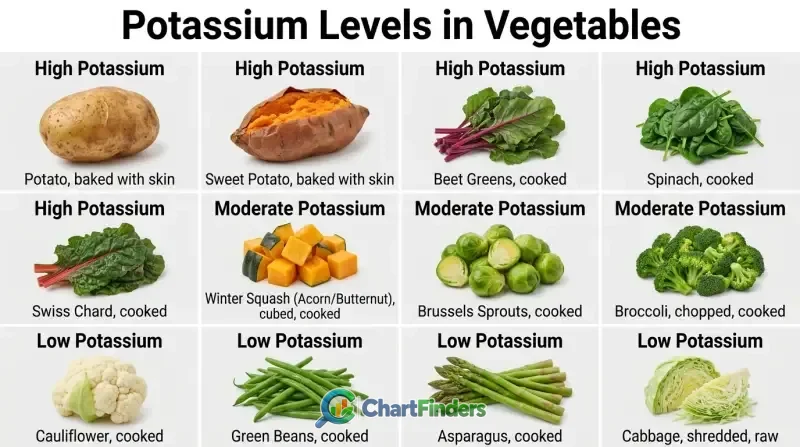
Potassium Vegetables Chart
- Potassium is a primary intracellular electrolyte essential for regulating fluid balance, blood pressure, and normal cardiac rhythm.
- Dark leafy greens, root vegetables, cruciferous varieties, and certain squashes represent the highest dietary vegetable sources of potassium.
- Cooking methods drastically alter potassium content; boiling leaches water-soluble minerals out of vegetables, whereas baking or roasting concentrates them.
- Healthy adults generally benefit from incorporating 2 to 3 varied servings of potassium-dense vegetables into their daily meal patterns.
- Individuals with advanced chronic kidney disease (CKD) or those taking potassium-sparing diuretics must restrict high-potassium vegetables to avoid hyperkalemia.
- A functional potassium vegetables chart must categorize produce by high, medium, and low tiers to facilitate both health optimization and medical restriction diets.
To effectively manage dietary intake, vegetables are commonly divided into distinct tiers based on their potassium concentration per standard serving size. The following reference chart aggregates standard USDA nutritional values to help you identify high-potassium powerhouses, moderate everyday choices, and low-potassium options suitable for specific medical guidelines.
| Vegetable Category | Specific Vegetable & Preparation | Standard Serving Size | Approximate Potassium (mg) | Clinical & Nutritional Notes |
|---|---|---|---|---|
| High Potassium | Potato, baked with skin | 1 medium (approx. 5 oz) | 900 – 950 | Skin intact yields maximum mineral concentration; excellent fiber source. |
| High Potassium | Sweet Potato, baked with skin | 1 medium (approx. 4 oz) | 540 – 600 | Rich in beta-carotene; lower glycemic impact than standard white potatoes when boiled. |
| High Potassium | Beet Greens, cooked | ½ cup | 640 – 650 | Unrivaled dark green density; also contains dietary nitrates supporting circulation. |
| High Potassium | Spinach, cooked | ½ cup | 420 – 440 | Shrinks significantly during cooking, concentrating minerals per volumetric serving. |
| High Potassium | Swiss Chard, cooked | ½ cup | 480 – 500 | Provides high magnesium and vitamin K alongside substantial potassium. |
| Moderate Potassium | Winter Squash (Acorn/Butternut), cubed, cooked | ½ cup | 250 – 300 | Provides complex carbohydrates, soluble fiber, and steady energy release. |
| Moderate Potassium | Brussels Sprouts, cooked | ½ cup | 250 – 270 | Cruciferous powerhouse containing glucosinolates and moderate minerals. |
| Moderate Potassium | Broccoli, chopped, cooked | ½ cup | 220 – 230 | Versatile everyday vegetable with balanced micronutrient profiles. |
| Low Potassium | Cauliflower, cooked | ½ cup | 150 or less | Popular low-carb substitute with minimal mineral load; renal-friendly. |
| Low Potassium | Green Beans, cooked | ½ cup | 100 – 140 | Low glycemic index, mild flavor, and safe for moderate potassium-restriction diets. |
| Low Potassium | Asparagus, cooked | ½ cup (6 spears) | 150 – 160 | Valued for culinary versatility and low baseline electrolyte impact. |
| Low Potassium | Cabbage, shredded, raw | ½ cup | 75 – 90 | High crunch and water content; minimal electrolyte accumulation. |
When analyzing the chart above, it becomes clear that preparation and serving size dictate actual mineral intake. For instance, a half-cup of raw spinach contains significantly less potassium than a half-cup of cooked spinach simply because cooking removes water content, packing far more plant matter into the same volumetric measure.
Physiological Role of Dietary Potassium
Potassium ($K^+$) is the principal cation inside living cells, whereas sodium ($Na^+$) is the principal cation in extracellular fluid. This chemical distinction is foundational to human biology. Specialized transmembrane proteins, most notably the sodium-potassium adenosine triphosphatase ($Na^+/K^+-ATPase$) pump, continuously expend cellular energy to push sodium out of cells while pulling potassium inward. This active transport mechanism establishes the resting membrane potential of cells, which is vital for three primary functions:
- Cardiovascular Regulation: Potassium dampens vascular tone by encouraging smooth muscle relaxation in blood vessel walls. Adequate intake counters the vasoconstrictive and blood pressure-elevating effects of excess dietary sodium.
- Neuromuscular Signaling: The rapid influx and efflux of potassium and sodium ions across nerve cell membranes generate the electrical impulses that allow thoughts, sensory perceptions, and motor commands to travel effortlessly throughout the body.
- Muscle Contraction: Skeletal, smooth, and cardiac muscle fibers rely on precise ionic shifts to trigger physical contraction and subsequent relaxation. Severe potassium imbalances can disrupt cardiac rhythm, leading to dangerous arrhythmias.
Categorizing Vegetables by Potassium Density
Navigating nutritional databases requires an understanding of how vegetables are grouped by mineral yield. Not all green vegetables share the same biochemical profile, and root vegetables span the entire spectrum from extremely high to remarkably low mineral content.
High-Potassium Vegetable Sources (Exceeding 400 mg per Serving)
High-potassium vegetables are nutrient-dense agricultural products that form the bedrock of a heart-healthy diet for individuals with normal renal clearance. Tubers, when consumed with their skins, top the list. A single medium baked potato can deliver nearly a quarter of an adult’s daily recommended intake. Dark leafy greens—such as Swiss chard, cooked spinach, and beet greens—also pack immense concentrations of potassium, accompanied by dense arrays of vitamins A, C, and K, as well as essential carotenoids.
Moderate-Potassium Vegetable Sources (200 mg to 400 mg per Serving)
Moderate-potassium options provide a safe, sustainable middle ground for everyday meal planning. Cruciferous vegetables like broccoli, Brussels sprouts, and cabbage fall into this category, along with various summer and winter squashes. These vegetables allow individuals to enjoy large volumetric portions without overwhelming their daily mineral totals, making them ideal for balanced omnivorous, vegetarian, and plant-based diets.
Low-Potassium Vegetable Sources (Under 200 mg per Serving)
For patients managing chronic kidney disease, stage 4 or 5 renal failure, or specific endocrine disorders, low-potassium vegetables are medically necessary. Vegetables such as cauliflower, green beans, cabbage, asparagus, cucumbers, and bell peppers offer wonderful culinary texture, fiber, and micronutrients without introducing dangerous loads of extracellular electrolytes.
Comparative Analysis: White Potatoes vs. Sweet Potatoes vs. Leafy Greens
When designing a diet rich in potassium, choosing between different vegetable categories involves balancing mineral density against carbohydrate loads, fiber content, and preparation requirements. The table below compares the macro- and micro-nutrient profiles of three prominent high-potassium vegetable choices per standard cooked or baked serving.
| Nutrient / Parameter | White Potato (Baked with Skin, 1 medium) | Sweet Potato (Baked with Skin, 1 medium) | Spinach (Cooked, ½ cup) |
|---|---|---|---|
| Potassium (mg) | 900 – 950 | 540 – 600 | 420 – 440 |
| Glycemic Index | Moderate to High (varies by cooling) | Low to Moderate | Very Low |
| Primary Vitamins | Vitamin C, Vitamin B6 | Vitamin A (Beta-Carotene), Vitamin C | Vitamin K, Vitamin A, Folate |
| Dietary Fiber (g) | 3.8 – 4.5 | 3.8 – 4.0 | 2.0 – 2.5 |
| Renal Suitability | Restricted / Leaching Required for CKD | Restricted / Leaching Required for CKD | Restricted / Leaching Required for CKD |
This comparison highlights that while white potatoes deliver the absolute highest potassium punch per tuber, sweet potatoes provide substantial beta-carotene alongside a more favorable glycemic index. Leafy greens like spinach offer exceptional mineral density per volumetric cup with negligible carbohydrate content, though their high oxalate levels require consideration for individuals prone to kidney stones.
The Impact of Culinary Preparation on Potassium Content
Unlike vitamins that degrade under excessive heat, minerals cannot be destroyed by cooking. However, potassium is water-soluble. This chemical property means that cooking techniques dramatically alter the final mineral content of vegetables on your plate.
When vegetables are boiled in a large volume of water, a significant percentage of their intracellular potassium leaches out into the cooking liquid. For individuals seeking to maximize their potassium intake, boiling is counterproductive unless the cooking liquid is consumed (as in a hearty stew or vegetable broth). Conversely, dry-heat methods such as baking, roasting, and steaming preserve nearly all the native mineral content. Roasting root vegetables or baking whole tubers locks the minerals inside the plant matrix.
For patients who love high-potassium vegetables like potatoes but must adhere to a potassium-restricted diet, a culinary technique known as leaching or double-cooking is frequently prescribed by renal dieticians:
- Peel and slice the high-potassium tubers or root vegetables thinly.
- Rinse the slices thoroughly in warm water.
- Soak the sliced vegetables in a large volume of warm water for at least two hours (or overnight for maximum extraction).
- Drain the soaking water completely and rinse the vegetables again.
- Boil the vegetables in a fresh, large pot of water using a high water-to-vegetable ratio until tender, then discard the boiling water.
While this process strips away flavor-bearing minerals and water-soluble vitamins, it can reduce the potassium content of stubborn root vegetables by up to 50%, providing a valuable strategy for restricted diets.
Daily Requirements and Clinical Considerations
The National Academies of Sciences, Engineering, and Medicine established an Adequate Intake (AI) level for potassium of 3,400 mg per day for adult males and 2,600 mg per day for adult females, though many global health organizations recommend higher targets (such as 3,500 to 4,700 mg daily) to support optimal cardiovascular health and mitigate hypertension risks.
Despite these guidelines, individual needs vary wildly based on physical activity levels, climate, sweat rates, and underlying medical conditions. Athletes engaged in prolonged endurance training lose significant electrolytes through sweat and require higher dietary replenishment. Conversely, individuals with compromised renal function face severe clinical risks if they consume high amounts of potassium.
When the kidneys fail to filter excess potassium from the bloodstream, a condition called hyperkalemia develops. Hyperkalemia is a medical emergency that can impair electrical conduction in the heart, leading to fatal cardiac arrhythmias. Patients with chronic kidney disease, those taking ACE inhibitors, angiotensin receptor blockers (ARBs), or potassium-sparing diuretics must work closely with their nephrologist and clinical dietitian to establish strict, personalized daily potassium caps.
Common Mistakes When Using Potassium Charts
Interpreting nutritional charts without practical context can lead to serious dietary miscalculations. Watch out for these frequent errors:
- Confusing Raw and Cooked Weights: A chart displaying raw spinach data will drastically underrepresent the potassium content of a cooked serving because cooking condenses the vegetable’s water weight.
- Ignoring Portion Sizes: Nutritional values are tied to exact serving sizes (e.g., ½ cup or 1 medium tuber). Consuming double or triple the portion size multiplies the mineral load accordingly.
- Overlooking Leaching Effects: Assuming boiled vegetables retain their raw nutritional profile ignores the reality of water-soluble mineral loss.
- Treating Reference Lists as Prescriptions: Universal nutritional charts provide baseline USDA data, not personalized medical advice. Individuals with kidney disease must defer to their clinical care team rather than generic dietary guides.
Frequently Asked Questions
Baked white potatoes with the skin intact generally rank among the highest vegetable sources, delivering approximately 900 to 950 mg of potassium per medium-sized tuber. Among dark leafy greens, cooked beet greens offer exceptionally high concentrations, providing around 640 mg per half-cup serving.
Yes. Because potassium is a water-soluble mineral, boiling vegetables in water causes significant amounts of the mineral to leach out into the cooking liquid. If you discard the water, you discard a substantial portion of the vegetable’s potassium. Steaming, roasting, and baking preserve much higher mineral concentrations.
A common misconception is that sweet potatoes dominate white potatoes in every nutrient category. In reality, a standard medium baked white potato with skin contains roughly 900 mg of potassium, whereas a medium baked sweet potato provides about 540 to 600 mg. Both are excellent sources, but white potatoes edge them out in raw potassium density.
Patients with chronic kidney disease who need to lower vegetable potassium often use a leaching technique. This involves peeling and slicing vegetables thinly, soaking them in warm water for several hours, rinsing them, and then boiling them in a large fresh pot of water while discarding the cooking liquid.
Healthy adults without kidney disease or specific medical restrictions generally benefit from incorporating 2 to 3 servings of varied, potassium-rich vegetables into their daily meal patterns to help meet overall electrolyte goals and support healthy blood pressure.
Navigating the nutritional landscape of potassium-rich vegetables requires a clear understanding of baseline mineral values, preparation methods, and individual health parameters. By utilizing a reliable potassium vegetables chart alongside mindful culinary techniques, you can successfully tailor your dietary intake to support long-term cardiovascular and metabolic wellness.