
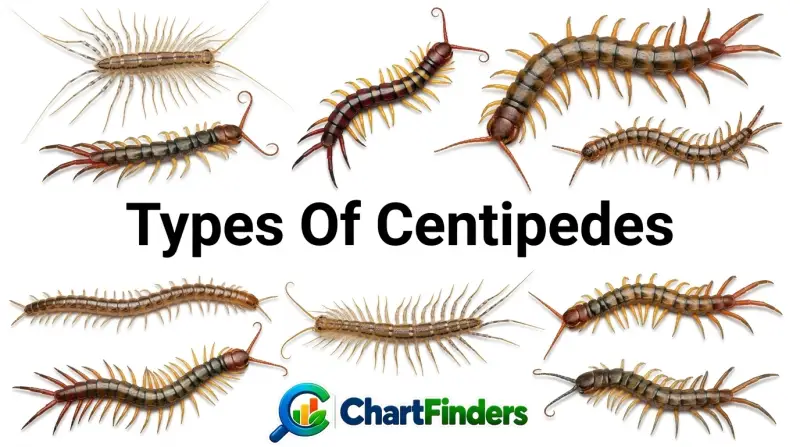
Few arthropods evoke as much instant fascination—and hesitation—as the centipede. Despite their common name suggesting one hundred legs, no known centipede has exactly one hundred legs. Instead, their leg counts range from 30 to over 350, always arranged in odd pairs per body segment. This anatomical quirk immediately distinguishes them from their herbivorous, slow-moving cousins, the millipedes, which feature two pairs of legs per body segment.
Understanding the types of centipedes requires a journey into five distinct evolutionary lineages that have adapted to everything from subterranean crevices and damp forest floors to human residential basements. Whether you are attempting to identify a scurrying house centipede, researching the painful bite capacity of tropical giant centipedes, or exploring soil ecology, this guide examines the classification, biology, behavioral traits, identification markers, and ecological significance of the world’s most notable centipede groups.
Taxonomic Classification and Diversity of Types Of Centipedes
- Five Main Orders: All living centipedes are categorized into Scutigeromorpha, Scolopendromorpha, Geophilomorpha, Lithobiomorpha, and Craterostigmomorpha.
- Leg Count Anomaly: Centipedes always have an odd number of leg pairs per body segment, distinguishing them from all other myriapods.
- Venom Delivery: They do not bite with jaws; they inject venom using modified front legs called forcipules located directly behind the head.
- Ecological Role: Every centipede species is an obligate carnivore, acting as a critical apex predator for soil and household microfauna.
- Habitat Specialization: Orders range from highly agile surface runners (Scutigeromorpha) to blind, burrowing subterranean specialists (Geophilomorpha).
Centipedes are ancient arthropods belonging to the subphylum Myriapoda and class Chilopoda. The class is split cleanly into two major clades: Notostigmophora (containing house centipedes with dorsal breathing pores) and Pleurostigmophora (containing the remaining orders, which breathe through lateral spiracles). The following breakdown examines the structural morphology, habitat preferences, and behavioral characteristics of each major group.
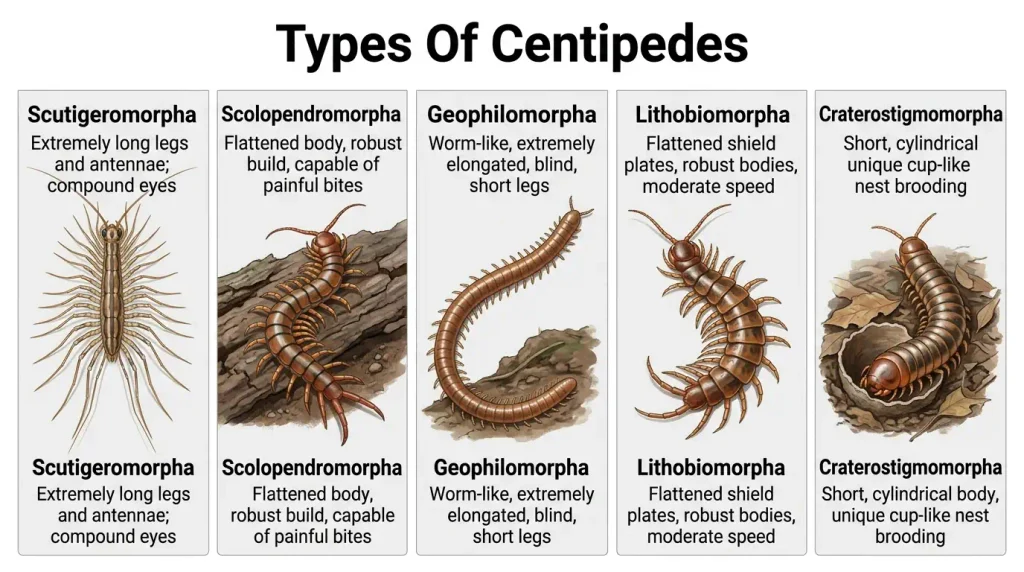
| Order | Common Name | Typical Leg Pairs | Primary Habitat | Key Identification Clue |
|---|---|---|---|---|
| Scutigeromorpha | House Centipedes | 15 pairs | Damp indoor spaces, caves, bark | Extremely long legs and antennae; compound eyes |
| Scolopendromorpha | Bark / Tropical Centipedes | 21 or 23 pairs | Tropical rainforests, rotting logs, soil | Flattened body, robust build, capable of painful bites |
| Geophilomorpha | Soil Centipedes | 27 to 191+ pairs | Subterranean soil, under deep stones | Worm-like, extremely elongated, blind, short legs |
| Lithobiomorpha | Stone Centipedes | 15 pairs | Leaf litter, beneath rocks and logs | Flattened shield plates, robust bodies, moderate speed |
| Craterostigmomorpha | Primitive Centipedes | 15 pairs | Tasmania and New Zealand forests | Short, cylindrical body, unique cup-like nest brooding |
The table above highlights the structural diversity within the class Chilopoda. While stone and house centipedes share a fixed count of 15 leg pairs, soil and bark centipedes vary widely in segment count depending on the species and sex.
1. Scutigeromorpha: The House Centipedes
Scutigeromorphs represent one of the most familiar yet misunderstood centipede lineages. The most prominent species encountered globally is Scutigera coleoptrata, commonly known as the house centipede. Unlike soil-dwelling relatives that require high humidity and die quickly in dry indoor air, house centipedes tolerate typical residential humidity levels exceptionally well.
- Anatomy: They possess 15 pairs of extraordinarily long, fragile legs and exceptionally long antennae. Their final pair of legs functions as sensory organs rather than locomotor appendages, often mistaken for a second set of antennae.
- Vision: Unlike blind soil centipedes, scutigeromorphs possess true, well-developed compound eyes, making them active visual hunters.
- Movement: They are among the fastest terrestrial invertebrates, capable of reaching speeds of up to 1.6 feet per second, allowing them to run down flies, spiders, silverfish, and cockroaches.
2. Scolopendromorpha: Bark and Tropical Giant Centipedes
Scolopendromorphs are robust, aggressive predators that dominate tropical and subtropical regions, though several species inhabit temperate zones. This order contains the largest living centipedes, such as the Amazonian giant centipede (Scolopendra gigantea), which can exceed 12 inches in length.
- Anatomy: These centipedes possess either 21 or 23 pairs of robust legs and flat, heavily sclerotized (hardened) bodies designed for wedging beneath tight bark and rock crevices.
- Venom Potency: Scolopendromorph venom is exceptionally potent relative to body size. While bites to humans are rarely fatal, they produce excruciating localized pain, swelling, erythema, and occasional systemic symptoms such as nausea and dizziness.
- Behavior: They are nocturnal ambush predators, hunting mice, lizards, large insects, and even small amphibians by wrapping their flexible bodies around prey and driving their forcipules deep into flesh.
3. Geophilomorpha: Soil and Earth Centipedes
Geophilomorphs are earthworm-like predators that spend their entire lives hidden beneath the soil surface, under deep stones, or inside rotting logs. Their morphology is heavily specialized for burrowing through tight interstitial spaces in soil matrices.
- Anatomy: They feature elongated, cylindrical bodies with high segment counts ranging from 27 to over 191 pairs of legs. Their legs are relatively short, preventing them from running fast on open surfaces.
- Sensory Adaptation: Geophilomorphs are entirely blind, lacking eyes or possessing only rudimentary light-sensing ocelli. They rely entirely on tactile mechanoreceptors and chemical chemoreceptors along their antennae and body surface.
- Defense Mechanisms: Many soil centipedes possess defensive glands along their ventral side that secrete sticky, foul-smelling, or luminescent fluids when threatened by predators like beetles or shrews.
4. Lithobiomorpha: Stone Centipedes
Lithobiomorphs represent a hardy, widespread order of temperate forest floor dwellers. Often found when turning over logs, leaf litter, or garden stones in temperate zones, stone centipedes share a superficial resemblance to house centipedes but possess shorter legs and stout bodies.
- Anatomy: They possess exactly 15 pairs of legs, alternating between long and short tergites (dorsal shield plates).
- Ecology: They are generalist predators, consuming springtails, nematodes, fly larvae, and small spiders.
- Life Cycle: Unlike some centipedes that scatter eggs blindly, female lithobiomorphs lay eggs individually in the soil, coating them with sticky soil particles to prevent fungal infection before actively guarding them.
5. Craterostigmomorpha: The Primitive Relatives
Craterostigmomorphs represent a relict order containing only two known living species, restricted entirely to Tasmania and New Zealand. They hold immense evolutionary interest because they bridge the gap between primitive and advanced centipede traits.
- Anatomy: These relatively small centipedes possess 15 leg pairs and a short, stout body terminating in a unique, cup-shaped anal segment.
- Parental Care: Female craterostigmomorphs exhibit rare, advanced maternal care, curling around their egg clutches in underground nests and protecting them through development until the first molt.
Anatomical Specializations: How Centipedes Hunt and Survive
The success of centipedes as ancient predators stems from specialized anatomical adaptations. Understanding these structures clarifies why centipedes behave the way they do and how they interact with their environment.
The Forcipules (Venom Claws)
A common misconception is that centipedes bite with mandibles inside their mouths. In reality, the primary weapon of any centipede is the forcipule—a pair of heavily modified legs situated immediately behind the head. Each forcipule is a multi-jointed appendage terminating in a sharp, hollow fang connected to a venom gland located inside the head capsule. When striking, the centipede swings these appendages forward like ice tongs, piercing the exoskeleton of prey and injecting neurotoxic and cytolytic venom that rapidly immobilizes the victim.
Respiration and Water Loss
Centipedes lack waterproof waxy cuticles comparable to those of true insects (such as beetles or cockroaches). As a result, they are highly susceptible to desiccation (drying out). Except for house centipedes, which possess specialized closable spiracles called notostigmata on their dorsal plates, most centipedes breathe via lateral spiracles along their sides. This physiological constraint forces them to seek out high-humidity microhabitats, such as subterranean soils, leaf litter, rotting logs, and damp basements.
Centipede vs. Millipede: Crucial Distinctions
Homeowners and gardeners frequently confuse centipedes with millipedes, yet the two groups belong to entirely different classes within the subphylum Myriapoda (Chilopoda versus Diplopoda). Distinguishing them is straightforward when examining specific physical and behavioral traits.
| Feature | Centipedes (Chilopoda) | Millipedes (Diplopoda) |
|---|---|---|
| Diet | Obligate carnivores (eat insects, spiders) | Detritivores (eat decaying plant matter) |
| Legs Per Segment | 1 pair per body segment | 2 fused pairs per body segment (diplosegments) |
| Locomotion | Extremely fast, darting movements | Slow, rhythmic, wave-like crawling |
| Defense | Venomous bite via forcipules | Coiling into a spiral; chemical/foul-liquid secretion |
| Body Shape | Generally flattened dorsoventrally | Generally cylindrical or slightly flattened |
Common Mistakes and Misconceptions in Centipede Identification
Misidentifying centipedes often leads to unnecessary panic or ineffective pest management. Evaluating common identification errors clarifies what is actually happening in a home or garden.
- Mistake 1: Assuming house centipedes infest wood or damage structures. House centipedes do not eat wood, paper, or stored food. If they are present in a home, it indicates a pre-existing population of other household pests (such as silverfish, spiders, or booklice) upon which the centipedes are feeding. Eliminating their food source naturally causes their numbers to decline.
- Mistake 2: Believing all centipedes are deadly to humans. While tropical giant centipedes (Scolopendromorpha) deliver painful bites requiring medical attention, smaller temperate species (such as Lithobiomorphs or Geophilomorphs) often lack jaws strong enough to pierce human skin, and their venom is negligible to mammals.
- Mistake 3: Confusing earwigs with centipedes. Earwigs feature pincer-like cerci at their rear and possess six legs, easily distinguishing them from multi-legged centipedes.
Frequently Asked Questions
Do house centipedes bite humans?
House centipedes can bite if trapped, handled roughly, or pressed tightly against bare skin (such as rolling over on one in bed). However, their forcipules are generally too weak to easily puncture human skin, and they are inherently docile creatures that prefer to flee rather than confront humans. If a bite does occur, it typically feels similar to a mild bee sting and resolves quickly without medical intervention.
How can I naturally control centipedes in my home?
Because centipedes require high moisture to survive, natural control focuses on environmental remediation. Use dehumidifiers in damp basements or crawlspaces, seal cracks and crevices in foundations and around windows, clear outdoor mulch and woodpiles away from exterior walls, and eliminate other indoor insect pests that serve as their food source.
Why do centipedes have an odd number of leg pairs?
The odd number of leg pairs is an ancestral developmental trait of the class Chilopoda. During embryonic development, centipede segments form in blocks (somites), and genetic expression patterns dictate that trunk segments alternate or develop in configurations resulting in odd pairs—ranging from 15 pairs in stone and house centipedes up to nearly 200 pairs in certain soil centipedes.
Are centipedes beneficial in the garden?
Yes. Soil and stone centipedes are fierce nocturnal predators that help regulate populations of garden pests, including slugs, cutworms, wireworms, and fly larvae. They act as natural pest controllers without harming living plant tissue, as they are strictly carnivorous.
How long do centipedes live compared to other insects?
Centipedes have remarkably long lifespans compared to most insects and arachnids. While many common insects live only a few weeks or months, temperate centipede species often live between 3 to 6 years, with some larger tropical scolopendromorph species surviving for over a decade in optimal conditions.
Conclusion
Centipedes represent an evolutionary masterclass in predatory specialization. From the lightning-fast house centipede patrolling residential baseboards to the blind, subterranean soil centipede navigating subterranean micro-tunnels, these creatures play vital ecological roles across global ecosystems. By understanding their distinct orders, physical adaptations, and environmental requirements, observers can appreciate their value as natural pest controllers while effectively managing any unwanted indoor encounters through moisture control and habitat modification.