
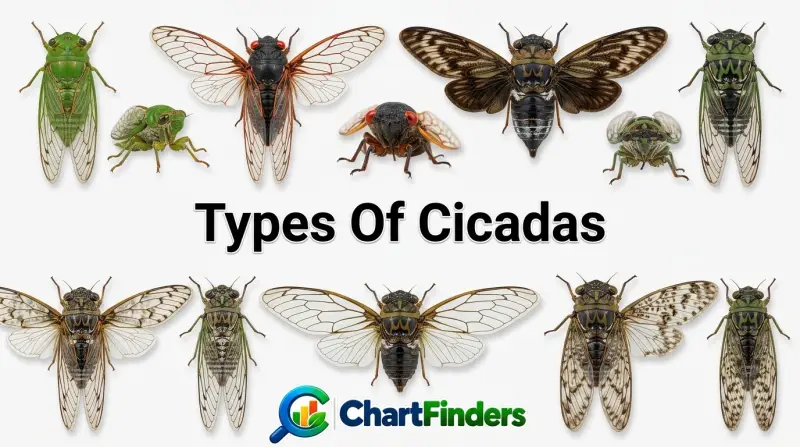
Cicadas are among the most remarkable insects on Earth, capturing human fascination through their deafening choruses, synchronized mass emergences, and unique subterranean life cycles. While many people assume cicadas appear every year or only emerge in 17-year intervals, the reality is far more diverse. The global family Cicadidae encompasses thousands of species distributed across every continent except Antarctica, each adapted to specific climates, host trees, and ecological niches.
In North America alone, entomologists divide cicadas into two primary groups based on their emergence patterns: periodical cicadas and annual cicadas. However, looking closer reveals complex sub-species, varying brood dynamics, and distinct visual and acoustic traits. Whether you are tracking a localized 17-year straggler emergence or listening to the high-pitched drone of dog-day cicadas in the midsummer heat, recognizing the specific types of cicadas helps demystify their behavior, biology, and ecological importance.
Taxonomy, Life Cycles, and the Core Categories of Types Of Cicadas
- Periodical cicadas (Magicicada spp.) spend 13 or 17 years underground as nymphs before emerging in coordinated broods numbering in the billions.
- Annual cicadas (primarily Neotibicen spp.) have overlapping multi-year life cycles, resulting in predictable yearly emergences every summer.
- Periodical cicadas are easily identified by their black bodies, striking red eyes, and amber-tinted wing veins, whereas annual cicadas are typically larger with green and black camouflage patterns.
- Distinct acoustic frequencies and tymbal structures allow individual species to attract mates of the exact same type within dense mixed-species choruses.
- While major regional emergences occur on fixed multi-year schedules, off-cycle “stragglers” frequently appear years ahead of or behind their main brood’s schedule.
To properly categorize the types of cicadas, entomologists rely on morphological differences, genetic markers, life cycle duration, and geographical distribution. Below is an exhaustive breakdown of how cicadas are classified, highlighting the major groups that dominate scientific literature and field observations.
| Cicada Category | Life Cycle Duration | Key Identification Clues | Geographic Range | Peak Emergence Timing |
|---|---|---|---|---|
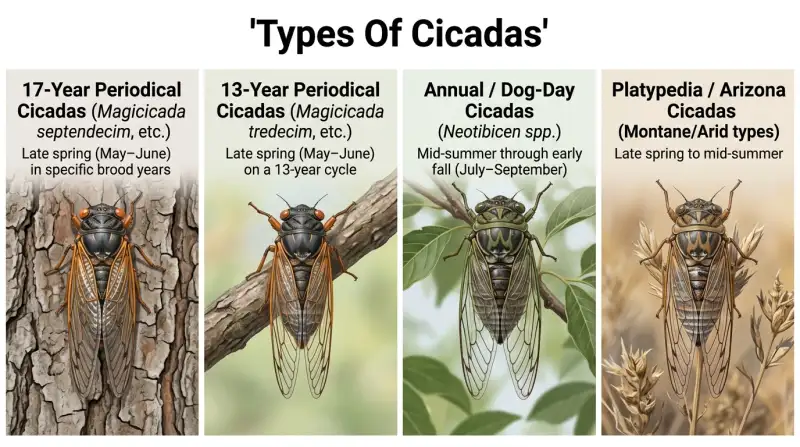
| 17-Year Periodical Cicadas (Magicicada septendecim, etc.) | 17 years | Black body, red eyes, orange-veined wings, smaller size (approx. 1–1.5 inches) | Eastern and Midwestern United States | Late spring (May–June) in specific brood years |
| 13-Year Periodical Cicadas (Magicicada tredecim, etc.) | 13 years | Morphologically identical to 17-year types; black body, red eyes | Southeastern and lower Midwestern United States | Late spring (May–June) on a 13-year cycle |
| Annual / Dog-Day Cicadas (Neotibicen spp.) | 2 to 5+ years (overlapping) | Green, black, and brown camouflage; larger size (up to 2+ inches); dark eyes | North America (widespread coast-to-coast) | Mid-summer through early fall (July–September) |
| Platypedia / Arizona Cicadas (Montane/Arid types) | Varies (often multi-year) | Hairy bodies, diurnal, often smaller, click-like or buzzing calls | Western United States, arid and mountainous regions | Late spring to mid-summer |
The table above outlines the foundational divisions within North American cicadas. While tropical regions host thousands of exotic genera with dazzling colors and specialized behaviors, North American cicadas offer the clearest template for understanding how life cycle variations define distinct insect types.
Periodical Cicadas (Genus Magicicada)
Periodical cicadas are famous for their prime-number life cycles (13 and 17 years), an evolutionary adaptation that helps them swamp predators through sheer numbers and avoid synchronization with short-lived predators’ population cycles. Within the genus Magicicada, entomologists recognize seven distinct species—three operating on a 17-year cycle and four operating on a 13-year cycle. Interestingly, each 13-year species has a 17-year morphological counterpart.
The 17-Year Species Group
- Magicicada septendecim (Linnaeus, 1758): Historically the first periodical cicada described scientifically. It is one of the larger 17-year species, recognized by its distinct pitch and broad orange stripes on the underside of its abdomen.
- Magicicada cassini (Fisher, 1852): A smaller species within the 17-year group. Males produce a unique ticking sound that transitions into a descending hiss. The underside of its abdomen is entirely black.
- Magicicada septendecula (Alexander and Moore, 1962): The smallest of the 17-year periodical cicadas. Its call features a distinct pitched pitch, and its abdominal sternites feature thin orange margins.
The 13-Year Species Group
- Magicicada tredecim (Walsh and Riley, 1868): The 13-year counterpart to M. septendecim, sharing the larger size and orange abdominal markings.
- Magicicada tredecassini (Alexander and Moore, 1962): The 13-year counterpart to M. cassini, featuring identical acoustic behavior and smaller stature.
- Magicicada tredecula (Alexander and Moore, 1962): The 13-year counterpart to M. septendecula, found primarily in southern river valleys and deciduous forests.
- Magicicada neotredecim (Marshall and Cooley, 2000): A distinct 13-year species genetically closer to 17-year cicadas, characterized by a lower-pitched calling song that bridges the gap between sibling species.
Annual or Dog-Day Cicadas (Genus Neotibicen and Related Genera)
Despite their common name, annual cicadas do not complete their life cycles in a single year. Instead, individual nymphs spend anywhere from two to five or more years underground feeding on xylem fluids from tree roots. Because different generations overlap, some nymphs mature and emerge every single summer, creating the illusion of a continuous annual population.
Annual cicadas are notably larger and sturdier than periodical cicadas. Their coloration features cryptic greens, browns, and blacks that blend into tree bark, contrasting sharply with the stark black-and-orange warning coloration (aposematism) of Magicicada species.
- Neotibicen tibicen (Swamp Cicada / The Lyric Cicada): Known for its high-pitched, whirring song that builds in volume, commonly heard in damp deciduous forests and suburban yards.
- Neotibicen pruinosus (Scissor-grinder Cicada): Recognizable by a whitish powdery coating (pruinosity) on its thorax and abdomen, producing a rhythmic grinding call resembling a mechanical saw.
- Neotibicen linneatus (Linnaeus’s Cicada): A widespread species across the central and eastern United States, featuring green and black patterning and a steady, buzzing drone.
Western and Arid Cicadas
While eastern North America dominates popular cicada literature, western North America hosts a diverse suite of genera adapted to arid scrublands, coniferous forests, and high-altitude mountain ranges. Genera such as Platypedia and Okanagana do not rely on massive subterranean choruses. Instead, many western species emerge during daylight hours, possess hairy bodies, and produce clicking sounds reminiscent of grasshoppers or crickets rather than the sustained electronic hums of eastern species.
Anatomy, Acoustic Identification, and Morphological Differences
Identifying the types of cicadas in the field relies heavily on examining specific anatomical structures, color markers, and acoustic signatures. Male cicadas possess specialized organs called tymbals located on the sides of the basal abdominal segments. By flexing these ribbed membranes using powerful internal muscles, males vibrate their hollow abdominal cavities to amplify mating calls.
Each species of cicada emits a strict, species-specific calling song. Female cicadas possess auditory organs (tympana) tuned specifically to recognize the precise frequency and pulse rate of males of their own species. This acoustic isolation prevents cross-breeding between co-emerging species, such as when Magicicada septendecim and Magicicada cassini emerge simultaneously during a massive brood year.
| Trait | Periodical Cicadas (Magicicada) | Annual / Dog-Day Cicadas (Neotibicen) | Western Montane Cicadas (Platypedia) |
|---|---|---|---|
| Eye Color | Brilliant reddish-orange | Dark brown or black | Dark or variable |
| Body Color | Jet black with orange wing veins | Green, brown, and black camouflage | Hairy, dark, or patterned |
| Size | Smaller (1 to 1.5 inches long) | Larger (1.5 to 2.5 inches long) | Small to medium |
| Emergence Pattern | Synchronous mass emergence every 13 or 17 years | Annual overlapping cohorts every summer | Variable, tied to regional moisture and warmth |
| Call Type | Whirring choruses, clicking, buzzing | Loud, sustained high-pitched drone | Clicks, chirps, or sharp buzzes |
Beyond acoustic cues, examining the ventral (underside) abdominal segments provides definitive proof of species identity among periodical cicadas. For instance, Magicicada septendecim displays prominent orange sternites, whereas M. cassini exhibits completely black ventral segments.
Brood Dynamics, Distribution Geography, and Recent Observations
Periodical cicadas are organized into numbered broods—a classification system established in 1898 by entomologist C.V. Marlatt. Roman numerals are assigned to each distinct group based on their emergence year.
In any given year, scattered off-cycle nymphs emerge ahead of or behind schedule. These individuals are known as stragglers. For instance, following major historical emergences, stragglers from regional populations frequently appear in isolated woodlots. Tracking these stragglers through citizen science platforms provides entomologists with crucial data on how shifting climate patterns and habitat fragmentation influence cicada emergence windows and geographical boundaries.
As observed in recent field monitoring, while major mass emergence years feature continent-spanning choruses, off-cycle years like 2026 see no major periodical cicada broods emerge at scale. Instead, observers rely on citizen science projects (such as iNaturalist tracking for Broods II and XXII stragglers) to document isolated pockets of 17-year stragglers, while annual dog-day cicadas remain the dominant summer acoustic presence across the landscape.
Common Mistakes and Identification Pitfalls
Amateur naturalists and property owners frequently misidentify cicadas or confuse them with other large flying insects. Avoiding these common errors ensures accurate classification:
- Confusing Annual Cicadas with Locusts: True locusts are swarming short-horned grasshoppers belonging to the family Acrididae that consume crops. Cicadas are true bugs (Hemiptera) that feed exclusively on plant xylem and do not form destructive agricultural feeding swarms.
- Assuming All Summer Cicadas are Part of a Brood: Hearing loud buzzing in July or August does not mean a “17-year brood” is emerging. Annual dog-day cicadas emerge every summer in standard overlapping cycles.
- Overlooking Stragglers: Finding a few red-eyed periodical cicadas in an off-year does not necessarily indicate a full brood emergence; these are isolated stragglers completing their nymphal development a year early or late.
- Relying Solely on Size: While periodical cicadas are generally smaller than annual dog-day cicadas, age, nutrition during the nymphal stage, and local environmental conditions can create size variations that make visual sizing unreliable without checking eye and wing-vein coloration.
Frequently Asked Questions
What is the difference between annual and periodical cicadas?
Annual cicadas emerge every summer in overlapping, multi-year cohorts, appearing from July through September with green-and-black coloration. Periodical cicadas emerge strictly every 13 or 17 years in massive, highly synchronized broods during late spring, featuring jet-black bodies and striking red eyes.
Why do periodical cicadas have 13- and 17-year life cycles?
Both 13 and 17 are prime numbers. This evolutionary adaptation prevents predators with shorter life cycles (such as birds and small mammals) from synchronizing their own population booms with cicada emergences. It also prevents different brood lines from emerging in the same year and hybridizing.
Are cicadas harmful to trees and gardens?
Adult cicadas do not bite or sting humans and do not feed on leaves. However, female periodical cicadas slice open small tree twigs to lay their eggs, which can cause “flagging” (dying branch tips) in young or ornamental trees. Mature, established trees easily withstand this minor damage without chemical intervention.
How can you tell different types of Magicicada apart?
Distinguishing periodical cicada species requires examining body size, abdominal coloration on the underside, and listening to their specific calling songs. For example, Magicicada septendecim is larger with orange abdominal stripes, while M. cassini is smaller with a completely black abdomen and a distinct ticking call.
Where do cicadas spend most of their lives?
Cicadas spend 99% of their lives underground as nymphs. They burrow deep into the soil—sometimes several feet down—attaching themselves to plant roots to feed on watery xylem sap using specialized straw-like mouthparts until hormonal triggers prompt their final emergence.
Conclusion
The vast diversity within the types of cicadas highlights the ways insects adapt to survive and thrive across changing landscapes. From the mathematical precision of 13- and 17-year periodical broods to the reliable, steady hum of annual dog-day cicadas each summer, these insects play a vital ecological role by pruning forest canopies, aerating soils through their burrows, and supplying an abundant seasonal food source for wildlife. Recognizing the specific traits, life cycles, and habitats of different cicada types deepens our appreciation for one of the natural world’s most astonishing phenomena.