
Cuttlefish occupy a fascinating ecological niche as the master illusionists of the shallow marine world. Despite their common name, they are neither fish nor insects; they are highly intelligent cephalopods equipped with sophisticated nervous systems, remarkable predatory agility, and an otherworldly capacity to manipulate their skin texture and color in real time. Ranging from sheltered tropical coral reefs to cold, deep continental shelves, the diversity within the order Sepiida reflects millions of years of evolutionary adaptation, complex neurological specialization, and niche partitioning.
Understanding the sheer variety of cuttlefish requires looking past simple physical appearance to examine their taxonomy, specialized anatomical features, ecological behaviors, and geographic distribution. Whether studying the flamboyant warning displays of tropical dwarf species or the massive aggregations of temperate giants, marine biologists and cephalopod enthusiasts continue to uncover complex behavioral traits that set these mollusks apart from other marine life.
Types Of Cuttlefish
- Taxonomic Diversity: There are over 120 species of cuttlefish grouped primarily under the order Sepiida, dominated by the expansive genus Sepia.
- Size Extremes: Species vary dramatically, from miniature dwarf cuttlefish measuring just a few centimeters to the giant Australian cuttlefish, which can grow up to 50 centimeters in mantle length and weigh over 10 kilograms.
- The Cuttlebone: Every true cuttlefish possesses a unique, gas-filled, aragonite internal shell—the cuttlebone—which regulates buoyancy through microscopic chambers.
- Specialized Genera: Genera such as Metasepia (flamboyant cuttlefish) exhibit potent toxins and striking aposematic coloration, whereas Sepiella species are characterized by an ink gland appendix.
- Behavioral Adaptations: Different types utilize distinct strategies, ranging from aggressive pelagic hunting and benthic ambush tactics to complex cooperative mating rituals.
To grasp the full scope of cuttlefish diversity, it helps to examine how scientists organize these animals and which species stand out due to their unique physiological, ecological, or behavioral traits. The following sections break down the primary families, genera, and iconic species that define the order Sepiida.
Taxonomic Classification and Major Genera
The order Sepiida belongs to the class Cephalopoda, sharing a common ancestry with squids, octopuses, and nautiluses. Within this order, taxonomy is heavily structured around shell morphology, radula structure, and the presence or absence of specific glandular appendages. The primary genera encompass the vast majority of known species:
- Genus Sepia: By far the largest genus, containing dozens of species including the common cuttlefish (Sepia officinalis) and the giant Australian cuttlefish (Sepia apama). Species in this genus typically feature a classic oval-to-lanceolate mantle and a fully developed cuttlebone.
- Genus Metasepia: Home to the flamboyant cuttlefish (Metasepia pfefferi) and paintpot cuttlefish (Metasepia tullbergi). These species are physically distinct, featuring thicker, diamond-shaped cuttlebones, compressed bodies, and a unique habit of walking across the substrate rather than swimming continuously.
- Genus Sepiella: Known commonly as duckbill cuttlefish, these animals are distinguished by a terminal gland located near the posterior end of the mantle that secretes a specific type of mucus or ink modification.
- Dwarf and Specialized Genera: Genera such as Hemisepius (including Hemisepius typicus) and specialized taxa like the trident cuttlefish (Erythalassa trygonina) or spider cuttlefish (Sepia lorigera) showcase extreme adaptations to specialized substrates, deep waters, or micro-habitats.
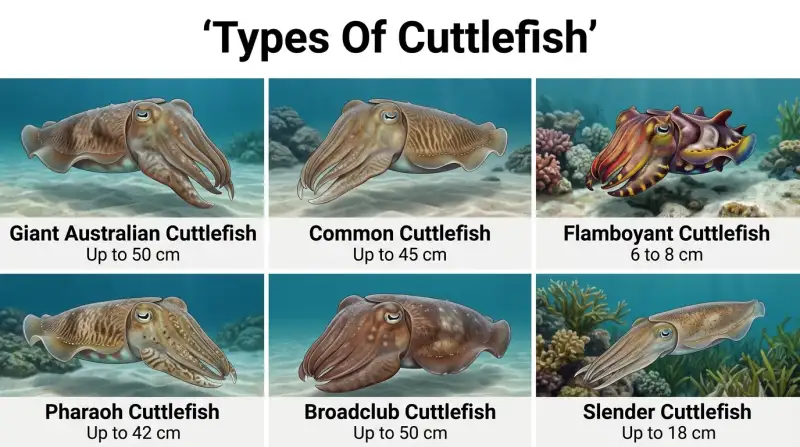
| Common Name | Scientific Name | Max Mantle Length | Primary Habitat | Key Identifying Feature |
|---|---|---|---|---|
| Giant Australian Cuttlefish | Sepia apama | Up to 50 cm | Temperate reefs, southern Australia | Massive size, complex skin folds, massive reproductive aggregations |
| Common Cuttlefish | Sepia officinalis | Up to 45 cm | Eastern Atlantic and Mediterranean | Classic broad oval mantle, robust calcareous cuttlebone |
| Flamboyant Cuttlefish | Metasepia pfefferi | 6 to 8 cm | Indo-West Pacific tropical muck | Vibrant red/yellow warning coloration, toxic flesh, walking gait |
| Pharaoh Cuttlefish | Sepia pharaonis | Up to 42 cm | Indo-Pacific, Red Sea to Japan | Striking zebra-stripe patterns, high commercial importance |
| Broadclub Cuttlefish | Sepia latimanus | Up to 50 cm | Coral reefs, Indo-Pacific | Extremely wide club tentacles, rapid behavioral mimicry |
| Slender Cuttlefish | Sepia aculeata | Up to 18 cm | Coastal Indo-Malayan waters | Elongated, slender mantle shape adapted to soft-bottom trawls |
The table above outlines several of the most ecologically significant and widely studied cuttlefish species. While size, geographic range, and morphology vary widely, all share the core physiological traits that define the Sepiida lineage.
Iconic Species Breakdown
Examining specific species highlights the evolutionary divergence within cuttlefish. While some have evolved massive proportions to dominate temperate rocky reefs, others remain small, highly specialized inhabitants of tropical mudflats.
The Giant Australian Cuttlefish (Sepia apama)
As the largest cuttlefish species on Earth, Sepia apama is an apex invertebrate predator of southern Australian coastal waters. During their annual breeding season in upper Spencer Gulf, tens of thousands of individuals gather in shallow rocky shallows. Males engage in elaborate color displays and tactical combat to secure mates. Their immense cuttlebone must withstand hydrostatic pressure down to considerable depths, yet remain lightweight enough to maintain neutral buoyancy.
The Common Cuttlefish (Sepia officinalis)
Inhabiting the Mediterranean Sea, the North Sea, and the eastern Atlantic, Sepia officinalis is the most thoroughly studied cephalopod in scientific literature. It thrives in shallow sandy and muddy substrates down to 200 meters. This species relies heavily on its exceptional ability to alter skin texture using muscular hydrostats known as papillae, matching jagged rocks, sand ripples, or smooth seagrass beds with astonishing precision.
The Flamboyant Cuttlefish (Metasepia pfefferi)
Unlike its pelagic and reef-dwelling cousins, the flamboyant cuttlefish is a benthic crawler native to the sandy and silty substrates of the Indo-West Pacific. It earned its name from the brilliant, pulsing waves of yellow, red, and brown chromatic displays that sweep across its mantle whenever it is disturbed. This conspicuous display is a form of aposematism; unlike most cuttlefish that rely on camouflage, the flamboyant cuttlefish possesses potent, muscle-paralyzing toxins in its flesh, making it strictly unpalatable to predators.
The Pharaoh Cuttlefish (Sepia pharaonis)
Widely distributed across the Indo-Pacific, including the Red Sea and Arabian Sea, the Pharaoh cuttlefish is recognized by its brilliant zebra-stripe signaling patterns used during courtship and territorial defense. It is also one of the most commercially harvested cuttlefish species globally, supporting major artisanal and industrial fisheries across Asian markets.
Anatomical and Physiological Variations
Beneath their varied external appearances, different types of cuttlefish exhibit distinct internal adaptations. The most critical anatomical differentiator across species is the cuttlebone. In pelagic and deep-water species, the cuttlebone is structurally reinforced to prevent implosion under high pressure. In contrast, benthic and shallow-water species often possess lighter, more porous cuttlebones or, in the case of some dwarf lineages, reductions in shell density.
, arm and tentacle morphology varies according to hunting specialization:
- Ambush Predators: Species with broad club tentacles (such as Sepia latimanus) utilize specialized surface areas packed with sucker rings to snap up fast-moving crustaceans and small fish from a hovering position.
- Sand-Burrowing Species: Many smaller species possess elongated, slender arms capable of rapidly scooping sediment over their bodies so that only their eyes protrude while waiting for prey.
- Specialized Glands: The presence of specific ink gland modifications—such as the accessory ink sac found in Sepiella species—allows these animals to release targeted mucous-bound ink blocks that mimic their own shape to confuse pursuing predators.
Ecological Distribution and Habitats
Cuttlefish are exclusively marine and are found in almost all temperate and tropical seas, with a notable absence in the Americas (true cuttlefish are native to the Old World: Europe, Africa, Asia, and Australia). Their distribution is heavily governed by water temperature, substrate availability, and salinity.
Temperate vs. Tropical Adaptations
Temperate species, such as the giant Australian cuttlefish and the common cuttlefish, experience seasonal migration patterns. They move into shallow coastal waters during spring and summer to spawn in warm, protected rocky reefs, then retreat to deeper continental shelf waters during colder winter months. Their life cycles are typically annual or biennial, ending shortly after mass spawning events.
Tropical species, by contrast, often maintain more stable, year-round populations in shallow coral reef ecosystems, mangrove fringes, and muck-diving grounds. Because tropical waters maintain relatively constant temperatures, breeding cycles are less strictly seasonal, though monsoon patterns and local current shifts can influence spawning peaks.
Substrate Specialization
The type of sea floor dictates which cuttlefish species can thrive in a given region:
- Sandy and Muddy Bottoms: Slender cuttlefish and various Sepia species rely on their ability to partially bury themselves in soft sediment to avoid detection by visual predators like sharks and marine mammals.
- Rocky Reefs and Kelp Forests: Large-bodied species utilize complex three-dimensional environments for shelter, egg-laying attachment sites (attaching fertilized eggs to the underside of ledges or kelp stipes), and ambush hunting grounds.
- Coral Rubble and Seagrass Beds: Smaller species weave through seagrass blades, utilizing disruptive coloration patterns that break up their silhouette against vertical vegetation lines.
Behavioral Diversity and Camouflage Mechanics
One of the defining characteristics uniting all types of cuttlefish is their extraordinary neural control over their integument. Their skin contains millions of specialized organs called chromatophores (pigment sacs expanded or contracted by radial muscles), iridophores (structural reflectors that create iridescent blues and greens), and leucophores (broad white reflectors).
Visual Signaling and Communication
Cuttlefish do not rely solely on passive camouflage; they use dynamic signals for intraspecific communication. During male-male competition, dominant individuals display intense high-contrast zebra banding, while subordinate males or those attempting sneaky mating tactics may display female-mimicking patterns on one side of their body while threatening rivals on the other.
Hunting Strategies
Cuttlefish are opportunistic carnivores, feeding primarily on crabs, shrimp, prawns, and small fish. Their hunting repertoire includes:
- The Hypnotic Display: Certain species ripple passing waves of color across their skin to mesmerize small fish or crustaceans before shooting out two specialized feeding tentacles with lightning speed.
- Stalking and Pouncing: Hovering close to the substrate, the cuttlefish adjusts its buoyancy to match the sea floor perfectly before lunging forward and trapping prey in its web of arms.
- Probe Hunting: Reaching into rock crevices and coral holes with flexible arms to flush out hidden crustaceans.
Commercial Importance and Conservation Status
Cuttlefish are economically vital marine resources, supporting major fisheries throughout the Mediterranean, East Asia, and the Indo-Pacific. They are harvested using bottom trawls, set nets, traps, and artisanal hook-and-line methods.
Fisheries and Human Consumption
Global cuttlefish catches run into hundreds of thousands of metrics tons annually. Their meat is prized in various global cuisines, and their cuttlebones are harvested extensively for the pet trade (providing essential calcium for caged birds and reptiles) and as traditional polishing agents in jewelry and dentistry.
Conservation Challenges
While the vast majority of cuttlefish species are classified as Least Concern by the IUCN due to their rapid growth rates and high reproductive output, certain populations face localized pressures:
- Habitat Destruction: Coastal development, port dredging, and industrial pollution degrade critical shallow-water spawning grounds.
- Overfishing: Intensive trawling during seasonal breeding aggregations can drastically deplete local stocks before individuals have a chance to reproduce.
- Climate Change: Rising ocean temperatures and ocean acidification threaten the structural integrity of the aragonite cuttlebone, impairing buoyancy regulation in sensitive pelagic and deep-water species.
Frequently Asked Questions
Are cuttlefish related to octopuses and squids?
Yes. Cuttlefish belong to the class Cephalopoda, making them close cousins to squids, octopuses, and nautiluses. They share high intelligence, a centralized brain, ink defense mechanisms, and complex eyes, but cuttlefish are uniquely distinguished by their internal, gas-filled cuttlebone.
How do cuttlefish control their buoyancy without a swim bladder?
Unlike fish that use gas-filled swim bladders, cuttlefish use their internal cuttlebone. The cuttlebone consists of numerous microscopic, lamellar chambers separated by vertical pillars. By pumping ions and water in and out of these chambers through a specialized membrane, the cuttlefish alters the gas-to-liquid ratio, allowing it to adjust its specific gravity and maintain neutral buoyancy at various depths.
Do all cuttlefish possess venom or toxins?
Not all cuttlefish are venomous or toxic, but several species possess defensive mechanisms. While most species use mild neurotoxins in their saliva to immobilize crustacean prey, the flamboyant cuttlefish (Metasepia pfefferi) is notably unique because its flesh contains potent toxins similar to those found in blue-ringed octopuses, making it lethal to consume.
How long do cuttlefish live?
Most cuttlefish species have remarkably short lifespans, typically living between 1 to 2 years. Their life cycle is semelparous, meaning they reproduce once at the end of their lifecycle and die shortly afterward. Rapid growth rates compensate for this short lifespan, allowing populations to rebound quickly under normal ecological conditions.
Can cuttlefish change their skin texture as well as their color?
Yes. In addition to expanding and contracting millions of chromatophores for color change, cuttlefish possess specialized muscles in their skin called papillae. These muscles allow them to physically alter the texture of their skin in fractions of a second, transforming a smooth surface into one covered in bumps, spikes, or ridges that mimic coral, seaweed, or sand.
Conclusion
The diversity within the order Sepiida highlights the extraordinary adaptability of cephalopods in marine environments. From the colossal giant Australian cuttlefish patrolling temperate reefs to the toxic, vibrant flamboyant cuttlefish scuttling across tropical muck, each type represents a unique evolutionary solution to survival in the ocean. Understanding these distinct species, their ecological needs, and their remarkable physiological traits underscores the importance of protecting coastal habitats to ensure these intelligent masters of disguise continue to thrive.