
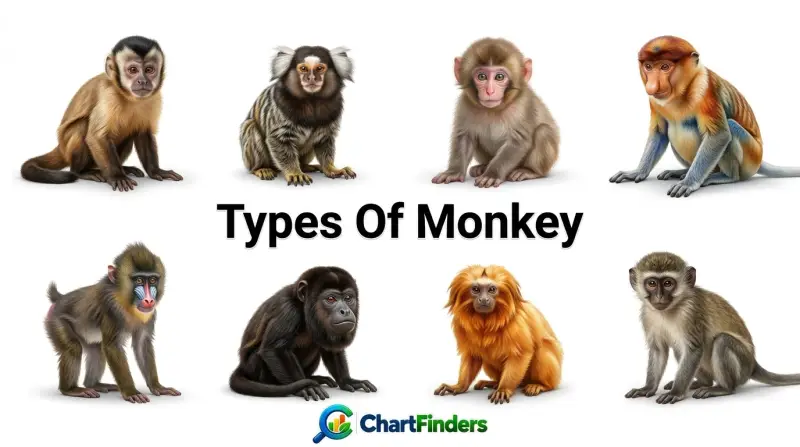
The primate order is one of the most diverse and fascinating branches of the animal kingdom, and within it, monkeys occupy a massive and ecologically complex space. When exploring the natural world, understanding the distinct classifications, evolutionary divides, and behavioral traits of these animals is essential. Far from being a monolithic group, monkeys have adapted to an extraordinary range of environments—from dense rainforest canopies and arid savannas to urban peripheries and high-altitude mountain forests. Recognizing what separates a baboon from a pygmy marmoset, or a New World monkey from an Old World species, requires diving deep into their biology, taxonomy, and ecological niches.
This master guide examines the taxonomy, major subfamilies, physical adaptations, and behavioral quirks that define the diverse array of monkeys living across the globe. Whether examining newly discovered species in Central Africa or analyzing the ancient evolutionary splits that separated American monkeys from their Eurasian and African counterparts, this resource delivers authoritative, zero-fluff insight into every major facet of monkey biology.
Types Of Monkey: An In-Depth Taxonomic and Ecological Overview
- Monkeys are split into two major infraorders: New World monkeys (Platyrrhini) and Old World monkeys (Catarrhini).
- There are over 260 recognized monkey species globally, with continuous field research uncovering new taxa, such as recent discoveries in the Congo basin.
- New World monkeys frequently possess prehensile tails and flat noses with sideways-facing nostrils; Old World monkeys lack prehensile tails and feature downward-facing nostrils.
- Apes (gibbons, chimpanzees, gorillas, orangutans, humans) are distinct from monkeys primarily because apes do not possess tails and exhibit superior brain-to-body mass ratios and suspensory shoulder anatomy.
- Monkey diets range from strict frugivory and folivory to opportunistic omnivory, heavily influencing their social structures, tooth morphology, and digestive tracts.
- Habitat loss, fragmentation, and illegal wildlife trafficking represent the most significant survival pressures facing wild monkey populations today.
To truly understand the various types of monkeys, one must first master the fundamental taxonomy that organizes them. Monkeys do not form a single, unified branch on the tree of life; rather, they represent two distinct evolutionary lineages that diverged tens of millions of years ago when continental drift separated the American landmass from Africa and Eurasia.
| Taxonomic Group | Geographic Range | Nose Structure | Tail Characteristics | Dental Formula | Representative Types |
|---|---|---|---|---|---|
| New World Monkeys (Platyrrhini) | Central and South America | Broad, flat; nostrils face sideways | Often prehensile (grasping) | 2.1.3.3 (36 teeth) | Capuchins, Spider Monkeys, Marmosets, Howler Monkeys |
| Old World Monkeys (Catarrhini) | Africa and Asia | Narrow; nostrils face downward | Non-prehensile (some species lack visible tails) | 2.1.2.3 (32 teeth) | Baboons, Macaques, Colobus, Mandrills, Langurs |
As the comparison table illustrates, anatomical divergence runs deep. The dental formula differences—where New World monkeys have three premolars on each side of the jaw (totaling 36 teeth), while Old World monkeys have only two premolars (totaling 32 teeth)—provide a definitive skeletal marker for researchers identifying museum specimens or fossilized remains.
New World Monkeys (Platyrrhini): The Arboreal Specialists of the Americas
Inhabiting the tropical forests of Mexico, Central America, and South America, New World monkeys are almost exclusively arboreal, spending the vast majority of their lives high in the forest canopy. Their anatomy is fine-tuned for a life spent leaping, climbing, and swinging among lianas and branches.
The Prehensile Tail Advantage
One of the most remarkable evolutionary adaptations found within Platyrrhini is the prehensile tail. Functioning almost like a fifth limb, these specialized tails feature friction pads, dermal ridges (similar to fingerprints), and powerful muscular control. Spider monkeys, woolly monkeys, and howler monkeys use their tails to anchor themselves while feeding on terminal branches that could never support their full weight. Marmosets and tamarins, which split off earlier in the evolutionary timeline, lack this capability entirely.
Key New World Families and Genera
- Atelidae (Spider, Woolly, and Howler Monkeys): Large-bodied arboreal monkeys known for complex social groups and loud vocalizations. Howler monkeys possess specialized hyoid bones that allow their roars to carry for miles through dense jungle.
- Cebidae (Capuchins and Squirrel Monkeys): Highly intelligent, dexterous monkeys famous for tool use, complex problem-solving, and large relative brain sizes.
- Pitheciidae (Sakis, Uakaris, and Titi Monkeys): Characterized by specialized seed-eating dentition and unique facial colorations, such as the bald, crimson-faced uakari.
- Callitrichidae (Marmosets and Tamarins): Miniature monkeys that exhibit cooperative breeding, where fathers and other group members carry twin infants, and claw-like nails instead of flat fingernails.
Old World Monkeys (Catarrhini): Ground Dwellers and Forest Adaptations
Crossing the Atlantic to Africa and Asia reveals the Old World monkeys. This single family, Cercopithecidae, is evolutionarily closer to apes and humans than to New World monkeys. Their ecological range is far broader, with many species having successfully transitioned from the trees to the ground.
Ischial Callosities and Cheek Pouches
Old World monkeys feature two distinct anatomical adaptations that set them apart from their American cousins. First, they possess ischial callosities—thickened pads of skin on their buttocks that allow them to sit comfortably on hard branches or rocky ground for extended periods without experiencing numbness or discomfort. Second, many species (such as guenons and macaques) possess internal cheek pouches, enabling them to stuff food quickly during foraging bouts and consume it later in the safety of the trees away from competitors and predators.
Subfamilies: Cercopithecinae and Colobinae
The family Cercopithecidae is divided into two major subfamilies based primarily on diet and digestive anatomy:
- Cercopithecinae (Baboons, Macaques, Guenons, and Mandrills): Generally omnivorous creatures with simple stomachs and cheek pouches. They thrive in diverse settings, from the freezing snow-covered mountains of Japan (macaques) to the open savannahs of East Africa (baboons).
- Colobinae (Colobus Monkeys, Langurs, and Leaf Monkeys): Specialized folivores (leaf-eaters) with complex, multi-chambered stomachs structurally similar to those of ruminants like cows. This specialized gut fermentation allows them to break down tough cellulose in leaves, though they cannot digest high-sugar fruits effectively and often live in areas with abundant foliage.
The Monkey Versus Ape Distinction: Clarifying Common Misconceptions
A frequent point of confusion among casual observers is the exact line separating monkeys from apes. In vernacular speech, people often call any non-human primate a monkey. Scientifically, however, the distinction is absolute and rooted in millions of years of divergent evolution.
The most reliable field marker is the presence or absence of a tail. No true ape possesses a tail, whereas the vast majority of monkeys do (with rare exceptions like the Barbary macaque, whose tail is vestigial). , apes (which include gibbons, siamangs, orangutans, gorillas, chimpanzees, bonobos, and humans) generally possess larger relative brain sizes, broader chests, shoulder joints adapted for suspensory locomotion (brachiation), and a more upright posture.
Monkeys move across supports using pronograde quadrupedalism—walking on all fours along the top of branches or the ground—with their spine kept roughly parallel to the ground. Apes, conversely, exhibit orthograde tendencies, capable of hanging, swinging, and walking semi-upright.
| Comparative Feature | Monkeys (Platyrrhini & Catarrhini) | Apes (Hominoidea) |
|---|---|---|
| Tail Presence | Usually present (prehensile or non-prehensile) | Completely absent in all species |
| Locomotion | Pronograde quadrupedalism (running/walking on top of branches) | Suspensory brachiating, knuckle-walking, or bipedalism |
| Shoulder Anatomy | Narrow chest, shoulder blades positioned laterally | Broad chest, shoulder blades positioned dorsally for overhead reaching |
| Brain-to-Body Ratio | Generally lower encephalization quotient | Significantly higher brain-to-body mass ratio |
Social Structures, Intelligence, and Foraging Ecology
Monkeys exhibit an extraordinary array of social organizations, driven largely by predation pressure, resource distribution, and reproductive strategies.
Matrilineal Societies and Dominance Hierarchies
In many Old World species, such as macaques and baboons, societies are strictly matrilineal. Females remain in their natal troop for life, forming tight kinship networks that dictate social dominance and access to resources. Males disperse upon reaching sexual maturity to avoid inbreeding, joining new troops where they must fight to establish social rank.
Conversely, species like spider monkeys often feature fission-fusion societies, where a large community breaks into smaller foraging parties during the day and reunites at night, depending on seasonal food availability and patch distribution.
Cognitive Complexity and Tool Use
Field studies have continually pushed back the boundaries of perceived primate intelligence. Capuchin monkeys in South America regularly use stone hammers and anvils to crack open extremely hard palm nuts, a cultural behavior passed down through generations. Macaques on coastal islands have been documented washing food, flaking stones, and even using human hair as dental floss.
Conservation Status and Threats in the Modern Era
Despite their adaptability, monkeys face severe anthropogenic pressures across their global range. Habitat destruction via slash-and-burn agriculture, palm oil plantations, and commercial logging fractures continuous forest tracts into isolated islands, leading to inbreeding depression and local extinctions.
Additionally, the illegal pet trade claims thousands of infant monkeys annually—often requiring poachers to kill the protective mother—while bushmeat hunting threatens numerous species in Central Africa and Southeast Asia. Field conservation efforts increasingly focus on community-led protected areas, corridor restoration, and ecotourism initiatives that provide local economic incentives to preserve intact primate habitats.
Frequently Asked Questions About Monkeys
What is the difference between a monkey and an ape?
The most definitive physical difference is that apes do not have tails, while almost all monkeys do. Apes also possess larger brains relative to body size, different shoulder anatomy that allows for arm-hanging (brachiation), and generally higher cognitive complexity.
Are lemurs considered monkeys?
No. Lemurs are strepsirrhine primates native exclusively to the island of Madagascar. They split from the evolutionary lineage that led to monkeys and apes over 60 million years ago. Lemurs possess distinct traits, such as wet noses (like dogs), tooth combs, and grooming claws.
Can monkeys be legally kept as pets?
In most jurisdictions, keeping monkeys as pets is either heavily restricted or outright illegal due to public health concerns, animal welfare issues, and the dangerous, aggressive behaviors adult monkeys often develop as they mature.
How many species of monkeys exist in the world?
There are over 260 recognized species of monkeys. Because field biologists continue to conduct expeditions in remote regions—such as the Congo basin and the Amazon rainforest—new species and subspecies are still periodically discovered and scientifically described.
Do all monkeys live in trees?
No. While most New World monkeys are strictly arboreal, many Old World monkeys—such as baboons, mandrills, patas monkeys, and certain macaques—spend a significant portion or even the majority of their lives on the ground.
Conclusion
Monkeys represent one of the most successful, adaptable, and diverse branches of mammalian evolution. From the prehensile-tailed acrobats of the New World tropical forests to the complex, ground-dwelling troops of the Old World, these animals display an astonishing variety of physiological and social adaptations. Understanding the distinct types of monkey, their geographic divides, and their ecological requirements not only enriches our knowledge of primatology but also underscores the vital importance of preserving the fragile habitats they call home.