
Sashimi is arguably the purest expression of Japanese culinary craftsmanship. Devoid of rice, sauces, or heavy cooking techniques, every slice stands entirely on its own merits: the quality of the harvest, the precision of the blade, and the expertise of the handler. Yet, before a single knife touches the block, mastery begins with absolute recognition. When staring at a pristine block of red tuna, a creamy amberjack loin, or a translucent slice of fluke, knowing exactly what species you are handling—and how to identify its anatomical landmarks—separates the amateur from the professional.
Whether you are sourcing product from a wholesale market, breaking down whole fish in a professional kitchen, or plating raw delicacies at home, an identification chart acts as your diagnostic map. This guide explores the taxonomy, visual markers, anatomical cuts, texture profiles, safety benchmarks, and identification edge cases of every major fish used in authentic sashimi preparation.
Explore our detailed breakdown on Rabbit Breed Identification Chart [Full Reference Chart].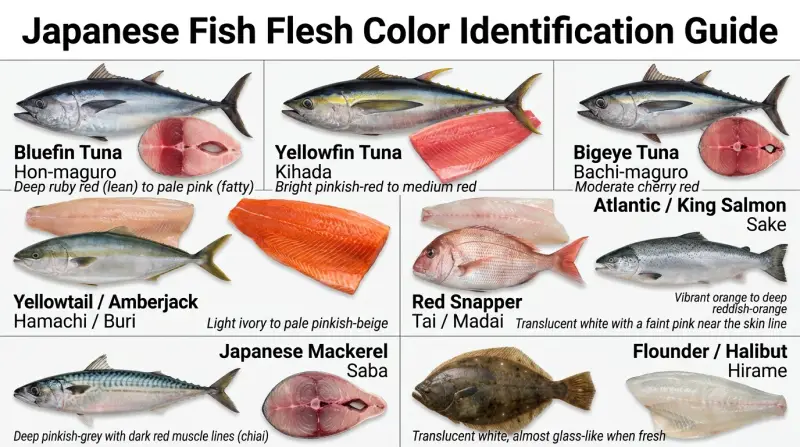
Identification Sashimi Fish Chart
- Visual Diagnostics: Sashimi identification relies heavily on flesh color, fat marbling patterns (shiro-ta), muscle grain direction, and translucency.
- Anatomical Precision: Different parts of a single fish (such as the senaka, chiai, and otoro of a tuna) yield entirely distinct textures and fat contents.
- Safety and Grading: Only sushi-grade (sashimi-grade) fish handled under strict parasite-free and temperature-controlled parameters should ever be consumed raw.
- Species Authentication: Recognizing subtle grain and color differences prevents costly mislabeling, such as mistaking oilfish (escolar) for legitimate butterfish or white tuna.
- Cutting Mechanics: Correct identification directly dictates knife technique—knowing whether to slice on a bias, pull-cut, or use a multi-directional drawing motion against the muscle fibers.
- Seasonal Variance: Many sashimi species change in fat content, flavor depth, and texture depending on seasonal spawning cycles and migratory patterns.
To master the identification of sashimi-grade fish, one must look beyond simple market names and examine the biological and physical characteristics of the flesh. The following reference matrix categorizes the essential species used in high-end raw bars, detailing their visual appearance, texture, and culinary profile.
| Fish Species (Common & Japanese) | Flesh Color & Appearance | Fat Content & Marbling | Texture & Mouthfeel | Flavor Profile |
|---|---|---|---|---|
| Bluefin Tuna Hon-maguro | Deep ruby red (lean) to pale pink (fatty) | Ranges from low (Akami) to intense, webbed marbling (Otoro) | Firm, melting, butter-like as fat increases | Rich, iron-forward (lean) to deeply sweet and savory (fatty) |
| Yellowfin Tuna Kihada | Bright pinkish-red to medium red | Very low fat; minimal to no visible marbling | Lean, firm, clean, and moderately dense | Mild, clean, less metallic than bluefin |
| Bigeye Tuna Bachi-maguro | Moderate cherry red | Medium; often shows clean fat lines in larger specimens | Softer than yellowfin, tender and moist | Balanced between the richness of bluefin and cleanliness of yellowfin |
| Atlantic / King Salmon Sake | Vibrant orange to deep reddish-orange | High; thick, wavy white fat lines (lipid bands) | Soft, buttery, and yielding | Rich, clean, naturally sweet oiliness |
| Yellowtail / Amberjack Hamachi / Buri | Light ivory to pale pinkish-beige | Moderate to high; rich intramuscular fat | Tender, snappy, yielding smoothly | Clean, buttery, slightly sweet finish |
| Red Snapper Tai / Madai | Translucent white with a faint pink tint near the skin line | Very low fat; lean | Firm, springy, and chewy with a clean snap | Subtle, sweet, clean, and delicate |
| Japanese Mackerel Saba | Deep pinkish-grey with dark red muscle lines (chiai) | High (oily fish) | Soft, flaky, dense | Strong, rich, savory, umami-heavy (typically cured in vinegar) |
| Flounder / Halibut Hirame | Translucent white, almost glass-like when fresh | Extremely low fat | Firm, elastic, chewy | Extremely subtle, clean, mineral-sweet |
Reading this table effectively requires understanding how muscle anatomy dictates these characteristics. For instance, fish with high swimming activity like mackerel develop robust, dark lateral blood lines, whereas sedentary flatfish like hirame yield pristine white, translucent fillets with a distinctly elastic bite.
Anatomy of Sashimi Fish Cuts
Identification goes beyond knowing the whole fish; it requires recognizing how a block of fish is sectioned. Master sushi chefs divide fish into specific anatomical zones to maximize texture and visual appeal.
The Tuna Breakdown: Akami, Chutoro, and Otoro
Bluefin and bigeye tuna are divided into three primary vertical and horizontal zones:
- Akami: The lean loin harvested from the upper back (senaka) and center of the fish. It features a deep ruby-red color, iron-rich flavor, and firm texture with virtually no visible fat marbling.
- Chutoro: The semi-fatty section located along the middle side and belly. It bridges the gap between lean akami and ultra-rich otoro, offering a balanced combination of iron depth and smooth melting fat. Recent refinements in cutting techniques, such as adjustments to the senaka block preparation, focus on minimizing sinews in chutoro to yield a silkier mouthfeel.
- Otoro: The prized under-belly portion (harakami/harashimo). It features extensive, web-like white fat marbling that melts instantly at body temperature, delivering a rich, buttery sweetness.
White Fish (Shiromi) Structural Zones
For white fish such as sea bream (madai) or fluke (hirame), the identification challenge lies in recognizing the skin-on presentation (matsukasa-zukuri or yubiki). Chefs often pour boiling water over the scaled skin to instantly cook the outer layer of fat while leaving the raw flesh intact beneath, creating a distinct dual-texture layer visible on the identification chart.
Key Identification Markers for Raw Consumption
When evaluating fish at a market or inspecting a block for sashimi prep, specific visual and tactile clues determine quality and species identity.
Flesh Grain and Muscle Fibers
Healthy sashimi-grade fish displays tight, unbroken muscle fibers. If the flesh appears separated, mushy, or gapping between the flakes, the fish is either improperly aged, mishandled, or past its prime. The direction of the grain tells the chef how to position the knife—always cutting across the muscle fibers to ensure a tender bite.
Color Uniformity and Oxidation
Fresh tuna should possess a vibrant, glowing red or pink hue. Brownish discoloration or grey edges indicate oxidation caused by exposure to oxygen or improper temperature control during transport. While surface oxidation can sometimes be trimmed away, deep discoloration points to structural degradation.
Odor Assessment
True sashimi-grade fish should smell clean, like a fresh sea breeze or cucumber, never fishy or ammonia-like. Any sour or heavy amine odor means the breakdown of proteins has begun, rendering the fish entirely unsafe for raw consumption.
Comparative Analysis of Major Sashimi Families
To deepen your diagnostic skills, it helps to compare raw fish families across broad culinary categories:
| Fish Category | Representative Species | Primary Sensory Marker | Standard Knife Technique |
|---|---|---|---|
| Akami / Red Meats | Bluefin, Bigeye, Yellowfin Tuna | Deep red iron hue, firm solid density | Hira-zukuri (Standard Rectangular Slice) |
| Shiromi / White Fish | Fluke (Hirame), Sea Bream (Madai) | Translucent glass-like clarity, elastic snap | Usu-zukuri (Paper-Thin Slice) |
| Hikarimono / Silver-Skin | Mackerel (Saba), Sardine (Iwashi) | Silvery skin, dark bloodline (chiai) | Sugata-zukuri or multi-cut patterned scoring |
| Fatty Pelagics | Salmon (Sake), Yellowtail (Hamachi) | Pronounced white lipid bands (marbling) | Kaku-zukuri or thick bias cuts |
Common Misidentifications and Safety Hazards
Mislabeling in the seafood industry remains a significant challenge. Certain species are frequently substituted, which can lead to culinary disappointment or severe digestive distress.
Escolar vs. White Tuna
One of the most notorious traps in raw fish identification is the substitution of Escolar (Lepidocybium flavobrunneum) or Oilfish for albacore tuna or butterfish (shiro-maguro). While escolar has a rich, buttery texture that appeals to some diners, it contains indigestible wax esters (gempylotoxyn) that can cause acute gastrointestinal distress (keriorrhea) when consumed in typical sashimi portions. Authentic albacore features a pale pinkish-tan hue with visible, fine muscle grain, whereas raw escolar is stark white and waxy.
Parasite Awareness and Freezing Protocols
Visual identification cannot always detect microscopic parasites such as Anisakis nematodes. Regulatory standards (such as FDA guidelines) dictate that wild-caught fish intended for raw consumption must be blast-frozen to specific sub-zero temperatures (e.g., -20°C/-4°F for 7 days or -35°C/-31°F for 15 hours) to neutralize parasites safely. Farmed Atlantic salmon, regulated under controlled feed diets, often bypasses traditional wild parasite risks, but verification of freezing or certified parasite-reduction protocols remains standard operating procedure.
Frequently Asked Questions
There is no official government or regulatory definition for “sashimi-grade” or “sushi-grade.” These terms are marketing and quality descriptors used by fishermen, wholesalers, and distributors to indicate that a fish has been handled, bled, gutted, and chilled rapidly, and typically frozen to kill parasites, making it safe and optimal for raw consumption.
Inspect the color, moisture, and clarity of the cut. Fresh sashimi-grade tuna should have a bright, translucent sheen without a milky film or drying edges. The color should be consistent throughout the block, and the aroma must be clean and briny, never sour or metallic.
That dark red muscle tissue is called chiai. It is rich in myoglobin and blood vessels, common in active swimmers like mackerel, bonito, and tuna. While completely edible and packed with iron and umami, chefs often trim the chiai from premium cuts because its strong, metallic flavor can overpower the delicate taste of the surrounding white or pink flesh.
Most wild freshwater fish (such as bass, trout, or catfish) are rarely served as traditional sashimi due to a high risk of dangerous liver flukes and parasites that cannot be reliably mitigated without cooking. The notable exception is specially farmed Atlantic salmon raised in controlled saltwater pens on sterile feed, which eliminates the parasite vector associated with wild river-run salmon.
Sashimi fish should be kept at the lowest possible refrigeration temperature without freezing solid (ideally between 32°F and 34°F / 0°C to 1°C). It should be wrapped tightly in paper towels to absorb excess moisture, then wrapped in plastic wrap to prevent air exposure, and consumed within 24 to 48 hours of purchase.
Conclusion
Mastering the identification of sashimi fish requires an ongoing appreciation of anatomy, handling standards, and visual diagnostics. By utilizing a comprehensive chart and respecting the intrinsic characteristics of each species, you ensure that every slice delivered to the table maintains the highest standards of safety, flavor, and culinary tradition.