
An Identification Siamese Color Chart categorizes the distinct temperature-sensitive point colorations found on Siamese cats, which are driven by a mutation in the tyrosinase enzyme. Traditional point colors include Seal, Chocolate, Blue, and Lilac, while newer recognized variations include Red (Flame), Lynx, and Tortie points. Correct identification relies on evaluating point pigment density, nose leather and paw pad coloration, and body-to-point contrast under natural lighting.
The enchanting beauty of the Siamese cat lies in one of the most fascinating genetic phenomena in the feline world: temperature-dependent albinism. When kittens are born, they are entirely white because the womb is uniformly warm, maintaining active tyrosinase enzymes that inhibit pigment production. As the cat matures and moves into cooler environments—specifically the extremities like the face, ears, legs, and tail—the enzyme activates, producing deep, rich coloration known as “points.”
Explore our detailed breakdown on Rabbit Breed Identification Chart [Full Reference Chart].Accurately identifying these variations requires more than a casual glance. Subtle shifts in undertones, skin pigmentation on the nose and paw pads, and the contrast against the torso distinguish a Seal Point from a Chocolate Point or a Blue Point from a Lilac Point. Whether you are an enthusiast, a prospective pet parent, or a breeder, understanding the nuances of the Siamese color spectrum ensures precise identification and deepens your appreciation of this iconic breed.
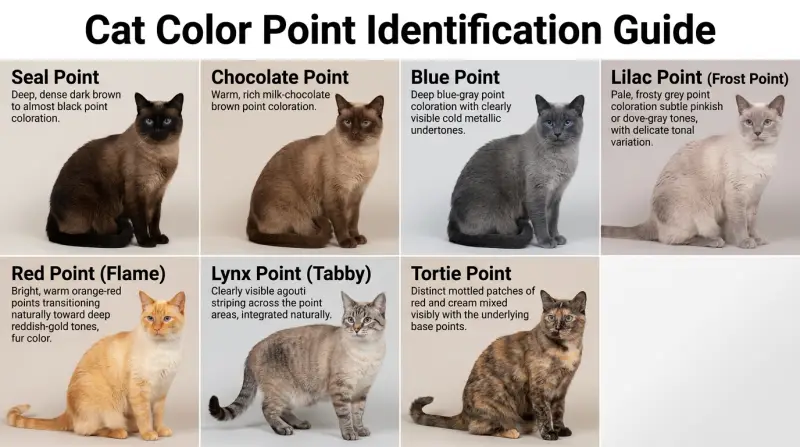
Understanding the Identification Siamese Color Chart
- Siamese point colors are governed by temperature-sensitive genetics, where cooler body areas develop deeper pigmentation.
- The traditional Siamese color chart comprises four core varieties: Seal, Chocolate, Blue, and Lilac.
- Modern breed registries recognize extended variations including Red (Flame), Cinnamon, Fawn, Tortie, and Lynx points.
- Nose leather and paw pad pigmentation serve as critical secondary identification markers when coat contrast is ambiguous.
- Body-to-point contrast varies significantly across categories, ranging from deep ivory shading to stark, cold-toned bluish-white.
To properly navigate the complexities of feline coat genetics, an organized framework is essential. The Siamese color chart serves as a taxonomic map, breaking down distinct color groups based on genetic melanin production, dilution genes, and agouti patterns. Below is a comprehensive breakdown of the recognized point colors.
| Point Color Category | Point Color Description | Body Color | Nose & Paw Pad Pigmentation | Key Identification Marker |
|---|---|---|---|---|
| Seal Point | Deep, dense dark brown to almost black | Fawn to warm cream, darkening with age | Dark brown to black | High contrast; dark points that dominate the face mask |
| Chocolate Point | Warm, rich milk-chocolate brown | Ivory to warm white, minimal shading | Cinnamon-pink to coral | Lighter, warmer point tone than Seal; milky brown ears and mask |
| Blue Point | Deep blue-gray with cold metallic undertones | Glacial white to cool platinum-gray | Slate gray | Cool, silver-blue cast across all points with a whitish body |
| Lilac Point (Frost Point) | Pale, frosty grey with pinkish or dove-gray tones | Magnolia white, very consistent | Lavender-pink | The lightest traditional point; distinct pinkish-gray cast |
| Red Point (Flame) | Bright, warm orange-red to deep reddish-gold | Creamy white, often showing faint shading | Flesh pink to coral pink | Tabby barring (ghost rings) commonly visible on the tail and forehead |
| Lynx Point (Tabby) | Agouti striping over any base point color | Shaded off-white with agouti ticking | Brick red edges (varies by base) | “M” marking on forehead, striped legs, banded tail |
| Tortie Point | Mottled patches of red/cream mixed with base points | Matches base point color | Matches base points, often mottled with pink | Feline chimerism appearance; multi-colored point breaking |
The table above highlights how genetic modifiers dictate the final visual profile of the cat. Examiners should never rely solely on body color, as environmental temperature fluctuations—such as living in a cold climate or having experienced a surgical shave—can cause a cat’s body fur to darken dramatically, a phenomenon known as thermal darkening.
Comparative Analysis: Siamese vs. Related Breed Standards
To provide further clarity on how Siamese point genetics intersect with the broader feline world, the following comparative table details the defining characteristics of Siamese color restrictions against closely related shorthair breeds.
| Feature | Siamese Cat | Oriental Shorthair | Colorpoint Shorthair |
|---|---|---|---|
| Coat Colors & Patterns | Strictly restricted to traditional and recognized point variations (Seal, Chocolate, Blue, Lilac, Red, Lynx, Tortie) | 300+ colors and patterns including solid, tabby, tortoiseshell, and smoke | Pointed pattern identical to Siamese, but includes red, cream, cinnamon, fawn, and lynx variations |
| Eye Color | Always vivid, deep blue (breed standard requirement across all point types) | Typically green; blue eyes are only permitted in white-coated individuals | Always vivid blue |
| Body Type & Frame | Slender, tubular, fine-boned with long legs and a wedge-shaped head | Nearly identical wedge head and angular frame to the Siamese | Slender, tubular, identical body structure to the Siamese |
| Vocalization | Extremely loud, melodic, and demanding communicators | Equally vocal, high-energy, and chatty | Very vocal, sharing the communicative traits of the Siamese ancestry |
The Four Traditional Siamese Point Colors
For decades, traditional cat fancy organizations restricted purebred Siamese to four distinct color classes. These core varieties share a unified ancestry and maintain strict phenotypic standards regarding eye color, body type, and point distribution.
Seal Point: The Original Phenotype
The Seal Point is what most people picture when they think of a classic Siamese. Featuring dense, dark brown points that extend to the face, ears, legs, and tail, these cats possess a striking contrast against their warm fawn or cream bodies. Over time, seal points tend to experience significant body shading, often turning a rich warm brown as they enter middle age. Their nose leather and paw pads are solidly dark brown or black.
Chocolate Point: The Warmer Contrast
Often confused with Seal Points by the untrained eye, Chocolate Points display a much warmer, milk-chocolate coloration on their points. Their bodies remain a clean, pale ivory without the heavy shading seen in older seal points. A definitive diagnostic feature for the chocolate point is the cinnamon-pink or coral coloration of the nose leather and paw pads, providing a softer overall aesthetic.
Blue Point: The Cool Aristocrat
The Blue Point is characterized by a cold, bluish-white body complemented by deep blue-gray points. Unlike the warm brown undertones of seal and chocolate, blue points carry a genetic dilution factor that replaces dense black/brown melanin with slate-gray pigment. The nose leather and paw pads are a matching slate gray, reinforcing the cool-toned palette.
Lilac Point: The Lightest Traditional
The Lilac Point—historically referred to as the frost point—represents the most delicate dilution in the traditional Siamese spectrum. The points present as a pale, frosty grey with distinct pinkish or dove-gray undertones. The body is a luminous magnolia white that resists heavy shading. The nose leather and paw pads are a unique lavender-pink, separating them instantly from the slate-gray of the blue point.
Modern and Outcross Point Variations
Through careful breeding programs and outcrossing with other shorthaired breeds, the Siamese color palette has expanded beyond the original four pillars. While purists historically debated these variations, modern registries widely accept them.
Red (Flame) and Cream Points
Introduced via crosses with domestic red tabbies and American Shorthairs, Red Points—often called Flame Points—feature bright orange-red points contrasted against a clear white body. Because the red gene carries agouti patterns inherently, faint “ghost” striping is almost always visible on the forehead and lower legs. Cream points represent the diluted version of the red point, displaying soft, pale buff-cream points on a snowy white coat.
Lynx Point (Colorpoint Shorthair Contributions)
Lynx points feature tabby striping overlaid onto any of the standard point colors. They can manifest as seal-lynx, blue-lynx, chocolate-lynx, or lilac-lynx. Key diagnostic identifiers include the classic “M” shape on the forehead, white spectacles around the eyes, striped whisker pads, and distinct rings encircling the tail and legs.
Tortoiseshell (Tortie) Points
Tortie points result from the combination of a base point color (usually seal, chocolate, or blue) with the sex-linked red or cream gene. This creates a mottled, patchwork appearance across the points, blending dark pigment with warm red or cream flecks. Because this genetic combination requires two X chromosomes, almost all Tortie Point Siamese are female.
Step-by-Step Identification Methodology
When assessing an unfamiliar cat using an identification Siamese color chart, a systematic approach prevents misclassification. Follow this workflow to accurately determine point color:
- Examine Overall Body Contrast: Assess the lightness or darkness of the torso. Pale ivory and white point toward chocolate and lilac, while warmer cream and shaded fawn point toward seal and blue.
- Inspect the Extremities (Points): Look closely at the mask, ears, legs, and tail under bright natural light. Differentiate between brown tones (seal vs. chocolate) and gray tones (blue vs. lilac).
- Check Nose Leather and Paw Pads: This is the ultimate tie-breaker. Slate gray indicates blue; lavender-pink indicates lilac; dark brown/black indicates seal; and cinnamon-pink indicates chocolate.
- Look for Agouti Markings: Check for striped legs, tail rings, or a forehead “M.” If present, classify the cat as a Lynx Point of the corresponding base color.
- Assess Sex and Mottling: If the points feature mixed patches of red/orange alongside dark brown or gray, identify the cat as a Tortie Point.
Common Identification Mistakes and Exceptions
Even experienced handlers can make errors when utilizing a color chart due to natural biological variables in felines. Understanding these pitfalls ensures accurate classification.
- Thermal Darkening: Cats living in colder climates develop darker body fur because the tyrosinase enzyme reacts to lower skin temperatures. A seal point living in a cold region can appear almost entirely dark brown across its torso.
- Age-Related Pigment Shifts: Siamese kittens are born pure white. Their final point coloration can take up to 12 to 18 months to fully mature and stabilize.
- Lighting Conditions: Artificial indoor lighting—particularly warm incandescent bulbs—can distort blue points, making them look warmer or browner than they actually are. Always verify colors in natural daylight.
- Coat Clipping After Surgery: When a patch of fur is shaved for veterinary procedures, the new hair grows back pitch black or deeply pigmented because the skin underneath is cooler during the regrowth phase, temporarily altering the cat’s visual profile.
Frequently Asked Questions
Lilac points and cinnamon/fawn variations are generally considered the rarest within traditional breeding lines. Because the genetic combinations require specific recessive dilution alleles from both parents, pure lilac and fawn specimens occur less frequently than dominant seal or blue points.
Yes. The genetic mutation responsible for point coloration (albinism mutation in the tyrosinase gene) also prevents pigment from depositing in the iris, resulting in the characteristic vivid blue eyes required by breed standards across all recognized point colors.
Yes. Siamese cats naturally darken with age. As their metabolism slows and internal body temperature drops slightly over the years, melanin production increases, causing the body fur to develop a shaded fawn or gray cast and the points to deepen.
The easiest way is to check the nose leather and paw pads. Seal points have dark brown or black leather, while chocolate points have a distinct cinnamon-pink or coral tone. Additionally, chocolate points maintain a cleaner, lighter ivory body, whereas seal points develop darker shading.
Lynx points—sometimes called Colorpoint Shorthairs in certain registries—originated from historical experimental crosses between Siamese and American Shorthairs with tabby patterns. Today, major cat fancier associations recognize them as legitimate variations of the Siamese family, though purist organizations maintain strict separations.
Conclusion
Mastering the identification Siamese color chart requires a blend of genetic awareness, visual observation, and attention to secondary markers like nose leather and paw pad pigmentation. Whether evaluating traditional pillars like Seal and Lilac or modern adaptations like Lynx and Tortie points, understanding the interplay between temperature, enzymes, and melanin allows for precise classification. By relying on structured identification protocols and accounting for environmental factors like thermal darkening, enthusiasts can accurately interpret the stunning spectrum of this iconic feline breed.