
The natural landscape is full of fascinating creatures, but few capture the imagination—or cause quite as much arboricultural concern—quite like the inchworm. Also known as loopers, spanworms, or measuringworms, these fascinating insects are actually the larval stage of moths belonging to the family Geometridae, a Greek derivative meaning “earth measurer.” Their common name stems from the optical illusion they create while traveling: because they lack the central prolegs found in most other caterpillars, they must draw their rear end up to meet their front end, arching their bodies high into the air before stepping forward once more.
For landowners, gardeners, and forestry professionals, accurate identification is the of effective landscape management. Misidentifying an inchworm or confusing it with other defoliating caterpillars can lead to mistimed interventions, wasted resources, and unnecessary environmental stress. Whether you are inspecting ornamental trees for early spring damage or attempting to diagnose a sudden defoliation event in a mixed hardwood forest, understanding the distinct morphology, color variations, feeding signs, and seasonal timelines of these creatures is vital. This guide provides an authoritative, field-tested breakdown to help you accurately identify, assess, and understand inchworms in any environment.
Explore our detailed breakdown on Rabbit Breed Identification Chart [Full Reference Chart].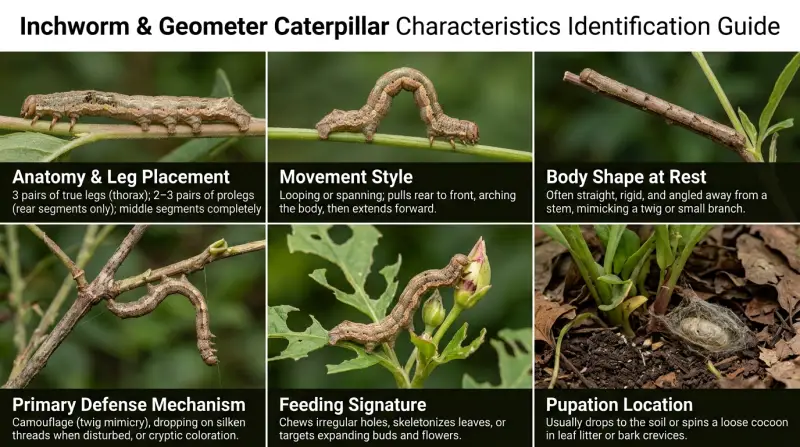
Inchworm Identification Chart
- Anatomical Distinction: Inchworms feature only two or three pairs of prolegs at their rear abdominal segments and true legs at the front, creating a distinctive legless gap in the middle.
- Locomotion Clue: Their unique “looping” gait (looping the body upward to pull the rear forward) is the most reliable behavioral identifier in the field.
- Taxonomic Origin: Inchworms are not a single species but represent the entire family Geometridae, encompassing thousands of distinct moth species globally.
- Seasonal Activity: Many destructive species (such as winter moth or fall cankerworm) emerge early in spring, aligning precisely with new bud break and leaf expansion.
- Mimicry Mastery: Many inchworm species possess rigid, bark-like textures and can hold themselves upright at an angle, perfectly mimicking twigs to evade avian predators.
- Damage Profile: Feeding typically results in “window-paning” (eating the green tissue while leaving veins intact) or complete defoliation if populations surge.
- Management Strategy: Early scouting and monitoring via traps or visual checks are necessary before moving to targeted treatments like biological controls or selective insecticides.
Distinguishing inchworms from other garden and forest caterpillars requires an understanding of both physical anatomy and behavioral patterns. The following comprehensive reference details the primary traits used by field entomologists and pest management professionals to identify geometrid larvae.
| Identification Feature | Inchworm (Geometrid Larva) | Standard Caterpillar (e.g., Owlet Moth / Tent Caterpillar) |
|---|---|---|
| Anatomy & Leg Placement | 3 pairs of true legs (thorax); 2–3 pairs of prolegs (rear segments only); middle segments completely legless. | 3 pairs of true legs (thorax); 4–5 pairs of prolegs distributed evenly along the abdomen. |
| Movement Style | Looping or spanning; pulls rear to front, arching the body, then extends forward. | Couching, gliding, or rippling forward smoothly with all prolegs engaged simultaneously. |
| Body Shape at Rest | Often straight, rigid, and angled away from a stem, mimicking a twig or small branch. | Usually resting flat against leaves, bark, or silken webs with the body relaxed or curled. |
| Primary Defense Mechanism | Camouflage (twig mimicry), dropping on silken threads when disturbed, or cryptic coloration. | Irritating hairs, defensive spines, distasteful chemical sequestration, or gregarious tent-building. |
| Feeding Signature | Chews irregular holes, skeletonizes leaves, or targets expanding buds and flowers. | Defoliates entire branches, creates heavy silken tents, or strips leaf margins completely. |
| Pupation Location | Usually drops to the soil or spins a loose cocoon in leaf litter or bark crevices. | Spins robust silken cocoons on branches, under bark flaps, or pupates underground. |
This structural difference is the foundational element of any reliable identification key. While standard caterpillars use a wave-like muscular contraction across five pairs of prolegs to glide along a surface, the geometrid’s reduced anatomy forces it to pivot entirely on its terminal anchors.
Anatomical Structure and Morphological Clues
To master inchworm identification, one must look closely at insect morphology. A standard caterpillar possesses up to eight pairs of legs—three pairs of true, segmented legs on the thorax (the segments immediately behind the head) and five pairs of fleshy prolegs along the abdomen. Inchworms, by evolutionary adaptation, have lost the prolegs on abdominal segments three through five.
This reduction is not a deformity; it is a specialized evolutionary design. By reducing unnecessary appendages, the caterpillar’s body becomes lighter and more streamlined, facilitating better disguise capabilities. When threatened, an inchworm can contract its specialized muscles and remain completely motionless, projecting outward from a twig at a 45-degree angle. Special hook-like structures on their rear prolegs (called crochets) lock onto the plant surface, allowing the larva to hold this rigid, twig-like posture for hours without muscle fatigue.
Coloration and Pattern Variations
Inchworm coloration varies wildly depending on the species, instar stage (growth phase), and host plant. Common hues include:
- Camouflage Green: Highly prevalent among species feeding on tender spring foliage, matching the exact shade of the host leaves.
- Bark Browns and Grays: Common in species that rest on woody stems during daylight hours, often featuring mottled patterns that mimic lichen or rough bark.
- Warning Colors (Aposematic): Though less common in geometrids than in other families, some species feature subtle yellow, orange, or dark striping to deter visual predators.
Behavioral Identification: The “Looping” Mechanism
When physical examination is difficult due to high foliage or tiny specimens, behavior provides the definitive answer. The locomotion of an inchworm is completely unique in the insect world.
When an inchworm travels, it executes a distinct sequence:
- Anchoring: The caterpillar anchors its thoracic true legs firmly to the surface.
- Releasing and Arching: It releases its rear prolegs and draws the posterior end forward directly behind the front legs. This causes the middle of the body to bow upward into a distinct vertical loop or “omega” shape.
- Extending: Once the rear prolegs are re-anchored close to the front, the caterpillar releases its true legs and lunges forward, stretching its body out flat to its maximum length.
- Repeating: The cycle repeats continuously, giving the impression that the creature is literally measuring out the distance it travels—hence the historical taxonomic term “measuringworm.”
Additionally, when disturbed, many inchworm species will immediately drop from the branch, suspended safely in mid-air by a fine strand of silk. Once the danger passes, they use the same thread to climb back up to the canopy.
Major Inchworm Species and Regional Variations
The family Geometridae is massive, containing over 35,000 described species worldwide. However, land care professionals and property owners typically encounter a handful of prominent species responsible for significant aesthetic or structural damage to trees and shrubs.
Winter Moth (Operophtera brumata)
An introduced pest prominent in northeastern North America, the winter moth is notorious for defoliating deciduous trees such as oak, maple, apple, and elm. The larvae emerge very early in spring—often coinciding with the swelling of buds. The tiny caterpillars burrow directly into unopened buds, destroying leaves before they can even unfurl. Fully grown larvae are pale green with white longitudinal stripes.
Fall Cankerworm (Alsophila pometaria)
Despite its name, fall cankerworm eggs hatch in early spring, and the larvae feed voraciously through late spring. The key distinguishing feature of the fall cankerworm is that it possesses three pairs of abdominal prolegs instead of the typical two found in most other inchworms (the first pair on the fifth abdominal segment is smaller, but present). They display high color variability, ranging from light green to dark brown or nearly black.
Spring Cankerworm (Paleacrita vernata)
Closely resembling the fall cankerworm, the spring cankerworm has only two pairs of abdominal prolegs. Spring cankerworm larvae are smooth-skinned, ranging from yellowish-green to dark gray or black with narrow yellow stripes down the sides. They feed on a wide variety of shade and fruit trees.
Fruittree Operophtera and Other Loopers
Various other loopers, such as the omnivorous looper or cabbage looper, target agricultural crops and garden ornamentals. While agricultural loopers target herbaceous plants and vegetables, arboricultural loopers focus on woody perennials, creating distinct management challenges.
Life Cycle and Seasonal Timeline
Understanding the life cycle of inchworms is essential for effective timing in landscape monitoring and management. While life cycles vary slightly by species, the general progression follows a predictable annual rhythm.
Most destructive forest and landscape inchworms complete one generation per year:
- Egg Stage: Eggs are typically laid in late autumn or early spring, depending on the species, tucked into bark crevices, lichen patches, or twig junctions.
- Larval Stage: Hatching occurs synchronously with spring bud break (often peaking in May). This is the feeding phase, lasting 4 to 6 weeks, during which the caterpillar passes through several instars, growing exponentially and causing the vast majority of plant damage.
- Pupation: Upon reaching maturity in late spring or early summer, the caterpillars drop to the ground on silken threads, burrowing into the soil or leaf litter to spin a loose cocoon and pupate.
- Adult Stage: Adults emerge as moths. In some species (like winter and fall cankerworms), the females are wingless or have vestigial wings and must crawl up tree trunks to lay eggs, a vulnerability exploited by sticky band barriers.
Scouting, Monitoring, and Damage Assessment
Effective management begins with rigorous scouting. Because inchworms can multiply rapidly and strip a canopy before damage is noticed from a distance, early detection is critical.
Visual Inspection Techniques
Inspect trees and shrubs during early spring when buds begin to swell. Look closely for:
- Tiny holes chewed through expanding bud scales.
- Silken threads hanging from branch tips.
- Leaves exhibiting “window-paning” or skeletonization, where the upper and lower epidermis are left intact while the green mesophyll is consumed.
Physical Traps and Monitoring Tools
For species with wingless females (such as cankerworms and winter moths), sticky barrier bands wrapped around tree trunks in autumn or late winter prevent crawling females from reaching the upper canopy to lay eggs. Pheromone traps can also be deployed to monitor adult male moth flight activity and gauge potential population pressures for the following spring.
Integrated Management and Control Strategies
Once inchworm identification is confirmed and population thresholds are assessed, land care professionals implement targeted management strategies that minimize environmental impact while protecting valuable flora.
Cultural and Mechanical Controls
- Hand-picking: Viable for small garden shrubs or low-hanging branches on young landscape trees.
- Barrier Bands: Highly effective non-chemical control for species with flightless adult females.
- Pruning: Removing heavily infested, dying twigs during winter pruning reduces overwintering egg masses.
Biological and Microbial Controls
When populations exceed aesthetic or structural thresholds, biological interventions are the preferred first line of defense:
- Bacillus thuringiensis (Bt): A naturally occurring soil bacterium that is highly specific to caterpillar larvae. Bt must be ingested by the feeding larva, making precise timing (application during early larval stages) critical. It has minimal impact on beneficial insects, birds, and mammals.
- Natural Predators: Encouraging predatory birds, parasitic wasps, and predatory beetles helps maintain natural equilibrium in diverse landscapes.
Chemical Options
If infestations are severe and threaten the health of mature, high-value landscape trees, professional arborists may utilize low-impact systemic or contact insecticides. Selection should always prioritize products that preserve pollinators and beneficial parasitoids whenever possible.
Frequently Asked Questions
No. While certain species like the winter moth and cankerworms can cause severe defoliation when populations surge, many geometrid species exist at low densities as a normal component of forest and garden ecosystems without causing noticeable harm. , inchworms serve as a vital food source for nesting songbirds and other wildlife.
Cutworms belong to the family Noctuidae and possess the standard caterpillar complement of prolegs (five pairs). They do not loop when they move; instead, they crawl smoothly and often curl into a tight “C” shape when disturbed. Cutworms also typically feed at night near the soil line, whereas inchworms are active in the canopy.
No. Unlike some stinging caterpillars (such as saddlebacks or puss caterpillars) that possess venomous spines or hairs, inchworms are completely harmless to handle. They have no venom and cannot bite human skin; their mandibles are strictly adapted for chewing plant foliage.
This is an innate escape response. When birds, wind, or human activity disturb the branch, the inchworm lets go and drops away from the immediate danger zone, relying on its silk thread as a safety line. Once the threat passes, it climbs back up the thread to resume feeding.
Healthy deciduous trees can generally survive a single season of heavy defoliation by refoliating later in the growing season, though it forces the tree to draw upon stored energy reserves. However, successive years of defoliation—or severe defoliation combined with other environmental stressors like drought—can fatally weaken the tree.
Conclusion
Mastering inchworm identification is an essential skill for anyone tasked with maintaining healthy landscapes, gardens, or woodlands. By recognizing their distinct anatomical structure—specifically the absence of central prolegs—and their signature looping locomotion, observers can easily separate geometrid larvae from look-alike caterpillars. Combined with a solid understanding of their seasonal timelines, feeding behaviors, and life cycles, proper identification allows property owners and professionals to implement timely, targeted management strategies, ensuring that valuable trees and plants remain vigorous and resilient for years to come.