
For rockhounds, amateur geologists, lapidary artists, and outdoor enthusiasts, stumbling upon an unremarkable, weathered nodule on a trail can lead to the discovery of a geological treasure. Geodes are among the most fascinating natural formations on Earth, yet their outward appearance is notoriously deceptive. To the untrained eye, a true geode resembles little more than a lumpy, dirt-encrusted stone ball or an ordinary piece of limestone. Walking past these hidden wonders is remarkably easy without a systematic framework for recognition and field verification.
Utilizing a proper identification chart bridges the gap between raw potential and verified discovery. By breaking down specific physical indicators—such as exterior nodular texture, relative weight anomalies, acoustic resonance, and regional weathering patterns—field-experienced rock hunters can dramatically increase their odds of identifying a geode before resorting to a rock hammer or tile saw. This comprehensive guide explores the anatomy of geodes, details the complete identification chart framework, examines internal mineral compositions, differentiates look-alikes, and provides practical field techniques for accurate rockhounds.
Explore our detailed breakdown on Unopened Geode Identification Chart: Complete Reference Chart.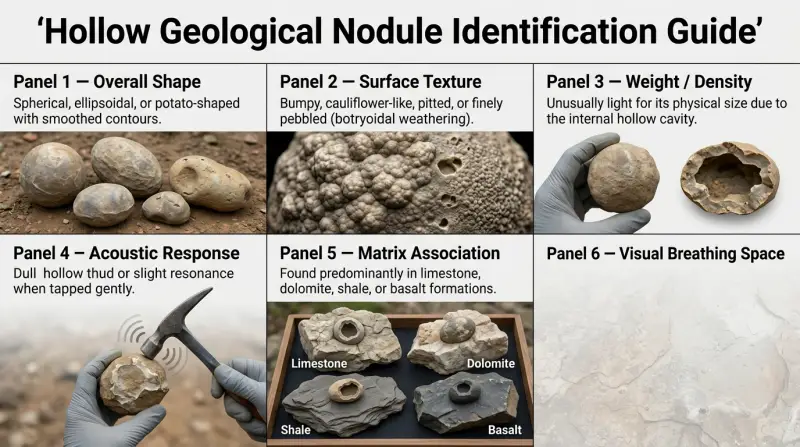
Identifier Geode Identification Chart
- External Shape Matters: True geodes frequently exhibit a rounded, spherical, ellipsoidal, or “potato-like” morphology rather than sharp, angular fracture planes or flat cleavage faces.
- Weight Anomalies: Because geodes possess a hollow or partially hollow interior cavity, they often feel noticeably lighter than solid rocks of identical volume and mineral composition.
- The Bumpy Crust: Many geodes feature a characteristic bumpy, lumpy, pitted, or cauliflower-like exterior texture (botryoidal weathering) caused by silica hardening on the outer shell.
- Sound Testing: Tapping a potential geode with a soft mallet, wooden handle, or hammer can produce a hollow thud or resonance rather than a sharp, solid clack, though this is not entirely foolproof.
- Matrix Distinctions: Distinguishing geodes from thundereggs (solid-filled nodules) and concretions requires examining internal silica bonding, host rock environment, and crystal growth phases.
The core of successful geode hunting relies on visual, tactile, and acoustic evaluation. The following identifier geode identification chart outlines the primary physical attributes, distinguishing characteristics, and field indicators used by professional mineralogists and experienced collectors to separate ordinary rock matrix from crystal-bearing cavities.
| Physical Attribute | Classic Geode Indicator | Look-Alike / False Positive | Field Significance |
|---|---|---|---|
| Overall Shape | Spherical, ellipsoidal, or potato-shaped with smoothed contours. | Angular, blocky, fractured chunks with sharp edges and cleavage planes. | Spherical forms indicate uniform cavity growth in host rock vesicles, fossils, or nodules. |
| Surface Texture | Bumpy, cauliflower-like, pitted, or finely pebbled (botryoidal weathering). | Smooth, glassy, or completely uniform and flat river-worn faces. | Silicon-rich rinds weather slower than surrounding limestone, creating a lumpy relief. |
| Weight / Density | Unusually light for its physical size due to the internal hollow cavity. | Heavy, dense, matching standard rock specific gravity (granite, basalt). | Mass distribution points to empty space or lightweight secondary crystal linings inside. |
| Acoustic Response | Dull hollow thud or slight resonance when tapped gently. | Sharp, solid, high-pitched clack or metallic ring. | Indicates air or loose interior matter, though solid chalcedony can dampen sound. |
| Matrix Association | Found predominantly in limestone, dolomite, shale, or basalt formations. | Igneous intrusive granites without secondary mineral replacement. | Chemical dissolution of nodules in sedimentary beds or gas bubbles in lavas creates host cavities. |
When analyzing rocks in the field, no single indicator should be taken in complete isolation. For instance, a rock can be heavy and still contain a geode if the internal cavity is entirely choked with thick, massive quartz or heavy barite crystals. Conversely, a completely hollow rock might simply be a weathered-out fossil mold rather than a mineral-lined crystal vault. Combining shape, surface texture, and weight provides the most reliable pre-fracture assessment.
Anatomy of a Geode: How They Form
Understanding how geodes form clarifies why identification charts rely on specific visual markers. Geodes begin their life as cavities in sedimentary, metasedimentary, or igneous rock. In sedimentary environments—such as limestone and dolomite beds—these cavities are often formed by dissolved fossils (such as brachiopods or crinoids), root cavities, nodules of anhydrite, or pockets within shale. In volcanic environments, gas bubbles trapped in cooling basalt or rhyolite lava flows form vesicles that later become the site of mineral deposition.
Over millions of years, groundwater rich in dissolved silica (in the form of microscopic quartz, chalcedony, or opal) percolates through the surrounding rock. This mineral-laden water seeps into the cavity. As the water settles, microscopic layers of silica precipitate along the inner walls of the cavity, forming a tough outer shell or “rind.” This rind is typically composed of cryptocrystalline chalcedony, which is far harder and more chemically resistant than the host limestone or basalt matrix.
Once the protective outer shell hardens, subsequent mineral-rich fluids continue to enter through microscopic pores or micro-fractures. Over extended geological epochs, these solutions feed crystal growth inward toward the center of the void. Depending on the chemical composition of the fluids, trace elements, and ambient temperatures, the interior may crystallize into sparkling quartz points, purple amethyst, golden calcite, pink barite, or banded layers of agate.
Visualizing Geode Distribution and Mineral Frequencies
To better understand what miners and rockhounds encounter in the field, mineralogical data reveals distinct patterns in internal mineral compositions across major North American and global geode fields. Quartz and chalcedony dominate the vast majority of finds, while rarer mineral fillings command high collector value.
| Mineral Filling Type | Relative Field Frequency (%) | Primary Coloration | Common Host Environment |
|---|---|---|---|
| Clear/White Quartz | 65% | Transparent, white, smoky gray | Limestone and dolomite beds |
| Chalcedony / Agate Bands | 20% | Gray, blue, brown, white banding | Volcanic basalt flows and sedimentary nodules |
| Calcite / Dolomite | 8% | Yellow, honey, white, colorless | Limestone cavities |
| Amethyst (Purple Quartz) | 5% | Light lavender to deep violet | Volcanic and hydrothermal cavities |
| Rare Minerals (Celestine, Barite, Pyrite) | 2% | Blue, metallic brass, tabular white | Specialized chemical sedimentary layers |
Step-by-Step Geode Identification Process
Applying a structured methodology prevents unnecessary damage to non-geode specimens and ensures that high-potential stones are properly handled. Field identification requires moving from macro-environmental observation down to close tactile inspection.
Step 1: Geological Context Verification
Before examining an individual rock, verify that you are searching in a geode-bearing geological formation. Geodes are rarely found randomly scattered across arbitrary terrain. They are most commonly hosted in:
- Limestone and Dolomite Formations: Formations dating to the Mississippian and Devonian periods are world-famous for producing hollow, quartz-lined geodes (such as those found in the Midwestern United States, including Keokuk, Iowa).
- Volcanic Basalt Flows: Gas bubble cavities in ancient lava flows frequently yield thundereggs, agate-filled nodules, and zeolite-lined vesicles.
- Shale and Marl Beds: Weathered clay-rich layers often erode away, leaving resilient silica-rinded nodules exposed on the surface.
Step 2: External Visual Inspection
Pick up the specimen and inspect the outer surface in natural sunlight. Look for a spherical or rounded shape that stands out from the angular, jagged rocks surrounding it. Check for the signature “lumpy,” “pitted,” or “cauliflower” texture. This texture is the result of chalcedony nodules growing outward and weathering differentially from the softer surrounding limestone matrix. Smooth, polished river stones or sharp, broken quarry gravel should be immediately ruled out.
Step 3: The Weight and Balance Test
Weigh the rock in your hand. Compare its size to standard rocks of similar dimensions made of solid granite, limestone, or sandstone. If the rock feels surprisingly light—as though it is hollow inside—it passes one of the most critical diagnostic tests for a geode. If it feels exceptionally heavy and dense, it is likely a solid rock or a thunderegg filled solid with chalcedony.
Step 4: The Tap Test (Acoustic Evaluation)
Gently tap the rock with a soft wooden mallet, a specialized rock pick handle, or another small stone. Listen closely to the sound produced:
- Solid Clack: Produces a high-pitched, sharp, ringing sound indicating a dense, solid interior.
- Hollow Thud: Produces a dull, muffled thud or a slight hollow resonance, indicating an air pocket or loose crystal interior.
Caution: Never strike a potential geode with extreme force during the testing phase, as doing so can shatter a pristine hollow crystal interior before its structure can be evaluated.
Distinguishing Geodes from Common Look-Alikes
One of the most frequent challenges for beginning rockhounds is confusing true geodes with geological look-alikes. Nature produces several formations that mimic the external appearance of a geode while possessing entirely different internal structures.
Thundereggs vs. Geodes
Thundereggs (often called filled geodes or nodular quartzites) share the exact same external appearance, weight distribution, and bumpy rind as true geodes. However, instead of a hollow interior cavity, thundereggs are completely filled solid with microcrystalline quartz, chalcedony, agate, or jasper. While they lack a hollow center, they often polish into stunning display pieces due to their internal patterns and banding.
Concretions
Concretions are hard, compact masses formed by the precipitation of mineral cement within the spaces between sediment particles. Common examples include Moqui marbles, septarian nodules, and ironstone concretions. While they can be remarkably spherical, concretions are solid through and through and do not possess inward-facing crystal linings.
Fossil Shells and Brachiopods
In limestone environments, fossilized shells of brachiopods, crinoids, and mollusks can become filled with silica and weather out of the rock as rounded nodules. When cracked open, they reveal fossil impressions, skeletal fragments, or simple calcite infill rather than geometric quartz crystal points.
| Formation Type | Internal Structure | Crystal Growth | Distinguishing Feature |
|---|---|---|---|
| True Geode | Hollow or partially hollow cavity. | Inward-facing terminated crystals (quartz, calcite, etc.). | Hollow core with distinct mineral lining. |
| Thunderegg / Nodule | Solid interior. | Massive chalcedony, agate, or quartz filling. | No hollow space; solid agate core. |
| Concretion | Uniform or concentric solid layers around a nucleus. | Fine-grained mineral cement. | Often iron-rich with concentric rings or septarian cracks. |
| Fossil Mold | Hollow or mineral-filled fossil cavity. | Organic imprints, shell fragments, or calcite infill. | Recognizable organic shapes. |
Common Mistakes in Geode Identification
Even experienced collectors occasionally fall victim to misidentification pitfalls. Recognizing these common errors saves time, prevents wasted effort, and protects valuable mineral specimens.
- Assuming All Round Rocks Are Geodes: Glaciers and rivers tumble rocks into perfectly rounded, smooth spheres. Without the bumpy botryoidal rind, a round river stone is almost never a geode.
- Applying Excessive Force Immediately: Striking a rock with a heavy sledgehammer on the first try often destroys delicate interior crystal structures or shatters the specimen into unrecoverable shards. Always use a proper rock pick, tile saw, or pipe-cutter splitting method.
- Ignoring Geological Mapping: Searching for sedimentary geodes in igneous mountain ranges or vice versa drastically reduces discovery rates. Always consult regional geological surveys before embarking on a hunt.
- Pitting Weight Expectations Against Porosity: A geode filled with heavy minerals like barite or heavy metal sulfides will not feel light. Relying solely on the weight test without evaluating surface texture leads to missed finds.
Frequently Asked Questions
You can identify a geode without breaking it by evaluating its shape, surface texture, and weight. True geodes are typically rounded or potato-shaped, feature a bumpy or cauliflower-like exterior texture (botryoidal rind), and feel noticeably lighter than solid rocks of the same size due to their hollow interior.
No. While clear, white, or smoky quartz is the most common interior mineral, geodes can also contain amethyst, chalcedony, calcite, dolomite, barite, goethite, and occasionally rare minerals like celestine or pyrite depending on the local chemical environment.
The safest and cleanest method to open a geode is using a tile saw with a diamond blade, which preserves both halves cleanly. Alternatively, field collectors use a manual geode-splitting hammer, a chisel, or place the geode inside a heavy-duty canvas bag and tap it evenly with a hammer around its circumference.
Yes, geodes frequently end up in rivers and stream beds because weathering breaks them out of surrounding limestone or shale cliffs, and they wash downstream. However, because they are durable, finding them in stream gravel requires looking for their distinctive bumpy exterior amidst smoother river rocks.
A geode forms in sedimentary or volcanic cavities with an open hollow interior lined with inward-growing crystals. A thunderegg (nodule) forms specifically in rhyolitic volcanic ash beds and is typically filled completely with solid agate, jasper, or chalcedony, featuring a star-shaped or solid core rather than an open cavity.
Conclusion
Mastering geode identification transforms a casual walk in nature into an engaging exercise in geological observation. By relying on a structured identifier geode identification chart, rock hunters can look past rough, unassuming exteriors and spot the subtle indicators of hidden crystal wonders. Whether exploring ancient limestone riverbeds or volcanic ash deposits, understanding shape anomalies, weight distribution, and surface textures ensures that every specimen collected is evaluated with precision, care, and geological appreciation.