
Quick Answer: Oklahoma is home to a diverse population of arachnids, most notably active hunters like wolf spiders and southern house spiders, alongside the medically significant brown recluse and black widow. While venomous species are present, true indoor encounters are often exaggerated compared to harmless roaming hunters. Accurate identification relies on examining eye arrangements, cephalothorax markings (such as the recluse violin), body proportions, and behavioral traits rather than color alone.
(Reference: Spider Identification: Brown Recluse and Black Widow)Navigating urban and rural pest management in the South Central United States requires an acute understanding of local biodiversity. Oklahoma’s unique climate zones—ranging from humid eastern forests and cross timbers to semi-arid western plains—create ideal microhabitats for a wide variety of arachnids. For homeowners, property managers, and pest control professionals, differentiating between harmless beneficial predators and hazardous species is a daily operational necessity. Misidentifying a common household roaming spider as a dangerous pest leads to unnecessary panic and improper chemical applications, while failing to recognize a medically significant species introduces real safety risks.
Explore our detailed breakdown on Pest Droppings Identification Chart: Field Data Breakdown.This comprehensive guide provides an authoritative framework for evaluating Oklahoma spider populations. By analyzing morphological indicators, behavioral patterns, habitat preferences, and venom profiles, you can accurately assess and manage arachnid encounters around structures. The following sections outline the essential identification markers, safety precautions, and integrated management strategies required to maintain a secure, pest-free environment.
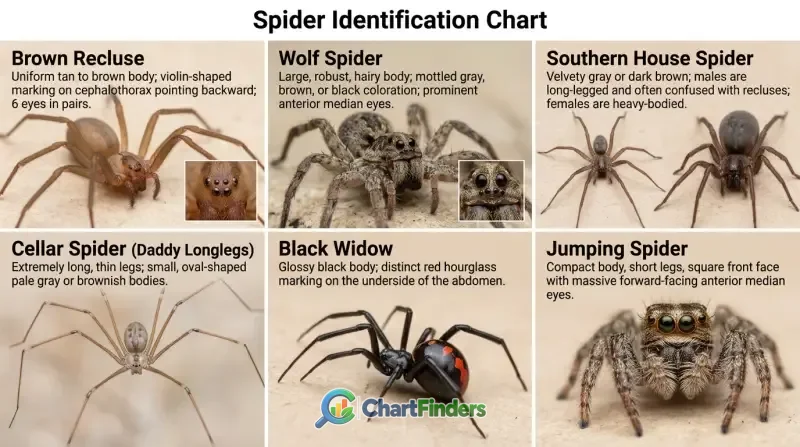
Oklahoma Spiders Identification Chart
- Dominant Species: Wolf spiders, southern house spiders, and cellar spiders represent the vast majority of large roaming and web-building spiders encountered in Oklahoma homes and yards.
- Medical Significance: The brown recluse and southern/northern black widows are native to Oklahoma; their venoms require cautious handling, though bites typically occur only when they are physically compressed against skin.
- Behavioral Indicators: Active ground hunters like wolf spiders do not spin webs for capturing prey, whereas southern house spiders, black widows, and cellar spiders construct distinct, irregular or scaffolding webs in hidden crevices and corners.
- Anatomical Markers: Eye patterns (such as the recluse’s 6 eyes in pairs), cephalothorax markings, and body proportions are definitive diagnostic features rather than color alone.
- Strategic Management: Structural exclusion, moisture reduction, and clutter elimination are far more effective than broad-spectrum chemical treatments for long-term spider control.
A structured approach to spider identification requires examining specific physical and behavioral traits. The following data table details the primary spider species encountered in Oklahoma structures and landscapes, contrasting their physical attributes, habitat choices, and management implications.
| Common Name | Scientific Name | Primary Identification Markers | Web & Hunting Behavior | Typical Habitat in Oklahoma | Medical Significance |
|---|---|---|---|---|---|
| Brown Recluse | Loxosceles reclusa | Uniform tan to brown body; violin-shaped marking on cephalothorax pointing backward; 6 eyes in pairs. | Irregular, sticky retreat web built in dark, undisturbed voids; hunts away from web at night. | Basements, closets, attics, behind storage boxes, undisturbed woodpiles. | Medically significant; necrotic venom requires medical evaluation. |
| Wolf Spider | Lycosidae family | Large, robust, hairy body; mottled gray, brown, or black coloration; prominent anterior median eyes. | Does not spin a web; active nocturnal ground hunter that chases down prey. | Ground level, yards, window wells, garage floors, near exterior foundations. | Not medically significant; defensive bite causes minor localized pain. |
| Southern House Spider | Kukulcania hibernalis | Velvety gray or dark brown; males are long-legged and often confused with recluses; females are heavy-bodied. | Constructs a messy, circular web with a tubular retreat hole in masonry crevices. | Exterior brickwork, porches, eaves, dark corners of garages and basements. | Harmless; docile temperament with minimal venom impact on humans. |
| Cellar Spider (Daddy Longlegs) | Pholcidae family | Extremely long, thin legs; small, oval-shaped pale gray or brownish bodies. | Builds loose, irregular, three-dimensional webs in high corners and damp areas. | Basements, crawlspaces, upper wall corners, damp utility rooms. | Harmless; completely benign to humans despite urban myths. |
| Black Widow | Latrodectus mactans / L. hesperus | Glossy black body; distinct red hourglass marking on the underside of the abdomen. | Strong, irregular scaffolding web built close to the ground in dark recesses. | Woodpiles, meter boxes, under outdoor furniture, crawlspace debris, hollow logs. | Medically significant; neurotoxic venom requires immediate medical attention. |
| Jumping Spider | Salticidae family | Compact body, short legs, square front face with massive forward-facing anterior median eyes. | Active daytime hunter; stalks prey and leaps significant distances; uses dragline silk. | Sunny exterior walls, garden foliage, window sills, fences. | Harmless; curious, docile temperament; bites are exceedingly rare and minor. |
Understanding the distinctions in the table above prevents misdiagnoses. For instance, the physical similarity between male southern house spiders and brown recluse spiders frequently causes unnecessary alarm. Reviewing specific anatomical keys prevents these costly identification errors.
Anatomical Foundations of Spider Morphology
Arachnid identification relies on specialized terminology. Unlike insects, spiders possess two main body segments: the cephalothorax (head and thorax fused) and the abdomen. They lack antennae and wings, utilizing pedipalps near the mouthparts for sensory functions and reproduction (particularly enlarged, bulbous tips in mature males).
- Eye Arrangement: Most spiders possess eight eyes, but arrangement and relative size vary drastically across families. Recluse spiders are distinct with six eyes arranged in three dyads (pairs). Wolf spiders feature a prominent pair of large upper eyes flanked by smaller rows. Jumping spiders possess a massive forward-facing set of principal eyes granting stereoscopic color vision.
- Leg Characteristics: Spine distribution, claw counts, and leg orientation differentiate families. Wandering hunters like wolf spiders have sturdy, heavily spined legs adapted for running over rough terrain, whereas web-weavers possess comb-like claws (such as theridiids) for manipulating silk.
- Spinnerets: Located at the rear of the abdomen, these silk-producing organs vary in length, number, and configuration, reflecting specific web-spinning and dragline-building habits.
Major Spider Categories Encountered in Oklahoma
Property owners evaluating arachnid populations across the state will generally encounter a few dominant groups. Recognizing their ecological roles helps determine whether control measures are necessary or if the species serves as a natural pest deterrent.
Active Ground Hunters: Wolf Spiders (Lycosidae)
Wolf spiders are heavy-bodied, robust hunters that frequently wander indoors during autumn as temperatures drop and they seek overwintering sites. They do not spin webs to capture prey; instead, they rely on exceptional eyesight and speed to ambush insects. Their large size and dark, mottled coloration often lead homeowners to mistake them for dangerous species. However, wolf spiders are inherently shy and will attempt to escape rather than confront humans. Bites occur strictly in self-defense when trapped against the skin.
Reclusive Dwellers: The Brown Recluse (Loxosceles reclusa)
While Oklahoma is situated well within the native range of the brown recluse, encounters inside well-maintained, climate-controlled living spaces are less common than public perception suggests. These spiders thrive in undisturbed, low-traffic microhabitats. They are characterized by a uniform coloration lacking distinct abdominal stripes or bands, paired with a dark violin-shaped pattern on the dorsal surface of the cephalothorax (pointing backward toward the abdomen). Because other harmless species share similar colorations, verifying the six-eyed arrangement under magnification is the only infallible identification method.
Medically Significant Web-Weavers: Black Widows (Latrodectus spp.)
Both the southern black widow (Latrodectus mactans) and occasionally the western black widow (Latrodectus hesperus) inhabit Oklahoma. Females are jet-black, shiny, and feature a characteristic red or orange hourglass shape on the ventral (underside) abdomen. They build erratic, dense scaffolding webs in sheltered, low-level outdoor areas such as meter boxes, stacked firewood, and crawlspaces. Their neurotoxic venom causes systemic symptoms (latrodectism) including severe muscle cramping, nausea, and hypertension, necessitating prompt medical evaluation if a bite occurs.
Web-Weavers and Crevice Dwellers
Static web builders account for the majority of everyday webs found in corners and structural joints. The southern house spider, cellar spider, and funnel-weaving grass spiders occupy these niches:
- Southern House Spiders: Often mistaken for recluses due to the long, slender legs of the males, these spiders build distinctive, fuzzy webs radiating outward from a masonry crevice. Females remain hidden deep within structural gaps, while males wander in search of mates.
- Cellar Spiders: Commonly referred to as “daddy longlegs” (distinct from harvestmen, which are true arachnids but not spiders), these creatures vibrate their webs rapidly when disturbed to blur their outline against predators.
- Grass Spiders: Frequently found on lawns and foundation borders, they construct sheet webs ending in a tubular retreat, causing panic when homeowners mistake their funnel webs for those of dangerous species.
Habitat Preferences and Seasonal Activity Patterns
Arachnid presence is heavily dictated by environmental factors such as temperature, relative humidity, and prey availability. In Oklahoma’s volatile climate, seasonal shifts trigger predictable movement patterns.
During spring and summer, populations expand outdoors where insect prey is abundant. As late summer transitions into fall, cooling outdoor temperatures prompt ground-dwelling hunters and wandering males to seek thermal refuge inside residential and commercial structures. Basements, garages, ground-level entryways, and utility rooms serve as primary migration corridors.
Moisture is another critical driver. Cellar spiders and fishing spiders congregate near damp crawlspaces, leaky plumbing fixtures, and sump pumps. Conversely, brown recluse spiders prefer dry, protected environments such as cardboard boxes stored in attics, unused clothing in closets, and structural voids behind drywall.
Diagnostic Identification Protocol
When an unidentified spider is discovered, utilize the following step-by-step evaluation protocol before taking action:
- Observe the Location and Web Architecture: Is the spider sitting in an open, messy web in a high corner, a dense scaffolding web near ground level, or is it actively running across the floorboards at night? Web-builders rarely pose medical risks compared to active wanderers or secretive crevice-dwellers.
- Examine the Cephalothorax: Look closely at the upper front body segment. Does it feature a distinct violin shape with the neck pointing toward the rear abdomen? If absent, rule out the brown recluse immediately.
- Count and Arrange the Eyes: Using a magnifying glass or macro photography, check the eye configuration. Spiders with six eyes grouped in distinct pairs strongly suggest a recluse species, whereas eight eyes arranged in specific rows point toward harmless hunters or other web-weavers.
- Inspect Abdominal Patterns and Proportions: Note whether the abdomen is solid-colored, striped, or marked with specific geometric shapes or a red hourglass. Most dangerous spiders possess highly identifiable abdominal markings or glossy, globular bodies.
Common Identification Mistakes and Pitfalls
Misidentifying spiders leads to inefficient pest management and unnecessary chemical exposure. Avoid these frequent errors:
- Relying Solely on Color: Many harmless species display shades of brown, tan, and gray identical to medically significant spiders. Color is the least reliable diagnostic feature.
- Confusing Cellar Spiders with Brown Recluses: The extremely long, delicate legs of cellar spiders bear no structural resemblance to the sturdy, medium-length legs of a recluse, yet panic frequently blurs these differences.
- Assuming All Ground Spiders are Dangerous: Large, hairy wolf spiders look intimidating, but their venom is mild and poses no systemic threat to healthy human adults.
- Overlooking Harvestmen: True harvestmen (daddy longlegs) possess a single fused oval body segment and lack venom entirely, yet people frequently attempt to exterminate them as dangerous pests.
- Mistaking Male Southern House Spiders for Recluses: Mature male southern house spiders have elongated legs and tan-brown colorations that frequently trigger unwarranted brown recluse alarms.
Integrated Pest Management (IPM) for Oklahoma Structures
Relying exclusively on chemical sprays yields poor long-term results for spider control because spiders do not groom themselves in the manner of insects, rendering many contact residual pesticides ineffective. An integrated strategy is essential.
Exclusion and Structural Sealing
Prevent spiders from crossing the threshold by securing the building envelope:
- Install and repair tight-fitting door sweeps on all exterior exits.
- Caulk gaps around window frames, utility penetrations, and siding joints.
- Repair torn window and door screens immediately.
- Seal masonry cracks and expansion joints around the foundation perimeter.
Sanitation and Habitat Modification
Eliminate the conditions that attract spiders and their insect prey:
- Store seasonal items in sealed plastic bins rather than open cardboard boxes, which provide ideal harborages for brown recluse spiders.
- Clear away heavy vegetation, woodpiles, and thick mulch beds from within three feet of the foundation wall.
- Reduce indoor humidity using dehumidifiers in damp basements and crawlspaces.
- Regularly vacuum dark corners, baseboards, and under furniture to remove egg sacs and web structures.
Frequently Asked Questions
No. Brown recluse spiders are remarkably non-aggressive. Bites occur almost exclusively when a spider is trapped directly against human skin—such as when sliding into a shoe left on the floor, rolling onto one in bed, or pressing against one while moving stored items. They prefer to flee when disturbed.
Wolf spiders are significantly larger, hairier, and feature prominent leg spines and mottled patterns. Brown recluse spiders are smaller, uniformly colored tan to brown, possess a distinct violin marking on the cephalothorax, and have six eyes arranged in three pairs rather than the eight eyes of a wolf spider.
Yes. Cellar spiders are aggressive predators that frequently capture and consume other spiders, including larger wandering spiders and occasionally brown recluses, by wrapping them rapidly in silk from a safe distance using their long legs.
Wash the bite area thoroughly with soap and water and apply a cold compress to reduce swelling. If you suspect a bite from a medically significant species (such as a brown recluse or black widow), or if localized pain intensifies, ulceration begins, or systemic symptoms develop, seek medical attention immediately.
Broad-spectrum indoor chemical spraying is generally discouraged. Spiders walk on the tips of their legs, minimizing contact with treated surfaces. , eliminating spiders without addressing their underlying insect food source or sealing entry points will only result in a quick re-infestation. Focus on exclusion, vacuuming, and reducing indoor clutter.
Conclusion
Managing Oklahoma spider populations requires a calm, methodical approach grounded in accurate identification and environmental control. While species like the brown recluse and black widow demand cautious handling and professional oversight when populations surge, the vast majority of spiders encountered indoors are harmless, beneficial predators that help suppress nuisance insect populations. By maintaining structural exclusion, reducing indoor moisture, and utilizing identification keys correctly, property owners can ensure a safe, balanced living environment without unnecessary chemical dependency.