
Avian reproduction presents field researchers, wildlife rehabilitators, and ornithologists with fascinating diagnostic challenges, none more unique than the identification of strigiform ova. Understanding the morphology of these reproductive units requires stepping away from the standard paradigms of passerine or waterfowl egg identification. While garden birds and raptors often lay tinted, speckled, or heavily blotched shells designed for camouflage in open or cup nests, strigiforms exhibit a remarkably conservative palette. Virtually all true owl eggs share a stark white or chalky appearance, an evolutionary byproduct of their cavity-nesting and nocturnal habits, where visual camouflage from aerial predators inside dark hollows, cliff ledges, or old raptor nests is largely unnecessary.
(Reference: Owls | Game Commission | Commonwealth of Pennsylvania)Identifying these fragile specimens correctly requires looking beyond color to a constellation of subtle physical parameters: precise millimeter dimensions, shell porosity, surface texture, clutch size configurations, and the temporal layout of the nesting substrate. Because disturbing active nests violates conservation ethics and, in many jurisdictions, federal wildlife protection laws, field identification must frequently rely on abandoned clutches, non-viable eggs left behind after fledging, or careful, non-invasive observation. This guide establishes a rigorous framework for examining strigiform reproductive material, offering detailed comparative metrics across multiple North American and Eurasian species to ensure accurate field diagnosis.
Explore our detailed breakdown on Pest Droppings Identification Chart: Field Data Breakdown.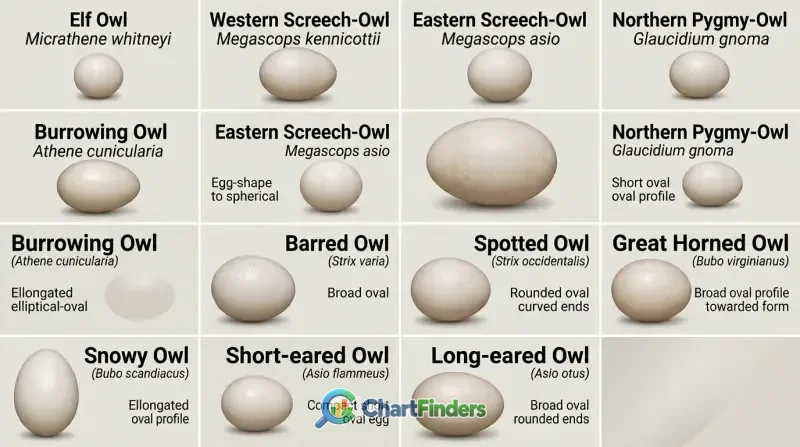
Owl Egg Identification Chart
- Universal Base Color: Nearly all owl eggs are solid white, cream-white, or dull chalk-white, completely lacking the complex speckling found in falconiform or accipitrid raptor eggs.
- Shape and Texture: Strigiform eggs tend to be unusually spherical (round-oval) or sub-elliptical, with a matte, non-glossy texture that often accumulates nest debris and stains over the incubation period.
- Size Scaling: Dimensions correlate directly with adult body mass, ranging from roughly 26 mm in tiny elf owls to over 54 mm in great horned and snowy owls.
- Clutch Staggering: Females begin incubation with the laying of the first egg, resulting in asynchronous hatching where eggs and nestlings of vastly different sizes coexist in the same cavity.
- Nesting Environment Clues: Because owls rarely build their own nests, the physical substrate—whether a tree hollow, old squirrel drey, cliff scrape, or abandoned hawk nest—provides vital contextual evidence.
- Conservation Status: All owl species and their reproductive materials are protected under strict wildlife regulations; handling active nests requires appropriate scientific permits.
Field identification of strigiform reproductive units is most effectively managed through systematic comparative analysis. The following comprehensive matrix outlines the physical parameters, typical clutch counts, and nesting contexts for major owl species, serving as a primary reference tool for field ornithologists.
| Species | Average Length (mm) | Average Width (mm) | Shape Profile | Clutch Size Range | Primary Nesting Substrate |
|---|---|---|---|---|---|
| Elf Owl (Micrathene whitneyi) | 26.0 – 28.5 | 22.0 – 24.0 | Nearly spherical | 2 – 4 | Old woodpecker tree cavities |
| Western Screech-Owl (Megascops kennicottii) | 33.0 – 37.0 | 28.0 – 31.0 | Broad oval | 3 – 5 | Natural tree hollows, nest boxes |
| Eastern Screech-Owl (Megascops asio) | 35.0 – 39.0 | 30.0 – 33.0 | Sub-spherical | 4 – 6 | Tree cavities, old flicker holes |
| Northern Pygmy-Owl (Glaucidium gnoma) | 27.5 – 31.0 | 23.0 – 26.0 | Short oval | 3 – 7 | Abandoned woodpecker holes |
| Burrowing Owl (Athene cunicularia) | 30.5 – 36.0 | 25.0 – 29.0 | Elliptical-oval | 6 – 11 | Underground mammal burrows |
| Barred Owl (Strix varia) | 46.0 – 52.0 | 38.0 – 43.0 | Broad oval | 2 – 4 | Large tree cavities, broken snags |
| Spotted Owl (Strix occidentalis) | 48.0 – 53.0 | 40.0 – 44.0 | Rounded oval | 2 – 3 | Old platform nests, tree forks |
| Great Horned Owl (Bubo virginianus) | 54.0 – 61.0 | 44.0 – 49.0 | Broad oval to rounded | 1 – 4 | Stick nests of hawks/ravens, ledges |
| Snowy Owl (Bubo scandiacus) | 53.0 – 65.0 | 42.0 – 50.0 | Elongated oval | 3 – 11 | Ground scrape on Arctic tundra ridges |
| Short-eared Owl (Asio flammeus) | 38.0 – 44.0 | 31.0 – 35.0 | Short oval | 4 – 8 | Ground depression in dense marsh/grass |
| Long-eared Owl (Asio otus) | 38.0 – 42.0 | 31.0 – 34.0 | Broad oval | 4 – 6 | Abandoned corvid or hawk nests |
| Northern Saw-whet Owl (Aegolius acadicus) | 29.5 – 32.5 | 24.5 – 27.0 | Sub-spherical | 4 – 7 | Conifer forest cavities, nest boxes |
Reading this reference chart requires understanding that biometric measurements in avian biology always feature slight intraspecific variance. Environmental factors, regional subspecies differences, and the age or nutritional health of the female parent can influence egg dimensions by a few millimeters in either direction. Therefore, measurements should be treated as a diagnostic baseline rather than an absolute rule.
Morphological Foundations of Strigiform Ova
The physical structure of an owl egg reflects millions of years of evolutionary adaptation to specific reproductive niches. Unlike songbirds that construct open cup nests exposed to solar radiation and avian predators, strigiforms lay their ova in sheltered, dark, or semi-subterranean microhabitats.
Coloration and Pigmentation Anomalies
The definitive baseline characteristic of strigiform reproductive units is the complete absence of ground-color pigmentation. When freshly laid, the calcareous shell displays a pristine, luminous white. However, field observers frequently encounter specimens that appear stained, yellowed, or brownish. This discoloration is almost universally secondary—resulting from contact with damp organic matter inside tree cavities, rotting wood dust, pellet debris, or fecal staining from brooding adults.
True pigment speckles, such as those seen in falcons or thrushes, do not occur naturally on healthy owl shells. In exceedingly rare cases, nutritional stress or physiological anomalies in captive or wild females can result in a faint, washed-out calcareous nodule deposition on the shell surface, but patterned spots or blotches immediately rule out an owl identification.
Shell Texture, Porosity, and Gloss
Examining the microscopic architecture of the shell reveals further diagnostic clues. Owl shells possess a relatively thick, fine-grained calcareous layer with high porosity. Under magnification, the surface lacks the smooth, highly polished vitreous gloss found in many woodpecker or kingfisher eggs. Instead, it features a matte, slightly chalky finish that feels micro-granular to the touch. This high porosity is essential for gas exchange within enclosed, poorly ventilated nesting cavities where carbon dioxide levels can rise if air circulation is minimal.
Geometric Shape Profiles
Geometric variation among strigiform ova leans heavily toward the spherical end of the avian spectrum. While seabirds possess sharply pyriform (pear-shaped) eggs to prevent them from rolling off narrow cliff ledges, and shorebirds produce tapered eggs that fit neatly beneath a brooding breast, owls have little need for specialized aerodynamic or rolling-prevention geometries.
- Sub-spherical (Nearly Round): Common in smaller species like the Elf Owl, Northern Saw-whet Owl, and Eastern Screech-Owl. The length-to-width ratio is exceptionally close to 1:1.2.
- Broad Oval: Typical of medium to large forest owls such as the Barred Owl and Great Horned Owl. One end is subtly broader than the other, though the apex remains blunt.
- Elongated Oval: Observed primarily in ground-nesting northern specialists like the Snowy Owl and Short-eared Owl, where clutch sizes are larger and space arrangement in a shallow ground scrape requires tighter geometric packing.
Ecological Context and Nesting Substrate Clues
Because identifying an abandoned or unhatched egg in isolation can introduce diagnostic uncertainty, field researchers must evaluate the surrounding nesting microhabitat. Owls exhibit a distinct behavioral trait across almost all families: they do not build nests.
| Nesting Guild | Typical Substrates | Associated Owl Species | Diagnostic Nest Signatures |
|---|---|---|---|
| Cavity Nesters (Primary/Secondary) | Rotting tree hollows, snags, flicker holes, deep crevices | Elf Owl, Screech-Owls, Saw-whet, Barred Owl | Accumulation of regurgitated pellets, insect frass, wood chips, no built structure. |
| Platform/Stick Nesters | Abandoned nests of hawks, eagles, ravens, crows, squirrels | Great Horned Owl, Long-eared Owl, Spotted Owl | Bulky stick framework lined with down feathers, prey remains, flattened center. |
| Ground Nesters | Tundra scrapes, grass tussocks, marsh hummocks, agricultural ditches | Snowy Owl, Short-eared Owl | Minimal depression in soil or moss, lined with shed down and contour feathers. |
| Subterranean Nesters | Abandoned mammal burrows (badgers, prairie dogs, ground squirrels) | Burrowing Owl | Tunnel entrance lined with mammal dung, feathers, and dried vegetation. |
Evaluating the substrate immediately narrows down the species probabilities. For instance, discovering a clutch of four chalk-white, sub-spherical eggs resting on bare dirt and mammal bones at the end of a desert rodent burrow immediately points to the Burrowing Owl, whereas identical-looking eggs discovered inside an old crow’s nest high in a conifer canopy point toward the Long-eared Owl.
Temporal Dynamics: Laying Intervals and Asynchronous Hatching
One of the most defining biological features of strigiform reproduction—and one that directly impacts what a field researcher finds in a nest—is the asynchronous laying and incubation strategy.
Unlike many passerines that lay a complete clutch over successive mornings and begin incubation only after the final egg is deposited, owls begin incubating immediately upon laying the first egg. This biological mechanism has profound consequences for the physical appearance of the clutch:
- Staggered Embryonic Development: Because incubation starts on day one, eggs within the same nest are at vastly different stages of embryonic development. If a clutch is examined via candling or if an unviable egg fails and is broken open weeks later, researchers will find disparate embryo sizes.
- Size Disparity in Young: When combined with asynchronous hatching, this means the oldest nestling may be twice the size of the youngest sibling. In years of scarce prey, this serves as a natural brood-reduction mechanism.
- Stained Appearance Progression: The first-laid egg is exposed to brooding adult plumage, mud, and prey oils for several weeks longer than the last-laid egg. Consequently, within a single active clutch, the earliest eggs are frequently heavily stained and discolored, while the final eggs remain relatively clean and chalk-white.
Comparative Analysis: Owl Eggs Versus Other Avian Taxa
A common field error involves confusing owl eggs with those of diurnal raptors, corvids, or gallinaceous gamebirds. Understanding key morphological boundaries prevents misidentification.
Owls vs. Diurnal Raptors (Hawks, Eagles, Falcons)
While both groups are apex avian predators, their reproductive shells diverge sharply. Accipitrids, buteo hawks, and falcons lay eggs that feature heavy background tinting—ranging from pale bluish-green to stark cream—overlaid with dense, rich brown, reddish, or lavender spots, blotches, and scrawls. Owl eggs are invariably unblemished white.
Owls vs. Gallinaceous Birds (Grouse, Pheasants, Quail)
Ground-nesting gamebirds often lay large clutches of smooth, glossy eggs that can be buff, olive, or speckled with fine brown dots. Their high gloss and hard, dense shell structure easily distinguish them from the matte, porous, chalky texture of strigiform ova.
Owls vs. Woodpeckers and Pigeons
Woodpeckers and pigeons also lay plain white eggs in cavities or simple platforms. However, woodpecker eggs possess a distinct, high-gloss vitreous sheen that reflects light like porcelain, whereas pigeon eggs are smaller, elliptical, and have a soft, waxy texture. Neither exhibits the micro-granular, chalky porous matrix characteristic of owls.
Field Methodology and Ethical Guidelines
Conducting field research on nesting raptors requires strict adherence to scientific ethics and legal frameworks. In the United States, all native owl species are protected under the Migratory Bird Treaty Act (MBTA), making it illegal to possess, collect, or intentionally disturb active nests, feathers, or eggs without appropriate federal and state scientific collecting permits.
- Minimize Disturbance: Approach potential nesting sites quietly and limit observation time to avoid flushing brooding adults, which exposes eggs to extreme ambient temperatures or avian predators.
- Utilize Non-Invasive Optics: Whenever possible, employ pole-mounted micro-cameras, binoculars, or spotting scopes to inspect cavity interiors rather than physically climbing nest trees.
- Document Without Handling: If an abandoned or non-viable egg is discovered outside an active context, photograph it alongside a standardized scale card for biometric reference rather than removing it from the ecosystem.
- Record Environmental Metadata: Note tree species, cavity height, aspect orientation relative to prevailing winds, and accompanying sign such as pellets, down feathers, and whitewash.
Frequently Asked Questions
No. Across all known extant species in the orders Strigiformes (true owls) and Tytonidae (barn owls), eggs are uniformly solid white, cream, or dull chalk-white. Any egg featuring spots, streaks, or vibrant coloration originates from a non-owl species.
In evolutionary biology, pigmentation serves primarily as visual camouflage against predators. Because owls lay their eggs inside enclosed, dark cavities, underground burrows, or well-hidden platform nests where light is severely restricted, ancestral selection pressure for shell camouflage was absent. Lacking pigment saves metabolic resources for the female.
Size is the primary diagnostic differentiator. Barred Owl eggs typically measure between 46 mm and 52 mm in length, whereas Great Horned Owl eggs are significantly larger, ranging from 54 mm to 61 mm. Additionally, Great Horned Owls almost exclusively utilize bulky stick nests built by other species, while Barred Owls heavily favor deep natural tree cavities.
While the classic “float test” is sometimes used by wildlife rehabilitators or poultry farmers to check avian embryo development, it is generally discouraged in wild field ornithology. Immersing wild eggs in water can disrupt the delicate gas exchange through the shell’s high-porosity pores, introduce harmful bacteria, or cause thermal shock to developing embryos.
If an egg is found on the ground outside a nest context, it is almost certainly non-viable, having been knocked out during predator interactions, harsh storms, or territorial disputes. Because disturbing native bird materials is regulated by wildlife protection laws, the best course of action is to leave the specimen in place and report the observation to local wildlife authorities or avian conservation groups if nesting activity is suspected nearby.
Conclusion
Accurate identification of strigiform reproductive material requires a disciplined approach that synthesizes biometric measurement, shell texture analysis, and ecological context. By recognizing that all true owl eggs share a matte, unblemished white exterior, observers can immediately narrow down their diagnostic scope. When paired with precise millimeter dimensions, clutch configurations, and an understanding of the nesting substrate—whether a woodland cavity, an old raptor platform, or an open tundra scrape—researchers can reliably decode the hidden nesting ecology of North America’s most elusive nocturnal predators while maintaining strict adherence to ethical wildlife conservation practices.