
The discovery of a feather on the forest floor, along a woodland edge, or beneath a known roost site immediately sparks curiosity. Among all avian plumage, none are as structurally specialized or as instantly captivating as those of strigiforms (owls). While the feathers of a hawk or duck are built for mechanical efficiency and waterproofing, owl feathers are precision-engineered acoustic mufflers. Understanding how to identify an owl feather requires moving beyond simple color variations to examine microscopic textures, leading-edge modifications, and structural morphology that reveal both the family and often the specific ecological niche of the bird.
(Reference: Bird Feather Identification: Buzzard, Owl & More – Woodland Trust)This master guide provides a comprehensive framework for diagnosing, categorizing, and interpreting owl plumage. By breaking down feather anatomy, macroscopic textural cues, species-level variations, legal constraints, and common field look-alikes, field naturalists, wildlife rehabilitators, and bird enthusiasts can accurately determine whether a specimen belongs to an owl and narrow down its probable source.
Explore our detailed breakdown on Pest Droppings Identification Chart: Field Data Breakdown.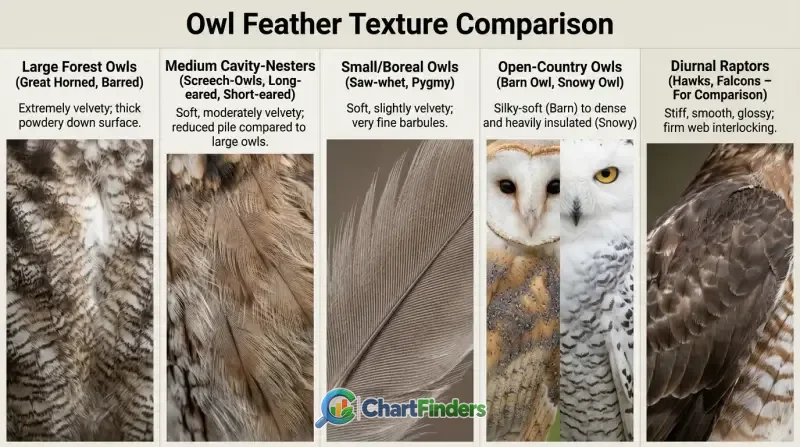
Owl Feather Identification Chart
- Velvety Pile: Owl contour and flight feathers feature a dense downy nap over the upper surface that dampens wing-beat sound.
- Comb-like Leading Edge: The outer primaries possess specialized serrations or a comb-like fringe that breaks turbulent air into micro-currents.
- Soft Fringed Trailing Edges: The trailing edges of primary and secondary feathers possess elongated, hair-like fringes that eliminate aerodynamic whistling.
- Cryptic Coloration: Plumage is heavily barred, vermiculated, or mottled in earth tones (browns, grays, buffs, and whites) for daytime camouflage.
- Anatomy Matters: Correct identification requires matching the feather type (primary, secondary, contour, covert, or facial disc) to its anatomical position.
- Legal Restrictions: In North America and many other regions, possession of native owl feathers is strictly regulated or prohibited under wildlife protection acts.
To assist in rapid fieldwork and morphology comparison, the following reference table outlines the defining physical traits across major North American and Eurasian owl species groups, contrasting them with non-predatory avian look-alikes.
| Species Group | Average Primary Length | Texture & Pile | Leading-Edge Fringe (Comb) | Coloration & Patterning | Acoustic Efficiency |
|---|---|---|---|---|---|
| Large Forest Owls (Great Horned, Barred) | 200mm – 380mm+ | Extremely velvety; thick powdery down surface. | Prominent, rigid comb-like serrations on P1–P5. | Heavy dark brown/black barring on pale background; vermiculated. | Maximum (Near total silent flight) |
| Medium Cavity-Nesters (Screech-Owls, Long-eared, Short-eared) | 100mm – 200mm | Soft, moderately velvety; reduced pile compared to large owls. | Fine serrations present; less rigid on smaller flight feathers. | gray, rust, and buff streaks, spots, and fine bars. | High (Optimized for agile hunting) |
| Small/Boreal Owls (Saw-whet, Pygmy) | 60mm – 110mm | Soft, slightly velvety; very fine barbules. | Delicate, micro-serrated comb structure. | Rich chocolate brown with distinct white spotting and barring. | Moderate-High (Scaled to wing size) |
| Open-Country Owls (Barn Owl, Snowy Owl) | 180mm – 350mm | Silky-soft (Barn) to dense and heavily insulated (Snowy). | Moderate to reduced comb; Barn owls sacrifice some silencing for speed. | Golden-buff with fine gray speckles (Barn); pure white with sparse black spotting (Snowy). | High (Barn); Moderate (Snowy, adapted for arctic open terrain) |
| Diurnal Raptors (Hawks, Falcons – For Comparison) | 150mm – 350mm | Stiff, smooth, glossy; firm web interlocking. | Smooth, sharp, un-fringed leading edge. | Clean bold bars, strong slate-gray, or rufous tones; no velvety pile. | Low (Produces audible swishing/whooshing) |
Reading this table requires looking at the intersection of texture, structural modifications, and patterning. While a hawk’s feather feels rigid and produces a distinct swishing sound when waved rapidly through the air, an owl’s feather remains completely silent due to its specialized micro-architecture.
Anatomy of Silent Flight: The Micro-Structure of Owl Feathers
The evolutionary driver behind the unique structure of owl plumage is acoustic stealth. Because owls hunt primarily by sound—locating small mammals beneath snow, leaf litter, or grass through hyper-sensitive facial discs—they cannot afford to alert their prey with the aerodynamic noise generated by standard bird wings. Three distinct micro-structural modifications achieve this acoustic camouflage.
The Velvety Upper Surface
If you stroke an owl’s flight feather from the base toward the tip, it feels like fine velvet or brushed suede. Under a 40x stereomicroscope, this texture is revealed as an extension of the pennaceous barbules. The upper surface of the barbules is elongated into dense, hair-like filaments that trap a microscopic layer of air and eliminate the friction noise caused by overlapping feathers rubbing against one another during the downstroke and upstroke.
Comb-like Serrations on the Leading Edge
The outermost primary feathers (typically primaries 1 through 5 or 6, depending on the species) feature a modified outer web. Instead of a smooth, continuous edge, the leading edge features a rigid, comb-like fringe. As the wing moves forward, this comb splits the oncoming airflow into tiny, turbulence-free streams. By breaking up the laminar boundary layer, the feather prevents the formation of loud vortex shedding that causes the characteristic “whoosh” sound of a pigeon or duck in flight.
Fringed Trailing Edges
While the leading edge manages incoming air, the trailing edge handles departing air. The barbs at the trailing edge of owl flight feathers do not interlock tightly right to the tip. Instead, they extend past the margin as a soft, frayed fringe. This trailing fringe acts as an acoustic diffuser, spreading the remaining high-frequency sound waves across a broader spectrum and dampening them into total inaudibility to the sensitive ears of rodent prey.
Classifying Feather Types Found in the Field
Finding a feather is only the first step; identifying its anatomical origin determines what part of the bird’s body it came from and helps prevent misidentifying body coverts as flight feathers.
Primary and Secondary Flight Feathers (Remiges)
Remiges are the large, asymmetrical feathers of the wing. Primaries attach to the manus (hand bones) and provide thrust and steering; they are strongly curved, highly asymmetrical, and bear the leading-edge comb. Secondaries attach to the ulna (forearm), are broader, more symmetrically shaped, and possess the fringed trailing edge without the rigid leading-edge comb.
Tail Feathers (Rectrices)
Tail feathers are relatively symmetrical, stiff compared to wing coverts, and feature squared or gently rounded tips with clear transverse barring. Unlike diurnal raptors, whose tail feathers often show a wide terminal subapical band, owl rectrices are usually evenly barred from base to tip to maintain complete camouflage when the tail is fanned during landing or maneuvering.
Contour and Body Coverts
Body feathers are small, incredibly fluffy, and feature a distinct after-feather (hypoptile) or voluminous downy base. Their primary function is thermal insulation and sound deadening for the body trunk. Because they lack the rigid shaft of flight feathers, they are easily mistaken for mammalian fur or down from other large birds.
Facial Disc Feathers
Stiff, spoon-shaped, and structurally unique, facial disc feathers form the parabolic sound-reflector around the eyes and ears. They have rigid shafts and specialized stiff barbs that act like a satellite dish to funnel high-frequency sounds directly into the ear openings. Finding a facial disc feather is a definitive indicator of an owl presence.
Species-Specific Identification Cues
Distinguishing between common owl species requires analyzing size, primary pigmentation, and specific bar patterns.
- Great Horned Owl (Bubo virginianus): Large, robust flight feathers ranging from 250mm to 380mm in length. Marked by heavy, irregular dark brown bars and vermiculations on a warm buff or gray background. The leading-edge comb is stiff and dark.
- Barred Owl (Strix varia): Medium-large feathers characterized by distinct transverse barring on the primaries and secondaries, alternating between dark chocolate brown and pale cream. Contour feathers often show characteristic barred spotting rather than streaks.
- Barn Owl (Tyto alba): Noticeably silky and pale. Primary feathers often display a rich golden-orange or tawny hue with subtle grayish-brown speckling and faint barring. The trailing edge fringe is exceptionally soft and woolly.
- Eastern/Western Screech-Owl (Megascops asio / kennicottii): Small flight feathers (100mm–140mm) displaying salt-and-pepper gray, black, and rufous patterning. They feature delicate, micro-serrated leading edges.
- Northern Saw-whet Owl (Aegolius acadicus): Miniature flight feathers (60mm–90mm) with rich chocolate-brown bases and distinct white spots or incomplete bars along the outer web.
Common Identification Mistakes and Look-Alikes
Even experienced field observers occasionally misidentify feathers due to convergence in coloration or wear patterns. Avoiding these common errors ensures accurate field records.
| Look-Alike Species | Why It Is Confused With Owls | Key Distinguishing Feature |
|---|---|---|
| Red-tailed Hawk / Buteos | Brownish, barred or mottled dorsal plumage that mimics raptor coloration. | Stiff, glossy vane; completely smooth leading edge; lacks velvety pile and noise-dampening fringe. |
| Woodcock / Snipe | Earthy tones, cryptic barring, and soft-feeling contour feathers found in forest understory. | Small size; non-serrated edges; lacks the specialized acoustic fringe and velvety upper barbules of owls. |
| Domestic Poultry (Chicken / Turkey) | Fluffy down and mottled brown coloration found near rural homesteads. | Coarse barb structure; stiff rachis; entirely lacks acoustic modifications; glossy sheen on barbs. |
| Mallard / Waterfowl | Barred gray and brown flank feathers found near water bodies. | Water-repellent oil coating; rigid interlocking barbs designed for hydrodynamics rather than acoustics. |
The single most reliable diagnostic test for an owl feather is the tactile and auditory test: stroke the upper surface of the vane. If it feels like dry silk or velvet and makes zero sound when rubbed rapidly between your fingers, it is an owl feather. If it emits a dry rustling or crisp clicking sound, it belongs to a non-strigiform bird.
Step-by-Step Field Identification Workflow
When encountering an unknown feather in the field, systematic evaluation prevents premature or incorrect conclusions:
- Examine the Size and Shape: Measure the length against a scale or reference object. Determine if it is curved (wing), symmetrical (tail), or fluffy and irregular (body).
- Check the Leading Edge (Tactile Inspection): Run a fingertip gently along the outer edge of the primary feather. Feel for serrations or a comb-like structure.
- Assess the Surface Texture: Rub the flat surface of the vane. Is it slick and glossy, or does it possess a soft, velvety nap that traps air?
- Analyze the Coloration and Pattern: Note whether the pattern consists of clean bars, fine vermiculations, spots, or solid tones. Match these against regional field guides for local owl species.
- Inspect the Trailing Edge: Look closely at the tips of the barbs along the trailing edge. Are they frayed into fine hair-like fringes, or do they terminate in a sharp, clean point?
Frequently Asked Questions
Usually not with 100% certainty. While body coverts show the characteristic velvety texture and cryptic barring of an owl, individual body feathers across similar-sized species (such as Barred Owls and Great Horned Owls) share nearly identical coloration. Positive species-level identification typically requires a primary flight feather or a rectrix.
Owls do not possess the same heavy waterproofing oil output from their uropygial (preen) gland as waterfowl or gulls because excessive oil coating would mat down the delicate velvety barbules and destroy their acoustic stealth. Instead, owl feathers rely on structure and powdery down to shed light moisture, though heavy rain temporarily prevents them from hunting.
Almost all species possess the structural adaptations for silent flight, but the degree of silence varies. Large apex predators like Great Horned and Barn Owls have highly developed combs. Conversely, some fishing owls (like the Blakiston’s Fish Owl) have secondarily lost many of these acoustic adaptations because their aquatic prey hunt by sight or vibration rather than sound, making silent flight evolutionarily redundant.
In many jurisdictions, including the United States under the Migratory Bird Treaty Act (MBTA) and Canada under the Migratory Birds Convention Act, it is illegal to possess feathers, bones, or nests of native migratory birds—including all owls—without specialized scientific or educational permits. Field naturalists should photograph and document feathers in situ rather than collecting them.
Many owls possess specialized powder down feathers that continuously disintegrate into a fine, talc-like keratin powder. Owls preen this powder through their plumage to help clean the feathers, absorb excess oils, and maintain the immaculate velvety texture required for silent flight.
Conclusion
Identifying owl feathers transforms a simple walk in the woods into an exercise in evolutionary morphology. By recognizing the specialized velvet pile, leading-edge combs, and acoustic fringe that define strigiform plumage, observers gain a direct window into the specialized sensory adaptations of these nocturnal apex predators. Whether distinguishing a Barred Owl primary from a hawk’s remiges or appreciating the microscopic engineering of a screech-owl covert, careful attention to texture and structure provides definitive answers in the field.