
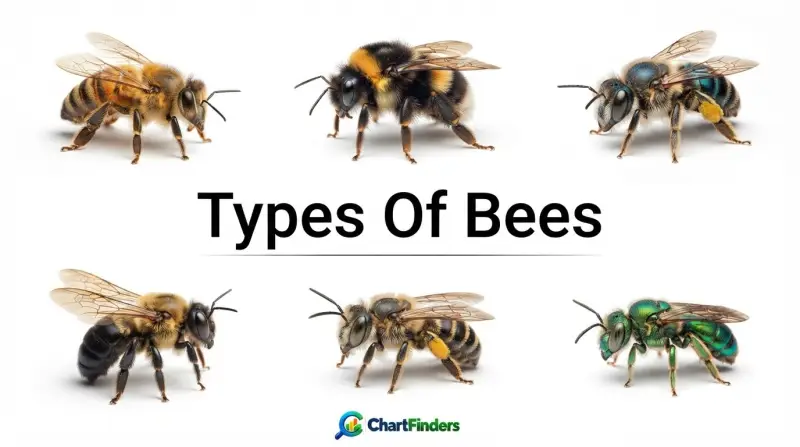
The order Hymenoptera contains a specialized clade of flying insects universally recognized for their evolutionary interdependence with angiosperms: bees. Far from being a monolithic group represented solely by the domestic honey bee, the apoid fauna is a staggering ecological spectrum of over 20,000 species. These organisms display radical variations in anatomy, thermal regulation, lifecycle synchronization, and trophic specialization. Understanding these variations requires moving beyond casual garden observations to examine structural morphology, behavioral ecology, and taxonomic classification.
For centuries, human perception of bees has been skewed toward managed agricultural species. However, wild populations—encompassing solitary miners, parasitic cuckoo bees, and short-lived social colonies—drive terrestrial ecosystem stability. As habitat fragmentation, agricultural intensification, and climate anomalies exert unprecedented pressures on these populations, identifying and categorizing the various types of bees has become an essential baseline for conservation biology, agricultural yield optimization, and ecological restoration.
Types Of Bees
- The global apoid fauna encompasses over 20,000 species, classified primarily by social structure (eusocial vs. solitary) and nesting habit (ground vs. cavity).
- Eusocial species, such as honey bees (Apis spp.) and bumble bees (Bombus spp.), feature complex caste systems, overlapping generations, and specialized anatomical adaptations like corbiculae (pollen baskets).
- Solitary bees—including mason bees, leafcutter bees, and mining bees—comprise roughly 85% of all bee species, operating without queens or workers while driving intensive native plant pollination.
- Morphological differentiation relies heavily on mouthpart length (glossa), wing venation patterns, and scopa placement (either on the hind tibia or ventral abdominal sterna).
- Conservation initiatives must prioritize wild, non-managed native taxa alongside managed honey bee colonies to prevent the collapse of specialized plant-pollinator networks.
To systematically navigate the vast diversity of Anthophila, entomologists divide bees into functional and taxonomic categories. The most fundamental division separates social structures, which dictate how individuals forage, defend resources, and reproduce. Below is a comparative breakdown of the primary families and behavioral groups that define the global bee population.
| Common Name | Scientific Family / Genus | Social Structure | Nesting Habit | Primary Identifying Feature |
|---|---|---|---|---|
| Western Honey Bee | Apidae (Apis mellifera) | Eusocial (Perennial) | Man-made hives, hollow trees | Corbiculae (pollen baskets), dense golden-brown pubescence. |
| Bumble Bee | Apidae (Bombus spp.) | Eusocial (Annual) | Subterranean cavities, abandoned rodent nests | Robust, densely furry body with contrasting warning coloration. |
| Carpenter Bee | Apidae (Xylocopa spp.) | Solitary to Subsocial | Excavated tunnels in sound or weathered wood | Large, glossy black or metallic abdomen lacking dense hair on dorsal plates. |
| Mason Bee | Megachilidae (Osmia spp.) | Solitary | Pre-existing hollow plant stems, beetle holes | Metallic blue, green, or black body; ventral scopa for pollen transport. |
| Leafcutter Bee | Megachilidae (Megachile spp.) | Solitary | Cavities lined with precisely cut leaf disks | Robust head with powerful mandibles; ventral scopa. |
| Mining Bee | Andrenidae (Andrena spp.) | Solitary | Ground burrows in well-drained soil | Foveae (depressions on upper face), pollen-collecting hairs on legs. |
| Sweat Bee | Halictidae (Multiple genera) | Solitary to Eusocial | Ground burrows | Frequently metallic green or copper; attracted to mammalian perspiration. |
The comparative matrix above illustrates the profound morphological and behavioral diversity within the suborder. While honey bees and bumble bees dominate public awareness due to their large colony sizes and economic output, the silent majority of pollination services are executed by solitary taxa that interact with flora in highly specialized ways.
Eusocial Bees: Hive Architecture and Colony Dynamics
Eusociality represents the pinnacle of social evolution among insects. Defined by cooperative brood care, a reproductive division of labor featuring sterile workers and fertile queens, and an overlap of generations within a single colony, eusocial bees operate as superorganisms. Within this category, two primary groups command scientific and agricultural attention.
The Apini Tribe: Honey Bees (Apis)
The genus Apis comprises perennial eusocial species capable of overwintering as a functional colony. Unlike annual species where only fertilized queens survive, honey bee colonies maintain thousands of workers through cold periods by clustering and shivering their flight muscles to generate metabolic heat. Worker bees exhibit a rigid temporal polyethism—shifting roles from hive cleaning and nursing to guarding and finally foraging as they age. Their anatomical adaptation for pollen transport is the corbicula, a smooth, concave polished area on the outer surface of the hind tibia bordered by stiff hairs. Nectar is transported internally in the honey stomach (crop) and transferred via trophallaxis to processing workers within the hive.
The Bombini Tribe: Bumble Bees (Bombus)
Bumble bees are large, robustly built eusocial insects characterized by dense corbicular hair coats (pubescence) that provide exceptional thermal insulation. This allows them to forage at lower ambient temperatures and higher latitudes than honey bees. Unlike Apis, bumble bee colonies are annual. A fertilized queen emerges from subterranean diapause in early spring, selects a nesting site—often an abandoned rodent burrow or tussock of grass—and single-handedly rears the first brood of sterile female workers. Colony populations peak in mid-summer before producing new reproductive males and queens, after which the old queen and workers perish. Only newly mated queens enter diapause.
Solitary Cavity-Nesting Bees: The Megachilidae Family
Comprising over 4,000 species globally, the family Megachilidae is unique for lacking hind-leg pollen baskets. Instead, females possess a dense brush of hairs on the ventral surface of the abdomen known as a gastric scopa. These bees are predominantly solitary, meaning each female constructs, provisions, and seals her own nest without assistance from workers.
Mason Bees (Osmia spp.)
Referred to as mason bees because females construct internal partitions and nest seals using moistened clay, mud, or chewed vegetation, these insects are exceptionally efficient orchard pollinators. Active primarily in early spring, individual females provision tubular cavities—such as hollow plant stems or drilled blocks of wood—with a mixture of pollen and nectar known as bee bread. An egg is laid upon each mass, and the cell is sealed with a mud wall. The resulting larvae consume the provision, spin a silk cocoon, pupate, and overwinter as fully formed adults inside their cells, emerging the following spring.
Leafcutter Bees (Megachile spp.)
Leafcutter bees share the ventral scopa and cavity-nesting tendencies of mason bees, but their construction material is distinctive. Using specialized, serrated mandibles, females excise precise circular or oval sections from the leaves of soft-leaved plants like roses, redbuds, and alfalfa. These fragments are transported back to the nesting cavity and rolled into thimble-shaped cells. Each cell is provisioned, seeded with an egg, and capped with a leaf disk lid. Their specialized preference for legume pollination makes them indispensable for commercial seed production.
Ground-Nesting Solitary Bees
The vast majority of bee species—roughly 70%—are subterranean architects. Excavating burrows in bare or sparsely vegetated soil, these solitary females construct lateral tunnels ending in individual brood cells. Recognizing these bees is critical, as their aggregations in lawns or gardens are frequently mistaken for wasp infestations or pest invasions.
Mining Bees (Andrenidae)
The family Andrenidae contains thousands of species, most notably within the genus Andrena. Mining bees are distinguished by facial depressions near the inner margins of the eyes called foveae, which are lined with microscopic hairs. Females dig vertical shafts in well-drained soil, lining the internal brood cells with a secreted waterproof varnish before provisioning them with pollen moistened with nectar. They are among the earliest spring-active insects, often emerging simultaneously with flowering fruit trees.
Sweat Bees (Halictidae)
Halictidae is a cosmopolitan family of small to medium-sized bees, many of which exhibit brilliant metallic green, bronze, or copper integuments. While many halictids are strictly solitary, others display fascinating evolutionary transitions toward sociality, including communal nesting, semi-social groups, and primitive eusociality where queens and workers differ only slightly in size. They are commonly called sweat bees because certain species are attracted to human perspiration to ingest salts and moisture.
The Parasitic Specialized Group: Cuckoo Bees
Evolutionary pressures have given rise to kleptoparasitism among multiple bee lineages, most notably within the subfamily Nomadinae and genera like Sphecodes. These insects are known colloquially as cuckoo bees because, much like cuckoo birds, they do not build nests or provision food for their young.
Morphologically, cuckoo bees often lack the anatomical apparatuses required for pollen collection—such as scopae or corbiculae—and frequently possess heavily sclerotized (hardened) cuticles that protect them from the defensive stings of host bees. A female cuckoo bee locates the active, hidden nest of a host species (often a mining or mason bee), enters while the host is foraging, and deposits an egg inside a sealed brood cell. When the parasitic larva hatches, it typically uses specialized, sickle-like mandibles to destroy the host egg or larva before consuming the accumulated provisions.
Identification and Morphology of Apoid Families
Accurate taxonomic identification of bees requires examining microscopic anatomical features. While color patterns and hair density offer preliminary field clues, definitive classification relies on wing venation, mouthpart morphology, and pollen-carrying structures.
Wing Venation and Hamuli
All Hymenoptera possess two pairs of membranous wings, with the forewings significantly larger than the hind wings. During flight, the fore and hind wings are coupled mechanically by a row of tiny hook-like structures on the leading edge of the hind wing called hamuli, which lock into a folded fold on the trailing edge of the forewing. The specific pattern of enclosed cells formed by the branching veins on the forewing is a primary diagnostic character used to separate families such as Apidae, Andrenidae, and Halictidae.
Mouthpart Adaptations (Glossa)
The feeding apparatus of bees has evolved to access floral nectar at varying depths. The labium is modified into an elongated tongue, or glossa, flanked by labial palps and galeae. Short-tongued bees (such as Andrenidae and Halictidae) possess broad, short glossae adapted for shallow flowers like composites and umbellifers. Long-tongued bees (such as Apidae and Megachilidae) possess highly extensible, probe-like glossae capable of reaching deep corolla tubes found in clovers, mints, and tubular wildflowers.
Ecological Roles and Trophic Specialization
The ecological impact of bees extends far beyond honey production. As primary vectors of entomophilous (insect-pollinated) plant reproduction, bees maintain the genetic diversity of wild flora and sustain agricultural food webs. However, ecological niches vary widely between generalist and specialist species.
Oligolecty vs. Polylecty
Bees can be categorized by their dietary breadth:
- Polylectic Bees: Generalist foragers that collect pollen from a wide taxonomic range of plant families. Examples include honey bees, bumble bees, and many sweat bees. This versatility allows them to survive environmental fluctuations where specific plant species fail.
- Oligolectic Bees: Specialist foragers that restrict pollen collection to a single plant family or genus. For instance, certain species of Andrena or Colletes forage exclusively on the pollen of native sunflowers (Helianthus) or evening primroses (Oenothera). This specialization ties their lifecycle directly to the phenology of their host plants, rendering them highly vulnerable to habitat disruption.
- Monolectic Bees: Extreme specialists that rely on a single plant species for all nutritional requirements.
Common Mistakes in Bee Identification and Management
Misidentifying bees or misunderstanding their biology can lead to ineffective conservation efforts or unnecessary pest control interventions. Below are critical distinctions to observe:
- Confusing Solitary Ground Nests with Infestations: Finding dozens of small holes in a lawn surrounded by tiny mounds of earth usually indicates an aggregation of harmless mining bees or sweat bees. These insects are solitary, non-aggressive, and vanish naturally after a few weeks of activity. Applying insecticides is ecologically destructive and unnecessary.
- Mistaking Carpenter Bees for Bumble Bees: While both are large and robust, carpenter bees (Xylocopa) have smooth, shiny, bare black abdominal dorsal plates. Bumble bees (Bombus) have densely furry, hairy abdomens, often featuring yellow, orange, or white banding.
- Assuming All Bees Sting: Male bees lack stingers (which are evolutionarily modified ovipositors). , solitary bees will only sting if trapped tightly against human skin; they possess no hive defense mechanisms or alarm pheromones.
- Over-Reliance on Managed Honey Bees for Conservation: Installing managed honey bee hives does not aid wild native bee conservation. In resource-limited urban or natural settings, high densities of honey bees can outcompete native solitary species for limited nectar and pollen resources.
Frequently Asked Questions
What is the difference between a bee, a wasp, and an ant?
All three belong to the order Hymenoptera. Ants are fundamentally modified, secondarily flightless wasps. Wasps are generally predatory carnivores that capture insects to feed their larvae, possessing smooth bodies and sparse hair. Bees are evolutionary derived, specialized vegetarian wasps that transitioned from predation to feeding entirely on pollen and nectar, developing branched body hairs to facilitate pollen collection.
Do all bees live in hives and make honey?
No. Only eusocial species within the tribe Apini (honey bees) and certain stingless bees construct permanent perennial hives and store surplus honey. The vast majority of bee species—roughly 85%—are solitary insects that construct independent nests in soil or cavities, producing no surplus honey and storing only a localized paste of pollen and nectar for individual larvae.
Why are solitary ground-nesting bees appearing in my yard in the spring?
Spring-active solitary bees, such as mining bees (Andrena spp.), take advantage of bare soil patches, warmth, and early-blooming trees. Females excavate individual underground burrows to lay eggs. These aggregations are temporary, lasting only as long as the blooming season, and the bees pose no threat to lawns, structures, or humans.
How can I support native bee populations in my garden?
Supporting native bees requires moving beyond generic nectar plants to provide nesting substrate and uninterrupted forage. Leave patches of undisturbed, bare soil for ground-nesters, install drilled wooden blocks or bundles of hollow stems for cavity-nesters, eliminate broad-spectrum systemic insecticides, and plant a continuous succession of native, open-flowered perennial plants blooming from early spring through late autumn.
Are stingless bees real, and where do they live?
Yes. Stingless bees (tribe Meliponini) are highly eusocial bees native to tropical and subtropical regions globally, including Central and South America, Africa, and Northern Australia. While they possess reduced, non-functional stingers and cannot deliver a venomous sting, they defend their colonies through biting, chemical secretions, or entanglement in hair.
Conclusion
The diversity of bees extends far beyond the familiar hum of the domestic honey bee. From subterranean solitary miners and wood-boring carpenters to brilliant metallic sweat bees and social bumble bees, the suborder Anthophila represents an of evolutionary adaptations. Recognizing the distinct morphological traits, nesting habits, and ecological requirements of these diverse types of bees is essential for accurate identification and effective conservation. By protecting both managed agricultural pollinators and the fragile, specialized wild bee populations that sustain native flora, we preserve the foundational architecture of terrestrial ecosystems.