
The arachnofauna of Indiana is remarkably diverse, occupying ecological niches from deciduous forest floors to residential basements. While the vast majority of Indiana spiders are ecologically beneficial apex predators of insect populations, homeowner concern frequently centers on accurate differentiation between harmless look-alikes and medically hazardous species. Misidentification often leads to unnecessary chemical applications or misdiagnosis of dermatological lesions. Understanding the morphological diagnostic markers of Indiana’s indigenous taxa provides a rational framework for safety, ecological appreciation, and integrated pest management.
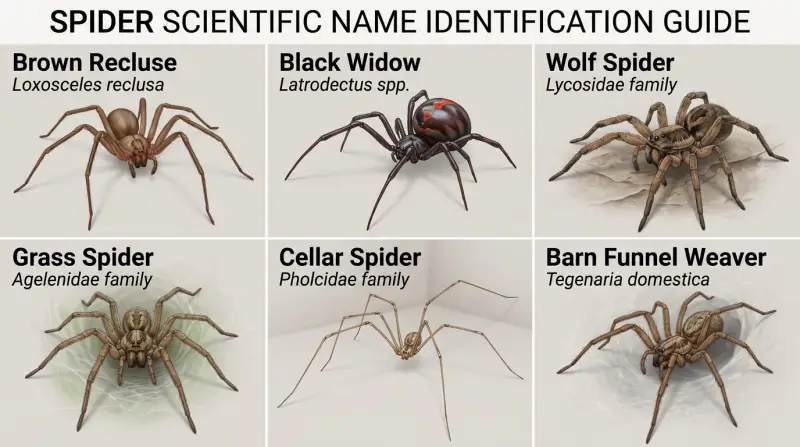
Indiana Spiders Identification Chart
- Indiana possesses only two medically significant venomous spiders: the Black Widow and the Brown Recluse.
- The Black Widow (Latrodectus spp.) is identified by a glossy, globose black abdomen featuring a distinctive red or orange ventral hourglass marking.
- The Brown Recluse (Loxosceles reclusa) exhibits a uniform tan-to-brown coloration, the absence of abdominal spines or strong patterns, and a characteristic dark violin-shaped dorsal prosoma (cephalothorax) marking.
- Unlike most spiders that possess eight eyes arranged in two rows, Loxosceles reclusa exhibits six eyes arranged in three dyads.
- Common non-venomous taxa—such as wolf spiders (Lycosidae) and grass spiders (Agelenidae)—are frequently mistaken for dangerous spiders due to their size or coloration.
To accurately assess an encounter with an arachnid in the Hoosier State, observers must move past generalized fear and focus on specific morphological criteria. The following reference matrix outlines the primary medically significant species alongside their most common harmless counterparts found in Indiana homes and outdoor habitats.
Explore our detailed breakdown on Rabbit Breed Identification Chart [Full Reference Chart].| Common Name | Scientific Name | Key Identification Markers | Web / Habitat Type | Venom / Medical Significance |
|---|---|---|---|---|
| Brown Recluse | Loxosceles reclusa | Uniform light brown/tan; violin-shaped marking on dorsal prosoma; 6 eyes in 3 dyads. No spines on legs. | Irregular, loose sheet web; found in dry, dark, undisturbed spaces (attics, boxes, woodpiles). | Necrotic venom containing sphingomyelinase D; localized tissue destruction and systemic loxoscelism. |
| Black Widow | Latrodectus spp. | Shiny, globose black abdomen; bright red/orange hourglass marking on ventral surface. Females ~1.5 inches leg span. | Irregular, coarse, 3D scaffolding web near ground level in dark crevices, under stones or stacked wood. | Neurotoxic venom (alpha-latrotoxin); causes severe muscle cramping, pain, and systemic autonomic symptoms. |
| Wolf Spider | Lycosidae family | Robust, hairy, mottled brown/grey coloration; large posterior median eyes; carries egg sac attached to spinnerets. | No permanent web; active nocturnal hunter wandering across ground, lawns, and basements. | Minor mechanical bite; venom causes localized pain and swelling similar to a bee sting; non-necrotic. |
| Grass Spider | Agelenidae family | Brownish with distinct longitudinal stripes on the prosoma; prominent, elongated posterior spinnerets. | Flat, sheet-like funnel webs terminating in a retreat tube, commonly built in grass or low structures. | Not medically significant; docile unless trapped; mechanical bite produces transient local irritation. |
| Cellar Spider | Pholcidae family | Extremely long, delicate legs (“daddy longlegs”); pale grey, tan, or translucent elongated bodies. | Irregular, messy space webs built in high ceiling corners, dark basements, and crawlspaces. | Harmless; incapable of piercing human skin effectively in most cases; often consumes other pests. |
| Barn Funnel Weaver | Tegenaria domestica | Brownish-grey with mottled markings on the abdomen; banded legs; short-to-medium stout build. | Dense sheet webs with a funnel retreat, frequently found in basements, cellars, and outbuildings. | Non-venomous threat to humans; docile, occasional defensive bite causes mild localized erythema. |
When reviewing this identification chart, it is critical to evaluate multiple morphological features concurrently rather than relying on a single trait. Cuticular color can vary significantly within populations, particularly among juvenile instars, making structural features like ocular configuration and spinneret length far more reliable diagnostic tools.
Medically Significant Taxa in Indiana
The state of Indiana sits within the overlapping geographic range of several distinct arachnid populations. Among these, the Theridiidae and Sicariidae families command the greatest attention due to the specific biochemical composition of their venom apparatuses.
The Black Widow (Latrodectus Species Complex)
Indiana hosts populations of both the Northern Black Widow (Latrodectus variolus) and, less frequently, the Southern Black Widow (Latrodectus mactans). Adult female Latrodectus are instantly recognizable by their globose, highly polished jet-black opisthosoma (abdomen) and the characteristic red or orange hourglass insignia located ventrally. In some specimens, this mark may be broken into two distinct red triangles or spots.
Male black widows are significantly smaller, sexually dimorphic, and non-threatening, featuring pale stripes and spots of red and white on a brownish background. Female black widows construct disorganized, three-dimensional scaffolding webs composed of exceptionally strong silk. These webs are typically established at or near ground level in dark, sheltered retreats such as woodpiles, stone walls, meter boxes, and undisturbed corners of unheated outbuildings.
The Brown Recluse (Loxosceles reclusa)
The brown recluse is frequently a source of intense anxiety for Indiana residents, particularly in the southern and central counties where populations are more established. The species is characterized by its uniform brown-to-fawn coloration across both cephalothorax and abdomen. The diagnostic dorsal marking on the prosoma resembles a dark violin, with the “neck” of the instrument pointing toward the posterior abdomen. However, this violin pattern can sometimes be faint or absent in juvenile specimens.
A definitive microscopic identification relies on ocular arrangement. While almost all other common spiders possess eight eyes arranged in two rows of four, members of the genus Loxosceles possess precisely six eyes, arranged in distinct pairs (dyads) forming a semicircle: one anterior pair and two lateral pairs. , the leg cuticles lack prominent spines, presenting a smooth, uniform appearance covered in fine, hair-like setae.
Common Harmless Look-Alikes
A significant percentage of suspected “brown recluse” or “black widow” sightings in Indiana actually involve harmless native species that share superficial traits with venomous taxa. Distinguishing these organisms prevents unnecessary panic and preserves local predatory biodiversity.
Wolf Spiders (Family Lycosidae)
Wolf spiders are large, robust, ground-dwelling hunters that frequently wander into Indiana homes during autumn as temperatures drop. Because of their substantial size, hairy bodies, and rapid movements, they are frequently mistaken for dangerous species. However, wolf spiders can be easily identified by examining their eye pattern: they possess a prominent row of four small eyes below two exceptionally large posterior median eyes, giving them acute forward vision. Additionally, female wolf spiders carry their spherical egg sacs attached directly to their spinnerets.
Grass Spiders (Family Agelenidae)
Often confused with wolf spiders or mistakenly feared as funnel-web weavers of medical consequence, grass spiders are ubiquitous in Indiana lawns. They construct dense, non-sticky sheet webs that taper into a tubular retreat where the spider waits for prey. Morphologically, they are distinguished by two dark, parallel longitudinal stripes running down the dorsal surface of the prosoma and exceptionally long, projecting posterior spinnerets.
Cellar Spiders (Family Pholcidae)
Often referred to colloquially as “daddy longlegs” (a term also applied to harvestmen, which are not true spiders), cellar spiders possess remarkably fragile, elongated legs and small, oval bodies. They inhabit the corners of ceilings, basements, and dark crawlspaces. When disturbed, cellar spiders engage in a distinctive defensive behavior: vibrating rapidly within their web to become virtually invisible to avian and mammalian predators.
Comparative Diagnostic Matrix: Venomous vs. Common Look-Alikes
To further eliminate confusion during home inspections, the following side-by-side diagnostic breakdown contrasts Indiana’s medically significant species against their most common look-alikes across critical anatomical and behavioral vectors.
| Comparison Pair | Medically Significant Species | Common Look-Alike | Primary Differentiating Feature |
|---|---|---|---|
| Fiddle Pattern Check | Brown Recluse (Loxosceles reclusa) | Cellar Spider / Grass Spider | Recluse has a distinct violin mark and 6 eyes in 3 dyads; look-alikes lack the fiddle shape and possess 8 eyes. |
| Abdominal Texture & Markings | Black Widow (Latrodectus spp.) | False Black Widow (Steatoda grossa) | True widow features a high-gloss, jet-black cuticle with a sharp red/orange ventral hourglass; false widows feature purplish-brown tones and duller markings. |
| Ground Hunting Habits | Brown Recluse (Loxosceles reclusa) | Wolf Spider (Lycosidae) | Wolf spiders are large, hairy, mottled brown with prominent eye arrangements and egg sacs; recluses are smooth, uniform tan, and smaller. |
Anatomical Identification Criteria
Accurate entomological and arachnological identification requires a systematic breakdown of external morphology. Understanding the basic anatomical divisions of an araneomorph spider ensures precise taxonomic keys can be applied effectively.
Prosoma (Cephalothorax) Markers
The anterior body section, or prosoma, houses the central nervous system, venom glands, mouthparts (chelicerae), and locomotory appendages. Key identification features on the prosoma include:
- Ocular Arrangement: The number, size, and spatial configuration of the eyes. This is the single most reliable diagnostic differentiator for the Loxosceles genus (six eyes in three dyads).
- Carapace Markings: Pigmentation patterns such as the violin shape of the brown recluse or the longitudinal stripes of grass spiders.
- Cheliceral Structure: The orientation and strength of the fangs. Spiders with vertical chelicerae (Mygalomorphae) differ fundamentally from those with opposing, pinching chelicerae (Araneomorphs).
Opisthosoma (Abdomen) Markers
The posterior segment contains the respiratory organs (book lungs and tracheae), digestive tract, silk glands, and reproductive structures. Diagnostic markers on the opisthosoma include:
- Cuticular Texture and Gloss: The high-gloss, reflective cuticle of the black widow versus the matte, suede-like pubescence of the brown recluse or wolf spider.
- Ventral and Dorsal Insignias: The presence of warning coloration (aposematism), such as red ventral hourglasses, lateral bands, or dorsal cardiac marks.
- Spinneret Morphology: The length, separation, and positioning of the silk-spinning appendages located at the posterior ventral terminus of the abdomen.
Habitat Distribution and Behavioral Ecology in Indiana
Geographic and microclimatic factors heavily influence where specific spiders establish residency within the state of Indiana. Understanding these ecological parameters assists in targeted property inspection and risk mitigation.
Indiana features a humid continental climate with distinct seasonal variations. During spring and summer, arthropod populations peak. Medically significant species adapt to human structures in distinct ways:
- Micro-Habitat Selection of Loxosceles reclusa: As their common name implies, brown recluses seek out dark, dry, undisturbed environments. In nature, they reside beneath loose bark, flat rocks, and decaying logs. In human habitations, they colonize rarely disturbed storage areas, cardboard boxes, closets, behind wall voids, and infrequently worn footwear or clothing items left on floors. They do not spin webs to capture flying prey; instead, they forage actively at night.
- Micro-Habitat Selection of Latrodectus Species: Black widows prefer dark, humid-to-dry sheltered cavities near ground level where structural integrity remains undisturbed. Woodpiles, crawlspaces, basement corners, under patio furniture, and around unsealed foundation gaps are prime real estate. Unlike recluses, they remain sedentary within their irregular scaffolding webs, waiting for ambulatory ground insects to become entangled.
- Seasonal Migration Patterns: As ambient temperatures decline in September and October, numerous outdoor species—including large male wolf spiders and funnel weavers—experience pressure to seek thermal refugia inside residential structures, leading to a temporary spike in indoor encounters.
First Aid and Clinical Response Protocol
While the vast majority of spider bites in Indiana result in nothing more than transient localized pain, erythema, and mild edema, exposures involving Latrodectus or Loxosceles species require clinical awareness.
- For Suspected Black Widow Envenomation: The bite may initially feel like a pinprick or go unnoticed. Within 30 to 60 minutes, intense localized pain develops, spreading rapidly to large muscle groups, particularly the abdomen, back, and thighs. Systemic manifestations of alpha-latrotoxin include muscle rigidity, diaphoresis, hypertension, and nausea. Patients should seek immediate medical evaluation; antivenom is available for severe systemic cases.
- For Suspected Brown Recluse Envenomation: The initial bite is frequently painless. Over 2 to 8 hours, the site becomes painful, red, and swollen, often developing a central blister or a “bullseye” appearance. In moderate to severe cases of loxoscelism, the local tissue undergoes ischemic necrosis, resulting in a firm, dark eschar that sloughs off to form an open ulcer requiring careful wound management. Secondary infection prophylaxis and supportive care are standard clinical protocols.
Frequently Asked Questions
No. While brown recluse populations are well-established and common in southern and central Indiana, they are comparatively rare in the northern tier of the state. Sightings in northern Indiana often turn out to be harmless native look-alikes, such as grass spiders, funnel weavers, or nursery web spiders.
The standard “cup and card” method is highly effective and safe. Place a rigid plastic cup or glass directly over the spider, carefully slide a thin piece of rigid cardboard or cardstock underneath the rim to trap the animal inside, lift the apparatus, and transport it outdoors well away from structural foundations.
This is a widespread urban legend. Cellar spiders (family Pholcidae) do possess venom, but laboratory analyses demonstrate that their venom is remarkably weak against vertebrate nervous systems. , their chelicerae are fully capable of piercing human skin, though they rarely attempt to bite humans and possess docile behavioral tendencies.
Wolf spiders are significantly larger, hairier, mottled in appearance, and possess eight eyes arranged with prominent large posterior median eyes. They do not spin webs and actively hunt across the ground. Brown recluses are smaller, uniform in color, feature a violin-shaped dorsal mark, possess exactly six eyes arranged in dyads, and inhabit dry, secluded indoor or outdoor retreats.
Integrated pest management (IPM) practices provide the most robust defense. Seal all foundation cracks, install tight-fitting weather stripping on exterior doors and basement windows, repair torn window screens, clear tall grass, brush, and woodpiles away from the immediate perimeter of the foundation, and reduce indoor clutter in basements, attics, and storage closets.
Conclusion
Accurate identification of Indiana spiders requires moving beyond emotional responses and applying objective morphological analysis. While the state supports over four hundred species, rigorous attention to ocular patterns, cuticular markings, and web architecture isolates true medical concern to just two primary taxa: the Black Widow and the Brown Recluse. By understanding the behavioral ecology, anatomical markers, and appropriate safety protocols associated with these organisms, residents can maintain a balanced, informed perspective that respects local biodiversity while ensuring domestic safety.