
Few stinging insects evoke the same level of caution—or confusion—as yellowjackets. Often misidentified as ordinary paper wasps or misnamed as hornets, these social insects play a complex ecological role while frequently posing serious safety challenges to homeowners, landscapers, and outdoor enthusiasts. Understanding the distinct types of yellowjackets, their behavioral variations, and their nesting preferences is essential for safe pest management and accurate ecological identification.
The taxonomy of yellowjackets is rooted in their social structure, reproductive cycles, and architectural choices. Unlike solitary wasps, yellowjackets build elaborate paper nests using chewed wood fiber mixed with saliva, housing hundreds or thousands of workers by late summer. Recognizing the specific species requires a close examination of facial markings, abdominal striping, and nest locations. This guide breaks down the primary types of yellowjackets, compares their geographic ranges and aggressiveness, and offers practical frameworks for safe identification and management.
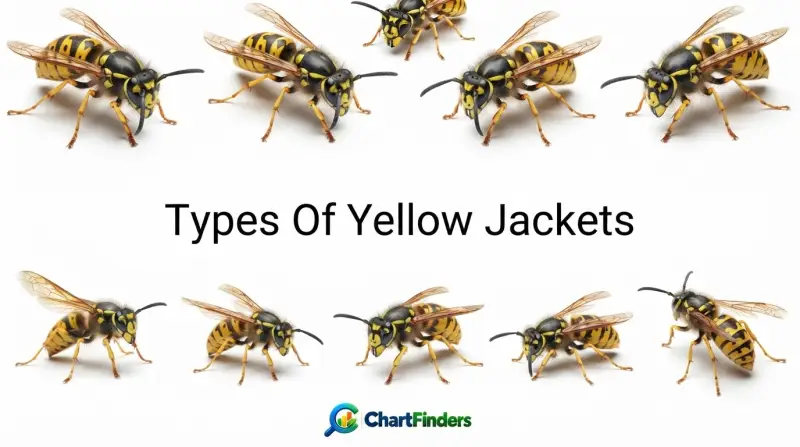
Types Of Yellow Jackets
- Yellowjackets belong primarily to two genera: Vespula (ground and cavity nesters) and Dolichovespula (aerial nesters).
- Unlike paper wasps, yellowjackets feature short, stout bodies, distinct anchor- or spear-shaped facial markings, and extremely defensive colony behaviors.
- Species such as the German yellowjacket and western yellowjacket are notorious scavengers that frequently raid human food sources in late summer.
- Nesting locations vary significantly by species, ranging from abandoned rodent burrows underground to wall voids and tree branches.
- Accurate identification requires examining the clypeus (face) and abdominal patterns, as many species look superficially similar at a glance.
To properly understand the spectrum of yellowjacket behavior, one must examine the specific species within the family Vespidae. While all yellowjackets share a general social framework and striking warning coloration, individual species exhibit marked differences in habitat preference, foraging habits, and geographic distribution.
The Genus Vespula: Ground and Cavity Nesters
The vast majority of pest yellowjackets belong to the genus Vespula. These species typically establish their colonies in dark, enclosed spaces. While subterranean locations—such as abandoned rodent burrows, hollow tree roots, or spaces beneath landscape timbers—are most common, Vespula species are equally opportunistic when finding structural voids in residential buildings.
German Yellowjacket (Vespula germanica)
Originally native to Europe, the German yellowjacket has established itself widely across North America. It is recognized by three distinct black spots on its clypeus (the lower face) and an unbroken, arrow-shaped black marking running down the center of its abdomen. Unlike native species whose colonies die out entirely in the winter, German yellowjackets occasionally establish perennial, multi-queen colonies in heated structural voids, making them a formidable pest. They are aggressive scavengers, frequently attending outdoor dining areas, trash cans, and picnic sites by late summer.
Eastern Yellowjacket (Vespula maculifrons)
Common across the eastern and central United States, the eastern yellowjacket typically builds its underground nests in wooded areas, lawns, and gardens. Visually, it features a yellow face with a broken black anchor mark or distinct spots. The workers are robust and fiercely defend a perimeter extending several feet from the nest entrance. Ground vibrations from lawnmowers or foot traffic easily trigger mass defensive stinging events.
Western Yellowjacket (Vespula pensylvanica)
As the dominant yellowjacket species across the western United States and Canada, the western yellowjacket is easily identified by bright yellow rings around its eyes and extensive yellow markings on the thorax and abdomen. They frequently nest underground in open fields or forest floors. In late summer, as natural insect prey declines, western yellowjackets become aggressive predators around human food, earning them the colloquial title of “meat bees” among campers and hikers.
Southern Yellowjacket (Vespula squamosa)
The southern yellowjacket exhibits unique polymorphism, with queens displaying a vivid orange and black coloration that differs significantly from the black-and-yellow workers. Distributed primarily across the southern and eastern United States, this species is well-known for occasionally acting as a facultative social parasite, taking over the established nests of other yellowjacket species before eventually establishing dominance.
The Genus Dolichovespula: Aerial Nesters
In contrast to their subterranean cousins, species in the genus Dolichovespula construct exposed paper nests hanging from tree branches, shrubbery, eaves, and structural overhangs. They are generally less prone to scavenging human food compared to Vespula species, focusing instead on capturing live insect prey such as flies and caterpillars.
Baldfaced Hornet (Dolichovespula maculata)
Despite its common name, the baldfaced hornet is not a true hornet (which belongs to the genus Vespa, such as the European hornet), but rather a large, black-and-white aerial yellowjacket. Reaching lengths of up to 3/4 inch, they construct large, football-to-basketball-sized gray paper nests high in trees or on building facades. They are exceptionally defensive when their aerial envelope is breached, known for accurately spraying venom when threatened.
Aerial Yellowjacket (Dolichovespula arenaria)
Also known as the common aerial yellowjacket, this species builds smaller, exposed paper nests attached to structural overhangs, deck railings, and tree limbs. They feature bright yellow and black striping similar to ground-nesting species but are distinguished by their choice of elevated, visible nesting sites and distinct facial markings.
| Common Name | Scientific Name | Primary Nesting Location | Scavenging Tendency | Aggression Level |
|---|---|---|---|---|
| German Yellowjacket | Vespula germanica | Subterranean / Wall Voids | Very High | High |
| Eastern Yellowjacket | Vespula maculifrons | Subterranean / Ground | Moderate | High |
| Western Yellowjacket | Vespula pensylvanica | Subterranean / Ground | Very High | High |
| Southern Yellowjacket | Vespula squamosa | Subterranean | Moderate | High |
| Baldfaced Hornet | Dolichovespula maculata | Aerial (Trees / Eaves) | Low | Very High |
| Aerial Yellowjacket | Dolichovespula arenaria | Aerial (Structures / Trees) | Low | Moderate-High |
The table above highlights the core operational differences among major yellowjacket species. Understanding whether a species is a ground-nester or aerial-nester, and whether it actively seeks out human food sources, dictates both safety precautions and professional remediation strategies.
Distinguishing Yellowjackets from Look-Alikes
Homeowners frequently misidentify stinging insects, leading to misguided control measures. Yellowjackets are regularly confused with paper wasps (genus Polistes) and honeybees (genus Apis). Accurate morphological differentiation prevents ineffective treatments and reduces unnecessary environmental disruption.
Yellowjackets vs. Paper Wasps
While both are social wasps that build paper nests, their physical builds and habits differ markedly:
- Body Shape: Yellowjackets are stout, compact, and distinctly wasp-waisted with short legs that do not dangle during flight. Paper wasps are slender, with elongated bodies and characteristically long legs that hang down noticeably while flying.
- Nest Architecture: Yellowjackets enclose their multi-tiered comb nests inside a protective outer paper envelope with a single entrance hole. Paper wasps construct single-comb, open-faced nests with visible cells pointing downward, lacking any outer covering.
- Behavior: Yellowjackets are notoriously defensive and will swarm if the nest is disturbed. Paper wasps are generally docile unless their open nest is directly physically struck.
Yellowjackets vs. Honeybees
Honeybees are sometimes confused with yellowjackets due to their shared black-and-yellow coloration, but they belong to an entirely different biological family (Apidae):
- Hair and Texture: Honeybees are covered in dense, branched setae (hairs) to collect pollen, giving them a fuzzy appearance. Yellowjackets have smooth, shiny, hairless bodies.
- Diet: Honeybees are strict vegetarians, collecting nectar and pollen exclusively. Yellowjackets are predatory carnivores that hunt other insects and scavenge protein and sugar from human sources.
- Stinging Anatomy: Honeybees possess barbed stingers that detach from their abdomen upon stinging, resulting in the bee’s death. Yellowjackets possess smooth stingers and can sting repeatedly without dying.
The Yellowjacket Lifecycle and Seasonal Dynamics
Yellowjacket behavior shifts dramatically across the calendar year, driven by the biological requirements of the colony cycle. Recognizing these phases explains why encounters escalate sharply in late summer.
Spring: Colony Initiation
In early spring, fertilized queens that survived the winter emerge from hibernation. Each queen searches for a suitable nesting site—either underground in a rodent burrow or elevated in a protected cavity. The queen builds a small initial paper comb, lays her first batch of eggs, and single-handedly forages and feeds the first generation of larvae until they mature into sterile female workers.
Summer: Worker Expansion and Foraging
By mid-summer, the colony enters a phase of rapid exponential growth. The queen remains inside the nest laying eggs, while hundreds or thousands of workers take over nest construction, foraging, and larval defense. During this period, their primary dietary focus is protein-rich insects (caterpillars, flies, and beetles) needed to feed the growing brood. Because natural insect populations are robust, interactions with humans are relatively low unless the nest is physically disrupted.
Late Summer to Autumn: The Behavioral Shift
By late August and September, the biological priorities of the colony shift entirely. The queen stops producing worker larvae and begins producing reproductive males and new future queens. Concurrently, the existing workers stop receiving the sugary salivary secretions produced by larvae—their primary nutritional reward. This creates a severe nutritional deficit.
Driven by starvation and the search for carbohydrates, worker yellowjackets become aggressive scavengers. They abandon their insect-hunting duties to swarm garbage cans, picnic tables, soda cans, and outdoor dining areas. This is the period when most stings occur, as foragers become trapped in clothing or inadvertently swallowed alongside sweet beverages.
Winter: Colony Collapse
As autumn temperatures drop and freezing weather sets in, the existing workers, males, and the old queen die off. Only newly mated young queens survive the winter by finding sheltered over-wintering sites under tree bark, in rotting logs, or inside structural insulation, ready to restart the cycle the following spring.
Practical Identification and Inspection Methods
Locating a yellowjacket nest requires careful observation, as underground and wall-void nests rarely reveal themselves until the colony is massive. Effective inspection follows a systematic approach:
- Observe Flight Paths: Sit at a safe distance during warm daylight hours and watch for steady streams of wasps entering and leaving a specific point—such as a hole in the lawn, a gap in siding, or a crack in a retaining wall.
- Check Structural Entry Points: Inspect weep holes in brickwork, gaps around dryer vents, soffits, and roof intersections where cavity-nesting species gain access to home interiors.
- Examine Vegetation: Scan low-hanging tree branches, dense shrubs, and porch ceilings for the gray, papery, sphere-like envelopes characteristic of aerial species like the baldfaced hornet.
- Acoustic Detection: In structural wall voids, gently tapping the drywall during the quiet morning hours may elicit an audible buzzing or scraping sound from the colony within.
Common Mistakes in Yellowjacket Management
Dealing with yellowjackets incorrectly often results in severe stings or exasperated infestations. Avoiding common pitfalls ensures safety and efficiency.
- Sealing Nest Entrances Prematurely: Never plug an active underground or wall-void nest entrance without first treating the colony. Trapped workers unable to exit through their normal hole will chew through drywall, electrical penetrations, or interior wood paneling to enter living spaces.
- Using Surface Sprays on Subterranean Nests: Aerosol surface sprays applied to a lawn opening only kill a fraction of surface guards. The core of the underground nest remains protected deep beneath the soil, resulting in renewed aggression.
- Flailing and Swatting: Swatting at foraging yellowjackets releases alarm pheromones that incite surrounding workers to sting. Slow, deliberate movements or stepping away calmly is far more effective.
- Ignoring Late-Season Risks: Assuming a ground nest is dormant because activity slowed down on a cool morning can lead to accidental disturbance during autumn landscaping or yard cleanup.
Frequently Asked Questions
Do yellowjackets lose their stingers when they sting humans?
No. Unlike honeybees, which have barbed stingers that anchor in human skin and tear away from their bodies, yellowjackets have smooth stingers. This anatomical difference allows a single yellowjacket to sting a human repeatedly without injuring itself.
How can I tell if a hole in my yard belongs to yellowjackets or bumblebees?
Bumblebees are fuzzy, move slower, and build small, messy wax-and-pollen clusters inside their underground nests, often utilizing abandoned rodent nests. Yellowjackets are smooth, shiny, fast-moving, and construct extensive paper comb structures. , yellowjackets are intensely defensive of their subterranean entrance, whereas bumblebees rarely exhibit aggressive guarding behavior unless handled directly.
Why are yellowjackets more aggressive in the fall than in the spring?
In spring and early summer, workers forage primarily for protein to feed developing larvae, ignoring humans unless threatened. By late summer, the colony finishes rearing brood and loses its source of larval sugar secretions. This sudden nutritional deficit forces workers to forage aggressively for sugar and carbohydrates in human environments, coinciding with peak population numbers.
Can yellowjackets chew through drywall into a house?
Yes. If a subterranean or cavity-nesting colony expands significantly inside an exterior wall void and runs out of space—or if someone mistakenly seals the exterior entrance hole—the workers will chew through drywall, insulation, and wooden paneling to emerge into the interior living spaces of a home.
What is the difference between a hornet and a yellowjacket?
True hornets (such as the European hornet) belong to the genus Vespa, are typically larger, and build large aerial paper nests. True yellowjackets belong primarily to the genus Vespula and predominantly nest underground. However, insects like the baldfaced hornet are actually large aerial yellowjackets rather than true hornets, creating widespread taxonomic confusion among the public.
Conclusion
Yellowjackets are ecologically vital predators that regulate pest insect populations, yet their aggressive nest-defense mechanisms and late-season scavenging habits make them challenging neighbors. By understanding the distinct behavioral traits, nesting habits, and physical markers of species such as the German, eastern, and western yellowjackets—as well as aerial species like the baldfaced hornet—property owners can accurately identify infestations and implement safe, targeted management strategies. Proper identification remains the of effective pest prevention, structural protection, and outdoor safety.