
The resurgence of interest in vintage lighting has transformed old lamps from overlooked household objects into prized design centerpieces. Whether sourced from a dusty estate sale or a curated boutique, a vintage lamp brings a layer of tactile history and architectural weight to a modern interior that mass-market fixtures simply cannot replicate. However, navigating the sprawling landscape of vintage lighting can be intimidating. Without a reliable framework, telling an authentic 1950s designer piece from a clever 1990s reproduction or an uninspired mid-century knockoff becomes an exercise in guesswork.
This comprehensive master guide serves as an analytical roadmap for identifying, dating, and authenticating vintage lamps. By dissecting the structural anatomy of lighting fixtures—from the composition of the metalwork to the evolution of electrical hardware—you will learn how to read the subtle signatures left behind by makers, factories, and decades of design evolution. Designed to cut through the confusion, this article provides the foundational expertise needed to evaluate vintage lighting with confidence.
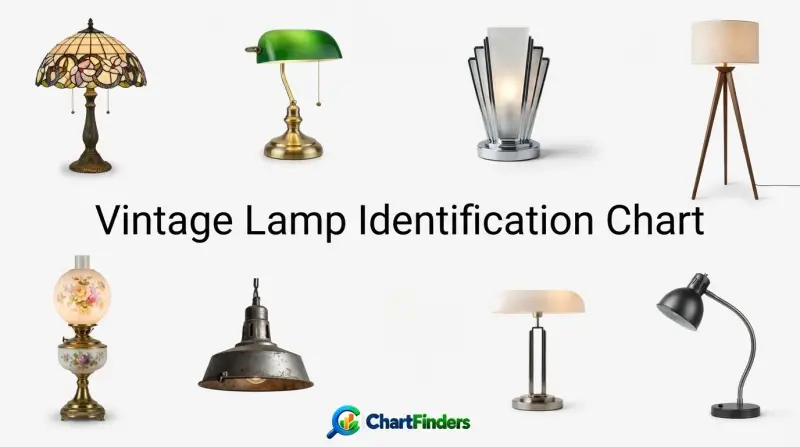
Vintage Lamp Identification Chart
- Material Evolution Matters: Heavy patinated brass, cast white metal (pot metal), spun aluminum, and hand-thrown ceramic are definitive time-markers when cross-referenced against historical manufacturing periods.
- Look Beyond the Shade: While shades are frequently replaced, the structural harp, finial, and mounting cluster often retain original period hardware.
- Electrical Components Tell a Story: Unpolarized molded plugs, vintage Leviton or Hubbell thumb-turn sockets, and twisted-cloth or rubber cords help establish a reliable manufacturing date range.
- Maker’s Marks Require Scrutiny: Stamped model numbers, incised studio signatures, and paper labels are frequently found underneath the base or inside the felt lining, though many high-end lamps remain unsigned.
- Style Eras Do Not Overlap Randomly: Art Deco geometric rigor, Mid-Century organic minimalism, and Hollywood Regency opulence each feature distinct manufacturing footprints that resist easy replication.
To successfully evaluate a vintage lamp, one must view it as an assemblage of distinct chronological layers rather than a single unified object. Manufacturers changed materials, wiring standards, and aesthetic philosophies rapidly throughout the 20th century. The following comprehensive reference guide outlines the primary eras, defining characteristics, typical materials, and prominent design markers that form the backbone of vintage lamp identification.
| Lighting Era | Primary Years | Defining Characteristics | Common Materials | Key Manufacturers / Studios |
|---|---|---|---|---|
| Art Deco | 1920s – 1930s | Geometric symmetry, stepped profiles, vertical emphasis, machine age optimism. | Chromed steel, cast brass, slag glass, Bakelite, onyx, wrought iron. | Artistic Brass & Bronze, Handel, Moe-Bridges, Chase Brass & Copper Co. |
| Mid-Century Modern (MCM) | 1940s – 1960s | Organic silhouettes, atomic starbursts, tapered wooden shafts, spun fiberglass, brass accents. | Walnut, teak, spun brass, ceramic, enameled metal, translucent fiberglass. | Louis Poulsen, Greta Grossman, Gerald Thurston, Kurt Versen, Lightolier. |
| Hollywood Regency | 1930s – 1970s | Ornate theatrical luxury, neoclassical motifs, gilded surfaces, faux bamboo, animal forms. | Cast brass, blown Murano glass, crystal drops, lacquered wood, porcelain. | Dorothy Thorpe, Chapman Manufacturing, Fontana Arte, Maison Jansen, Stiffel. |
| Space Age / 1970s Bold | 1960s – 1970s | Plastic revolution, acrylic globes, chromed spherical clusters, primary colors, futuristic shapes. | Lucite, molded ABS plastic, polished chrome, smoked glass, spun aluminum. | Artemide, Flos, Guzzini, Verner Panton, Sonneman. |
When analyzing the table above, remember that transitional periods often blur these boundaries. A lamp manufactured in 1948 may display late Art Deco restraint while incorporating nascent Mid-Century organic curves. True identification relies on cross-referencing multiple attributes simultaneously rather than relying on a single visual clue.
Anatomical Breakdown of Vintage Lamps
Every vintage lamp is a composite machine made of several modular components. Understanding how these parts interact is essential for both identification and restoration.
The Base and Body
The base provides structural stability and is frequently the most revealing diagnostic element. Heavy cast iron weights hidden beneath felt pads are common in quality lamps from the 1930s through the 1950s. Look for casting seams, mold imperfections, and tooling marks. Smooth, perfectly uniform surfaces often indicate late-20th-century Asian reproduction imports, whereas minor irregularities suggest vintage sand-casting or hand-turning techniques.
Sockets and Switches
Electrical sockets are a goldmine for dating. Turn-key knobs, push-through switches, and pull chains made by companies like Bryant, Leviton, Hubbell, and Arrow-Hart often feature patent dates or specific typography that can narrow down a manufacturing window to within a few years. Unlined paper insulating sleeves inside brass socket shells are standard on pre-1960s fixtures; modern replacements typically use heavy-duty molded plastic.
Cords and Plugs
Original wiring is a critical authentication tool, though it must often be replaced for safety reasons. Lamps wired with rayon- or cotton-wrapped twisted pair cords generally date from the 1920s through the 1940s. Molded rubber or vinyl unpolarized plugs with wide blades point directly to the post-war era, prior to the mandatory introduction of polarized safety plugs in the late 1960s and 1970s.
Decoding Maker’s Marks, Stamps, and Signatures
One of the greatest challenges in vintage lamp identification is the absence of maker’s marks. Unlike fine porcelain or sterling silver, the vast majority of 20th-century lighting was produced by assembly-line manufacturers who left their products unsigned, relying instead on paper labels that dissolved, tore, or were peeled away by frustrated homeowners decades ago.
When signatures do exist, they typically manifest in one of four ways:
- Under-base Stampings: Heavy cast-metal bases frequently feature raised or incised manufacturer initials, patent numbers, or mold numbers cast directly into the metal on the underside.
- Socket Shell Engravings: The metal cap of the light bulb socket often bears the manufacturer’s name alongside electrical rating stamps (e.g., “GE,” “Leviton,” or “Paulos”).
- Ceramic Incising: Studio pottery lamps from the Mid-Century era are often signed by the artist directly into the wet clay near the base rim, accompanied by glaze registration numbers.
- Original Paper Foil Labels: Companies like Stiffel, Laurel Lamp Manufacturing Co., and Rembrandt often used metallic foil stickers affixed to the neck, body, or inside of the shade. The presence of residual glue lines where a sticker once lived can be just as informative as the sticker itself.
Material Identification and Chronology
The chemical composition and physical properties of a lamp’s body offer undeniable proof of its era. Industrial innovation drastically changed what lighting was made of decade by decade.
Pot Metal and Cast White Metal
Dominating the 1920s through the 1940s, pot metal is an alloy of inexpensive metals like zinc, lead, and tin. It was easily cast into ornate, highly detailed figural or floral shapes and then electroplated with brass, bronze, or nickel finishes. Over decades, the underlying alloy can pit, bubble, or show greenish-white oxidation where the plating has worn thin.
Solid Brass and Spun Brass
True heavy brass was the hallmark of high-end manufacturers like Stiffel and Chapman. Spun brass—created by pressing a flat sheet of brass against a spinning lathe chuck—became ubiquitous in Mid-Century modern floor and desk lamps. Genuine vintage brass develops a deep, warm, uneven patina (often showing dark freckling or verdigris in crevices) that artificial chemical aging struggles to replicate.
Ceramic, Pottery, and Glaze Chemistry
Post-war ceramic lamps—ranging from California pottery studios to European imports—rely heavily on glaze analysis. Craquelure (fine network of cracking in the glaze) that runs deep into the body, coupled with unglazed clay foot-rings showing genuine shelf wear and soil absorption, confirms true vintage provenance. Modern reproductions frequently feature synthetic craquelure applied uniformly across the entire surface.
Common Pitfalls and Authentication Mistakes
Even seasoned collectors occasionally fall victim to sophisticated alterations and clever reproductions. Understanding these common traps prevents costly misidentifications.
The single most frequent mistake is assuming a lamp is entirely original because a single component is vintage. Lighting fixtures are inherently modular. It is common to find an authentic 1930s cast-iron base paired with a 1970s replacement shade and modern rewiring. Appraisers refer to this as a “marriage lamp”—an assembled piece made of genuine vintage parts that never actually belonged together originally.
Another major pitfall is mistaking patinated modern brass for genuine mid-century hardware. Unlacquered solid brass manufactured today will tarnish naturally within months if left unmaintained, creating a convincing faux-antique look. To differentiate true age, examine the wear patterns on high-touch areas like switch knobs and adjustment joints. Genuine vintage wear shows smooth, friction-buffed high spots contrasted against deep, undisturbed grime in protected recesses.
Frequently Asked Questions
How can I date a lamp if there are no maker’s marks or labels?
Dating an unmarked lamp requires analyzing its structural hardware and manufacturing methods. Examine the plug, cord type, socket mechanism, switch style, and fastening hardware (such as threaded brass nipples and hex nuts). Cross-reference these components with electrical catalog archives from eras like the 1930s or 1950s. Additionally, the overall silhouette, weight distribution, and base construction style will point toward a specific design decade.
Are Stiffel lamps valuable, and how do I identify them?
Stiffel lamps, particularly those produced from the 1950s through the 1970s, are highly collectible and valued for their heavy brass construction and neoclassical elegance. Authentic Stiffel lamps almost always feature a distinctive heavy weighted base, rich brass plating, and frequently retain their original metallic foil tag near the socket or on the felt bottom. Many models also feature a patented switch mechanism or inner cylindrical diffuser shade.
Is it safe to use original vintage lamp wiring?
Generally, no. Original wiring from the early-to-mid 20th century typically utilizes rubber, silk, or cotton insulation that degrades, becomes brittle, and cracks over time, creating a severe fire and shock hazard. While preservationists prefer to keep original cords intact for display-only pieces, any vintage lamp intended for daily functional use should be professionally rewired with modern UL-listed internal components while retaining the original exterior shell and switches.
What is the difference between pot metal and solid brass on a vintage lamp?
Pot metal is an inexpensive alloy of zinc and lead cast into molds and electroplated with a brass or bronze finish. It is relatively lightweight, prone to pitting, and will show a dull gray or white powdery base metal underneath worn plating. Solid brass is heavy, non-magnetic, homogeneous all the way through, and develops a rich, deep patina that can be polished back to a bright golden sheen without exposing a different underlying metal.
How do I clean a tarnished vintage brass lamp without destroying its value?
To preserve collector value, avoid harsh chemical dips or abrasive steel wool, which strip away the authentic aged patina and leave an unnatural, overly bright finish. Instead, gently clean the surface with a mild solution of warm water and dish soap using a soft microfiber cloth. If you wish to remove active corrosion or heavy grime, use a specialized non-abrasive brass cleaner like Flitz or Simichance, applying it sparingly and buffing gently by hand.
Mastering vintage lamp identification requires patience, a keen eye for material integrity, and an appreciation for how manufacturing technology evolved across the 20th century. By systematically evaluating the base composition, hardware components, electrical mechanics, and design silhouettes, you can separate authentic period masterpieces from modern imitations and appreciate the enduring craftsmanship of vintage lighting.