
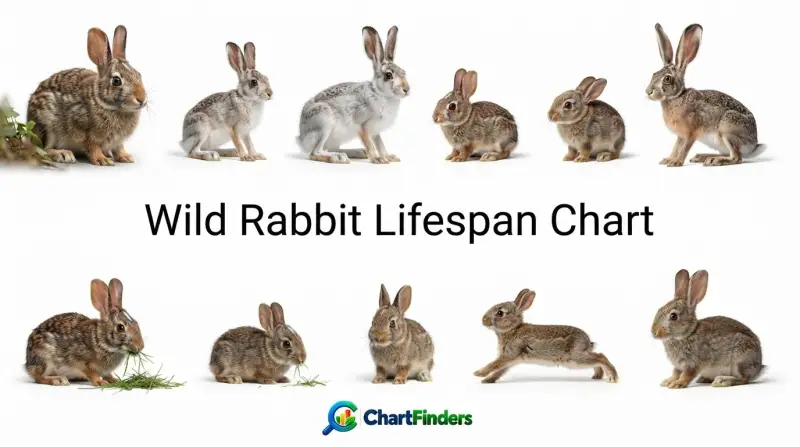
Understanding the lifespan of a wild rabbit requires looking beyond simple averages and examining the intense ecological pressures these animals face every day. Unlike their domestic counterparts that enjoy climate-controlled housing and routine veterinary care, wild lagomorphs navigate a perilous landscape defined by high predation, extreme weather, food scarcity, and fast-spreading viral or bacterial pathogens. While biological aging processes suggest a potential lifespan of several years, actual survival rates are heavily skewed by infant mortality and environmental hazards.
This comprehensive guide examines the wild rabbit lifespan chart, breaking down survival curves, mortality factors, biological milestones, and the vast differences between wild and captive lagomorphs. Whether you are studying local wildlife ecology, rehabilitating an orphaned kit, or researching population dynamics, the following sections provide a thorough, field-experienced analysis of how long wild rabbits truly live and what determines their survival.
Wild Rabbit Lifespan Chart and Survival Dynamics
- The average life expectancy for a wild rabbit that survives its first year is typically 2 to 3 years.
- Up to 70% to 80% of wild rabbit kits die within their first year of life due to predation and disease.
- Maximum biological potential under optimal wild conditions can reach 8 to 9 years, though extremely rare.
- Environmental factors—such as seasonal weather, habitat fragmentation, and food availability—directly dictate local mortality rates.
- Disease outbreaks (e.g., Rabbit Hemorrhagic Disease and Myxomatosis) can wipe out up to 90% of a naive wild population in a single season.
- Predation pressure acts as the primary natural regulator of wild rabbit population cycles and individual longevity.
To understand the lifespan of wild rabbits, wildlife biologists rely on population ecology models and field survival studies. The following data highlights the stark reality of lagomorph mortality across different life stages and environmental conditions.
| Life Stage / Environment | Average Duration | Primary Mortality Factors | Survival Probability |
|---|---|---|---|
| Nestling Kit (0–4 weeks) | 1 month | Exposure, nest flooding, hypothermia, small mammalian predators | Low (approx. 20–30% survive to weaning) |
| Juvenile (1–6 months) | 5 months | Inexperience, avian predators, ground carnivores, parasites | Moderate for survivors of weaning |
| Adult Wild Rabbit (1–3 years) | 24–36 months | Predation, vehicular strikes, disease outbreaks, severe winter | Low annual survival rate (15–25% per year) |
| Aged Wild Veteran (4–9 years) | Up to 9 years | Senescence, tooth wear, reduced mobility, accumulated parasite load | Extremely Rare (<1% of wild population) |
| Protected Domestic Equivalent | 8–12 years | Age-related medical conditions, husbandry issues, cancer | High (with optimal veterinary care and diet) |
The table above illustrates a classic Type III survivorship curve, typical of prey species. High initial infant mortality is balanced by high reproductive output, ensuring the continuation of the species despite individual lifespans being severely truncated by ecological factors.
Visualizing Wild vs. Domestic Survival Curves
Comparing wild rabbit longevity against domestic counterparts clarifies how environmental stressors truncate life expectancy. The chart below contrasts average and maximum age milestones across different living conditions.
Comparative Maximum and Average Lifespan (Years)
- Wild Average: 1.5 Years (Typical lifespan due to high predation and disease)
- Wild Maximum: 8–9 Years (Rare survivors in protected rural or island niches)
- Urban/Suburban Wild: 3–5 Years (Fewer natural predators, increased human hazards)
- Domestic Average: 8–12 Years (Indoor housing, premium diet, veterinary care)
Biological Factors Dictating Wild Rabbit Longevity
A wild rabbit’s body is finely tuned for rapid reproduction and explosive burst locomotion to evade predators, an evolutionary strategy that directly influences aging. Understanding the physiological and environmental mechanisms at play sheds light on why wild rabbits rarely reach old age.
Metabolic Rate and Accelerated Aging
Lagomorphs possess a high basal metabolic rate. Their hearts beat rapidly, and their digestive systems operate continuously to process fibrous plant matter. This fast-paced metabolic engine, combined with the constant adrenaline surges required to survive in a world filled with predators, places considerable oxidative stress on cellular structures. Over time, cellular damage accumulates faster in wild animals than in sheltered species, accelerating senescence if predators do not claim them first.
Predation Pressure as the Ultimate Regulator
The single greatest deterrent to a long wild rabbit lifespan is predation. Wild rabbits serve as a foundational prey species for a vast array of carnivores and raptors. Depending on the geographic region, predators include:
- Avian Predators: Hawks, owls, and eagles that strike from above with exceptional visual acuity.
- Mammalian Carnivores: Foxes, coyotes, wolves, weasels, ferrets, wild cats, and domestic dogs.
- Reptilian Predators: Large snakes, particularly in warmer climates.
Because predators preferentially target the young, the slow, the sick, or the unwary, very few wild rabbits survive long enough to experience natural, age-related physical decline.
Disease and Parasite Load
Wild populations are continuously exposed to epizootic diseases that can devastate local cohorts. Notable pathogens include:
- Myxomatosis: A poxvirus transmitted by fleas and mosquitoes that causes severe swelling, blindness, and high mortality rates, particularly in European rabbits (Oryctolagus cuniculus).
- Rabbit Hemorrhagic Disease Virus (RHDV2): A highly contagious, fatal calicivirus affecting both wild and domestic rabbits, causing internal hemorrhaging.
- Internal and External Parasites: Heavy burdens of ticks, fleas, mites, coccidia, and intestinal worms weaken immune systems, making individuals more vulnerable to predators and weather extremes.
Life Stages and Chronological Development
Tracing a wild rabbit through its life stages reveals the critical vulnerabilities associated with each age bracket. Growth is rapid, ensuring that offspring can fend for themselves within weeks of birth.
1. The Nestling Phase (Weeks 0 to 4)
Born blind, hairless, and completely dependent on maternal care, kits reside in a shallow scrape lined with fur and grass pulled from the mother’s abdomen. The mother (doe) visits the nest typically only once or twice every 24 hours for a few minutes to nurse, minimizing scent trails for predators. Despite this clever evolutionary tactic, mortality in the nest remains high due to flooding, agricultural machinery, farm equipment, and small mammalian predators like rats, mice, and domestic cats.
2. The Juvenile Dispersion Phase (Months 1 to 6)
Weaned at approximately four weeks of age, young rabbits scatter from the natal nest. This is a perilous transition period. Inexperienced in predator avoidance, foraging, and shelter selection, juvenile mortality spikes during these months. Those that master the art of freezing, zigzag running, and utilizing escape warrens graduate to sub-adulthood.
3. Prime Adulthood (Months 6 to 36)
By six months of age, most wild rabbits are fully mature and actively reproducing. This is the prime of a wild rabbit’s life. Adults are wise to local predator habits, possess established home ranges, and have optimized their foraging routes. However, fierce competition for territory, breeding rights, and continuous exposure to environmental risks keep annual mortality high.
4. Senior and Veteran Status (Years 3 to 9)
Any wild rabbit surpassing three years of age is a senior veteran. At this stage, physical wear begins to manifest. Dental health is critical; open-rooted teeth that grow continuously can misalign over years of chewing abrasive vegetation. Vision and hearing may dull slightly, and joint stiffness reduces top-speed escape velocity. Reaching ages 6 through 9 requires an exceptional combination of secure habitat, low predator density, and robust genetics.
Habitat and Geographical Variations in Lifespan
Lifespan expectations vary considerably depending on the specific species of wild rabbit and the geography it inhabits. Environmental stability, climate harshness, and human encroachment heavily shape longevity.
European Rabbit (Oryctolagus cuniculus)
Native to southwestern Europe and introduced globally, the European rabbit lives in complex subterranean warrens. These extensive burrow systems offer superior protection against predators and extreme weather, allowing some colony members to live up to 4 to 5 years under favorable conditions, though disease outbreaks like myxomatosis frequently reset population curves.
North American Cottontails (Sylvilagus species)
Species such as the Eastern Cottontail do not dig extensive burrows; instead, they rely on surface forms (shallow depressions in tall grass or brush) for shelter. This lack of a subterranean fortress exposes them to greater predation risk, making an average lifespan of 12 to 15 months standard, with maximum wild longevity rarely exceeding 3 years.
Urban and Suburban Adaptations
Wild rabbits inhabiting suburban parks, golf courses, and residential gardens often experience a unique set of survival parameters. While natural predators like wolves or large raptors may be scarce, urban rabbits face high mortality from domestic pets, rodenticides, lawn maintenance equipment, and vehicular collisions. Paradoxically, some suburban rabbits live slightly longer on average due to abundant, irrigated food sources and reduced pressure from apex predators.
Wild vs. Domestic Rabbits: Why the Massive Disparity?
A common point of curiosity is why wild rabbits rarely live past 3 years while pet rabbits comfortably reach 10 years or more. The gap is driven by environmental control, diet, and medical intervention.
| Parameter | Wild Rabbit (Sylvilagus / Oryctolagus) | Domestic Rabbit (Oryctolagus cuniculus form) |
|---|---|---|
| Primary Shelter | Exposed surface forms or shared, damp burrows | Climate-controlled indoor housing, predator-proof hutches |
| Dietary Quality | Foraged grasses, bark, roots, dependent on seasonal availability | Unlimited timothy hay, measured high-fiber pellets, fresh leafy greens |
| Veterinary Care | None; illness or injury results in death or predation | Routine checkups, vaccinations (RHDV2), neutering/spaying, prompt illness treatment |
| Predation Risk | Constant, daily exposure to carnivores, raptors, and humans | Zero natural predation risk in indoor environments |
| Stress Levels | Chronic environmental vigilance (fight-or-flight response active) | Low background stress in a safe, predictable routine |
As the table demonstrates, the domestic rabbit’s extended lifespan is an artificial construct made possible by removing evolutionary survival pressures and substituting them with modern husbandry and medicine.
Field Assessment: How to Estimate a Wild Rabbit’s Age
Wildlife researchers and rehabilitators often need to determine whether a rescued or observed rabbit is a dependent kit, a juvenile, or a mature adult. While exact aging without dental sectioning or tagging is challenging, several visual and physical markers provide reliable clues.
Physical Markers for Age Estimation
- Size and Weight: Eastern cottontail kits weigh under 100 grams at two weeks old, while fully grown adults range from 900 to 1,800 grams. A rabbit reaching adult weight has entered its first year of life.
- Coat Texture and Ear Proportions: Juveniles often display slightly fuzzy, woolly juvenile fur coats before shedding into sleek adult guard hairs. Their heads may appear slightly larger in proportion to their bodies compared to perfectly proportioned adults.
- Behavioral Vigilance: Young kits are relatively naive and may hesitate less before bolting or may crouch rigidly in place (freeze response). Prime adults exhibit acute environmental awareness, calculating escape routes instantly.
- Wear and Tear: Older wild veterans often show scarred ears, minor nicks from territorial disputes, or slightly worn claw tips, though severe wear is often hidden until post-mortem examination.
Common Misconceptions About Wild Rabbit Lifespan
Wildlife folklore contains several myths regarding how long wild animals live. Clarifying these misconceptions ensures a realistic understanding of lagomorph ecology.
Myth 1: Wild Rabbits Live Fast and Die Young of Old Age at 5 Years
The vast majority of wild rabbits do not die of physiological old age or natural senile decline. They are removed from the population by external agents—predation, disease, or vehicular accidents—long before their cellular machinery wears out.
Myth 2: If a Wild Rabbit Survives Its First Month, It Is Safe
While surviving the nestling phase is a major milestone, the juvenile dispersal period (months 1 to 6) is equally lethal. Young rabbits transitioning to independence face peak predation vulnerability.
Myth 3: Wild Rabbits Age at the Same Rate as Domestic Rabbits
Biologically, wild rabbits experience accelerated physiological aging due to chronic stress, continuous environmental hazards, and physical exertion, meaning a 3-year-old wild rabbit is far more weathered and physically degraded than a pampered 3-year-old house rabbit.
Frequently Asked Questions
How long do wild rabbits live on average?
In natural habitats, the average lifespan of a wild rabbit is between 12 and 18 months. High infant mortality and intense predation pressure prevent the vast majority of individuals from surviving past their second year, even though adults that beat the odds can live 2 to 3 years.
What is the oldest recorded wild rabbit?
While verified, long-term tracking of individual wild rabbits is notoriously difficult, field data suggests that exceptional wild survivors can reach 7 to 9 years of age under ideal, low-predator conditions. For comparison, the oldest recorded domestic rabbit lived to 18 years and 10 months.
Why do domestic rabbits live so much longer than wild rabbits?
Domestic rabbits live longer because they are protected from predators, receive consistent veterinary care, eat nutritionally balanced diets, and are sheltered from extreme weather and infectious wildlife diseases like myxomatosis and RHDV2.
What kills most wild rabbits in their first year?
Predation by avian raptors, foxes, coyotes, and domestic cats accounts for the largest percentage of wild rabbit mortality. Infectious diseases, severe weather events, agricultural practices, and vehicular strikes also claim a significant portion of young populations.
Can you keep a wild rabbit as a pet to increase its lifespan?
In most jurisdictions, capturing and keeping native wild rabbits as pets is illegal without specialized wildlife rehabilitation permits. , wild rabbits possess extreme stress responses to human captivity; attempting to house them domestically often leads to fatal capture myopathy or severe psychological distress.
Conclusion
The wild rabbit lifespan chart tells a story of high-stakes survival, evolutionary adaptation, and ecological balance. While an individual wild rabbit’s time on earth is typically brief—measured in months rather than decades—their prolific reproductive capacity ensures that populations endure despite staggering mortality rates. Recognizing the difference between the harsh, predator-driven reality of the wild and the protected longevity of domestic care provides a profound appreciation for how these resilient lagomorphs fit into the wider natural world.