
Interpreting wildlife sign is one of the most reliable fieldcraft skills available to hikers, conservationists, rural landowners, and wildlife enthusiasts. When you encounter mysterious droppings along a trail, property line, or campsite, you are looking at a biological ledger that records an animal’s recent diet, metabolism, health, and travel routes. Rather than relying on guesswork, field-experienced trackers use systematic classification protocols to determine which species left the evidence.
Yet, animal scat identification is notoriously nuanced. Environmental factors such as weathering, moisture, age, and seasonal shifts in diet can radically alter the appearance of droppings from the exact same animal. A coyote eating summer berries will produce loose, amorphous scat that looks remarkably like that of a raccoon, whereas the same coyote eating small mammals in winter will leave distinct, twisted, hair-packed tubular droppings. Mastering scat identification requires looking past superficial variation to evaluate structural morphology, composition, and micro-habitat context.
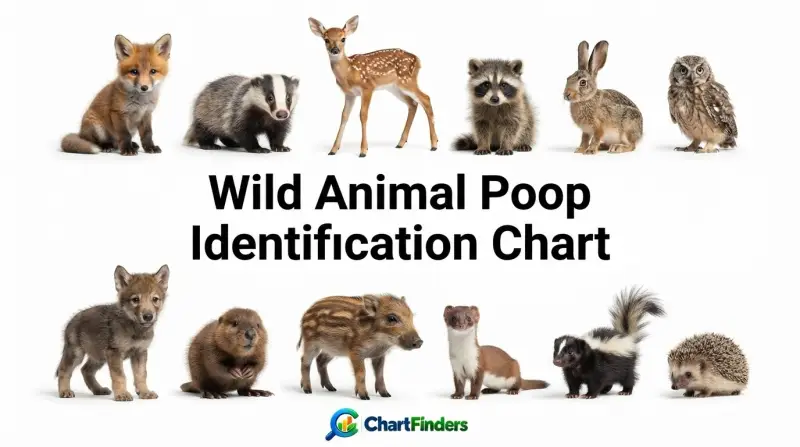
Wild Animal Poop Identification Chart
- Scat morphology is dictated primarily by digestive physiology: carnivores produce segmented, rope-like or tubular deposits, while herbivores produce pelleted or fibrous masses.
- Dietary shifts alter appearance drastically; omnivores and carnivores consuming soft fruits or high-moisture vegetation will produce amorphous droppings rather than firm shapes.
- Contents matter as much as shape. Dissecting or inspecting scat (safely with tools or sticks) reveals undigested hair, bone fragments, seeds, chitin, or cellulose fibers.
- Location and deposition habits provide behavioral clues, such as the buried latrines of felines, scraped earth of canids, or random pellet scatter of ungulates.
- Freshness indicators include surface sheen, moisture content, elasticity, and insect activity, helping determine how recently the animal passed through the area.
- Safety protocols are mandatory: never handle scat directly, avoid inhaling dust from dry samples, and wash hands thoroughly to prevent zoonotic transmission.
To help field naturalists, hikers, and researchers navigate these distinctions, the following comprehensive reference breaks down wild animal droppings by taxonomic group, structural characteristics, dietary components, and typical deposition sites.
| Species Group | Typical Shape & Structure | Average Size | Primary Contents | Common Deposition Sites |
|---|---|---|---|---|
| Canines (Wolf, Coyote, Fox) | Tubular, tapered ends, often twisted or rope-like; segments may be visible; fox scat frequently exhibits distinct pointed tips and twisted hair. | Length: 2–6 inches Diameter: 0.5–1.5 inches (species dependent) | Hair, bone fragments, teeth, insect chitin, seasonal seeds/berries. | Prominent locations: trail junctions, rocks, logs, elevated dirt mounds; often left uncovered. |
| Felines (Mountain Lion, Bobcat) | Segmented cylinders with blunt or rounded ends; surfaces can be slightly cracked or smooth; less twisted than canine scat. | Length: 3–5 inches (Lion) Diameter: 0.75–1.25 inches | Dense fur, bone fragments, digested meat residue; rarely contains plant matter. | Usually buried or partially covered with scraped leaf litter, dirt, or pine needles. |
| Ursids (Black Bear, Grizzly Bear) | Massive, tubular, blunt-ended piles; consistency varies wildly from firm logs to loose cow-pie-like sludge depending on diet. | Length: Varies widely Diameter: 1.5–2.5+ inches | Massive volumes of vegetation, berries, nuts, mast, or scavenged meat/garbage. | On trails, under fruit trees, near feeding sites, or random forest floors. |
| Mustelids (Fisher, Marten, Weasel, Otter) | Long, thin, highly twisted or rope-like cords; often pinched at the ends; frequently contains visible structural twists. | Length: Varies Diameter: 0.25–0.75 inches | Bones, fur, feathers, insect parts, fish scales (otter). | Elevated rocks, logs, stream banks, snow mounds, or specialized latrine sites. |
| Procyonids (Raccoon) | Tubular with blunt ends, often dark, cylindrical, and stacked in uniform piles; contents frequently visible on the surface. | Length: 2–4 inches Diameter: 0.5–1.0 inches | Indiscriminate: seeds, fruit pulp, human garbage, crayfish shells, corn. | Flat surfaces, large tree forks, fallen logs, rocks, barn roofs, and community latrine sites. |
| Cervids (Deer, Elk, Moose) | Separate individual pellets; oval to cylindrical; smooth or slightly dimpled; can clump during lush spring vegetation growth. | Pellet size: 0.4–1.0 inch long (species scale increases) | Finely ground woody browse, grass fibers, leaves, twigs. | Randomly scattered across feeding areas, bedding grounds, and trails. |
| Lagomorphs (Rabbits, Hares) | Nearly spherical pellets; fibrous interior; lighter brown/tan color; composed of compressed plant material. | Diameter: 0.25–0.5 inches | Finely chewed herbaceous plant matter, grasses, bark. | Scattered near brush piles, feeding edges, and resting forms. |
| Rodents (Beaver, Porcupine) | Blocky, cylindrical pellets with blunt, squared-off ends; often lighter in color due to high wood-fiber content. | Length: 0.5–1.25 inches Diameter: 0.25–0.5 inches | Wood chips, inner bark, aquatic plant stems, pine needles. | Near lodges, bank dens, tree bases, or regular feeding perches. |
Analyzing this data matrix requires an understanding of how mammalian digestive systems process food. Carnivores lack complex multi-chambered stomachs or lengthy fermenting hindguts, meaning their waste retains high amounts of unmerchantable animal structures like hair and bone. Conversely, herbivores must process massive volumes of low-calorie cellulose, resulting in high-volume, highly uniform pellet production or compressed fibrous logs.
Anatomy of Wildlife Scat: Morphology, Texture, and Composition
To move beyond basic guessing, field trackers break down scat analysis into three structural components: morphology (external shape), consistency (moisture and binding), and inclusions (what is inside). Each of these elements provides diagnostic clues that separate one species from another.
External Morphology and Shape Dynamics
The physical outline of a dropping is primarily determined by the muscular contractions of the animal’s colon and the diameter of its anal sphincter. Canids and felines produce tubular castings, but their geometry differs. Canine scat often features a tapered, stringy tail end because the animal’s diet includes hair that binds the waste into a continuous rope before breaking off. Fox scat is notably slender, frequently featuring a twisted, corkscrew tail and sharp, pointed ends.
In contrast, feline scat is cleaner-cut at the ends, appearing as uniform segments. Bears produce high-volume cylinders that often lack taper entirely. When bears feed heavily on soft mast (such as huckleberries or serviceberries), their droppings lose structural integrity altogether, resembling a wet pile of dark purple or black paste.
Internal Composition and Dietary Inclusions
The single most revealing feature of wildlife scat is its internal matrix. You do not need to dismantle droppings with your hands; a sturdy stick is sufficient to gently tease apart the outer layer to inspect what lies within.
- Hair and Fur: Indicates carnivorous or omnivorous feeding. Predators ingest hair when consuming small mammals, deer, or lagomorphs. The hair helps wrap and bind the feces.
- Bone Fragments and Teeth: Common in larger carnivores like wolves, cougars, and coyotes. Highly acidic stomach environments dissolve smaller bones, but enamel teeth, jaw shards, and dense bone chips survive transit.
- Vegetative Matter and Fiber: Coarse, shredded wood fibers point directly to rodents like beavers or porcupines. Finely packed, uniform vegetable mush indicates ungulates or bears.
- Seeds and Fruit Pits: Heavy concentration of seeds suggests omnivores (bears, raccoons, coyotes, foxes) or avian activity. Canids and bears are major seed dispersers, leaving intact seeds surrounded by nutrient-rich manure.
- Chitin and Exoskeletons: Shiny, iridescent fragments of beetle shells or grasshopper legs are diagnostic of bears, raccoons, skunks, and foxes during seasonal insect hatches.
Taxonomic Breakdown: Identifying Major Wildlife Groups
Recognizing the broader family to which an animal belongs narrows down the identification process instantly. Below is a detailed breakdown of the primary mammalian families encountered in the field.
Canidae (Wolves, Coyotes, Foxes)
Canid scat is characterized by its rope-like, segmented appearance and prominent placement. Canids use scent-marking as a territorial communication tool, meaning they deliberately deposit feces on prominent raised objects such as rocks, fallen logs, dirt hummocks, and the centers of hiking trails or logging roads.
Coyote scat typically measures between three and five inches long and roughly three-quarters of an inch in diameter. It is packed with rodent fur, bone shards, or seasonal fruit. Wolf scat is substantially larger—often exceeding six inches in length and over an inch in diameter—and contains massive amounts of ungulate hair and large bone chunks. Fox scat is much smaller, resembling a thick permanent marker in diameter, highly tapered, and frequently twisted with visible insect parts or small rodent bones.
Felidae (Mountain Lions, Bobcats, Lynx)
Felines are stealth hunters and fastidious animals, which directly influences their defecation habits. Unlike canids, felines rarely leave their scat in the middle of open trails unless marking a primary territorial boundary. Instead, they deposit their cylindrical, blunt-ended waste in hidden spots and frequently scratch soil, leaves, or pine needles over the top.
Mountain lion (cougar) scat consists of large, segmented, cylindrical pieces with dull ends, measuring up to five inches long and over an inch thick. It is composed almost entirely of dense, tightly packed fur with very little plant matter or debris. Bobcat scat looks remarkably similar in composition and shape but is scaled down significantly—typically two to four inches long and under three-quarters of an inch in diameter.
Ursidae (Black Bears, Grizzly Bears)
Bear scat is unmistakable due to sheer volume and variable consistency. Because bears are opportunistic omnivores whose diet shifts dramatically by season, their droppings change from week to week.
In spring, bear scat often consists of coarse green grass and fibrous plant shoots. In summer, it transforms into piles of bright red, blue, or purple berry pulp mixed with seeds. In autumn, bear droppings are massive, pungent masses packed with acorns, beechnuts, hazelnuts, or residual carrion. Unlike dogs, bears do not carefully bury their waste; they simply drop it wherever feeding or traveling occurs.
Mustelids and Procyonids (Raccoons, Fishers, Otters, Skunks)
This diverse grouping includes some of the most adaptable foragers in the wild.
Raccoons are famous for establishing community latrines—repeatedly using the exact same elevated site (such as a fallen log fork, tree crotch, or flat rock) until a substantial pile accumulates. Raccoon scat is tubular, dark, blunt-ended, and often filled with undigested corn kernels, fruit seeds, or crayfish parts. Warning: Raccoon roundworm (Baylisascaris procyonis) eggs are frequently present in these latrines and pose severe health risks if disturbed.
River otters utilize specific “scat stations” along riverbanks, characterized by flattened, dark, mucous-rich deposits packed with fish scales, vertebrae, and chitinous crustacean fragments. Fishers and martens leave long, highly twisted, rope-like cords that taper sharply at the ends, deposited prominently on elevated rocks or logs.
Ungulates (Deer, Elk, Moose, Bighorn Sheep)
Herbivore scat is designed around maximum fiber extraction. Ungulate droppings consist of compressed vegetable matter formed into individual pellets.
White-tailed and mule deer produce smooth, oval pellets (often called “beans”) that measure about half an inch long. In dry weather or winter, they scatter individually or in small groups. During spring when fresh, succulent green grass is consumed, deer pellets can clump together into an amorphous, cow-pie-like mass. Elk pellets are larger, more cylindrical, and feature a slight dimple or indentation on one end. Moose scat consists of very large, fibrous, barrel-shaped nuggets that are noticeably lighter in color due to the high proportion of woody browse and bark consumed during winter.
Field Methodology: Step-by-Step Scat Identification Process
When you encounter an unfamiliar sample in the field, follow a structured elimination workflow to arrive at the correct species identification.
- Assess Location and Placement: Is the scat sitting proudly on top of a rock or trail center (canid/mustelid)? Is it hidden beneath scraped earth (feline)? Is it part of a massive accumulated pile in a tree fork (raccoon)? Or is it randomly scattered across a feeding zone (ungulate)?
- Measure Dimensions: Note the length and diameter. Use a scale reference object like a coin or pocket knife next to the sample (without touching it) if you plan to photograph it for later verification.
- Examine Shape and Termini: Check whether the ends are tapered and stringy, blunt and squared-off, or formed into discrete individual pellets. Look for rope-like twists or segmentation.
- Analyze Composition: Inspect the outer surface and gently tease the sample with a stick. Identify whether hair, bone, seeds, wood fibers, or insect chitin dominate the matrix.
- Evaluate Age and Freshness: Check for surface moisture, sheen, elasticity, odor, and insect activity (such as blowflies or dung beetles). Fresh scat is dark, moist, and pliable; aged scat is faded, bleached, cracked, and brittle.
- Corroborate with Secondary Sign: Look around the immediate vicinity for supporting tracking evidence—such as paw prints, hoof impressions, claw marks on trees, hair snagged on bark, or rubbed vegetation.
- Consult Digital or Physical Field Guides: Compare your findings against regional field guides or verified wildlife tracking databases.
Common Identification Mistakes and Look-Alikes
Even experienced naturalists occasionally misidentify scat due to environmental mimicry and dietary overlap. Understanding common pitfalls prevents tracking errors.
Dietary Overlap Between Omnivores and Carnivores
The single greatest trap in scat identification is assuming a species’ diet remains static. A coyote feeding exclusively on wild cherries or autumn olives in October will produce soft, purple, seed-filled scat that looks almost identical to that of a black bear or a large raccoon. Always check secondary indicators, such as footprint size and gait patterns, before finalizing your conclusion.
Weathering and Degradation Distortions
Rain, snow, freezing temperatures, and sun-drying alter scat morphology rapidly. Fresh canine scat that starts as a firm, segmented cylinder can dissolve into an amorphous blob after two heavy rainstorms, losing its distinctive tapered ends and twisted surface texture. , insect activity and fungal colonization (such as white mold growth) can obscure surface details within 48 to 72 hours.
Domestic Animal Confusion
In rural-urban interfaces, state parks, and multi-use trails, domestic dogs and cats leave scat that frequently mimics wild predators. Large domestic dog droppings can easily be mistaken for wolf or coyote sign. However, domestic dog scat often exhibits blunt, uniform thickness throughout due to processed commercial diets lacking natural hair and bone binders, and it is rarely deposited with the deliberate, strategic precision of a wild canid marking a territorial apex.
Frequently Asked Questions
How can I safely examine animal scat without risking disease?
Never touch animal scat with your bare hands. If you need to inspect internal contents, use a dedicated stick or a trowel. Avoid disturbing dry, powdery scat in enclosed spaces or arid environments to prevent inhaling spores or parasite eggs. Always wash your hands thoroughly with soap and water or use an alcohol-based hand sanitizer immediately after completing your field observation.
Can I determine the exact sex and age of an animal from its droppings?
Generally, no. While male large carnivores often deposit slightly larger scat than females due to physical dimorphism, and mature adults produce larger volumes than juveniles, there is immense size overlap. Definitive determination of sex and age requires genetic analysis (DNA extraction from mucosal cells on the outer layer of the scat), which is typically reserved for formal wildlife research studies.
What is the difference between coyote and red fox scat?
Size and placement are the primary separators. Coyote scat is substantially larger (typically 3 to 5 inches long and 0.75 to 1 inch in diameter), whereas red fox scat is much thinner (resembling a thick marker, around 0.5 inches or less in diameter). Fox scat also tends to feature very sharp, pointed, twisted ends and is frequently deposited on prominent raised stones or tufts of grass to mark territory boundaries.
Why do some animal droppings have white spots or powdery residue?
White coloration or powdery crumbling in older carnivore scat is caused by high calcium content from digested bones. When wolves, cougars, or coyotes consume skeletal structures, their digestive systems break down the mineral matrix. As the scat ages and dries in the sun, residual calcium carbonate compounds turn the exterior and interior chalky white.
How long does animal scat remain in the environment?
Decomposition rates vary wildly based on climate, season, and composition. Herbivore pellet scat (deer, rabbit) in dry or freezing conditions can persist for many months, slowly crumbling into the soil. High-protein carnivore scat decomposes faster through insect activity and bacterial decay, often disappearing within weeks during warm, wet summer months, though hair and bone fragments may remain recognizable for a season.
Conclusion
Mastering wild animal poop identification transforms a casual walk in the woods into an engaging exercise in wildlife tracking and ecological literacy. By methodically evaluating morphology, internal composition, placement context, and environmental freshness, you can accurately decode the presence and behavior of the mammals sharing your landscape. Always prioritize safety, respect wildlife boundaries, and use scat analysis as a non-invasive tool to deepen your understanding of the natural world.