
Arachnid diversity across the upper Midwestern United States reflects a complex interplay of temperate forest ecology, agricultural matrices, and urban microclimates. In Wisconsin, homeowners, agriculturalists, and outdoor enthusiasts frequently encounter various web-weaving and roaming predators. While folklore and media representations often exaggerate the hazards posed by native arachnids, a scientific examination reveals that true medically significant encounters are exceptionally rare. Understanding the precise anatomical distinctions between harmless, beneficial taxa and rare dangerous species is essential for effective pest management, public safety, and ecological appreciation.
This master reference guide provides a comprehensive framework for identifying the spiders of Wisconsin. By examining specific anatomical structures, behavioral patterns, habitat preferences, and venom characteristics, readers can accurately evaluate encountered specimens. The following sections into general arachnid biology, detailed identification profiles for common and medically significant taxa, ecological roles, and safe management protocols.
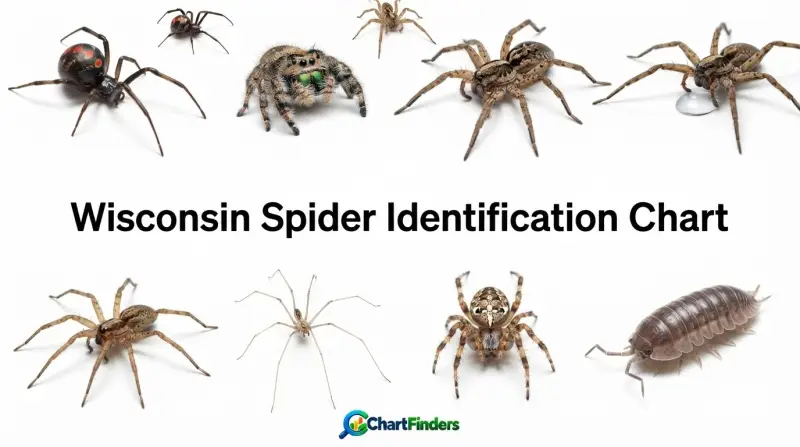
Wisconsin Spider Identification Chart
- The vast majority of spiders encountered in Wisconsin homes and landscapes are harmless and beneficial pest predators.
- Medically significant species in Wisconsin are limited primarily to the northern black widow and the occasional, accidental introduction of the brown recluse.
- Visual identification should never rely on color alone; specific structural details like eye arrangements (oculi) and abdominal markings are critical.
- Common look-alikes, such as yellow sac spiders and grass spiders, are frequently misidentified as dangerous species due to superficial color similarities.
- Non-chemical exclusion and habitat modification remain the most effective, long-term strategies for managing indoor spider populations.
To assist in rapid field and indoor identification, the following matrix compares key morphological, behavioral, and ecological attributes of the most frequently encountered spider groups in Wisconsin. Use this comparative data alongside close visual inspection to distinguish between benign native fauna and potential hazards.
| Common Name | Scientific Taxon | Primary Habitat | Web Architecture | Medical Significance | Key Visual Identifier |
|---|---|---|---|---|---|
| Northern Black Widow | Latrodectus varius | Underside of logs, stones, dark sheds | Irregular, tangled, scaffolding web | High (Neurotoxic venom) | Glossy black body with red hourglass or spots |
| Brown Recluse | Loxosceles reclusa | Dark, undisturbed indoor storage areas | Irregular, sheet-like retreat | High (Necrotic venom; rare in WI) | Uniform tan-brown body; dark violin marking on cephalothorax |
| Yellow Sac Spider | Cheiracanthium mildei | Indoor walls, ceilings, outdoor foliage | Silken tube or sac; no orb web | Low-Moderate (Mild localized tissue reaction) | Pale yellow-tan body; dark median stripe on abdomen |
| Wolf Spider | Lycosidae (family) | Ground, leaf litter, gardens | None (Active hunter) | None (Mechanical bite only) | Robust, hairy body; large distinct anterior median eyes |
| Common Orb Weaver | Araneidae (family) | Gardens, forests, eaves | Vertical, symmetrical wheel web | None (Benign) | Variable bright coloration; broad, bulbous abdomen |
| Cellar Spider | Pholcidae (family) | Basements, cellars, crawlspaces | Loose, irregular 3D tangle | None (Benign) | Extremely long, fragile legs (“daddy longlegs”) |
| Jumping Spider | Salticidae (family) | Sunny walls, foliage, fences | None (Active stalker/leaper) | None (Benign) | Compact, hairy body; large, expressive forward-facing eyes |
| Grass Spider | Agelenopsis spp. | Lawns, low shrubs, foundation edges | Horizontal sheet web with funnel retreat | None (Benign) | Tan with longitudinal dark stripes; prominent spinnerets |
When analyzing this dataset, note that size ranges, exact coloration, and geographic distribution can vary depending on local microclimates and seasonal shifts. The following sections provide an in-depth breakdown of these distinct families and genera found across Wisconsin.
Understanding Arachnid Anatomy for Field Identification
Accurate spider identification requires moving past general impressions and examining specific anatomical landmarks. Unlike insects, which possess three distinct body segments, arachnids possess two primary tagmata: the cephalothorax (fusion of the head and thorax) and the abdomen (opisthosoma), connected by a narrow pedicel.
Key anatomical features utilized by entomologists include:
- Ocular Arrangement (Eyes): Most spiders possess eight simple eyes (oculi), though some cave-dwelling or subterranean taxa possess six or fewer. The size, spacing, and arrangement of these eyes on the anterior cephalothorax are diagnostic at the family level (e.g., Lycosidae possess a distinct large pair of posterior-median eyes; Loxosceles possess six eyes arranged in three dyads).
- Chelicerae and Fangs: The mouthparts used to inject venom and manipulate prey. In Mygalomorphae (tarantulas and trapdoor spiders), chelicerae move parallel to the body axis. In Araneomorphae (the vast majority of true spiders), they oppose each other like pincers.
- Spinnerets: Silk-spinning appendages located at the posterior ventral end of the abdomen. The number, length, and positioning of spinnerets help differentiate funnel-web weavers (Agelenidae) from other taxa.
- Epigyne and Palps: In mature specimens, female genital plates (epigyne) and male pedipalps (modified boxing-glove-like reproductive structures) offer definitive species-level identification traits.
Medically Significant Species in Wisconsin
Although Wisconsin’s climate naturally limits the proliferation of warm-climate arachnids, two medically important species demand careful attention. Encounters with these spiders are uncommon, but understanding their ecology minimizes accidental bites.
Northern Black Widow (Latrodectus varius)
The northern black widow is native to parts of Wisconsin, typically inhabiting undisturbed, sheltered microhabitats such as woodpiles, stone walls, hollow stumps, and dark outbuildings. Females are easily recognized by their glossy, jet-black globular abdomen marked with characteristic red spots or a broken hourglass shape on the ventral surface. Males are much smaller, lighter in color, and entirely harmless.
The venom of Latrodectus varius is a potent neurotoxin containing latrotoxin, which triggers massive neurotransmitter release. Bites cause immediate local pain followed by severe muscle cramps, abdominal rigidity, diaphoresis, and systemic distress. While rarely fatal to healthy adults due to modern medical interventions, bites require immediate professional evaluation.
The Brown Recluse (Loxosceles reclusa) Status in Wisconsin
A common point of confusion and anxiety for Wisconsin residents is the brown recluse. Established, self-sustaining populations of the brown recluse are generally restricted to the south-central and southern United States. However, individual specimens occasionally hitchhike into Wisconsin via transported goods, boxes, or furniture.
Morphologically, the brown recluse features a uniform tan-to-dark-brown coloration without stripes or bands on the legs, and a distinctive darker violin-shaped marking on the dorsal cephalothorax with the neck of the violin pointing backward. Crucially, while many harmless spiders (such as cellar spiders and grass spiders) possess eight eyes, the brown recluse possesses a unique arrangement of six eyes paired in triads (three groups of two). Its venom contains sphingomyelinase D, which can cause localized dermonecrotic lesions. True encounters in Wisconsin, however, are statistically rare; most suspected brown recluse bites turn out to be staphylococcal infections, necrotic arachnidism from other species, or insect bites.
Common Harmless and Beneficial Wisconsin Spiders
The vast majority of spiders observed in Wisconsin gardens, agricultural fields, and residential structures are completely harmless to humans and play a in regulating insect populations.
Wolf Spiders (Family Lycosidae)
Wolf spiders are robust, ground-dwelling hunters that do not construct webs to capture prey. Instead, they actively chase down insects across lawns, leaf litter, and basements. They are easily identified by their distinct eye arrangement—featuring a prominent row of four small eyes below two very large anterior-median eyes—and their habit of carrying their egg sacs attached to their spinnerets, followed by hundreds of spiderlings riding on the female’s dorsal abdomen after hatching.
Common Orb Weavers (Family Araneidae)
Araneids construct classic, highly symmetrical wheel-shaped webs across gardens, doorways, and tree branches. Notable Wisconsin examples include the marbled orb weaver and the spotted orb weaver. These spiders feature stout, brightly patterned abdomens and often consume and rebuild their complex webs daily to recycle silk proteins.
Cellar Spiders (Family Pholcidae)
Frequently referred to colloquially as “daddy longlegs” (causing frequent confusion with harvestmen, which are entirely different arachnids), cellar spiders possess exceptionally long, delicate legs and small oval bodies. They inhabit the upper corners of basements, crawlspaces, and garages, spinning loose, chaotic 3D webs. When disturbed, they vibrate rapidly within their web to blur their outline against predators.
Jumping Spiders (Family Salticidae)
Salticids are easily recognized by their compact bodies, short legs, and exceptionally large, forward-facing anterior median eyes that grant them acute stereoscopic vision. They do not build webs for hunting; instead, they stalk and execute powerful, calculated leaps onto insect prey. Many species exhibit iridescent coloration and engaging behavioral displays.
Look-Alike Species and Common Identification Pitfalls
Misidentification frequently leads to unnecessary panic or improper pest control measures. Several harmless Wisconsin spiders closely resemble medically significant taxa:
- Yellow Sac Spiders (Cheiracanthium spp.): Often mistaken for the brown recluse due to their pale yellowish-tan coloration and nocturnal roaming habits. Unlike the recluse, yellow sac spiders lack the violin marking and possess eight eyes arranged in two equal rows. They construct small, silken retreat sacs in upper room corners and can deliver a defensive nip if trapped against skin, resulting in localized mild pain.
- Grass Spiders (Agelenopsis spp.): Frequently confused with wolf spiders or wandering species due to their brown-and-tan striped dorsal patterns. Grass spiders, however, build sheet-like webs terminating in a tubular funnel on lawns and feature conspicuously long, prominent spinnerets extending from the rear of the abdomen.
Practical Management and Prevention Protocols
When spider populations within residential or commercial structures exceed comfortable thresholds, integrated pest management (IPM) offers the most sustainable and scientifically sound approach. Chemical intervention alone provides only temporary relief if underlying structural and environmental conditions remain unaddressed.
- Habitat Modification (Sanitation): Clear tall grass, brush piles, firewood stacks, and dense mulch away from the immediate exterior foundation of buildings. Indoors, reduce clutter in basements, attics, and storage closets where solitary wanderers seek shelter.
- Structural Exclusion: Seal cracks, gaps, and crevices in foundations, mortar, and siding using high-grade silicone caulk. Install tight-fitting weather stripping around exterior doors and window screens to prevent entry.
- Lighting Adjustments: Exterior incandescent and fluorescent lighting attracts high volumes of flying insect prey, which in turn draws predatory spiders to structural entry points. Switch to sodium-vapor or yellow-spectrum insect repellent lighting further away from doorways.
- Targeted Mechanical Control: Utilize a standard vacuum attachment to physically remove wandering specimens, egg sacs, and web structures from corners and baseboards.
Frequently Asked Questions
Are there any deadly spiders native to Wisconsin?
No spiders native to Wisconsin are considered routinely deadly to healthy human adults. While the northern black widow possesses potent neurotoxic venom capable of causing severe systemic illness, fatalities are extremely rare, particularly with prompt medical treatment and antivenom availability.
How can I tell the difference between a harvestman and a cellar spider?
While both are commonly called “daddy longlegs,” harvestmen (order Opiliones) are not true spiders; they possess a single oval body segment without a waist and do not produce silk or venom. Cellar spiders (family Pholcidae) are true spiders with a distinct two-part body, can spin silk webs, and possess venom glands used exclusively for subduing insect prey.
Why do I suddenly see so many large spiders in my house during autumn?
Late summer and early autumn mark the biological mating season for many common Wisconsin species, such as giant house spiders and wolf spiders. Mature males abandon their web retreats or ground covers to actively search for receptive females, leading to increased indoor encounters as temperatures drop outdoors.
Is it safe to crush spiders found indoors?
Physically dispatching wandering spiders poses no inherent biological hazard beyond standard hygiene, but crushing them against skin or fabrics should be avoided to prevent accidental defensive biting or staining. Relocating non-venomous specimens outdoors using a container and a piece of paper is an ecologically sound alternative.
What should I do if I suspect I have been bitten by a brown recluse in Wisconsin?
First, remain calm, as true brown recluse bites in Wisconsin are statistically improbable. Clean the bite site thoroughly with mild soap and water, apply a cold compress to reduce swelling, and monitor the area. If you develop systemic symptoms, expanding redness, or a central blister with necrosis, seek professional medical evaluation immediately. Capture or photograph the spider if safely possible to aid clinical diagnosis.
Conclusion
Navigating the rich arachnid fauna of Wisconsin requires a balance of scientific observation and practical caution. While encounters with rare venomous taxa such as the northern black widow or transient brown recluse warrant vigilance, the vast majority of encountered spiders are benign, beneficial predators that contribute significantly to natural pest regulation. By utilizing detailed anatomical markers, maintaining structural exclusion, and embracing an integrated approach to property management, residents can safely coexist with Wisconsin’s diverse native arthropods.