
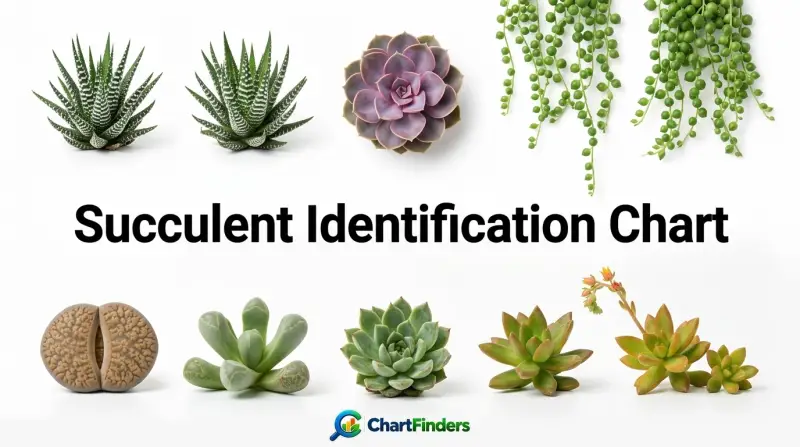
Succulent identification is both an art and a botanical science. Because these resilient plants have evolved across vastly different arid and semi-arid ecosystems worldwide—from the high plateaus of Mexico to the rocky slopes of South Africa—they have developed diverse adaptations to survive drought. These survival mechanisms result in a bewildering array of shapes, colors, and textures that can easily confuse both novice indoor gardeners and experienced horticulturists. When caring for these species, applying a one-size-fits-all approach is a recipe for root rot or sunburn. Accurately matching a plant to its correct genus and species using a systematic identification chart ensures that its specific environmental requirements are met.
This guide serves as a definitive resource for parsing the complex taxonomy and physical traits of the most common and structurally distinct succulent families. By breaking down botanical terminology, examining leaf and stem architectures, mapping care metrics, and addressing common misidentifications, this article provides the deep domain knowledge required to confidently identify and cultivate succulents.
Succulent Identification Chart
- Morphology Matters: Leaf arrangement, epidermal texture, and stem architecture are the primary diagnostic pillars for succulent identification.
- Genus Distinctions: Closely related genera—such as Echeveria and Graptopetalum—often require examination of floral structures or subtle leaf tips for precise classification.
- Light & Water Profiles: Accurate identification directly informs care needs; glaucous or powdery coatings usually indicate high direct sun requirements, while soft, thin leaves often signal a preference for bright indirect light.
- Growth Habit Classification: Succulents generally split into rosettes, trailing vines, columnar stems, and caudiciform sculptures, each dictating distinct spatial and potting strategies.
- Common Pitfalls: Environmental stress, etiolation, and overwatering can severely alter a plant’s physical appearance, leading to frequent misidentification.
To establish a functional baseline, a structured identification chart must correlate physical features with taxonomic names, baseline care requirements, and cultivation difficulty. The matrix below contrasts major succulent groups, highlighting the diagnostic identifiers used in field and greenhouse settings.
| Succulent Genus / Type | Primary Identification Clues | Growth Habit | Light Requirements | Watering Frequency | Difficulty |
|---|---|---|---|---|---|
| Echeveria | Symmetrical rosettes; fleshy leaves often coated in a waxy, powdery farina. | Low-growing rosette | Bright indirect to direct morning sun | Every 10–14 days (Soak-and-dry) | Beginner |
| Sempervivum | Tight geometric rosettes; produces offsets (“hens and chicks”); highly cold-hardy. | Clumping rosette | Full sun (outdoor optimal) | Every 2–3 weeks | Beginner |
| Graptoveria | Hybrid cross (Echeveria × Graptopetalum); slightly thicker, pointed leaves with pastel hues. | Rosette transitioning to trailing | Full sun to bright indirect | Every 10–14 days | Beginner |
| Aloe | Fleshy, lance-shaped leaves with serrated or toothed margins; basal rosettes; tubular flowers. | Upright, clumping, or arborescent | Bright indirect to direct light | Every 2–3 weeks | Beginner |
| Haworthia | Small, compact rosettes; leaves feature white tubercles, translucent window panes, or rough bands. | Clumping ground-level rosette | Bright indirect light (shade-tolerant) | Every 14–21 days | Beginner |
| Gasteria | Tongue-shaped, asymmetrical leaves; dark green with white spots; curved, stomach-shaped flowers. | Distichous or rosetted clump | Low to bright indirect light | Every 14–21 days | Beginner |
| Crassula | Opposite leaves fused at the base; woody stems (subshrub form); geometric stacking in some species. | Upright or trailing subshrub | Bright indirect to direct sun | Every 10–14 days | Beginner to Intermediate |
| Sedum | Fleshy, rounded, needle-like, or flat leaves arranged spirally; creeping ground cover or trailing stems. | Creeping or trailing | Full sun | Every 14–21 days | Beginner |
| Senecio | Cylindrical, bean-like, or teardrop-shaped leaves (“string of pearls/tears”); succulent vines. | Trailing / hanging vine | Bright indirect light | Every 7–10 days | Intermediate |
| Euphorbia | Architectural ribbed stems; often features sharp thorns and toxic, milky white latex sap when cut. | Columnar, branching, or shrubby | Bright direct light | Every 2–3 weeks | Intermediate |
When analyzing this chart, note that categories are organized by taxonomic family traits and physical structure. The transition from a beginner-friendly rosette like Echeveria to a more delicate trailing specimen like Senecio involves shifts not only in appearance, but also in soil aeration, humidity tolerance, and watering discipline.
Decoding Succulent Morphology: Anatomy of an Identification Key
Botanical identification relies on dissecting a plant into its component parts. To successfully identify an unknown succulent, one must evaluate specific structural markers systematically rather than relying on overall color alone, which can shift dramatically based on sun exposure and temperature stress (a process known as developing “stress colors”).
Leaf Arrangement (Phyllotaxis)
The geometric layout of leaves on the stem is the first major diagnostic clue:
- Rosette: Leaves radiate outward from a central point in a tight, overlapping spiral (e.g., Echeveria, Sempervivum, Aeonium). This maximizes light capture while minimizing surface area exposure to drying winds.
- Opposite (Decussate): Leaves emerge in pairs directly across from each other on the stem, with successive pairs crossing at right angles (e.g., Crassula ovata).
- Alternate / Spiral: Leaves are spaced singly along the stem in a spiral or alternating fashion (e.g., Sedum, Senecio).
- Distichous: Leaves grow in two strict, flat vertical ranks on opposite sides of the stem, creating a fan-like profile (e.g., certain Haworthia and Gasteria species).
Epidermal Texture and Specializations
The outer layer of the leaf reveals how the plant manages moisture loss and solar radiation:
- Farina (Glaucous): A powdery, chalky, or waxy white-to-blue coating produced by the plant as a natural sunscreen and moisture barrier. Rubbing it off damages the plant; its presence strongly points toward Echeveria, Pachyphytum, or specific Graptoveria hybrids.
- Pubescent / Tomentose: Fine hairs or fuzzy trichomes covering the leaf surface, which trap ambient moisture and reduce wind evaporation (e.g., Kalanchoe tomentosa “Panda Plant”).
- Windowed Leaves: Translucent epidermal panels at the leaf tips that allow light to penetrate into internal photosynthetic tissue while the rest of the plant remains buried beneath desert soil (e.g., Haworthia cooperi, Lithops).
- Tubercles and Warting: Raised white bumps, rough dots, or hardened ridges distributed across the leaf epidermis, common in Haworthia and some aloes.
Detailed Breakdown of Major Succulent Genera
To move beyond general categories, a rigorous identification process requires an in-depth look at the distinct physical characteristics, growth habits, and cultivation nuances of the most prominent succulent genera found in home collections and botanical gardens.
1. Echeveria: The Epitome of Symmetry
Native primarily to semi-desert regions of Central America, Mexico, and northwestern South America, Echeveria is prized for its exquisite geometrical symmetry. The leaves are typically thick and broad at the base, tapering to a sharp or rounded point. They form dense, stemless or short-stemmed rosettes that readily produce basal offsets, known as “pups.”
Identification markers: Look for tightly packed rosettes, a noticeable farina coating on many varieties, and bell-shaped flowers borne on one-sided arching cymes (flower stalks).
Care profile: They demand maximum light intensity to maintain tight form; in low light, they stretch out in a process called etiolation. They require gritty, fast-draining soil and a strict soak-and-dry watering schedule.
2. Haworthia and Gasteria: The Shade-Loving Window Dwellers
Hailing from the rocky, often shaded outcrops and grasslands of South Africa, Haworthia and Gasteria represent a divergence from sun-baked desert stereotypes. They are small, clumping rosettes or distichous fans that thrive under the canopy of shrubs or rocks.
Identification markers for Haworthia: Compact size (rarely exceeding 6 inches across), dark green to brownish leaves, and distinctive white horizontal bands, raised bumps (tubercles), or translucent leaf tips (“window panes”).
Identification markers for Gasteria: Asymmetrical, tongue-shaped leaves that often lie flat or twist in a spiral, dark green coloration heavily speckled with white spots, and distinctively curved, stomach-shaped flowers that give the genus its name.
Care profile: Unlike Echeveria, both genera scorch easily in intense midday sun. They flourish in bright indirect light and prefer slightly more organic, yet still well-draining, potting mixes.
3. Crassula: From Tiny Stacked Coins to Arborescent Shrubs
The Crassula genus contains over 300 species displaying remarkable morphological diversity, ranging from tiny, creeping ground covers to large, woody-stemmed indoor trees like the Jade Plant (Crassula ovata).
Identification markers: Leaves are invariably opposite, often fused at the base around the stem. Stems lignify (turn woody and brown) as the plant matures. Some species, such as Crassula perforata (String of Buttons), exhibit a stacked architectural form where leaves clasp the central stem tightly.
Care profile: Extremely adaptable, preferring bright indirect to direct light. They store substantial water in their fleshy stems and leaves, making them sensitive to overwatering during winter dormancy.
4. Senecio: Architectural Vines and Unusual Leaf Forms
The massive Senecio genus spans annuals, perennials, shrubs, and striking succulent vines. It is best known in succulent horticulture for its unique trailing species.
Identification markers: Often featuring trailing or cascading stems with modified leaves. Senecio rowleyanus (String of Pearls) features spherical, pea-like leaves with a translucent stripe; Senecio radicans (String of Bananas) features elongated, curved leaves.
Care profile: These trailing species require bright indirect light and shallow root space. Because their root systems are relatively fine and shallow, they require slightly more frequent watering (every 7 to 10 days) than deep-rooted rosette succulents.
5. Euphorbia: The Convergent Evolution Mimics
Often mistaken for cacti due to their ribbed, spiny, and columnar appearance, Euphorbia species belong to the Euphorbiaceae family and originate largely from Africa and Madagascar. They exhibit convergent evolution, developing similar survival strategies to American cacti without being botanically related.
Identification markers: Look for sharp paired spines (which are modified stipdes rather than true spine clusters from an areole), distinct ribbed or angled stems, and—most crucially—the presence of a toxic, milky white latex sap that oozes when the stem or leaf is broken.
Care profile: High light requirements, excellent drainage, and careful handling (the sap is a severe skin and eye irritant). They tolerate drought exceptionally well.
Comparative Analysis of Succulent Growth Forms and Care Demands
Understanding how a succulent’s physical structure relates to its ecological origin allows growers to predict care parameters even when identifying an entirely unknown specimen. The chart below correlates growth architecture with environmental tolerances.
| Growth Architecture | Representative Genera | Root System Depth | Drought Tolerance | Primary Environmental Stressor |
|---|---|---|---|---|
| Flat/Compact Rosette | Echeveria, Sempervivum | Moderate (Fibrous) | High | Etiolation from low light; rot from trapped crown moisture. |
| Clumping/Windowed | Haworthia, Gasteria | Shallow (Fleshy roots) | Moderate-High | Leaf scorch from direct, harsh sun; root rot from heavy soil. |
| Woody Subshrub | Crassula, Portulacaria | Deep / Extensive | High | Stem rot from poor drainage; cold damage below freezing. |
| Trailing / Hanging Vine | Senecio, Ceropegia | Very Shallow / Fine | Moderate-Low | Dehydration during summer; root rot from soggy topsoil. |
| Columnar / Arborescent | Euphorbia, Pachypodium | Deep Anchor Roots | Extreme | Overwatering during winter dormancy; physical breakage. |
As this comparison illustrates, plants with shallow, fine root systems (like trailing vines) dry out faster and cannot tolerate prolonged drought as effectively as woody subshrubs or deep-rooted columnar specimens. Conversely, deep-rooted or woody plants hold immense water reserves in their trunks, making them much more vulnerable to stem rot if kept in continuously wet potting mixes.
Step-by-Step Succulent Identification Workflow
When faced with an unidentified succulent, follow this structured diagnostic sequence to narrow down the taxonomy:
- Examine the Stem and Shape: Does the plant form a tight ground-level rosette, a woody shrub, a trailing vine, or a vertical, ribbed column? (Eliminates 70% of mismatched genera immediately).
- Analyze Leaf Attachment and Shape: Are the leaves flat, rounded, needle-like, triangular, or tongue-shaped? Are they arranged opposite each other, in a spiral rosette, or randomly scattered along the stem?
- Check for Epidermal Specializations: Look closely at the leaf surface. Is there a powdery white farina coating? Are there translucent window panes, fuzzy hairs, rough tubercles, or sharp marginal teeth?
- Test for Latex Sap (Cautiously): Make a tiny, non-destructive nick on a hidden part of the stem. If a milky white fluid emerges, the plant is likely a Euphorbia or a member of the Apocynaceae family. If clear, watery sap emerges, it is likely a standard succulent leaf (e.g., Aloe or Agave).
- Consult Floral Structures: If the plant is blooming, examine the flower shape. Bell-shaped flowers on one-sided stalks point to Echeveria; tubular, spotted flowers often indicate Aloe or Gasteria.
Common Identification Mistakes and Pitfalls
Even experienced botanists can be tricked by succulents because these plants change dramatically under environmental stress. Recognizing these pitfalls prevents misclassification:
- Etiolation (Light Deprivation Stretching): When a compact rosette like an Echeveria receives too little light, it stretches upward, losing its compact form, changing leaf spacing, and turning a pale green. A stretched plant can look entirely different from its healthy counterpart, leading growers to misidentify it as a different genus or species.
- Sun Stress Coloration: Intense light and cool temperatures trigger the production of anthocyanin pigments, turning green plants bright red, purple, or orange. A green specimen indoors may look completely different when sun-stressed outdoors, confusing visual identification charts.
- Superficial Resemblance (Convergent Evolution): Mistaking an African Euphorbia for an American cactus is the most frequent taxonomic error. Remember that cacti possess areoles (specialized cushion-like structures from which spines and flowers emerge) and clear sap, whereas Euphorbia lack areoles and bleed milky latex sap.
- Hybrid Confusion: The horticultural market is flooded with intergeneric hybrids (such as Graptoveria, Pachyveria, or x Sedeveria). These plants share mixed genetic traits from two different genera, often resulting in ambiguous leaf thickness and color patterns that defy clean textbook keys.
Frequently Asked Questions
How do I know if my succulent needs more light based on its identification?
If your identification chart classifies a plant as a high-light rosette (such as an Echeveria or Sempervivum), it will display etiolation—stretching, downward-pointing leaves with wide gaps on the stem—when light is insufficient. Conversely, shade-tolerant succulents like Haworthia will develop bleached, yellowish, or scorched brown patches on their leaves if subjected to direct, harsh midday sun.
What is the difference between an Aloe and an Agave on an identification chart?
While both feature basal rosettes of thick, spiny leaves, Aloe species typically have soft, flexible, fleshy leaves filled with clear gel, and they produce tubular flowers on vertical stalks (and many aloes are polycarpic, meaning they bloom repeatedly). Agave species feature extremely rigid, fibrous leaves with sharp terminal spines, and they are monocarpic, meaning they grow for decades, produce a massive one-time flower spike, and then die.
Why is my succulent losing its powdery farina coating?
The farina (glaucous coating) is a delicate, natural wax produced by the plant as a protective shield against UV rays and pests. It does not regenerate once rubbed off. Physical handling, heavy overhead watering, or rain will wash it away, leaving permanent fingerprints or dark patches on the leaves. Always handle farina-coated succulents like Echeveria by their root balls or pots rather than their leaves.
How can I accurately identify a succulent that is currently dormant?
Dormancy—often triggered by extreme summer heat or winter cold—slows or halts new growth. During dormancy, leaves may pucker slightly, and growth tips close tightly. To identify a dormant plant safely, focus on permanent structural markers such as stem lignification, fixed leaf margins, permanent tubercles, or root crown architecture rather than soft, active growth tips.
Are all fuzzy or hairy succulents safe to water from overhead?
No. Succulents with dense pubescence or fuzzy trichomes, such as Kalanchoe tomentosa, trap water droplets within their hairs. If watered from overhead, moisture remains trapped against the epidermis, easily leading to fungal leaf rot and ugly brown scarring. These species should always be watered via bottom-soaking or careful soil-level application.
Conclusion
Mastering succulent identification requires moving past superficial aesthetics to examine the structural anatomy of leaves, stems, growth habits, and epidermal adaptations. By utilizing a systematic identification chart and understanding the ecological pressures that shaped these remarkable plants, you can accurately classify unknown specimens and provide the precise light, soil, and watering regimens they require to thrive.