
The human fascination with minerals spans millennia, but the methods we use to categorize them have evolved from ancient lore into precise earth sciences. In contemporary collecting and wellness spaces, the demand for reliable crystal identification has surged as raw, tumbled, and cut stones circulate globally. When a collector unpacks a new specimen or encounters an unfamiliar mineral in the field, knowing how to systematically evaluate its physical attributes is essential. Without a structured framework, identifying stones based purely on color or surface appearance often leads to mislabeling, as many completely different mineral species share identical hues.
This comprehensive guide explores the anatomy, application, and practical utility of crystal identification charts. By breaking down mineralogy fundamentals, physical diagnostic tests, crystal systems, optical behaviors, and advanced verification techniques, this resource equips you with the exact knowledge needed to decode any mineral specimen you encounter.
Explore our detailed breakdown on Seashell Identification Chart (Complete Data Matrix).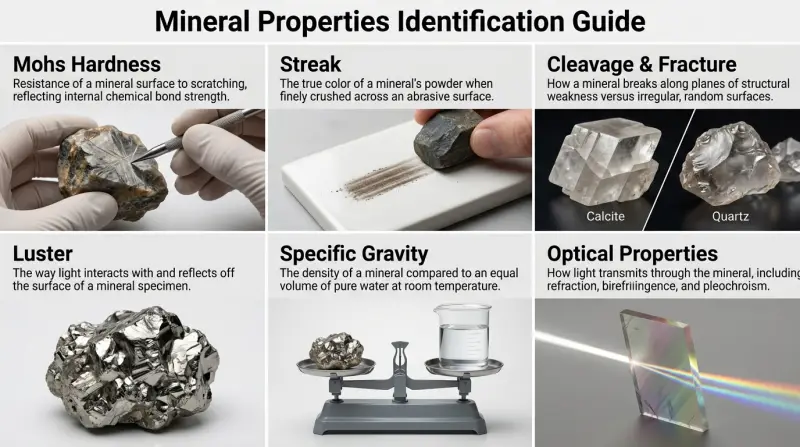
Mastering the Identifier Crystal Identification Chart
- Visual appearance alone is deceptive; accurate identification requires a multi-step evaluation of physical, optical, and chemical properties.
- The Mohs scale of mineral hardness provides a standardized baseline for testing scratch resistance against common reference tools and marker minerals.
- Crystals are categorized into seven distinct crystal systems based on their internal atomic symmetry and external geometric habit.
- Diagnostic properties such as streak, cleavage, fracture, luster, and specific gravity differentiate look-alike minerals that share similar external colors.
- An effective identification chart functions as a sequential elimination key rather than a simple picture gallery.
- Distinguishing between scientific mineralogy and metaphysical crystal charts ensures proper specimen naming and structural understanding.
Navigating an identifier crystal identification chart effectively requires moving beyond passive observation and engaging in active physical testing. Mineral identification is fundamentally a process of elimination. A well-designed chart correlates observable traits with scientific classifications, allowing you to narrow down a specimen from broad mineral classes down to specific species and varieties.
The table below outlines the core diagnostic properties utilized in standard mineralogical identification charts, detailing what each property measures, how it is tested, and its diagnostic utility for collectors.
| Physical Property | Definition & Significance | Testing Method | Diagnostic Value |
|---|---|---|---|
| Mohs Hardness | Resistance of a mineral surface to scratching, reflecting internal chemical bond strength. | Scratch test using reference minerals or common objects (fingernail [2.5], copper coin [3.5], glass [5.5], steel file [6.5]). | High; eliminates entire families of soft or hard minerals instantly. |
| Streak | The true color of a mineral’s powder when finely crushed across an abrasive surface. | Rubbing the specimen firmly across an unglazed porcelain streak plate. | Very High; often differs entirely from the external body color of the stone. |
| Cleavage & Fracture | How a mineral breaks along planes of structural weakness versus irregular, random surfaces. | Observing natural break lines or noting conchoidal, uneven, hackly, or splintery fracture patterns. | High; reveals internal atomic geometry, bonding planes, and structural symmetry. |
| Luster | The way light interacts with and reflects off the surface of a mineral specimen. | Visual inspection under direct lighting (categorized as metallic, vitreous, pearly, greasy, silky, earthy). | Moderate-High; separates metallic ore minerals from non-metallic silicates and halides. |
| Specific Gravity | The density of a mineral compared to an equal volume of pure water at room temperature. | Heft test (comparative weight in hand) or precise hydrostatic weighing using a digital scale. | Moderate; helps distinguish heavy metallic oxides and lead-bearing minerals from lightweight silicates. |
| Optical Properties | How light transmits through the mineral, including refraction, birefringence, and pleochroism. | Inspection with a jeweler’s loupe, polariscope, or refractometer. | High; separates single-refractive (isometric) minerals from double-refractive crystals. |
By cross-referencing these primary properties on a structured chart, enthusiasts can systematically eliminate false matches and arrive at a confident identification.
Anatomy of a Professional Mineral Identification Matrix
Professional mineralogists and advanced collectors rely on multi-column classification tables that organize minerals by crystal system, chemical family, and physical constants. Understanding how these columns interact is vital for interpreting any identification chart.
Chemical Composition and Mineral Families
Minerals are grouped into distinct chemical classes based on their dominant anionic group or chemical makeup. The most common classes found in standard identification charts include:
- Silicates: Comprising over 90% of Earth’s crust, built around fundamental silicon-oxygen tetrahedra ($SiO_4$) linked in chains, sheets, or frameworks (e.g., Quartz, Feldspar, Tourmaline, Garnet).
- Oxides: Metal cations bonded directly to oxygen anions, often characterized by high density and metallic or adamantine lusters (e.g., Hematite, Magnetite, Corundum, Cassiterite).
- Carbonates: Minerals containing the carbonate ion ($CO_3^{2-}$) that vigorously effervesce (fizz) when exposed to weak hydrochloric acid (e.g., Calcite, Aragonite, Malachite, Azurite).
- Sulfates & Sulfides: Sulfur-bearing compounds featuring either metal-sulfur bonds with dense metallic lusters (Sulfides like Pyrite, Galena, Sphalerite) or sulfate tetrahedra often formed in evaporite deposits (Sulfates like Gypsum, Barite, Celestite).
- Halides & Native Elements: Halides feature halogen elements bonded to alkali or alkaline earth metals (e.g., Halite, Fluorite), while native elements occur in pure elemental form (e.g., Gold, Copper, Sulfur, Graphite).
The Significance of Crystal Habit and Growth Form
While tumbled, polished, and carved stones lose their natural external geometry, raw specimens exhibit characteristic growth habits that serve as immediate visual markers. Recognizing these habits directly on a chart bridges the gap between raw field geology and polished aesthetic specimens:
- Prismatic / Columnar: Elongated crystals with parallel faces (e.g., Tourmaline, Beryl, Quartz).
- Botryoidal: Smooth, hemispherical, grape-like clusters formed by radial crystal growth (e.g., Hematite, Smithsonite, Prehnite).
- Octahedral / Cubic: Isometric geometric forms with eight triangular faces or six square faces (e.g., Fluorite, Pyrite, Magnetite, Spinel).
- Acicular / Fibrous: Needle-like or thread-like delicate crystals (e.g., Natrolite, Rutile, Actinolite).
- Dendritic / Massive: Tree-like branching patterns or compact amorphous masses lacking external crystal faces (e.g., Manganese dendrites in agate, Turquoise).
The Seven Crystal Systems and Internal Symmetry
At the atomic level, minerals crystallize into one of seven distinct crystal systems defined by the geometric relationships of their crystallographic axes ($a$, $b$, and $c$) and interaxial angles ($alpha$, $beta$, and $gamma$). Identification charts frequently utilize these systems to categorize mineral families:
| Crystal System | Axis Relationships | Interaxial Angles | Diagnostic Symmetry & Examples |
|---|---|---|---|
| Isometric (Cubic) | $a = b = c$ | $alpha = beta = gamma = 90^circ$ | Maximum symmetry; 3 equal axes at right angles. Examples: Pyrite, Halite, Garnet, Fluorite. |
| Tetragonal | $a = b neq c$ | $alpha = beta = gamma = 90^circ$ | Square cross-section, longer or shorter vertical axis. Examples: Zircon, Rutile, Chalcopyrite. |
| Orthorhombic | $a neq b neq c$ | $alpha = beta = gamma = 90^circ$ | Three unequal axes at right angles; rectangular prisms. Examples: Topaz, Barite, Olivine, Aragonite. |
| Hexagonal | $a_1 = a_2 = a_3 neq c$ | $alpha_1 = alpha_2 = alpha_3 = 60^circ, gamma = 120^circ$ | Four axes (three horizontal at $120^circ$, one vertical). Examples: Beryl (Emerald/Aquamarine), Apatite. |
| Trigonal (Rhombohedral) | $a_1 = a_2 = a_3 neq c$ | Axes inclined symmetrically; rhombohedral form. Examples: Quartz, Calcite, Tourmaline, Corundum. | |
| Monoclinic | $a neq b neq c$ | $alpha = gamma = 90^circ, beta neq 90^circ$ | Three unequal axes, one inclined oblique angle. Examples: Gypsum, Orthoclase Feldspar, Azurite, Talc. |
| Triclinic | $a neq b neq c$ | $alpha neq beta neq gamma neq 90^circ$ | Lowest symmetry; all three axes unequal and all angles oblique. Examples: Turquoise, Plagioclase Feldspar, Kyanite. |
Step-by-Step Methodology for Using a Crystal Chart
Attempting to identify an unknown crystal by randomly flipping through a picture book is inefficient and prone to error. Follow this rigorous step-by-step framework when consulting an identifier chart:
- Initial Visual Assessment: Note the primary body color, transparency level (transparent, translucent, or opaque), surface luster, and overall crystal habit or growth form without damaging the stone.
- Perform Non-Destructive Density Tests: Check the specific gravity by hefting the stone in your hand. Compare its perceived weight against a known stone of similar size (e.g., feeling the noticeable heaviness of Galena or Barite versus lightweight Amber or Opal).
- Examine Luster, Cleavage, and Fracture: Inspect existing break points or natural cleavage planes under magnification (a 10x jeweler’s loupe). Determine if the mineral cleaves smoothly along flat atomic planes or breaks conchoidally like glass.
- Determine Mohs Hardness (With Caution): If the specimen is raw and has an inconspicuous base, carefully test its scratch resistance against standard reference tools (fingernail ~2.5, copper penny ~3.5, window glass ~5.5, steel knife blade ~6.0, quartz crystal ~7.0). Never scratch polished jewelry pieces, cabochons, or delicate cleavage-prone crystals like fluorite or mica.
- Execute a Streak Test: Drag an inconspicuous edge or corner of the mineral across an unglazed porcelain streak plate. Observe whether the resulting powder is white, colored, or black (noting that a mineral’s body color can differ radically from its powder streak).
- Evaluate Special Diagnostic Properties: Check for magnetism (using a neodymium magnet for Magnetite or Pyrrhotite), acid reaction (dropping a tiny drop of dilute vinegar or muriatic acid on carbonates to check for effervescence), fluorescence under UV light (common in Fluorite, Calcite, and Hyalite Opal), or optical phenomena like chatoyancy, asterism, and birefringence.
- Consult the Chart Matrix: Match your gathered data points against the intersecting rows and columns of your reference chart to isolate the correct mineral species and variety.
- Common Pitfalls and Misidentification Factors
- Even experienced collectors occasionally misidentify specimens due to natural geological variables. Being aware of these pitfalls prevents common identification errors:
- Color Variation (Allochromatism): Trace chemical impurities drastically alter mineral colors. For instance, pure quartz is transparent and colorless, but trace titanium creates rose quartz, iron creates amethyst or citrine, and aluminum combined with natural irradiation creates smoky quartz. Relying on color alone is the single greatest cause of misidentification.
- Tumbled Stone Distortion: Industrial tumbling removes all natural crystal faces, striations, growth lines, and cleavage planes, leaving only hardness, streak, specific gravity, and optical reactions as reliable diagnostic indicators.
- Synthetic, Imitation, and Treated Stones: Lab-created gems (such as flame-fusion synthetic corundum, hydrothermally grown quartz, or synthetic spinel), glass imitations, and heat-treated minerals (like baked amethyst sold as citrine, or dyed agates) often possess physical properties that mimic natural stones, requiring advanced gemological inspection under magnification or ultraviolet light.
- Pseudomorphism: A geological phenomenon where one mineral replaces another atom-by-atom while retaining the original mineral’s external crystal shape (e.g., Tiger’s Eye replacing fibrous crocidolite, or quartz pseudomorphs after wood). An identification chart based purely on external shape can easily misclassify pseudomorphs if internal hardness and chemistry are ignored.
- Frequently Asked Questions
- What is the most reliable test for identifying an unknown crystal?
- The combination of Mohs hardness testing and streak testing provides the highest diagnostic reliability for field identification. While external colors can deceive, a mineral’s internal crystal structure dictates its exact atomic bond strength (hardness) and micro-crystalline powder color (streak), making these two tests the bedrock of practical mineralogy.
- Can I identify a crystal without scratching it?
- Yes. Non-destructive identification relies on measuring specific gravity (heft), observing crystal habit and cleavage planes, testing optical properties (such as birefringence, refractive index, or pleochroism), evaluating luster and transparency, and utilizing specialized tools like UV lamps for fluorescence or neodymium magnets for magnetic attraction.
- Why does my crystal’s streak color differ from its outside appearance?
- The external color of a mineral is often caused by trace chemical impurities, structural lattice defects, or light diffraction across microscopic internal fractures. When crushed into a fine powder on an unglazed porcelain streak plate, light reflects uniformly off the mineral’s true micro-crystalline powder structure, revealing its authentic diagnostic chemical color.
- Are healing crystal charts and scientific mineralogy charts the same thing?
- Not entirely. Scientific mineralogy charts organize stones by chemical composition, crystal system, atomic bonding, and physical constants. Healing and metaphysical charts typically categorize stones by chakra alignment, elemental correspondence, zodiac associations, and wellness properties. However, accurate metaphysical identification still relies on proper scientific mineral naming to ensure you are working with the genuine stone.
- How do I differentiate between real quartz and lead glass (often sold as “herkimer diamonds” or quartz points)?
- True quartz has a Mohs hardness of 7 and will easily scratch window glass (hardness ~5.5). Lead glass (often marketed deceitfully) is significantly softer (hardness ~5.0–5.5), feels noticeably warmer to the touch initially due to thermal conductivity differences, and under 10x magnification may exhibit tiny spherical internal air bubbles rather than natural straight mineral inclusions, growth tubes, or fluid phantoms.
- Mastering the use of an identifier crystal identification chart transforms the way you interact with the mineral kingdom. By replacing guesswork with systematic physical testing, you ensure absolute accuracy in your collection, deepen your understanding of earth sciences, and gain full confidence in evaluating any raw, tumbled, or polished stone you encounter.