
The pursuit of antique and vintage glassware offers a direct link to centuries of artistic expression, domestic history, and master craftsmanship. Yet, navigating the secondary market can be daunting. Without a reliable framework, distinguishing between a mid-century pressed-glass utilitarian tumbler, a late-Victorian lead crystal decanter, and a contemporary borosilicate reproduction becomes guesswork. The sheer volume of historic glassworks—spanning Bohemian and Venetian blowing houses, American Brilliant Period factories, and post-war Scandinavian design studios—demands a systematic approach to authentication and dating.
This master guide serves as a definitive resource for identifying, dating, and assessing vintage crystal glass. By breaking down physical properties, manufacturing anomalies, decorative cuts, and regional signatures, you will gain the field-experienced knowledge needed to evaluate pieces with absolute confidence. Whether you are auditing an inheritance, hunting at estate sales, or curating a collection, understanding the physical science and artistic heritage of glass is your most powerful tool.
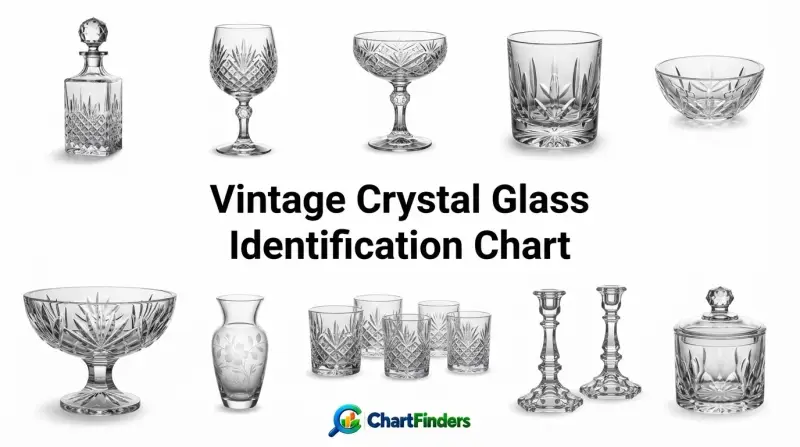
Vintage Crystal Glass Identification Chart
- Lead Content is Definitive: True crystal contains a minimum percentage of lead oxide (traditionally 24% or higher), which increases density, malleability for cutting, and light refraction.
- Acoustic and Weight Cues: Authentic vintage lead crystal is visibly heavier than standard soda-lime glass and produces a sustained, resonant bell tone when tapped.
- The Pontil Mark Test: A smooth, ground, or polished indentation on the base indicates a handblown or mold-blown piece finished off the pontil rod, separating it from modern machine-pressed items.
- Signature Verification: Maker’s marks evolved from rough acid-stamps and paper labels to laser-engraved signatures. Lack of a signature does not rule out antiquity, especially for pre-20th-century pieces.
- Period Distinctions: American Brilliant Period (1876–1916) glass features deep, sharp mitering and brilliant clarity, whereas mid-century modern crystal favors minimalist profiles and optical effects.
- Condition Impacts Value: Micro-rim chips (fleabites), heavy base scratching (shelf wear), and cloudiness from mineral leaching significantly depress collector value.
To establish a systematic baseline for identification, reference the comprehensive classification matrix below. It categorizes historic crystal and fine art glass by era, manufacturing technique, acoustic profile, optical characteristics, and primary identification markers.
| Glass Category / Era | Primary Manufacturing Method | Acoustic / Weight Profile | Optical & Surface Traits | Key Identification Markers |
|---|---|---|---|---|
| American Brilliant Period (ABP) (c. 1876–1916) | Hand-blown mold blanks, deeply wheel-cut and hand-polished. | Exceptionally heavy; high density; brilliant, sustained ring. | Sharp 90-degree miters; intense prismatic fire; no mold seams on the patterned body. | Hobstars, fan motifs, cane patterns, star centers, highly polished starbursts on bases. |
| Victorian Pressed Crystal (c. 1840–1900) | Machine- or hand-pressed into metal or iron molds. | Moderate to heavy weight; duller, shorter acoustic ring due to lower lead or soda composition. | Thick walls, rounded pattern edges, visible internal mold seams, sometimes stippled backgrounds. | Lacy patterns, Roman Rosette, Thumbprint, heavy fire-polish or visible mold lines. |
| Mid-Century European Crystal (c. 1940–1970) | Free-blown, optical mold-blown, or heavy heavy-press with hand-finishing. | Substantial heft; clear, musical ring. | Clean lines, heavy cased colors, organic Scandinavian forms or ultra-deep French cuts. | Acid-etched monograms, paper foil labels (Orrefors, Kosta, Val St. Lambert), smooth polished bases. |
| Carnival Glass (c. 1907–1930s) | Pressed glass treated with metallic salts while hot to create iridescence. | Lighter weight; standard soda-lime ring. | Rainbow sheen (oils-on-water effect) over base colors like marigold, amethyst, or ice green. | Ruffled rims, geometric or floral motifs, prominent mold seams, lack of deep hand-cutting. |
| Depression Glass (c. 1920s–1940s) | Mass-produced machine-pressed glass. | Thin to moderate weight; lightweight compared to true crystal. | Transparent pastel hues (pink, green, amber, cobalt); uniform thickness; minor manufacturing bubbles/swirls. | Recognizable dinnerware patterns (Cherry Blossom, Madrid, Cameo), pronounced mold lines. |
Reading this table effectively requires examining a piece holistically. For instance, an object with heavy weight and sharp, unyielding cut facets immediately rules out mass-produced Depression glass, narrowing the assessment toward brilliant-period or high-end European production. Conversely, smooth mold lines combined with an iridescent sheen point directly to Carnival glass production eras.
Understanding the Core Physics and Chemistry of Crystal
The term “crystal” is frequently misused in everyday retail language to describe any clear, sparkling glassware. Legally and historically, however, true crystal is defined by its chemical composition and physical properties. Understanding these parameters is essential for separating genuine high-end items from ordinary glass.
Lead Oxide Content and Its Effects
In 1969, the European Union established strict standardization (subsequently updated) defining crystal classifications based on lead oxide ($text{PbO}$) content and density:
- Full Lead Crystal: Must contain a minimum of 24% lead oxide, with a density of at least $2.90text{ g/cm}^3$ and a refractive index ($n$) of 1.545 or greater.
- Lead Crystal (Semi-Lead): Contains a minimum of 18% to 24% lead oxide, offering high clarity and brilliance with slightly lower weight.
- Crystalline / Crystal Glass: Contains a lower percentage of lead (often substituted with zinc oxide, barium oxide, or potassium oxide) but maintains high transparency and a refractive index above 1.52.
The introduction of lead oxide alters the molecular structure of the silica. It increases the softness of the glass while it is molten—allowing master cutters to carve deep, facets without shattering the material—and drastically raises the refractive index. This causes white light to disperse into its spectral components (fire), creating the signature prismatic sparkle characteristic of vintage crystal.
The Acoustic Test: The Bell Ring
One of the most reliable field tests for vintage lead crystal is the acoustic test. When you gently flick the rim of a piece of 24% lead crystal with a fingernail, it produces a distinct, high-pitched, resonant bell tone that vibrates for several seconds. Ordinary soda-lime glass or modern lime-silica substitutes produce a dull, short thud with virtually no sustain. This acoustic property stems from the uniform density and elasticity imparted by the heavy metal content.
Caution note: Never strike glassware forcefully with metal objects or hard implements to test this tone, as even high-lead crystal can fracture under sharp, localized stress.
Manufacturing Techniques and Structural Markers
Examining how a piece of glassware was formed provides definitive clues regarding its age and authenticity. Different eras utilized distinct technological processes, leaving behind characteristic physical evidence on the object’s body and base.
Hand-Blown vs. Mold-Blown vs. Pressed Glass
Before the widespread mechanization of glass factories in the mid-19th century, nearly all fine glassware was mouth-blown. Master glassblowers gathered molten batch on a blowpipe, shaped it using wooden blocks and wet papers, and transferred it to a pontil rod for finishing.
- Free-Blown Glass: Shaped entirely by breath and hand tools without a mold. Asymmetry, subtle wall-thickness variations, and smooth contours are standard.
- Mold-Blown Glass: Blown into a multi-part wooden or iron mold to establish a preliminary pattern or shape, then removed and finished by hand. Mold seams may be faint or absent if the piece was subsequently rotated or fire-polished.
- Pressed Glass: Molten glass is dropped into an iron mold and forced against the mold walls by a mechanical plunger. This technique democratized glassware in the Victorian era but leaves sharp exterior patterns paired with smooth interior surfaces, alongside prominent, raised mold seams running vertically up the piece.
The Significance of Pontil Marks
The pontil (or punty) mark is the single most definitive indicator of hand-finished, pre-industrial or high-end artisan glassware. When a glassblower finished shaping a vessel, the piece was attached to a solid iron rod (the pontil) using a small dab of hot glass so the blower could remove the blowpipe and finish the rim.
Once finished, the piece was knocked off the pontil rod, leaving behind a rough, circular scar known as a rough pontil mark. On higher-end antique crystal, this rough scar was subsequently ground down and polished flat or concave, resulting in a smooth, circular indentation known as a polished pontil or star pontil. If a piece of purported “antique crystal” features a completely flat, machine-ground base with concentric circular saw marks or a completely smooth, fire-polished factory bottom with zero indentation, it was almost certainly manufactured using modern automated machinery.
Maker’s Marks, Signatures, and Trademarks
While physical characteristics help narrow down an era, maker’s marks provide absolute attribution. However, collectors must remember that prior to the late 19th century, most fine crystal manufacturers did not sign their wares. Instead, they relied on distinct cutting styles, paper labels, or subtle factory nuances.
Evolution of Identification Marks
- Paper and Foil Labels: Widely used by European houses such as Orrefors, Baccarat, Val St. Lambert, and Stuart from the early 20th century onward. Because these labels washed off easily, many genuine vintage pieces arrive today unsigned.
- Acid-Etched Stamps: Introduced around the turn of the 20th century, companies used hydrofluoric acid to etch their logos into the glass surface. Lalique, Daum, and Baccarat frequently utilized script or block acid stamps.
- Sandblasted and Laser Engravings: Post-1970s crystal makers (such as Waterford) transitioned to microscopic sandblasted script or laser-etched serial codes to prevent counterfeiting and provide permanent attribution.
When evaluating signatures, examine the depth and clarity of the mark. Vintage acid-stamps often show slight bleeding or unevenness under magnification, whereas modern laser etchings appear hyper-precise and uniform.
Regional Styles and Major Historical Houses
Different geographic regions developed unique aesthetic vocabularies that aid significantly in vintage crystal identification.
Bohemian and Czech Crystal
Bohemia (modern-day Czech Republic) has been a global epicentre of glassmaking since the Middle Ages. Bohemian crystal is celebrated for its deep, saturated color overlays (ruby red, cobalt blue, emerald green), hand-painting with 24k gold leaf, and deep-relief wheel cutting. Pieces often feature complex floral motifs, pastoral scenes, or layered glass that is cut back to reveal a contrasting clear or white core.
Irish Crystal (Waterford and Galway)
Irish crystal, dominated historically by Waterford, is world-renowned for heavy, brilliant lead crystal characterized by deep diamond cuts, fan motifs, and vertical pillars. Vintage Waterford pieces produced before the company shifted major production overseas bear distinctive acid-etched seahorse or block-letter marks. The cuts on vintage Waterford are notably sharp and crisp, engineered to maximize light dispersion.
French Masterworks (Baccarat, Lalique, and Saint-Louis)
French crystal represents the apex of luxury glassware production:
- Baccarat: Famed for its Harcourt pattern (created in 1841), featuring flat-cut sides and heavy hexagonal stems. Vintage Baccarat often includes a subtle, acid-etched circular logo on the base or a red paper label.
- Lalique: Pioneered opalescent and frosted art glass. René Lalique’s pieces combine high-relief molded figures with satin-finished (frosted) backgrounds that contrast sharply with polished highlights.
- Saint-Louis: The oldest active glassworks in France (dating to 1586), celebrated for complex millefiori paperweights and heavy, multi-layered overlay goblets.
Step-by-Step Practical Identification Framework
When evaluating a piece of crystal in the field, execute the following five-step examination protocol to determine its authenticity, age, and potential value:
- The Heft and Balance Test: Pick up the vessel. Does its weight surprise you relative to its physical size? Genuine lead crystal is noticeably denser and heavier than everyday glassware.
- Visual Clarity and Refraction Check: Hold the glass up to natural light. Look for internal imperfections (tiny air bubbles are acceptable in hand-blown antique pieces, but modern machine glass is often completely pristine). Check for rainbow prismatic dispersion along cut edges.
- Acoustic Evaluation: Gently flick the rim with your fingernail. Listen for a clear, sustained, bell-like ring rather than a dull thud.
- Base and Pontil Inspection: Turn the piece upside down. Examine the base under a 10x jeweler’s loupe. Look for shelf wear (fine, random scratches indicating years of use), a polished pontil depression, or an acid-etched signature.
- Edge and Cut Analysis: Run a finger along the cut facets. On hand-cut vintage crystal (such as American Brilliant or fine European work), the edges of the cuts are crisp and sharp. On molded imitations, edges feel slightly rounded, soft, or greasy to the touch.
Common Mistakes and Pitfalls in Crystal Identification
Even seasoned collectors occasionally fall victim to deceptive look-alikes and common misconceptions. Avoid these frequent errors:
- Assuming All Marked Pieces Are Valuable: Not every signed piece commands a high price. Mass-market production lines from the late 20th century frequently featured acid-etched maker’s marks but possess minimal secondary market demand.
- Confusing Mold Seams with Hand-Cuts: Mold-pressed glass often features simulated diamond patterns. If you look closely with a magnifying glass and see smooth, rounded intersections with a vertical seam running up the side, it is pressed glass, not hand-cut crystal.
- Overlooking Crystal Cloudiness (Sickness): “Glass sickness” occurs when moisture leaches alkaline components out of the glass structure over decades, leaving an irreversible, milky-white interior haze. While this does not mean the piece is fake, it severely diminishes collector value and cannot be cleaned with standard washing.
- Mistaking Pressed Glass for ABP: The American Brilliant Period is heavily counterfeited in concept. Heavy, sparkling pressed glass from the mid-20th century is frequently misidentified as ABP. True ABP pieces show the uneven hand of the individual wheel-cutter under magnification, rather than uniform machine stamping.
Frequently Asked Questions
How can I tell if my crystal contains lead without laboratory testing?
While absolute verification requires X-ray fluorescence (XRF) testing, you can establish a strong probability by combining three tests: weight (lead crystal is substantially heavier than soda-lime glass), acoustic ring (producing a sustained musical tone when tapped), and refractive index (exhibiting intense rainbow dispersion when exposed to direct light).
Does the lack of a maker’s mark mean my crystal is worthless?
No. Maker’s marks only became standard industry practice in the late 19th to mid-20th centuries. The vast majority of antique Georgian, Victorian, and American Brilliant Period crystal was completely unsigned, relying instead on distinct cutting signatures, pattern recognition, and superior material quality for identification.
Can I put vintage crystal in the dishwasher?
Never put vintage crystal in a dishwasher. The combination of high heat, harsh alkaline detergents, and water pressure causes irreversible clouding (glass sickness), etches the delicate surface, and can easily chip thin handmade rims.
What causes milky-white stains inside vintage crystal decanters?
This condition, known as “glass sickness” or mineral leaching, occurs when moisture sits inside an enclosed vessel for years, breaking down the surface silica. While specialized commercial glass-cleaning solutions or non-abrasive denture tablets can remove organic residue, true chemical etching of the glass surface is permanent.
How do I differentiate between Depression glass and vintage crystal?
Depression glass is typically mass-produced, machine-pressed glassware from the 1920s to 1940s characterized by pastel colors (pink, green, amber), lightweight construction, and prominent mold seams. Vintage crystal is heavier, clearer, features precise hand-cutting or superior acoustic properties, and is rarely found in the lightweight pastel palettes typical of Depression-era tableware.
Conclusion
Mastering the identification of vintage crystal glass requires patience, tactile experience, and an eye for manufacturing detail. By moving beyond surface-level sparkle and systematically evaluating heft, acoustic resonance, base characteristics, and cutting techniques, you can successfully separate mass-market replicas from true historical masterpieces. Armed with this comprehensive framework, you are fully equipped to assess, authenticate, and appreciate the enduring artistry preserved within fine vintage glassware.