
To the untrained observer, all palm trees can look remarkably similar—an iconic image of a single, slender trunk topped by a sweeping crown of green fronds swaying in the breeze. Yet, botanical science recognizes over 2,600 distinct palm tree varieties (family Arecaceae), adapted to everything from blistering desert oases and tropical rainforests to surprisingly cold temperate zones. Because of this astonishing genetic diversity, accurately identifying a specific palm requires moving beyond general impressions and examining precise structural morphology.
Whether you are a professional arborist, a landscape designer selecting specimens for a regional urban canopy, or a property owner trying to diagnose a newly acquired plant, a reliable identification framework is essential. This guide provides an exhaustive blueprint for reading the architectural language of palms, exploring the key structural diagnostic markers, regional distribution patterns, look-alike species, and a practical stepwise field methodology to ensure precise identification every single time.
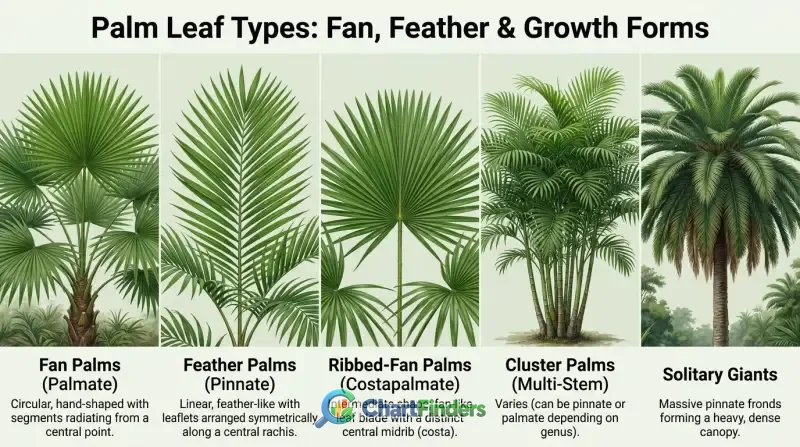
Palm Tree Identification Chart
- Leaf morphology is the premier diagnostic filter, dividing palms into three major architectural groups: palmate (fan), pinnate (feather), and costapalmate (ribbed-fan transitional).
- Trunk characteristics—including single versus clustered growth habits, diameter consistency, ring spacing, and the presence or absence of persistent boot fibers—provide vital clues for species separation.
- Crown features such as smooth crownshafts (sheathing leaf bases), petiole armature (spines and thorns), and inflorescence placement further narrow down botanical families and genera.
- Many plants commonly referred to as palms—such as sago palms and traveler’s palms—are not true palms at all, belonging instead to completely different plant divisions like cycads or streitziaceae.
- Environmental context, including hardiness zones, soil moisture preferences, and geographic origin, acts as an indispensable secondary filter in field identification.
Field identification is most successful when approached systematically. Rather than guessing based on overall height or location, botanists use a structured matrix that filters unknown specimens down from broad family traits to distinct species-level markers. The following reference chart compares the core morphological indicators used across the most common and structurally diverse palm categories encountered in cultivation and the wild.
| Palm Group / Common Type | Leaf Type | Trunk Architecture | Crown / Crownshaft | Key Diagnostic Feature | Common Example |
|---|---|---|---|---|---|
| Fan Palms (Palmate) | Circular, hand-shaped with segments radiating from a central point. | Single or clustered; often mantled in a “skirt” of dead fronds if unpruned. | No true crownshaft; petioles attach directly to the trunk. | Rigid, pleated fronds with or without thread-like filaments (hastula present). | California Fan Palm (Washingtonia filifera) |
| Feather Palms (Pinnate) | Linear, feather-like with leaflets arranged symmetrically along a central rachis. | Smooth or ringed; columnar or bottle-swollen; single or multi-stemmed. | Frequently features a prominent, smooth colored crownshaft just below the fronds. | Pinnately divided leaves giving a soft, feathery canopy silhouette. | Queen Palm (Syagrus romanzoffiana) |
| Ribbed-Fan Palms (Costapalmate) | Intermediate shape; fan-like leaf blade with a distinct central midrib (costa). | Sturdy, upright, ringed with old leaf scars or smooth with age. | Lacks a traditional crownshaft; petioles merge into a rigid central rib. | Stiff, slightly curved folding leaf blade combining fan and feather traits. | Cabbage Palm / Palmetto (Sabal palmetto) |
| Cluster Palms (Multi-Stem) | Varies (can be pinnate or palmate depending on genus). | Multiple slender trunks emerging from a single root base (suckering). | Varies; some species feature tight cluster crownshafts. | Dense clump formation with continuous basal shoot generation. | Areca Palm (Dypsis lutescens) |
| Solitary Giants | Massive pinnate fronds forming a heavy, dense canopy. | Thick, heavy, columnar trunk with pronounced ring scars; uniform thickness. | Large, heavy crown without a distinct smooth crownshaft. | Imposing height coupled with massive, self-cleaning drop of dead fronds. | Royal Palm (Roystonea regia) |
By cross-referencing an unknown specimen against the columns in this matrix, you can instantly eliminate up to seventy percent of possibilities. For instance, a multi-stemmed palm with feather leaves and a bright yellow-green crownshaft immediately points toward Dypsis lutescens, whereas a single-trunked palm with stiff, sharply toothed petioles and a massive skirt of dead leaves directs attention toward Washingtonia robusta.
Comparative Analysis of Major Palm Leaf Structures
| Leaf Architecture | Geometric Form | Structural Adaptation | Primary Genera |
|---|---|---|---|
| Palmate | Symmetrical, fan-like, radiating segments from a central anchor (Hastula). | Captures sunlight in open, arid, or wind-swept canopies; self-shading. | Washingtonia, Chamaerops, Livistona, Trachycarpus |
| Pinnate | Feather-like arrangement of individual leaflets along an extended rachis. | Reduces wind drag by allowing air to pass between leaflets; high tensile strength. | Phoenix, Cocos, Roystonea, Dypsis, Syagrus |
| Costapalmate | Intermediate hybrid; folded, fan-shaped blade supported by a central rib (costa). | Exceptional structural rigidity; deflects high-velocity hurricane winds without tearing. | Sabal, Livistona (in part) |
The comparative table above underscores how form follows function in palm biology. Understanding these architectural variances allows field botanists to infer a palm’s native environmental adaptations—such as high wind tolerance in costapalmate leaves or maximum solar interception in large palmate fans—just by observing canopy geometry.
Leaf Morphology: The Primary Diagnostic Filter
The single most efficient way to begin identifying any palm is to examine its foliage. Palm leaves are divided into three major structural categories based on how the blade develops and how the leaflets or segments are arranged.
- Palmate (Fan Palms): These leaves resemble an open human hand. The leaflets radiate outward from a central point at the end of the petiole (leaf stem). Often, a specialized triangular appendage called a hastula sits right where the blade meets the stem. Fan palms are exemplified by genera such as Washingtonia, Chamaerops, and Livistona.
- Pinnate (Feather Palms): These leaves resemble a bird’s feather. The leaflets emerge along both sides of an extended central stem axis known as the rachis. Feather palms represent the largest group of palms globally and include familiar names like Phoenix (dates), Cocos (coconuts), and Roystonea (royals).
- Costapalmate (Intermediate Palms): A hybrid architecture where the leaf is roughly fan-shaped, but the central axis (the costa) extends out into the blade, causing the leaf to curve downward in a graceful, boat-like arch. This structural adaptation provides exceptional wind resistance, making costapalmate palms like the Sabal genus exceptionally resilient during severe hurricanes.
Trunk Architecture and Stem Habit
Once you have classified the leaf type, the trunk provides the next critical layer of data. Palms do not possess lateral cambium layers, meaning their trunks do not increase in diameter over time through secondary growth the way traditional hardwood trees do. Instead, a palm trunk achieves its final width early in its vertical development.
Trunks can be evaluated through several distinct physical characteristics:
- Growth Habit: Is the palm solitary (maintaining a single, independent trunk throughout its life) or clustering (producing multiple suckers from the base to form a dense colony)? Examples of clustering palms include the Bamboo Palm (Chamaedorea seifrizii), while Canary Island Date Palms (Phoenix canariensis) are strictly solitary.
- Surface Texture: Examine whether the trunk is smooth, ringed with horizontal scars where old leaves dropped off, covered in persistent woody leaf bases (boots), or heavily armored with the spiny remnants of old petioles.
- Profile Variations: While most trunks maintain a uniform columnar shape, certain species exhibit dramatic swellings. The Bottle Palm (Beaucarnea recurvata—though technically a succulent, often grouped colloquially) and the true Palm Champagne Palm (Hyophorbe lagenicaulis) feature distinct bulges that act as structural water reservoirs.
Crown, Crownshaft, and Armature
The upper canopy zone provides microscopic and macroscopic clues that finalize an identification. The crownshaft—a smooth, cylindrical column formed by tightly wrapped sheathing leaf bases located directly above the trunk and below the green fronds—is present in genera like Roystonea, Archontophoenix, and Wodyetia, but completely absent in fan palms and species like coconuts.
, evaluating armature (thorns and spines) is essential for safety and species separation. Many palms feature sharp, needle-like modified leaflets along the lower petiole (such as the Phoenix genus, where lower leaflets transform into lethal defensive spines) or sharp teeth lining the edges of fan palm petioles (such as Washingtonia robusta versus the unarmed petioles of Washingtonia filifera).
Step-by-Step Field Identification Methodology
When standing before an unfamiliar palm in a landscape or natural habitat, professional botanists follow a strict, sequential decision-making process to avoid misidentification. Working through these four distinct field phases ensures high accuracy.
- Step 1: Verify It Is Actually a Palm. Confirm that the specimen has parallel-veined leaves, an unbranching vertical stem with an apical growth bud (the “heart” of the palm), and lacks true secondary wood rings. Rule out look-alikes like cycads, tree ferns, and pandanus.
- Step 2: Determine Leaf Structure. Look up into the canopy. Is the leaf blade a rigid circle of radiating segments (Palmate), a feather-like array along a central stem (Pinnate), or a rigid, folded fan with a visible midrib (Costapalmate)?
- Step 3: Inspect Trunk and Base Conditions. Observe whether the trunk is clean, ringed, covered in fibrous mesh, encased in heavy dead leaf boots, or completely hidden by a dense multi-stemmed cluster. Check for basal swelling or distinctive colorations.
- Step 4: Analyze Canopy Details and Micro-Markers. Look for a smooth crownshaft, colored petioles, defensive armature (spines or teeth), inflorescence structure (hanging flower/fruit stalks emerging from within or below the leaves), and overall habitat context (coastal salt tolerance, desert resilience, or cold hardiness).
Common Identification Pitfalls and Look-Alikes
One of the most frequent errors in amateur palm identification involves misclassifying non-palm species that share similar superficial silhouettes. Understanding these botanical imposters prevents embarrassing misclassifications in landscape inventories.
- Cycads (e.g., Sago Palm – Cycas revoluta): Often called “sago palms,” these ancient gymnosperms are not palms at all. They feature stiff, stiffly recurved leaflets with rolled margins, produce cones rather than flowers or true drupes, and belong to an evolutionary lineage older than dinosaurs.
- Tree Ferns (Order Cyatheales): Possessing a woody trunk and a crown of finely divided fronds that unroll in a fiddlehead fashion, tree ferns are spore-producing vascular plants lacking flowers, fruits, or true palm anatomy.
- Dracaenas and Yuccas: Woody monocots with rosettes of sword-like leaves sitting atop thick trunks. While they share the monocot classification with palms, their secondary thickening meristem allows some species to branch extensively—something true palms cannot do.
- Traveler’s Tree (Ravenala madagascariensis): Belonging to the Strelitziaceae family, this plant features massive, paddle-shaped banana-like leaves arranged on a single flat fan plane, supported by a trunk that scars similarly to a palm. However, its floral and genetic structure places it closer to ginger and birds of paradise.
Frequently Asked Questions
The easiest way to distinguish between Washingtonia filifera (California Fan Palm) and Washingtonia robusta (Mexican Fan Palm) is trunk thickness and the persistent dead leaf skirt. The California Fan Palm has a noticeably thicker, sturdier trunk and less aggressive shedding, whereas the Mexican Fan Palm features a slender, taller trunk and retains a dense, highly flammable “petticoat” of old dead fronds unless aggressively pruned.
No. Out of more than 2,600 palm species, only a tiny fraction produce commercially valuable or edible fruits. The true coconut palm (Cocos nucifera) and date palms (Phoenix dactylifera) are specific species with distinct fruit structures. Many palms produce small, dry, fibrous, or toxic drupes that are inedible to humans.
Trunk swellings—such as those seen in the Bottle Palm or the Royal Palm—are natural genetic variations often associated with structural water storage, age-related growth spurts, or nutrient-storage adaptations native to specific microclimates and soil conditions. However, sudden or irregular swelling in a species that is normally columnar can sometimes indicate internal decay, environmental stress, or nutrient deficiencies.
True palm trees possess only a single apical meristem (growing tip) located at the top of the trunk inside the crown. Because of this single growth point, normal true palms cannot branch horizontally or recover if the main crown bud is completely destroyed. The rare exceptions are a few naturally branching species like the Doum Palm (Hyphaene thebaica), which fork dichotomously due to unique genetic mutations.
Cold hardiness depends heavily on the species’ native habitat. Palms originating from high-altitude montane regions or temperate zones—such as the Windmill Palm (Trachycarpus fortunei)—can tolerate heavy snow and sub-freezing temperatures down to USDA Zone 7 or lower. Tropical obligates like the Coconut Palm generally suffer physiological damage or death if exposed to prolonged temperatures below 30°F (-1°C).
Conclusion
Mastering palm tree identification transforms a confusing forest of green fronds into an orderly, legible botanical landscape. By methodically evaluating leaf architecture—distinguishing between palmate fans, pinnate feathers, and costapalmate ribs—coupled with a careful examination of trunk profiles, crownshafts, and armatures, you can reliably categorize virtually any specimen encountered in the field. Armed with this structured framework, arborists, landscape professionals, and enthusiasts alike can approach palm identification with scientific precision and absolute confidence.