
Petrified wood—scientifically termed silicified or permineralized wood—is one of nature’s most magnificent geological transformations. It represents an ancient record of prehistoric forests, where fallen organic tissue was systematically replaced atom-by-atom with mineral solutions over millions of years. For rockhounds, lapidaries, and amateur geologists, identifying petrified wood is both an art and a science. Because nature utilizes diverse mineral solutions and depositional environments, no two specimens look exactly alike. Misidentifying ordinary rock or modern weathered timber as petrified wood is a common beginner pitfall. To master field identification, one must look beyond superficial coloration and evaluate microscopic cellular remnants, physical mineral properties, and characteristic structural patterns.
(Reference: Identifying Petrified Wood | Visit Utah)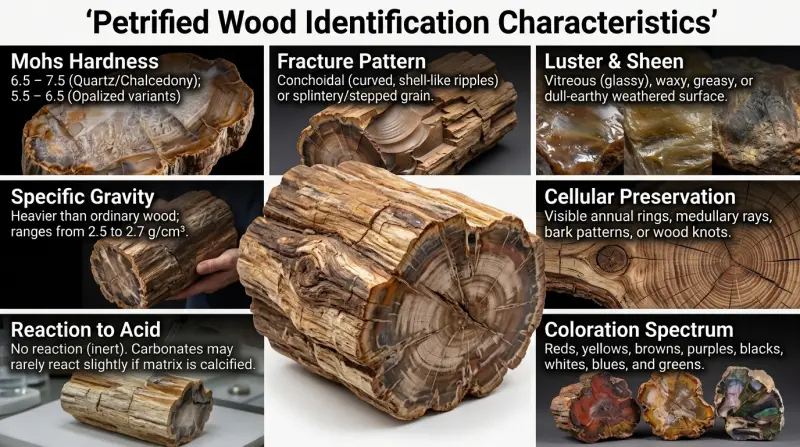
Petrified Wood Identification Chart
- Hardness Threshold: True petrified wood is primarily composed of quartz or opal, registering between 5.5 and 7.5 on the Mohs scale, allowing it to easily scratch standard window glass and steel.
- Fracture Mechanics: While quartz-replaced wood exhibits a distinctly glassy, conchoidal fracture, opalized specimens often display smoother, more bulbous fractures.
- Luster Indicators: Freshly broken or polished faces typically reveal a waxy, vitreous, or dull-siliceous luster rather than the dull, earthy finish of ordinary sedimentary sandstone or limestone.
- Structural Relics: Diagnostic indicators include visible annual growth rings, bark texture, node knots, and microscopic cell walls visible under a 10x loupe.
- Mineral Pigmentation: Iron oxides produce vibrant reds, yellows, and browns; carbon yields blacks; manganese creates pinks and purples; and copper delivers brilliant blues and greens.
Field identification requires a structured approach. The following comprehensive diagnostic chart outlines the primary physical, optical, and structural markers used by field specialists to verify, classify, and categorize petrified wood specimens.
Explore our detailed breakdown on Types Of Orangutans (Complete Field Identification).| Identification Property | Diagnostic Characteristics | Mineral Cause / Geologic Origin | Field Verification Test |
|---|---|---|---|
| Mohs Hardness | 6.5 – 7.5 (Quartz/Chalcedony) 5.5 – 6.5 (Opalized variants) | Silica-rich groundwater permineralization. | Attempts to scratch a streak plate or window glass; leaves a clear scratch. |
| Fracture Pattern | Conchoidal (curved, shell-like ripples) or splintery/stepped grain. | Crystalline quartz structure versus retained fibrous wood architecture. | Examine fresh breaks using a 10x loupe for conchoidal ripples or wood grain lines. |
| Luster & Sheen | Vitreous (glassy), waxy, greasy, or dull-earthy weathered surface. | Microcrystalline quartz (chalcedony/jasper) reflection properties. | Inspect under direct sunlight; look for light reflection off fractured quartz faces. |
| Specific Gravity | Heavier than ordinary wood; ranges from 2.5 to 2.7 g/cm³. | Replacement of lightweight cellulose by dense silicate minerals. | Heft test—specimen feels surprisingly heavy for its physical size. |
| Cellular Preservation | Visible annual rings, medullary rays, bark patterns, or wood knots. | Pre-burial cellular casting preserved before complete decay. | Use a hand lens to search for microscopic tubular channels or wood grain texture. |
| Coloration Spectrum | Reds, yellows, browns, purples, blacks, whites, blues, and greens. | Trace elemental impurities trapped during crystallization. | Visual inspection of cross-section matrices and color banding. |
| Reaction to Acid | No reaction (inert). Carbonates may rarely react slightly if matrix is calcified. | Pure silica composition resists hydrochloric acid. | Apply dilute muriatic acid; true silicified wood produces no effervescence. |
The table above serves as the primary screening tool when encountering ambiguous rocks in the field. Understanding how each property interrelates allows you to quickly separate genuine fossilized forest remnants from look-alike sedimentary rocks, volcanic flow bands, or modern wood encrusted in mineral scale.
Understanding the Geological Formation of Petrified Wood
To accurately identify petrified wood, one must understand how it forms. The petrification process begins when a living tree falls—often due to volcanic activity, floods, or windstorms—and is rapidly buried by sediment, volcanic ash, or mud. This rapid burial protects the organic material from aerobic decay and scavengers.
Over thousands to millions of years, groundwater supersaturated with dissolved minerals, primarily silica (silicon dioxide in the form of quartz, cristobalite, or opal), percolates through the porous wood structure. As the groundwater moves through the cellular matrix, mineral ions precipitate out of solution. In a process known as permineralization, these minerals fill the empty cell lumens and intercellular spaces. In the more advanced replacement phase, the original cellulose and lignin cell walls slowly dissolve away and are simultaneously replaced atom-by-atom by solid silica. This precise replacement preserves even the finest microscopic cellular details of the original plant tissue.
| Mineral Replacement Type | Visual Appearance | Key Characteristics | Common Geologic Environment |
|---|---|---|---|
| Homogeneous Chalcedony | Uniform ring color, light tones, smooth matrix. | Composed primarily of microcrystalline quartz; highly durable. | Volcanic ash beds with slow, steady silica groundwater flow. |
| Spotted / Leopard Wood | Distinct contrasting spots, orbicular clusters, multi-toned. | Combinations of opal and chalcedony filling decayed cellular pockets. | Epithermal hot spring deposits and silica-rich lakebeds. |
| Jet-Like & Banded Wood | Clear linear patterns, high-contrast wavy lines, deep blacks. | High concentration of carbonaceous matter preserved alongside silica. | Swampy floodplains buried under thick carbonaceous muds. |
| Opalized Wood | Play-of-color (iridescence), vitreous luster, translucent to opaque. | Hydrated amorphous silica ($SiO_2 cdot nH_2O$) filling wood cavities. | Arid desert environments with low-temperature hydrothermal activity. |
Key Visual Indicators: Color and Mineral Chemistry
The vibrant colors that make petrified wood prized by lapidaries and collectors are driven entirely by microscopic trace elements present in the groundwater during the permineralization phase. Pure silica is clear and colorless, but trace minerals act as natural pigments, painting the fossilized logs in stunning palettes.
- Iron Oxides and Hydroxides: Produce rich warm tones including deep reds, rust oranges, sunny yellows, and earthy browns.
- Carbon and Organic Matter: Yield deep jet blacks, charcoal grays, and smoky silvers.
- Manganese and Manganese Oxides: Create striking pinks, purples, soft lavenders, and dendritic fern-like patterns.
- Copper, Cobalt, and Chromium: Responsible for rare and highly coveted brilliant blues, emerald greens, and turquoise highlights.
Physical Testing Methods for Field Identification
Visual inspection alone is rarely sufficient for positive identification. Field-experienced rockhounds rely on a series of hands-on physical tests to confirm petrified wood before packing heavy specimens out of the field.
1. The Hardness and Scratch Test
Because petrified wood is composed of quartz or opal, it possesses a Mohs hardness rating between 6.5 and 7.5. Modern wood has a hardness well below 2, and ordinary sedimentary sandstone ranges from 3 to 5. Take an ordinary piece of window glass or a steel pocketknife blade and attempt to scratch an inconspicuous area of the specimen. Genuine petrified wood will easily leave a sharp, deep scratch on glass without being scratched itself. If the stone is easily scratched by a steel knife, it is likely soft limestone, calcite, or weathered shale.
2. The Heft and Density Check
Pick up the specimen. Petrified wood has been completely mineralized with rock-forming silica, making it significantly heavier than a standard piece of modern wood of identical size. It should feel surprisingly dense, cold to the touch, and heavy—possessing the heft of solid quartz rather than the lightness of weathered timber or modern driftwood.
3. The Magnification Test (10x Loupe)
Examine the cross-section and longitudinal surfaces of the specimen using a 10x or 20x jeweler’s loupe. Look for diagnostic plant structures: medullary rays radiating from the center, annual growth rings, distinct bark texture, or cellular tube openings. Modern weathered rock may mimic wood grain through weathering cracks, but true petrified wood maintains regular, ordered cellular architecture under magnification.
Common Field Mistakes and Look-Alikes
Even experienced rockhounds occasionally misidentify look-alike materials in the field. Recognizing common geological imposters saves time and prevents collecting useless non-fossil rocks.
- Weathered Rhyolite and Volcanic Tuff: Volcanic rocks often weather with linear flow bands that mimic wood grain. However, close inspection reveals micro-crystals of feldspar rather than cellular wood structures, and the overall hardness may vary.
- Stromatolites and Algal Mats: Laminated sedimentary structures can display fine concentric banding that resembles tree rings. Check for biological growth forms and lack of radiating medullary rays.
- Weathered Sandstone and Quartzite: Iron-stained sandstone can exhibit beautiful liesegang rings (concentric color bands) that look strikingly like petrified wood cross-sections. However, sandstone will readily scratch with a steel knife or crumble under pressure, whereas petrified wood is solid quartz.
- Modern Waterlogged Driftwood: Heavy, dark, waterlogged wood found in riverbeds can feel dense and heavy. However, it can easily be whittled with a knife, burns when exposed to a flame, and floats or absorbs water readily—traits absent in stone.
Frequently Asked Questions
To distinguish petrified wood from normal rock, look for structural evidence of trees—such as annual growth rings, bark texture, or cellular wood grain visible under a 10x loupe. Additionally, perform a hardness test: petrified wood is made of quartz and will scratch glass, whereas many ordinary rocks will not.
Most petrified wood has a Mohs hardness between 6.5 and 7.5 because the original organic matter has been replaced by microcrystalline quartz, chalcedony, or jasper. Opalized variants may have a slightly lower hardness of 5.5 to 6.5.
No. Because all organic cellulose has been replaced by heavy minerals like silica, petrified wood has a specific gravity of roughly 2.5 to 2.7, making it dense, heavy, and completely incapable of floating.
Colors are caused by mineral impurities trapped in the silica solution during fossilization. Iron oxides create reds and yellows, carbon creates black, manganese creates pinks and purples, and copper or cobalt creates blues and greens.
Petrified wood can be found on every continent, typically in sedimentary deposits, ancient floodplains, and volcanic ash layers where trees were rapidly buried. Major concentrations occur in places like the Petrified Forest National Park in Arizona, state parks in Utah, and deposits across Argentina, Madagascar, and Greece.
Conclusion
Mastering petrified wood identification requires combining a keen eye for botanical structures with reliable geological testing methods. By evaluating physical indicators—such as the 6.5+ Mohs hardness, conchoidal fracture, vitreous luster, and preserved cellular growth rings—you can confidently distinguish true fossilized timber from mineral look-alikes. Whether you are exploring desert washes, examining lapidary rough, or studying geological formations, a systematic approach ensures accurate field identification every time.