
Few animals evoke the primal awe and ecological fascination inspired by the crocodile. Surviving virtually unchanged for tens of millions of years, these formidable reptiles have adapted to thrive in tropical and subtropical habitats across the globe. Understanding the different types of crocodiles requires a journey through complex taxonomy, evolutionary biology, behavioral adaptations, and distinct geographical distribution.
While casual observers often confuse crocodiles with alligators, caimans, or gharials, true crocodiles belong to the distinct family Crocodylidae. They are characterized by specialized physiological traits, including a powerful fourth mandibular tooth that remains visible when the jaw is closed, specialized salt-excreting glands that allow them to inhabit marine and hypersaline environments, and complex social and parental behaviors.
This master guide provides an authoritative, field-experienced breakdown of the types of crocodiles, examining their taxonomy, physical attributes, geographical ranges, ecological roles, and conservation statuses. Whether you are a wildlife professional, a researcher, or an enthusiast seeking deeper biological insight, this resource details everything you need to know about the diversity of the world’s remaining crocodilian species.
Taxonomic Diversity and Types Of Crocodiles
- There are 23 recognized species of true crocodiles within the family Crocodylidae, distributed across Africa, Asia, the Americas, and Australia.
- The saltwater crocodile (Crocodylus porosus) is the largest living reptile, capable of navigating open ocean currents and tolerating high salinity environments.
- Taxonomic revisions remain active, with modern genetic studies continually re-evaluating cryptic species, such as the recently recognized Mexican crocodile and newly split African slender-snouted lineages.
- True crocodiles are easily distinguished from alligators by their narrower snouts and the interlocking arrangement of their upper and lower jaws, which leaves the fourth lower tooth exposed.
- Habitats range from pure freshwater rivers and swamps to brackish estuaries, mangrove forests, and coastal marine zones.
- Human-wildlife conflict, habitat fragmentation, and illegal skin poaching represent the primary threats to wild crocodile populations globally.
The order Crocodilia is split into three primary families: Alligatoridae (alligators and caimans), Gavialidae (the gharial and false gharial), and Crocodylidae (true crocodiles). Focusing specifically on Crocodylidae, the diversity is remarkably rich. Modern science recognizes over two dozen distinct species and subspecies, each shaped by the specific ecological pressures of its native range.
Taxonomy in herpetology is dynamic. Historically, classification relied heavily on external morphology—such as head shape, scale patterns, and body proportions. However, modern phylogenetics heavily utilizes mitochondrial and nuclear DNA sequencing. This technological shift has occasionally split widely recognized “single species” complexes into multiple distinct, localized species, ensuring that conservation efforts can target genetically unique populations.
Major Genera Within Crocodylidae
The vast majority of true crocodiles fall under the genus Crocodylus, which contains the most widely known species. However, other specialized genera exist, reflecting unique evolutionary paths:
- Crocodylus: The largest and most diverse genus, containing iconic species like the saltwater, Nile, and American crocodiles. They are characterized by broad adaptability, strong swimming abilities, and generalist predatory diets.
- Osteolaemus: Represented by the African dwarf crocodile complex. These are small, heavily armored forest-dwellers that prefer slow-moving rainforest streams and a diet dominated by crustaceans, fish, and small mammals.
- Mecistops: Comprising the slender-snouted crocodiles of West and Central Africa. Their elongated jaws are specialized for catching fast-moving fish in dense riverine habitats.
| Common Name | Scientific Name | Primary Geographic Range | Maximum Recorded Length | IUCN Conservation Status |
|---|---|---|---|---|
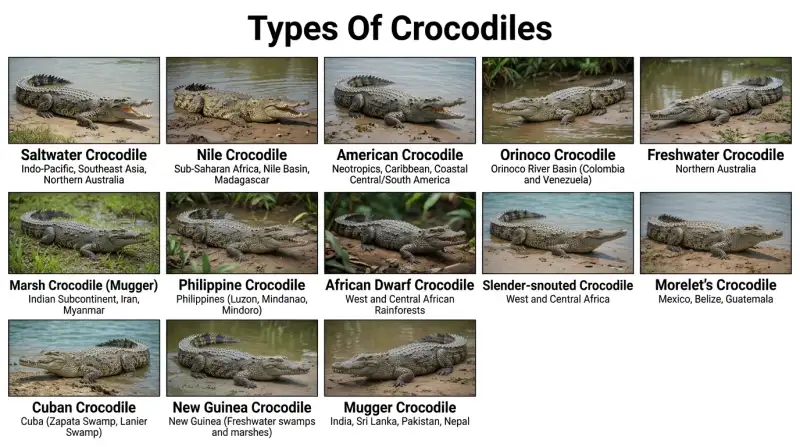
| Saltwater Crocodile | Crocodylus porosus | Indo-Pacific, Southeast Asia, Northern Australia | 6.0+ meters (20+ ft) | Least Concern |
| Nile Crocodile | Crocodylus niloticus | Sub-Saharan Africa, Nile Basin, Madagascar | 5.0–6.0 meters (16–20 ft) | Least Concern |
| American Crocodile | Crocodylus acutus | Neotropics, Caribbean, Coastal Central/South America | 4.0–6.0 meters (13–20 ft) | Vulnerable |
| Orinoco Crocodile | Crocodylus intermedius | Orinoco River Basin (Colombia and Venezuela) | 4.5–5.2 meters (15–17 ft) | Critically Endangered |
| Freshwater Crocodile | Crocodylus johnstoni | Northern Australia | 2.5–3.0 meters (8–10 ft) | Least Concern |
| Marsh Crocodile (Mugger) | Crocodylus palustris | Indian Subcontinent, Iran, Myanmar | 4.0–5.0 meters (13–16 ft) | Vulnerable |
| Philippine Crocodile | Crocodylus mindorensis | Philippines (Luzon, Mindanao, Mindoro) | 2.0–3.0 meters (6.5–10 ft) | Critically Endangered |
| African Dwarf Crocodile | Osteolaemus tetraspis | West and Central African Rainforests | 1.5–1.9 meters (5–6 ft) | Vulnerable |
| Slender-snouted Crocodile | Mecistops cataphractus / leptorhynchus | West and Central Africa | 3.0–4.0 meters (10–13 ft) | Critically Endangered |
| Morelet’s Crocodile | Crocodylus moreletii | Mexico, Belize, Guatemala | 3.0–3.5 meters (10–11.5 ft) | Least Concern |
| Cuban Crocodile | Crocodylus rhombifer | Cuba (Zapata Swamp, Lanier Swamp) | 2.5–3.5 meters (8–11.5 ft) | Critically Endangered |
| New Guinea Crocodile | Crocodylus novaeguineae | New Guinea (Freshwater swamps and marshes) | 2.7–3.5 meters (9–11.5 ft) | Least Concern |
| Mugger Crocodile | Crocodylus palustris | India, Sri Lanka, Pakistan, Nepal | 4.0–5.0 meters (13–16 ft) | Vulnerable |
The table above highlights the significant variance found across the family Crocodylidae. From small forest dwellers that rarely exceed two meters to colossal apex predators capable of crossing ocean basins, each species occupies a specialized ecological niche.
Comparative Analysis: Crocodiles vs. Alligators and Caimans
To properly contextualize the types of crocodiles, it is helpful to contrast true crocodiles (Family Crocodylidae) with their closest living relatives in the order Crocodilia. Morphological and physiological distinctions dictate their geographic limits, ecological preferences, and behavioral repertoires.
| Trait / Feature | True Crocodiles (Crocodylidae) | Alligators (Alligatoridae) | Caimans (Alligatoridae) |
|---|---|---|---|
| Snout Shape | Generally narrower, V-shaped or pointed | Broad, U-shaped snout | Varying from broad to very slender (e.g., slender-snouted caiman) |
| Tooth Visibility | Lower fourth tooth is visible outside the closed upper jaw | Lower teeth are entirely hidden when the mouth is closed | Lower teeth often interlock or show, though jaw structure resembles alligators |
| Salt Tolerance | Equipped with functional lingual salt glands; highly marine-tolerant | Lack functional salt glands; strictly restricted to freshwater | Lack functional salt glands; restricted to freshwater (with rare brackish tolerance) |
| Geographic Distribution | Pantropical: Africa, Asia, Australia, Americas | North America and China only | Central and South America |
| Aggression and Temperament | Generally more aggressive and unpredictable (e.g., Saltwater, Nile) | Generally more docile or defensive unless provoked or nesting | Varies; black caiman can be aggressive, while smaller species are timid |
Anatomical and Physiological Adaptations
To understand the different types of crocodiles, one must examine the physiological marvels that enable their survival. Crocodilians possess anatomical specializations that have remained virtually unchanged since the Mesozoic era.
Saltwater Tolerance and Lingual Glands
One of the defining evolutionary advantages of true crocodiles over alligators is the presence of functional lingual salt glands on their tongue. These specialized glands allow crocodiles to excrete excess salt ions ingested while consuming marine prey or drinking brackish water. This physiological adaptation explains why species like Crocodylus porosus and Crocodylus acutus can populate coastal marine ecosystems, island-hop across ocean straits, and tolerate high salinity environments that would rapidly dehydrate other reptiles.
Cardiovascular Supremacy: The Heart
Crocodiles possess a four-chambered heart, structurally more advanced than that of any other living reptile and comparable to that of birds and mammals. However, a unique anatomical feature called the foramen of Panizza connects the left and right aortas, allowing the crocodile to shunt blood away from the lungs when submerged. By bypassing pulmonary circulation while diving, crocodiles can conserve oxygen and remain underwater for extended periods—often up to an hour during resting states.
Sensory Integumentary Sense Organs (ISOs)
If you examine the head of any crocodile closely, you will notice thousands of tiny, dark dome-shaped spots scattered across the upper and lower jaws. These are Integumentary Sense Organs (ISOs). Packed with mechanoreceptors, thermoreceptors, and pressure sensors, ISOs allow crocodiles to detect the slightest microscopic ripple or pressure change in the water. This sensory network enables them to strike with pinpoint accuracy in total darkness or turbid water.
Geographical Distribution and Major Species Profiles
Crocodile species are distributed across distinct zoogeographic regions. Examining their regional profiles reveals how climate, topography, and prey availability have driven speciation.
The Indo-Pacific : Giants of the East
The Indo-Pacific is home to some of the most formidable crocodilians on Earth:
- Saltwater Crocodile (Crocodylus porosus): Universally recognized as the largest living reptile. Males can reach lengths exceeding 6 meters and weigh over 1,000 kilograms. Their vast range spans from eastern India across Southeast Asia to northern Australia and the Solomon Islands. They are opportunistic apex predators known to consume everything from fish and birds to water buffalo and humans.
- Freshwater Crocodile (Crocodylus johnstoni): Endemic to northern Australia, the “freshie” is a much smaller, slender-snouted relative of the saltwater crocodile. They primarily feed on fish, frogs, and small terrestrial vertebrates. They generally avoid marine environments, remaining strictly within freshwater billabongs, rivers, and gorges.
- Philippine Crocodile (Crocodylus mindorensis): A critically endangered freshwater specialist found in isolated pockets of the Philippines. Intensive conservation breeding and habitat protection are currently required to prevent its extinction in the wild.
- New Guinea Crocodile (Crocodylus novaeguineae): A medium-sized freshwater dweller inhabiting the marshes, swamp forests, and lakes of the island of New Guinea. They are nocturnal hunters primarily feeding on fish, amphibians, and waterbirds.
- Siamese Crocodile (Crocodylus siamensis): A freshwater species native to Southeast Asia (including Thailand, Cambodia, Indonesia, and Vietnam). Critically endangered in the wild due to habitat conversion, they are extensively bred on commercial crocodile farms.
The African Continent: Rivers and Rainforests
Africa hosts a diverse array of crocodilians, adapted to environments ranging from wide savanna river systems to dense equatorial rainforests:
- Nile Crocodile (Crocodylus niloticus): The undisputed king of African waterways. Found throughout sub-Saharan Africa, the Nile basin, and Madagascar, they are aggressive, highly adaptable predators capable of taking large migrating mammals such as wildebeest and zebras during river crossings.
- African Slender-snouted Crocodile (Mecistops cataphractus / leptorhynchus): Distinctly specialized with a narrow, elongated snout designed for capturing slippery fish in complex riverine systems. Recent taxonomic work has split this into distinct West African and Central African species, both facing severe conservation pressures.
- African Dwarf Crocodile (Osteolaemus tetraspis): The smallest crocodile in the world. Heavily armored to defend against forest predators, this secretive, nocturnal species inhabits sluggish streams, flooded forests, and swamp networks in West and Central Africa.
The Americas: Neotropical Diversity
The Western Hemisphere hosts a fascinating mix of coastal and riverine true crocodiles:
- American Crocodile (Crocodylus acutus): A widespread species found in coastal areas, mangrove lagoons, and tidal river mouths from the southern tip of Florida and the Caribbean down through Central America and northern South America. They possess a relatively narrow, triangular snout and tolerate full marine salinity.
- Orinoco Crocodile (Crocodylus intermedius): Critically endangered and restricted primarily to the Orinoco river basin in Colombia and Venezuela. Historically hunted extensively for its valuable hide, it is one of the rarest crocodilians on the planet.
- Morelet’s Crocodile (Crocodylus moreletii): A medium-sized freshwater specialist native to the Atlantic regions of Mexico, Belize, and Guatemala. They inhabit freshwater marshes, swamps, and sluggish rivers, often hiding in dense vegetation.
- Cuban Crocodile (Crocodylus rhombifer): Famous for its bright, pebble-patterned coloration, flattened rear teeth for crushing turtle shells, and exceptionally aggressive disposition. Endemic primarily to the Zapata Swamp in Cuba, it displays terrestrial hunting behaviors rarely seen in other crocodilians.
- Mexican Crocodile (Crocodylus moreletii / Regional Cryptic Lineages): Recent taxonomic and genetic assessments have highlighted distinct localized populations and cryptic species complexes across Mesoamerica, ensuring continuous updates to regional management frameworks.
Ecological Role as Keystone Predators
Crocodiles are not merely dangerous aquatic beasts; they are vital keystone species that maintain the health and structural integrity of wetland and riverine ecosystems.
In tropical and subtropical systems, apex predators regulate the population sizes of medium-to-large herbivores and fish species. By culling weak, sick, or injured animals from prey populations, crocodiles prevent overgrazing of riparian vegetation and reduce the spread of disease within aquatic communities. , during severe dry seasons, crocodiles actively excavate deep burrows and wallows—often referred to as “gator holes” in analogous environments—which retain water when surrounding wetlands dry up. These micro-habitats serve as essential refugia for fish, amphibians, birds, and mammals, ensuring the survival of countless species through extreme environmental stress.
Nutrient cycling is another critical ecosystem service provided by crocodilians. By moving between terrestrial and aquatic zones, they transport marine and riverine nutrients onto land, enriching riparian soils and supporting diverse botanical growth.
Human-Wildlife Conflict and Conservation Challenges
As human populations expand and agricultural, industrial, and residential developments encroach upon natural riverbanks and coastal zones, human-crocodile interactions have intensified. Because several crocodile species—particularly the saltwater and Nile crocodiles—are large enough to view humans as potential prey, conflict is an ongoing management challenge across Africa, Asia, and northern Australia.
Historical overexploitation for the global leather trade severely depleted numerous populations during the mid-20th century. While international regulatory frameworks like CITES (Convention on International Trade in Endangered Species of Wild Fauna and Flora) have successfully curbed illegal skin trading and facilitated remarkable population rebounds for species like the American and saltwater crocodiles, other species remain precarious.
Today, habitat destruction, dam construction disrupting migratory corridors, entanglement in fishing nets, and retaliatory killings following livestock predation represent the most pressing threats. Modern conservation strategies increasingly emphasize community-based wildlife management, ecotourism, sustainable-use ranching programs, and public education campaigns aimed at coexistence.
Frequently Asked Questions
How can you tell the difference between a crocodile and an alligator?
The most reliable field identifier is jaw shape and tooth visibility. When a crocodile closes its mouth, its upper and lower jaws are roughly the same width, interlocking completely and leaving the large fourth tooth on the lower jaw exposed and pointing upward outside the upper lip. Alligators possess a wider, U-shaped snout, and when their mouth is closed, the upper jaw completely conceals the lower teeth. Additionally, alligators lack lingual salt glands and are almost exclusively restricted to freshwater habitats, whereas many crocodile species thrive in brackish and marine environments.
What is the largest species of crocodile?
The saltwater crocodile (Crocodylus porosus) is the largest living crocodilian and the largest reptile on Earth. Mature males routinely reach lengths of 4.5 to 5 meters (15 to 16 feet) and weigh between 400 and 1,000 kilograms. Exceptional individuals can exceed 6 meters in length and scale past 1,000 kilograms.
Do crocodiles live in the ocean?
Some species do. The saltwater crocodile and the American crocodile possess specialized lingual salt glands that allow them to process and excrete excess salt. This physiological adaptation enables them to swim through open ocean waters, navigate marine currents, and inhabit mangrove swamps, estuaries, and coastal coral fringes.
Are any crocodile species currently endangered?
Yes. While species like the saltwater and Nile crocodiles maintain robust wild populations, several others face severe extinction risks. The Orinoco crocodile (Crocodylus intermedius), Philippine crocodile (Crocodylus mindorensis), and African slender-snouted crocodile (Mecistops species) are classified as Critically Endangered by the IUCN due to habitat loss, historical overhunting, and restricted geographical distributions.
How long can a crocodile hold its breath underwater?
When resting or basking underwater in a low-energy state, crocodiles can submerge for up to one to two hours. Their physiological capacity is enhanced by a four-chambered heart that can shunt blood away from the lungs via the foramen of Panizza, coupled with high concentrations of myoglobin in their muscle tissue to store oxygen efficiently.
Conclusion
The diversity within the order Crocodylidae reflects millions of years of evolutionary refinement. From the massive marine-frequenting saltwater crocodile to the secretive, heavily armored African dwarf crocodile, each type of crocodile occupies a specialized ecological niche that dictates its morphology, behavior, and physiological capabilities. Recognizing the distinct biological characteristics, distributions, and conservation statuses of these 23 recognized species is essential for appreciating their ecological importance and ensuring their continued survival alongside human populations in a rapidly changing world.