
Quick Answer: A marble identification chart is a systematic reference guide used by collectors to classify vintage and antique marbles based on core manufacturing attributes: glass type (opaque, translucent, transparent), optical patterns (swirls, ribbons, micas, patch designs), construction seams (pontil marks, pinched gates), size, and historical company markers. Key identifying makers include Akro Agate, Christensen Agate, Peltier Glass, and Vitro Agate, whose distinct production techniques separated machine-made pieces from handmade European glass.
(Reference: Valuable Marbles Identification and Price Guide)The world of marble collecting is equal parts history, glass chemistry, and forensic analysis. When examining a jar or collection of vintage glass, distinguishing a common contemporary glass toy from a rare 19th-century German handmade swirl or a pristine 1930s machine-made Christensen Agate requires more than a casual glance. Without a structured framework, every marble can begin to look alike, leading to misidentifications that hide true value or misrepresent historical eras.
Explore our detailed breakdown on Utah Spiders Identification Chart (Complete Data Matrix).This comprehensive guide bridges the gap between casual curiosity and expert-level taxonomy. By breaking down manufacturing methods, optical characteristics, physical traits, and historical timelines, we provide an authoritative master reference. Whether you are sorting through an estate sale find, cataloging a personal collection, or trying to understand the elusive differences between Akro Agate and Ravenswood novelties, the following insights, classification criteria, and structured tables will arm you with the diagnostic tools necessary to evaluate any marble with confidence.
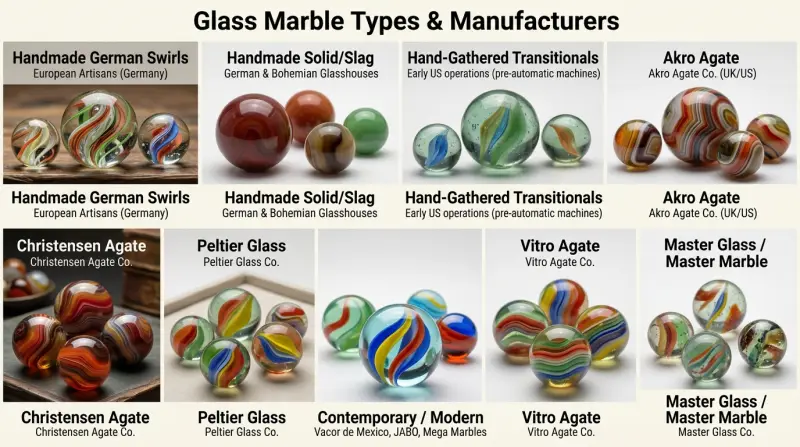
Marble Identification Chart: The Master Classification Framework
- Manufacturing Era Defines Value: Marbles are broadly categorized into Handmade (pre-WWI European), Hand-Gathered (transition era, late 1800s to 1920s), and Machine-Made (1910s–present US manufacturers).
- Seams Tell the Mechanical Story: Machine-made marbles typically display distinct cutlines, mold marks, or pinch points where the molten glass slug was sheared.
- Substrate and Glass Opacity: The base glass (opaque, translucent, transparent, slag, or milk glass) dictates the underlying category before pattern analysis begins.
- Signature Maker Attributes: Major American companies like Akro Agate, Peltier Glass, and Christensen Agate left distinct proprietary signatures in their color combinations and ribbon formations.
- Condition Dictates Grade: Mint condition, surface wear, as-made manufacturing flaws (chiggers, cold rolls), and chip depth dramatically alter a marble’s collectible value.
- Forensic Light Testing: Ultraviolet (UV) light testing is a non-destructive method to detect uranium glass or specific optical minerals used in vintage manufacturing.
A successful marble identification chart functions as a dichotomous key. It requires evaluating specimens across multiple physical dimensions simultaneously: how the glass was formed, how the internal colors were mixed, the physical dimensions (size), and any microscopic or macroscopic surface anomalies. Below is a comprehensive master table detailing the primary eras, manufacturing characteristics, and key identifying traits of collectible marbles.
| Era / Category | Active Timeline | Key Manufacturers | Primary Identification Clues | Common Pattern Types |
|---|---|---|---|---|
| Handmade German Swirls | c. 1840s – WW1 | European Artisans (Germany) | Rough pontil mark (ground or snapped), asymmetrical twists, internal air bubbles, irregular sphere shape. | Latticinio cores, solid colored ribbons, mica flecks, solid opaque bases. |
| Handmade Solid/Slag | c. 1850s – 1920s | German & Bohemian Glasshouses | Swirled opaque streaks, off-center pontil scar, varied glass density. | Opaque swirls, oxblood ribbons, sulfides (figures embedded inside). |
| Hand-Gathered Transitionals | Late 1800s – 1930s | Early US operations (pre-automatic machines) | Pinch marks, shear marks on one side, single or double pontil remnants fading into machine cuts. | Patches, early swirls, stacked ribbons. |
| Akro Agate | 1911 – 1951 | Akro Agate Co. (UK/US) | Corkscrew pattern, “9” or comma shapes at poles, distinctive slag colors, marked boxes. | Corkscrews, Oxbloods, Slags, Peltier-like crosses (early). |
| Christensen Agate | 1925 – 1933 | Christensen Agate Co. | Slag lines, slag ribbons, translucent base glass, ‘Guinea’ freckled surface, flawless roundness. | Guineas, Cobalt/Amber Slags, Cyclone swirls. |
| Peltier Glass | 1927 – 2002 | Peltier Glass Co. | National Leaguer patterns, “Peerless” patch styles, butterfly or multi-ribbon cuts. | Peerless patches, National Leaguers, Rainbo swirls, Superiors. |
| Vitro Agate | 1932 – 2004 | Vitro Agate Co. | Cat’s eyes with distinct vane structures, Conqueror patches, Tri-lites, bright primary colors. | Cat’s Eyes, Conquerors, Agates. |
| Master Glass / Master Marble | 1930 – 1974 | Master Glass Co. | Flame patterns, patch styles with feathered edges, “Sunburst” designs. | Flames, Master Patches, Sunbursts. |
| Contemporary / Modern | 1930s – Present | Vacor de Mexico, JABO, Mega Marbles | High gloss, uniform machine seams, modern glass chemistry, vibrant opaque colors. | Cat’s eyes, iridescent coatings, solid novelties. |
Reading this table requires looking past a single color palette. For example, while both Akro Agate and Christensen produced slag marbles, Christensen’s slag lines tend to weave tighter with translucent base glass, whereas Akro’s slag formulations often present an opaque, marbled appearance with distinct surface finishing marks.
The Three Foundational Eras of Marble Manufacturing
Understanding the chronological development of marble manufacturing is the single most effective way to narrow down an unknown specimen. The timeline of glass production shifts from slow, individual artisan craft to high-speed industrial automation.
1. Handmade Era (1840s to World War I)
The vast majority of antique handmade marbles originated in Germany and Bohemia. Master glassblowers used specialized shears and canes to shape molten glass by hand.
- Pontil Marks: The absolute hallmark of a handmade marble is the pontil mark—a rough, indented scar where the marble was snapped off the iron pontil rod. These are frequently ground down and polished, leaving a dimple, or left rough as a “snapped” pontil.
- Shape Irregularities: True hand-rolled marbles are rarely perfectly spherical. Rolling them across a flat surface will often reveal slight wobbles or flat spots.
- Optical Core (Latticinio): Many antique swirls feature a delicate, basket-weave network of white or colored threads (latticinio) twisted through the core of transparent glass.
2. The Transitional Era (Late 1800s to 1930s)
As the Industrial Revolution pressed into glass production, manufacturers attempted to bridge the gap between hand-gathered glass and automated machinery. These “transitionals” exhibit hybrid traits:
- Shear Marks: Instead of a pontil scar, transitional marbles often feature a small, flat circular or crescent-shaped cut mark where the glass slug was hand-cut from the furnace stream.
- Asymmetry: The internal color ribbons may look like machine-made swirls, but the exterior flow lines demonstrate manual gathering techniques.
3. The Machine-Made Era (1910s to Present)
The invention of automatic marble-making machines revolutionized the industry. Companies like Akro Agate, Christensen, and Peltier patented specialized rolling drums and shear mechanisms that dropped molten glass slugs into spiral grooves.
- Seams and Cutlines: Machine-made marbles feature visible or subtle seams—raised lines, indented channels, or paired polar dots (poles) where the rolling machinery gripped the glass.
- Mass Consistency: Machine-made specimens exhibit geometric perfection, uniform sizing, and standardized optical patterns unique to each factory’s machinery setup.
Optical Patterns and Glass Body Classifications
Once you establish the manufacturing era, the next step in the identification chart involves analyzing the internal pattern and the nature of the glass body itself. Marbles are categorized into several broad optical families.
Swirls and Corkscrews
Swirls feature continuous bands of color rotating around a central axis or core.
- German Swirls: Feature single or multiple colored glass ribbons wrapped around a clear, opaque, or latticinio core.
- Corkscrews: Primarily associated with Akro Agate. The colored bands wrap around the marble in a continuous, unbroken spiral from pole to pole, resembling a barber pole or a corkscrew. When viewed from the poles, they often form a “9” or comma shape.
Slags and Onyx Marbles
Slags are characterized by a streaky, marbled mixture of white glass combined with one or more vibrant colors (such as royal blue, amber, emerald green, or purple).
- Christensen Agate and Akro Agate mastered this style. True vintage slags feature rich, dense saturation with internal depth that modern reproductions struggle to replicate.
- Oxblood features rich, dark red lines that sit on or just beneath the surface, resembling dried blood. True oxblood is a crucial value indicator in Akro and Christensen specimens.
Patches and Panels
Patch marbles feature distinct geometric patches of color (usually two, four, or six) applied to a base glass.
- Peltier Peerless patches feature colored panels separated by clear or contrasting channels.
- Master and Vitro also produced vast quantities of patch variations, often featuring feathered or blurred borders where the patch meets the body.
Cat’s Eyes
Characterized by distinct multi-colored glass vanes (the “fish” or “feathers”) suspended inside a clear glass sphere, cat’s eyes dominated the mid-to-late 20th century.
- While often dismissed by high-end antique collectors, early vintage cat’s eyes produced by Vitro Agate in the 1930s–1950s feature sharp, crisp vane structures and high-clarity glass that set them apart from modern mass-produced imports.
Manufacturer Spotlight: Distinguishing the Major American Giants
A master identification chart must account for the specific corporate signatures of the golden age of American marble manufacturing. Each major factory utilized proprietary machinery that left unique structural DNA.
Akro Agate Company (Parkersburg, West Virginia / Clarksburg, West Virginia)
Operating from 1911 to 1951, Akro is one of the most prolific and collected names in the hobby.
- Signature Types: Corkscrews, Oxbloods, Slags, and Sparklers (marbles infused with aventurine or copper flakes).
- Identification Telltale: Look for the polar “9” shape on corkscrews. Akro glass also tends to have a brilliant luster and crisp color separation. Their packaging—such as Akro Agate oxblood boxes—adds significant value.
Christensen Agate Company (Bridgeport, Connecticut / Cambridge, Ohio)
Though active for a short window (1925–1933), Christensen produced some of the most sought-after artistic marbles in history.
- Signature Types: Guineas (marbles with a translucent or opaque base densely freckled with multi-colored dots and surface slashes), Cobalt Slags, and Cyclones.
- Identification Telltale: Christensen Guineas have a distinct, mottled surface texture and exceptional glass translucency. Their slag lines are sharp, sweeping, and ribbon-like.
Peltier Glass Company (Ottawa, Illinois)
Peltier produced glass from 1927 well into the modern era, specializing in striking, high-contrast designs.
- Signature Types: Peerless Patches, National Leaguers (named after baseball teams, featuring two contrasting color ribbons), and Rainbo swirls.
- Identification Telltale: National Leaguers feature two distinct ribbons that cross at the poles, creating a symmetrical four-panel appearance. Rainbo swirls feature fine, straight, parallel lines running across the surface.
Vitro Agate Company (Parkersburg, West Virginia)
Vitro operated from 1932 to 2004, supplying the market with vast quantities of popular play marbles.
- Signature Types: Conquerors, Tri-lites, and All-Reds, alongside massive quantities of cat’s eyes.
- Identification Telltale: Vitro Conqueror patches often feature a characteristic “bullseye” or “target” appearance when viewed from the top, with concentric color rings.
Step-by-Step Practical Identification Workflow
When faced with an unidentified marble from an unknown source, running through a disciplined diagnostic sequence prevents hasty conclusions. Follow this step-by-step framework to evaluate any specimen:
- Clean the Specimen: Wash the marble gently with warm water and mild dish soap. Dirt, pocket lint, and old oils can obscure translucent base glass, fake patinas, or hide pontil scars. Never use abrasive pads or harsh chemical cleaners.
- Examine Under Bright Lighting (Magnified): Use a jeweler’s loupe (10x or 20x magnification) under direct daylight or a focused LED task light.
- Look for a pontil mark (handmade/transitional) or a machine seam/pinch mark.
- Inspect the subsurface glass for micro-bubbles, which are common in handmade German swirls and rare in modern machine-mades.
- Evaluate Geometry and Sphericity: Roll the marble across a flat, hard surface. Does it roll smoothly and true, or does it wobble? Measure its exact diameter in millimeters or inches using digital calipers. Size is a critical discriminator in pricing and classification.
- Analyze Color Chemistry and Opacity: Determine whether the base glass is transparent, translucent, opaque slag, or milk glass. Check for oxblood ribbons, aventurine (metallic copper flecks), or UV-reactive glass formulations.
- Check Under Ultraviolet (UV) Light: Shine a 365nm or 395nm UV blacklight on the marble.
- Uranium glass will glow a brilliant, neon green.
- Certain cadmium or manganese glasses will exhibit milky-green, yellow, or pink fluorescence, helping isolate vintage chemical compositions from modern soda-lime glass.
- Compare Against Known Reference Types: Cross-reference your physical observations with established photographic guides, museum archives, and collector databases (such as Block’s identification guides or verified collector society resources).
Common Identification Mistakes and Pitfalls
Even experienced collectors occasionally fall victim to visual illusions and manufacturing quirks. Being aware of common pitfalls ensures accurate evaluation.
Confusing Machine Seams with Pontil Scars
A novice collector may mistake a flattened machine seam or a pinched polar dot for a handmade pontil scar. Machine seams are typically raised, indented lines running along the circumference of the marble or flattened circular contact points. Pontil scars are rough, irregular, or ground-down fractures located strictly at one or both poles where the holding rod detached.
Mistaking Modern Reproductions for Vintage Treasures
Modern glassworks in Mexico, Asia, and the United States (such as JABO or Vacor) regularly produce reproduction “German Swirls” and antique-style slags designed to deceive casual buyers.
- The Luster Test: Modern glass often possesses an unnatural, high-gloss “wet” shine or pristine surface condition that is inconsistent with true century-old wear.
- Glass Purity: Modern glass tends to be chemically purer, lacking the microscopic impurities, uneven glass flow lines, and erratic internal air bubbles characteristic of 19th-century furnace production.
Overvaluing Condition Flaws
Condition is in marble valuation. A rare Christensen Guinea or Akro Oxblood with heavy “chiggers” (tiny surface chips), fleabites, deep moon-cracks, or extensive abrasions loses the vast majority of its collector value. Always inspect marbles under magnification for subsurface bruising before assigning premium status.
Frequently Asked Questions
Handmade German swirls feature an irregular, snapped or ground pontil mark at one pole, subtle asymmetry when rolled, and internal air bubbles stretched along the glass flow. Machine-made swirls (like Akro or Ravenswood) feature machine seams, polar dots or cut lines, and near-perfect geometric sphericity.
Oxblood is a dense, dark red, non-translucent glass formulation used by premium American manufacturers like Akro Agate and Christensen Agate. Because oxblood glass is visually striking and difficult to replicate, marbles featuring genuine oxblood ribbons command significantly higher collector values.
No. Only marbles containing specific mineral additives—such as uranium oxide (which glows vibrant green) or certain manganese and cadmium formulations—will fluoresce under ultraviolet light. The vast majority of vintage glass does not react to UV light; lack of fluorescence does not mean a marble is modern.
Standard vintage play marbles typically measure between 5/8 inch (approx. 16mm) and 11/16 inch. However, handmade swirls and sulfide marbles can range widely from small peewees (under 1/2 inch) to large monumental marbles exceeding 1.5 to 2 inches in diameter.
Condition is evaluated on a strict grading scale ranging from Mint (M, flawless as-made condition) down to Damaged. Even rare masterworks suffer severe value drops if they exhibit deep chips, fractures, or extensive “as-made” manufacturing cold-rolls and surface chiggers.
Conclusion
Mastering the art of marble identification requires patience, tactile experience, and a structured reliance on manufacturing history. By methodically evaluating glass opacity, construction seams, optical patterns, and company-specific traits, you can look past the colorful exterior of any glass sphere and decode its precise historical origin. Whether you are preserving a rare Akro Agate corkscrew or organizing a collection of vintage German swirls, the identification framework outlined in this guide serves as your definitive roadmap through the fascinating world of collectible glass.