
The mid-Atlantic ecosystem of Maryland provides a rich mosaic of microhabitats, ranging from the humid salt marshes of the Eastern Shore to the dense deciduous canopies of the Appalachian Plateau. This environmental heterogeneity supports an extensive assemblage of terrestrial chelicerates. For both amateur naturalists and pest management professionals, distinguishing between benign garden dwellers and medically significant taxa is a critical diagnostic skill. Misidentifications often lead to unnecessary chemical interventions or heightened anthropogenic anxiety regarding encounters with harmless species.
(Reference: Spiders in Maryland | University of Maryland Extension)This reference guide provides a thorough taxonomic breakdown, morphological identification keys, and ecological profiles for the most frequently encountered spiders throughout Maryland. By examining anatomical characteristics—such as eye arrangement, chelicerate structure, spinneret placement, and specific pigmentation patterns—observers can systematically categorize specimens. Understanding these morphological and behavioral traits illuminates the vital predatory role these arthropods play in regulating agricultural and residential insect populations.
Explore our detailed breakdown on Unopened Geode Identification Chart: Complete Reference Chart.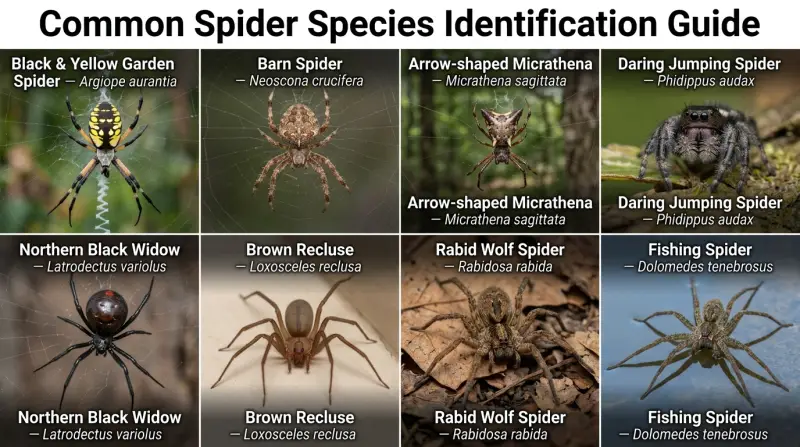
Maryland Spiders Identification Chart
- Maryland’s spider fauna is dominated numerically by orb-weavers (Araneidae) and jumping spiders (Salticidae), which pose zero medical threat to humans.
- The Northern Black Widow (Latrodectus variolus) is native and established throughout Maryland, identifiable by its globular black abdomen and irregular red or orange ventral markings.
- The Brown Recluse (Loxosceles reclusa) is historically absent from established wild populations in Maryland, though transient specimens occasionally arrive via interstate shipping.
- Anatomical identification relies heavily on ocular patterns (such as the distinct six-eyed arrangement in two rows characteristic of Loxosceles) and spinneret morphology.
- Web architecture offers an immediate behavioral classification clue, distinguishing structural orb-nets from sheet-webs, funnel-nets, and active hunting strategies.
- Most non-venomous encounters involve defensive bites that result in localized, transient cutaneous irritation akin to a minor Hymenoptera sting.
To systematically identify Maryland spiders, observers must evaluate structural morphology alongside macro-habitat associations. The following reference matrix categorizes the primary families and species documented across the state, detailing their diagnostic physical traits, web architecture, and ecological habits.
| Common Name | Scientific Nomenclature | Family | Diagnostic Morphology | Web Architecture / Habitat | Medical Significance |
|---|---|---|---|---|---|
| Black & Yellow Garden Spider | Argiope aurantia | Araneidae | Large size; black and bright yellow abdominal markings; silver carapace. | Large orb-web with a distinct zigzag stabilization structure (stabilimentum); tall grass and garden edges. | None (benign; mild mechanical pinch possible if handled). |
| Barn Spider | Neoscona crucifera | Araneidae | Hairy, bulbous abdomen with a distinct cross or leaf-like dorsal pattern; brownish-orange hues. | Vertical orb-web constructed at dusk, often near exterior lighting; dismantled at dawn. | None (benign). |
| Arrow-shaped Micrathena | Micrathena sagittata | Araneidae | Bright yellow, white, or red abdomen featuring distinct, sharp posterior spines. | Asymmetrical orb-web spun at face-height along wooded forest trails; late summer. | None (benign). |
| Daring Jumping Spider | Phidippus audax | Salticidae | Robust, densely hairy black body; prominent iridescent green chelicerae; white dorsal abdominal spots. | No web; active visual hunter utilizing silk safety draglines; found on vertical walls and window sills. | None (benign; docile unless severely provoked). |
| Northern Black Widow | Latrodectus variolus | Theridiidae | Shiny black, globular abdomen with interrupted red stripes or spot patterns on the dorsal and ventral sides. | Irregular, three-dimensional tangle webs constructed near ground level in dark, sheltered crevices. | Medically significant (neurotoxic venom causing latrodectism; requires medical evaluation). |
| Brown Recluse | Loxosceles reclusa | Sicariidae | Uniform light brown to yellow-brown color; dark violin-shaped marking on the dorsal cephalothorax. | Loose, irregular sheet webs in undisturbed, dry indoor environments (woodpiles, basements, boxes). | Medically significant (necrotic venom causing dermonecrotic lesions; rare/accidental introduction in MD). |
| Rabid Wolf Spider | Rabidosa rabida | Lycosidae | Large body; distinct dark longitudinal stripes running down the cephalothorax and abdomen. | No web; nocturnal ground hunter running down prey in fields, tall grass, and under leaf litter. | None (benign; defensive bite can cause localized pain). |
| Fishing Spider | Dolomedes tenebrosus | Pisauridae | Very large, sprawling legs; mottled gray-brown coloration providing cryptic camouflage on bark. | Semi-aquatic; sits near pond edges, tree trunks, and dock pilings waiting for aquatic vibrations. | None (benign). |
When analyzing this data, it becomes apparent that anatomical features—particularly eye configurations and abdominal sclerotization—serve as the most reliable diagnostic markers. Field researchers should never rely solely on color variation, as intraspecific polymorphism is common among orb-weavers and salticids.
Taxonomic Breakdown of Major Maryland Spider Families
The classification of Maryland’s arachnid population relies on established phylogenetic hierarchies. Understanding these families allows for rapid narrowing of candidates during field identification.
Araneidae (Orb-Weavers)
Araneids are renowned for constructing symmetrical, wheel-shaped webs designed to intercept flying insect prey. Morphologically, they possess eight similar-sized eyes arranged in two rows, robust legs armed with numerous spines used for handling struggling prey, and a relatively soft, highly distensible abdomen that often features dramatic coloration or cuticular projections. Prominent Maryland genera include Argiope, Neoscona, and Micrathena. These species are sedentary, spending the majority of their adult lives stationed at the hub or margin of their webs.
Salticidae (Jumping Spiders)
Representing the largest family of spiders by species count, salticids are instantly recognizable by their anterior median eyes, which are exceptionally large and provide acute stereoscopic vision. Their cephalothorax is typically high and squared off, maximizing internal musculature for hydraulic leaping mechanics. Unlike web-builders, jumping spiders do not construct snares; instead, they stalk, calculate trajectories, and leap distances up to fifty times their body length to capture Diptera, Hemiptera, and other small arthropods.
Theridiidae (Cobweb Spiders)
Cobweb spiders weave irregular, three-dimensional tangle webs composed of sticky, viscous silk threads anchored to structural substrates. They possess comb-like setae (the comb) on the tarsus of their fourth pair of legs, which they use to pull and wrap silk tightly around immobilized prey. This family contains the genus Latrodectus, making accurate family-level identification vital for assessing potential medical risks in domestic environments.
Lycosidae (Wolf Spiders)
Wolf spiders are robust, ground-dwelling hunters characterized by a unique ocular arrangement: four small eyes in a lower row, two very large eyes looking forward in a middle row, and two medium eyes set further back on the carapace. This layout provides near-360-degree field of vision. Female lycosids exhibit specialized maternal care, carrying their spherical egg sacs attached to their spinnerets and later transporting hundreds of spiderlings on their dorsal opisthosoma.
Anatomical Identification Clues and Morphological Terminology
Accurate scientific identification requires examining specific anatomical structures under magnification. Relying on superficial traits often results in misclassification.
- Cephalothorax (Prosoma): The fused head and thorax. Observers should examine the dorsal shield (carapace) for characteristic markings, such as the violin-shaped pattern in Loxosceles or the contrasting stripes of Rabidosa.
- Abdomen (Opisthosoma): The posterior segment containing vital visceral organs, silk glands, and respiratory book lungs. Cuticular textures range from smooth and globular to leathery, spiny, or tuberculate.
- Ocular Arrangement: The number, size, and spatial configuration of the eyes on the anterior carapace. Most spiders possess eight eyes, but exceptions exist (e.g., Loxosceles possesses exactly six eyes arranged in three dyads).
- Chelicerae and Fangs: The oral appendages used to pierce prey and inject venom. The orientation (parallel vs. crossing) and presence of distinct boss structures or coloration (such as the metallic green chelicerae of Phidippus audax) provide key taxonomic clues.
- Spinnerets: Tubular silk-spinning appendages located at the ventral posterior tip of the abdomen. The number and arrangement of these structures separate primitive mygalomorphs from modern araneomorphs.
Comparative Analysis of Common Maryland Spiders
To further assist in field identification and risk assessment, the following comparative breakdown highlights key behavioral and morphological divergences across major Maryland spider groups.
| Taxonomic Group | Hunting / Web Strategy | Primary Prey | Typical Habitat in MD | Defensive Behavior |
|---|---|---|---|---|
| Orb-Weavers (Araneidae) | Vertical or horizontal wheel webs | Flying insects (flies, mosquitoes, moths) | Gardens, structural eaves, forest trails | Drop from web or retreat to margin |
| Jumping Spiders (Salticidae) | Active stalking and visual leaping | Small mobile arthropods (flies, other spiders) | Sills, vertical walls, sunny foliage | Flee via rapid jump or lift front legs |
| Wolf Spiders (Lycosidae) | Ground-running ambush/pursuit | Ground-dwelling insects and beetles | Leaf litter, turfgrass, basements | Flee rapidly or rear up defensively |
| Cobweb Spiders (Theridiidae) | Irregular tangle webs with sticky lines | Crawling and walking insects | Crawl spaces, woodpiles, dark corners | Play dead or retreat into crevice |
Medically Significant Species in Maryland: Fact vs. Myth
Public apprehension regarding venomous arachnids frequently eclipses biological reality. Within Maryland’s borders, only two groups warrant genuine medical caution, and their geographic distributions, behavioral habits, and physical appearances differ markedly.
The Northern Black Widow (Latrodectus variolus)
The Northern Black Widow is native to wooded and brushy habitats throughout Maryland. Unlike its southern counterpart (Latrodectus mactans), which often features a continuous hourglass marking, Latrodectus variolus typically displays a broken red or orange hourglass or a series of distinct red spots down the dorsal midline of the glossy black abdomen. Females measure roughly 8 to 10 millimeters in body length, excluding the span of their slender legs. They construct messy, low-to-the-ground tangle webs in woodpiles, stone walls, hollow logs, and neglected outdoor equipment. Their neurotoxic venom affects vertebrate nervous systems, causing severe muscle cramping, diaphoresis, and systemic distress. However, bites are almost exclusively defensive, occurring when a spider is pressed directly against human skin.
The Brown Recluse (Loxosceles reclusa) and Recluse Myths
The Brown Recluse is frequently blamed for necrotic skin lesions reported by Maryland residents. However, entomological surveys confirm that Maryland lies far outside the natural endemic range of Loxosceles reclusa, which is primarily restricted to the south-central United States. Transient specimens occasionally arrive via interstate commerce, freight, or luggage, but established, breeding wild populations do not exist in the state. Morphologically, the brown recluse is uniform light brown, lacks strong abdominal patterns, possesses a distinct dark violin marking pointing toward the posterior abdomen, and has six eyes arranged in three pairs. Countless misdiagnosed infections, bacterial staph infections (Staphylococcus aureus), and chemical burns are frequently misattributed to recluse encounters in the mid-Atlantic region.
Field Identification and Encounter Protocol
When conducting field surveys or managing residential properties, encountering unfamiliar arachnids requires a structured approach to ensure both human safety and ecological preservation.
- Observe Without Contact: Maintain visual distance. Never attempt to handle unknown specimens with bare hands. Use a magnifying glass or macro camera setting to examine ocular arrangements and cuticular patterns.
- Evaluate the Microhabitat: Note whether the specimen is in an open orb-web, a sheet web in a dark corner, running across open ground, or sitting passively on vegetation. Habitat context immediately narrows down candidate families.
- Check for Medically Significant Markers: Look specifically for the six-eyed, violin-marked profile of Loxosceles or the shiny, globular, red-marked abdomen of Latrodectus. If neither set of markers is present, the spider is biologically incapable of causing medically significant systemic envenomation in humans.
- Relocate Safely if Necessary: For benign species located indoors, use a rigid container and a sliding card to capture the specimen, then release it into a suitable outdoor garden or woodland edge where it can resume predatory regulation of insect populations.
Frequently Asked Questions
No. Native tarantulas (Family Theraphosidae) do not inhabit Maryland or the mid-Atlantic region. Their geographical range in the eastern United States is restricted much further south, primarily to the sandy soils and pine flatwoods of the deep South and Florida. Any large, hairy spider encountered outdoors in Maryland is typically a large wolf spider (Family Lycosidae) or a fishing spider (Family Pisauridae).
Wolf spiders are much larger, hairier, and move with rapid bursts of speed. They possess eight eyes arranged in three distinct rows and do not feature a violin marking. , wolf spiders actively hunt without webs and are commonly seen wandering across lawns or basements. Brown recluse spiders are smaller (body length rarely exceeds 10–12 millimetres), possess six eyes in three pairs, have long, delicate legs devoid of prominent spines, and feature the characteristic cephalothoracic violin.
Jumping spiders (Family Salticidae) possess chelicerae and venom capable of subduing insect prey, but they are exceptionally docile toward humans. They rely on their acute vision to flee from perceived threats rather than biting. If forcibly squeezed or trapped directly against bare skin, a jumping spider may deliver a defensive pinch, but the resulting sensation is minor, transient, and entirely devoid of systemic medical complications.
If an individual experiences a suspected bite from Latrodectus variolus, they should immediately clean the wound site with soap and water, apply a cold compress to slow systemic venom absorption, and seek professional medical evaluation. Symptoms of latrodectism include intense localized pain that spreads to the chest, abdomen, or back, accompanied by muscle rigidity, nausea, and sweating. Capturing the spider safely in a sealed container can assist medical personnel in confirming the diagnosis, though antivenom is rarely required outside of severe systemic reactions.
Many orb-weaving species, particularly garden and barn spiders, systematically consume their own sticky silk web each morning or allow it to degrade due to dew, wind damage, and trapped insect debris. By ingesting the silk proteins, the spider recycles essential amino acids. They then construct an entirely fresh, structurally pristine orb-web at dusk to maximize nighttime hunting efficiency for flying nocturnal insects such as moths and mosquitoes.
The arachnid fauna of Maryland represents an ecologically vital component of local biodiversity. By utilizing structured morphological keys, understanding ocular and cuticular markers, and separating factual distribution patterns from urban myths, observers can accurately identify the diverse spiders inhabiting the state while appreciating their role as beneficial biological regulators.