
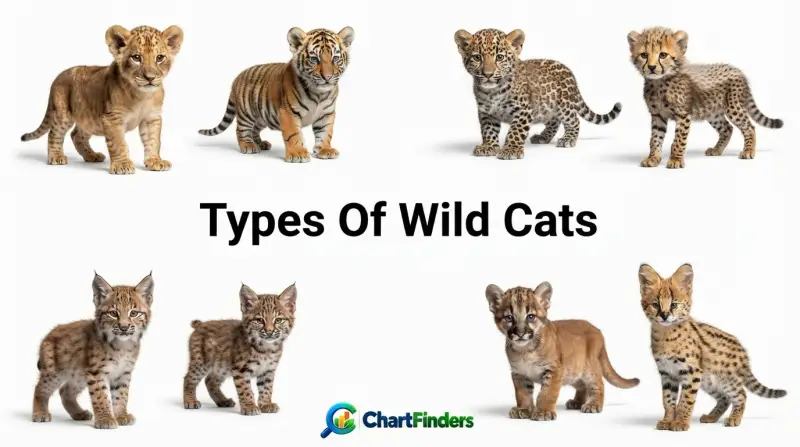
The family Felidae represents one of the most successful lineages of obligate carnivores on Earth. From the sub-zero peaks of Central Asia to the dense tropical canopies of the Amazon basin, wild cats have evolved specialized morphological and behavioral adaptations that make them apex or meso-predators in virtually every habitat they occupy. Understanding the different types of wild cats requires navigating a complex taxonomy divided not just by geography or body size, but by anatomical distinctions such as vocalization mechanics, skeletal structures, and specialized ecological niches.
For field researchers, conservationists, and wildlife enthusiasts, properly categorizing wild cats is essential for tracking population dynamics, understanding ecological roles, and implementing targeted protection strategies. As mounting pressures from habitat fragmentation and illegal wildlife trafficking threaten numerous populations—with many species remaining heavily endangered or largely depleted—a rigorous understanding of these magnificent creatures is more critical than ever. This guide provides an exhaustive taxonomy and deep-dive analysis of the world’s wild cat species, exploring their physical classifications, ecological niches, identification traits, and conservation realities.
Types Of Wild Cats
- Wild cats are strictly divided into two primary subfamilies: Pantherinae (roaring cats) and Felinae (purring cats).
- Size alone does not determine classification; the ability to roar depends on the anatomical structure of the larynx and hyoid apparatus.
- The Pantherinae subfamily contains five extant species: the lion, tiger, jaguar, leopard, and snow leopard.
- The Felinae subfamily contains dozens of diverse species, ranging from massive cougars down to small desert dwellers like the sand cat.
- Many wild cat species face acute conservation challenges, including severe habitat loss, human-wildlife conflict, and poaching.
- Specialized adaptations—such as the snow leopard’s widened nasal cavity for freezing air or the cheetah’s semi-non-retractable claws—dictate their ecological niches.
To fully understand the diversity of wild cats, one must look beyond superficial resemblances and examine the scientific framework that groups them. The Felidae family diverged millions of years ago into distinct lineages, adapting to varied prey bases and environmental pressures. The following sections break down these types systematically, moving from the largest roaring cats to the diverse spectrum of smaller feline specialists.
The Subfamily Pantherinae: The Big Roaring Cats
The subfamily Pantherinae represents the pinnacle of feline size and predatory power. Often referred to colloquially as the “big cats,” biological classification reserves this title for species possessing an incompletely ossified hyoid bone. This specialized anatomical feature, combined with stretchy elastic ligaments in the vocal cords, allows Pantherines to produce a deep, resonant roar. They cannot, however, purr continuously while inhaling and exhaling the way smaller cats do.
Panthera tigris (The Tiger)
The tiger is the largest of all wild cat species, instantly recognizable by its distinct dark vertical stripes on reddish-orange fur. Historically ranging across vast swaths of Asia, tigers now exist in fragmented populations spanning India, Russia, Southeast Asia, and parts of China. They are solitary, highly territorial apex predators that rely heavily on stealth, camouflage, and immense physical strength to bring down large ungulates like deer and wild boar. Unlike many other cat species, tigers are exceptional swimmers and frequently bathe in rivers and lakes to cool off.
Panthera leo (The Lion)
Lions are unique among wild cats for their highly social structure, living in family groups known as prides. Historically distributed across Africa, Europe, and Asia, wild lions are now largely restricted to sub-Saharan Africa, with a tiny, critically endangered remnant population of Asiatic lions surviving in India’s Gir Forest. Sexual dimorphism is pronounced in lions: males boast thick, prominent manes that signal health and genetic fitness, while females (lionesses) handle the majority of cooperative hunting for the pride.
Panthera onca (The Jaguar)
The jaguar is the largest cat in the Americas and the third-largest globally. Sporting a robust, muscular build and a coat patterned with rosettes containing inner spots, jaguars inhabit dense tropical forests, wetlands, and seasonally flooded grasslands from Central America down through the Amazon basin. Unlike most cats that deliver a suffocating throat bite, the jaguar possesses an exceptionally powerful jaw capable of piercing the skulls or turtle shells of its prey with a direct bite.
Panthera pardus (The Leopard)
Leopards are remarkably adaptable, pound-for-pound among the strongest climbers of the big cats, and possess a vast geographic range spanning sub-Saharan Africa, the Middle East, and parts of Asia. Their coat features rosette patterns similar to jaguars, though without the central spots. Leopards are famous for hoisting heavy kills—sometimes weighing more than the cat itself—high into the branches of trees to keep them away from ground-dwelling scavengers like hyenas and lions.
Panthera uncia (The Snow Leopard)
Adapted to the harsh, freezing climates of the high mountain ranges of Central and South Asia, the snow leopard is an elusive master of camouflage. It features thick, smoky-grey fur marked with dark rosettes, an exceptionally long and heavy tail used for balance and warmth, and wide paws that act as natural snowshoes. Due to their remote alpine habitat and secretive nature, studying snow leopards in the wild presents immense logistical challenges.
| Species | Primary Subfamily | Geographic Range | Vocalization Type | Conservation Status |
|---|---|---|---|---|
| Tiger (Panthera tigris) | Pantherinae | Asia (India, Russia, SE Asia) | Roar | Endangered |
| Lion (Panthera leo) | Pantherinae | Africa, small pocket in India | Roar | Vulnerable |
| Jaguar (Panthera onca) | Pantherinae | Central and South America | Roar | Near Threatened |
| Leopard (Panthera pardus) | Pantherinae | Africa and Asia | Roar | Vulnerable |
| Snow Leopard (Panthera uncia) | Pantherinae | Central Asian Mountains | Roar | Vulnerable |
The table above outlines the core members of the Pantherinae subfamily. While these five species dominate public recognition of “big cats,” the vast majority of feline biodiversity actually resides within the second major subfamily: Felinae.
The Subfamily Felinae: Small-to-Medium Cats
The subfamily Felinae encompasses all remaining wild cat species. A common misconception is that “Felinae” means small cats; while this group does contain diminutive species like the rusty-spotted cat and the black-footed cat, it also includes massive apex predators like the cougar, which rivals a leopard in weight. The defining anatomical characteristic uniting Felinae is a fully ossified hyoid bone, which prevents them from roaring but allows them to purr continuously during both inhalation and exhalation.
Acinonyx jubatus (The Cheetah)
The cheetah stands alone in its own genus (Acinonyx) and is famous as Earth’s fastest land mammal, capable of reaching speeds up to 60-70 mph in short, explosive bursts. Physically distinct from other cats, the cheetah possesses semi-non-retractable claws that act like running cleats for traction, a lightweight aerodynamic frame, long legs, and a specialized tail that functions as a rudder during high-speed pursuits. They primarily inhabit the open savannas and semi-arid regions of Africa, with a critically endangered subpopulation lingering in Iran.
Puma concolor (The Cougar / Mountain Lion / Puma)
Known by dozens of local names—including cougar, mountain lion, puma, and panther—Puma concolor boasts the widest latitudinal range of any native land mammal in the Western Hemisphere, stretching from the Canadian Yukon down to the southern Andes of South America. Cougars are remarkably adaptable generalists, thriving in dense forests, rugged mountain terrain, deserts, and scrublands. While technically classified within the Felinae subfamily and incapable of roaring, large cougars match or exceed the body weight of several Pantherine species.
Lynx Species (The Eurasian, Canada, Iberian, and Bobcat)
The lynx genus is easily identified by distinct physical markers: a short, stubby tail, prominent tufts of black hair on the tips of their ears, and large, padded paws designed for deep snow.
- Eurasian Lynx: The largest lynx species, ranging across European and Asian forests.
- Canada Lynx: Heavily specialized for hunting snowshoe hares across northern North American boreal forests.
- Iberian Lynx: One of the world’s most critically endangered cat species, restricted to localized scrubland pockets in Spain and Portugal, relying almost exclusively on European rabbits.
- Bobcat: A smaller, highly adaptable North American wildcat characterized by a barred coat and a bobbed tail.
Neotropical Small Cats: Ocelots, Margays, and Jaguarundis
Central and South America support a rich radiation of smaller wild cat species adapted to complex forest canopies and scrub environments:
- Ocelot (Leopardus pardalis): A medium-sized spotted cat with stunning chain-like rosettes. Ocelots are skilled swimmers and hunt a variety of small mammals, reptiles, and birds.
- Margay (Leopardus wiedii): A smaller, arboreal specialist possessing exceptionally flexible ankle joints that allow it to rotate its hind legs 180 degrees, enabling it to climb down tree trunks head-first like a squirrel.
- Jaguarundi (Herpailurus yagouaroundi): A slender, uniform-colored cat with short legs, a long tail, and an otter-like head, active primarily during daylight hours across brushlands and forest edges.
- Andean Cat (Leopardus jacobita) & Pallas’s Cat (Otolobulus manul): Highly specialized high-altitude and steppe dwellers, with the Andean cat recognized as one of the rarest and most elusive wild cats in South America.
Ecological Roles and Specialized Adaptations
Wild cats are vital keystone species within their respective ecosystems. As apex and meso-predators, they exert top-down control on herbivore populations, which in turn prevents overgrazing, protects local vegetation structures, and maintains overall habitat health. The evolutionary adaptations that allow them to fulfill these roles are marvels of natural selection.
Morphological traits vary wildly depending on environmental pressures. For instance, desert-dwelling species such as the sand cat (Felis margarita) have evolved thick fur pads on the bottoms of their paws to insulate them against scorching desert sand and prevent sinking into loose dunes. Conversely, snow leopards possess an enlarged nasal cavity that warms freezing mountain air before it reaches their lungs, preventing thermal shock at extreme altitudes.
Behavioral adaptations are equally diverse. While many wild cats are strictly nocturnal or crepuscular (active at dawn and dusk), others like the African serval utilize acute hearing and long legs to flush out and catch rodents in tall savanna grasses during daylight hours. Understanding these distinct ecological requirements underscores why captive breeding and generalized conservation approaches often fall short; saving wild cats requires preserving entire, functional ecosystems.
Conservation Status and Threats
Despite their evolutionary prowess, wild cats face unprecedented global pressures. According to assessments by the IUCN Species Survival Commission, numerous wild cat species and distinct subspecies are currently categorized as Endangered, Vulnerable, or Largely Depleted. Prime examples include the Sri Lankan leopard and the Andean cat, both of which face severe population contractions.
The primary threats driving these declines include:
- Habitat Loss and Fragmentation: Expanding agricultural frontiers, deforestation, and infrastructure development break continuous wild cat ranges into isolated patches, leading to inbreeding depression and genetic stagnation.
- Poaching and Illegal Wildlife Trade: Driven by demand for pelts, bones, and traditional medicine ingredients, illegal poaching continues to devastate populations of tigers, leopards, and jaguars.
- Human-Wildlife Conflict: As human settlements encroach on wild ranges, cats that prey on livestock are frequently poisoned, shot, or snared by farmers seeking to protect their livelihoods.
- Prey Depletion: Overhunting of wild ungulates by humans reduces the natural food base available to large carnivores, forcing them to target domestic animals and heightening retaliatory conflicts.
Frequently Asked Questions
What is the difference between Pantherinae and Felinae?
The primary scientific distinction lies in the structure of the hyoid apparatus in the throat. Members of the Pantherinae subfamily have an incompletely ossified hyoid bone connected by elastic ligaments, allowing them to roar. Members of the Felinae subfamily have a fully ossified hyoid bone, which prevents roaring but enables them to purr continuously.
Are all big cats dangerous to humans?
Yes. While most wild cats actively avoid human contact, all large wild cats (such as tigers, lions, leopards, jaguars, and cougars) possess the physical capability and predatory drive to view humans as potential threats or prey under certain conditions, particularly if the animal is sick, injured, or habituated to human presence.
Can wild cats be kept as domestic pets?
No. Wild cats possess intense, hardwired predatory instincts, high-energy needs, and specialized environmental requirements that cannot be met in a standard domestic environment. Even high-generation hybrid cats, such as early-generation Savannahs derived from servals, carry strong prey drives, require extensive environmental enrichment, and demand specialized containment rather than acting as low-maintenance pets.
How many species of wild cats are there in the world?
While exact taxonomical classifications vary slightly depending on whether certain regional populations are designated as full species or subspecies, modern scientific consensus generally recognizes around 38 to 40 distinct species within the family Felidae.
Why are so many wild cat species endangered?
Wild cat populations face severe anthropogenic pressures, most notably widespread habitat destruction, agricultural expansion, climate-driven ecosystem shifts, illegal poaching for skins and body parts, and retaliatory killing by farmers due to livestock depredation.
Conclusion
The family Felidae represents a breathtaking spectrum of evolutionary engineering, from roaring apex predators ruling the tropical forests and arid plains to elusive high-altitude specialists navigating frozen crags. Recognizing the distinct types of wild cats—differentiating between the mighty Pantherines and the diverse array of Felines—provides vital insight into how these magnificent animals structure global ecosystems. Protecting them demands aggressive anti-poaching enforcement, habitat corridor preservation, and sustainable coexistence frameworks to ensure that the world’s remaining wild cats endure for generations to come.