
Mastering meat cookery is a blend of art and food science. While traditional home cooking relied heavily on visual cues like exterior color, juices, or cooking time, modern culinary practice relies entirely on internal temperature. Relying on visual indicators often leads to overcooked, dry proteins or, worse, food safety hazards. Understanding the science of heat transfer, protein denaturation, thermal death times for foodborne pathogens, and muscle fiber mechanics ensures every meal is both safe and succulent.
(Reference: MEAT BUYER'S GUIDE)This comprehensive guide explores the structural mechanics of meat, the physics of carryover cooking, precise temperature benchmarks for every major animal protein, common mistakes that compromise texture and safety, and decision criteria for handling complex cuts. Whether you are roasting a whole holiday turkey, searing a prime ribeye, or grinding your own sausage, this resource equips you with the field-tested knowledge needed to execute every dish with confidence.
Explore our detailed breakdown on Types Of Flies.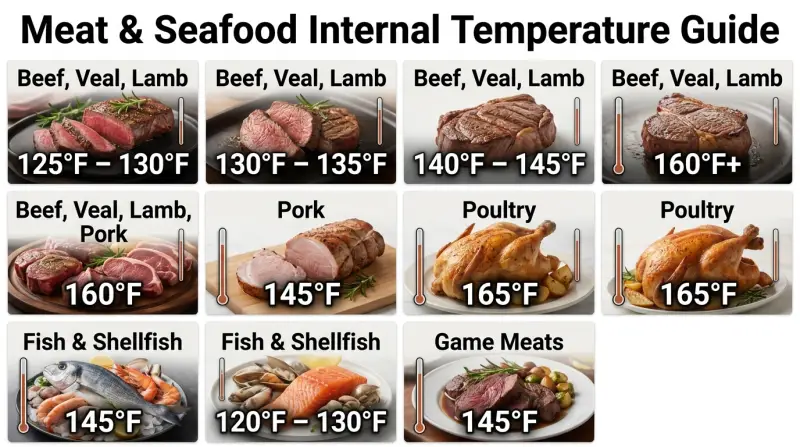
Meat Cooking Temperature Chart
- Whole Cuts vs. Ground Meats: Whole cuts (steaks, chops) are sterile on the inside, meaning bacteria only live on the surface. Ground meats mix surface bacteria throughout the entire product, requiring a higher internal kill temperature.
- The Poultry Rule: All poultry—chicken, turkey, duck, and wild game birds—must reach an internal temperature of 165°F (74°C) to neutralize pathogens efficiently.
- The Power of Resting: Rest time is not passive waiting; it is a critical cooking phase during which internal temperature equalizes and muscle fibers reabsorb moisture.
- Thermometer Placement: Always insert an instant-read thermometer into the thickest part of the meat, avoiding direct contact with bone, fat pockets, or gristle.
- Carryover Cooking: Dense roasts and thick cuts continue to cook after removal from the heat source, often rising 5°F to 15°F depending on mass and ambient cooking temperature.
To navigate meat preparation safely and successfully, you need a reliable reference standard. The following master chart aggregates USDA safety guidelines and professional culinary benchmarks across all major meat classifications, cuts, and preferred doneness levels.
| Meat Category | Specific Cut / Type | Target Internal Temp (°F) | Target Internal Temp (°C) | Mandatory Rest Time | Notes / Culinary Doneness |
|---|---|---|---|---|---|
| Beef, Veal, Lamb | Whole Cuts (Steaks, Chops, Roasts) – Rare | 125°F – 130°F | 52°C – 54°C | 3 Minutes | Cool to warm red center; soft texture. |
| Beef, Veal, Lamb | Whole Cuts (Steaks, Chops, Roasts) – Medium Rare | 130°F – 135°F | 54°C – 57°C | 3 Minutes | Warm red center; optimal balance of tenderness and juiciness. |
| Beef, Veal, Lamb | Whole Cuts (Steaks, Chops, Roasts) – Medium | 140°F – 145°F | 60°C – 63°C | 3 Minutes | Warm pink center; firmer texture. USDA minimum safe whole-cut temp is 145°F. |
| Beef, Veal, Lamb | Whole Cuts (Steaks, Chops, Roasts) – Well Done | 160°F+ | 71°C+ | 3 Minutes | Fully brown center; firm and dry. |
| Beef, Veal, Lamb, Pork | Ground Meats (Burgers, Meatballs, Meatloaf) | 160°F | 71°C | None required | Grinding distributes surface bacteria throughout; requires higher heat. |
| Pork | Fresh Cuts (Chops, Loin, Tenderloin) | 145°F | 63°C | 3 Minutes | Slight blush of pink is normal and safe; juicy texture. |
| Poultry | Chicken, Turkey, Duck (Whole, Breasts, Thighs) | 165°F | 74°C | None required (Recommended 10m for whole birds) | Dark meat can be cooked to 175°F–180°F to break down collagen and connective tissue. |
| Poultry | Ground Chicken or Turkey | 165°F | 74°C | None required | High pathogen risk; requires thorough heating throughout. |
| Fish & Shellfish | Finfish (Salmon, Halibut, Cod, etc.) | 145°F | 63°C | None required | Flesh should be opaque and flake easily with a fork. |
| Fish & Shellfish | Scallops, Shrimp, Lobster, Crabs | 120°F – 130°F | 49°C – 54°C | None required | Opaque appearance; firm texture. |
| Game Meats | Venison, Elk, Wild Boar (Whole Cuts) | 145°F | 63°C | 3 Minutes | Similar profile to beef/pork; wild game benefits from careful monitoring to prevent drying. |
When reviewing the chart above, it is vital to distinguish between regulatory food safety baselines and culinary preference. While food safety authorities establish temperatures that instantly or rapidly destroy harmful bacteria, culinary professionals often manipulate heat application, cooking times, and resting phases to achieve optimal tenderness and flavor without sacrificing health standards.
The Science Behind Meat Temperatures
To understand why different meats require different internal temperatures, we must examine the microscopic structure of animal muscle tissue. Meat is composed primarily of water, protein filaments (actin and myosin), and connective tissue (collagen), bound together within cellular membranes.
As heat is applied to meat, thermal energy disrupts the weak bonds holding protein structures together, causing them to unfold and coagulate. This process is known as denaturation. As proteins tighten, they squeeze out moisture. The degree of this protein contraction directly dictates the doneness of the meat:
- Rare (120°F–130°F): Proteins have barely begun to coagulate. Muscle fibers retain most of their natural moisture, and red myoglobin proteins remain liquid and vibrant.
- Medium (140°F–150°F): Proteins contract significantly, expelling free moisture. Myoglobin denatures further, turning grayish-pink or tan.
- Well Done (160°F+): Proteins form a tight, dense matrix that squeezes out virtually all unbound water, resulting in a firm, dry texture.
Why Whole Cuts Differ From Ground Meats
One of the most common points of confusion in home cooking is why a steak can be safely consumed at 135°F while a hamburger must reach 160°F. The answer lies in the microbiological geography of the animal carcass.
Pathogenic bacteria such as Escherichia coli, Salmonella, and Listeria reside almost exclusively on the exterior surfaces of live animals and slaughtered cuts. When a whole muscle cut like a sirloin or pork chop is seared or roasted, surface heat instantly eradicates any surface bacteria. The interior of a whole muscle remains sterile.
Conversely, the mechanical grinding process required to make hamburger meat or sausage shatters muscle structure, mixing surface bacteria throughout the entire batch. Consequently, bacteria that were once safely isolated on the outside are now distributed uniformly throughout the center of the patty. To ensure safety, ground meat must be heated uniformly to an internal temperature of 160°F (71°C).
Deep Dive: Specific Meat Categories
Different animal species possess distinct fat distributions, connective tissue densities, and microbiological profiles. Treating every protein with a uniform approach guarantees uneven culinary results.
Beef, Veal, and Lamb
Red meats are remarkably forgiving when cooked as whole primal or sub-primal cuts. Because their connective tissues (collagen) soften during long, slow braises or render down in marbled steaks, they can be enjoyed across a wide spectrum of doneness.
For tender cuts like ribeye, strip loin, tenderloin, and lamb chops, temperature staging defines culinary success:
- Rare: Cool, bright red center. Internal temp: 120°F–130°F.
- Medium Rare: Warm, red center. Internal temp: 130°F–135°F. (The gold standard for steakhouse cuts).
- Medium: Warm, pink center. Internal temp: 135°F–145°F.
- Medium Well: Slightly pink center. Internal temp: 145°F–155°F.
- Well Done: No pink remaining. Internal temp: 155°F+.
For tougher cuts containing high amounts of collagen—such as beef chuck, brisket, and lamb shoulder—low-and-slow cooking is required. While these cuts eventually reach internal temperatures of 195°F–205°F, this extended heat exposure is not for safety alone; it is necessary to melt tough collagen into gelatin, transforming a tough cut into fork-tender meat.
Pork: Dispelling the Trichinosis Myth
For generations, home cooks were taught that pork had to be cooked until completely gray and dry to prevent trichinosis, a parasitic infection caused by roundworms. Modern agricultural practices and rigorous inspection standards have practically eradicated trichinosis in commercial pork production.
In 2011, the USDA officially updated its safe cooking temperature for fresh cuts of pork (chops, roasts, tenderloin) to 145°F (63°C), followed by a mandatory 3-minute rest period. Cooking pork to this temperature preserves natural moisture and leaves a slight, safe blush of pink in the center, radically improving texture and flavor.
Poultry: Chicken, Turkey, and Duck
Poultry requires stricter temperature controls than red meat due to the high prevalence of Salmonella and Campylobacter bacteria on feathers, skin, and processing environments. The USDA safe minimum internal temperature for all poultry—whether whole birds, breasts, wings, or ground meat—is 165°F (74°C).
However, an important culinary nuance exists between white and dark poultry meat:
- Chicken/Turkey Breast: Lean white meat contains very little fat or connective tissue. It dries out rapidly once it crosses 160°F–165°F. Pulling breasts right at 165°F (or slightly lower if utilizing carryover heat) ensures maximum succulence.
- Chicken/Turkey Thighs and Legs: Dark meat is rich in connective tissue, myoglobin, and intramuscular fat. It is actually unpleasantly chewy and rubbery at 165°F. Dark meat reaches its ideal texture when cooked to 175°F–180°F (79°C–82°C), as the higher heat renders the internal fats and melts connective tissue into rich gelatin.
Seafood
Seafood cooks much faster than terrestrial meat due to its delicate, short muscle fibers (myotomes) and lack of heavy connective tissue. Finfish like salmon, cod, and halibut are legally and safely cooked to an internal temperature of 145°F (63°C), though many culinary experts prefer pulling delicate fish around 130°F–135°F while the center is still translucent and moist.
Shellfish such as shrimp, scallops, and lobster are safely done when their internal temperature reaches 120°F–130°F, marked by an opaque flesh and firm, springy texture.
The Physics of Resting and Carryover Cooking
One of the most frequent errors in home kitchen cooking is cutting into meat the exact second it is removed from the heat source. Doing so guarantees that savory juices will pool instantly onto the cutting board rather than staying inside the meat.
How Carryover Cooking Works
Heat energy moves from areas of high temperature to areas of low temperature. When meat is exposed to high oven, grill, or pan heat, the exterior reaches temperatures far exceeding the target internal temperature (e.g., a 400°F oven creates a hot outer ring while the center is 125°F).
When you remove the meat from the heat, thermal energy stored in the outer layers continues to migrate toward the cooler center. This phenomenon is called carryover cooking. Depending on the size, density, and initial cooking technique:
- Thin cuts (steaks, chops): Rise 3°F to 5°F during rest.
- Medium roasts (pork loins, whole chickens): Rise 5°F to 10°F during rest.
- Large roasts (prime rib, whole turkeys): Rise 10°F to 15°F during rest.
Failing to account for carryover cooking is why many roasts overshoot their target doneness and turn out overcooked.
The Mechanics of Muscle Relaxation
As meat heats up, muscle fibers contract tightly, squeezing moisture toward the center like a wrung-out sponge. If you slice hot meat immediately, the internal pressure forces juices out.
Allowing meat to rest gives muscle fibers time to relax. As the temperature plateaus and begins to drop, the proteins relax slightly, reabsorbing and redistributing moisture throughout the cut. A standard 3-to-10-minute rest ensures juiciness with every bite.
Essential Tools: Accuracy Over Guesswork
Estimating doneness by touch, color, or cooking time is notoriously unreliable. Variables such as meat thickness, fat distribution, pan composition, and ambient kitchen temperature make rigid time charts inaccurate.
Every kitchen requires a reliable digital food thermometer. The two primary styles are:
- Instant-Read Digital Thermometers: Featuring a thin probe and a digital readout, these provide accurate readings within 3 to 5 seconds. They are used intermittently at the end of the cooking process to check progress.
- Leave-In Probe Thermometers: These feature a heat-resistant cable connected to a stainless steel probe inserted into the meat before cooking. The probe remains inside the oven or smoker, allowing continuous monitoring and programmable alerts when the target temperature is reached.
Proper Thermometer Technique
Even the most accurate thermometer will give a false reading if placed incorrectly:
- Target the Center: Insert the probe into the thickest part of the meat.
- Avoid Obstacles: Ensure the tip does not touch bone, gristle, or large pockets of external fat, as these conduct heat differently than muscle tissue and yield artificially high readings.
- Deep Insertion: For dial thermometers, ensure the probe is inserted up to the dimple or indentation on the shaft (usually 1.5 to 2 inches). Digital sensor tips are located in the final quarter-inch of the probe.
Common Meat Cooking Mistakes
Avoiding common temperature-related pitfalls elevates culinary results from inconsistent to professional quality.
- Relying on Cooking Time Alone: Recipes that state “cook steak for 6 minutes per side” ignore variations in meat thickness, starting temperature, and pan heat. Always cook to internal temperature, not time.
- Skipping the Rest Period: Slicing meat straight off the grill or out of the oven evacuates moisture. Always factor rest time into your cooking schedule.
- Ignoring Carryover Cooking: Pulling a roast at its exact target temperature guarantees it will overcook on the counter as residual heat drives the internal temperature higher.
- Incorrect Probe Placement: Touching a bone with a thermometer creates a false high reading, leading you to believe the meat is fully cooked when the center remains raw.
- Not Calibrating Thermometers: Over time, digital and dial thermometers can lose calibration. Submerge your thermometer in an ice-water bath (32°F / 0°C) or boiling water (212°F / 100°C) periodically to verify accuracy.
Frequently Asked Questions
There is no single temperature that satisfies all cuts while maintaining ideal culinary quality. However, 165°F (74°C) is the universal benchmark that instantly destroys foodborne pathogens in all poultry and ground meats. Whole cuts of beef, pork, lamb, and veal are safely consumed at 145°F (63°C) with a 3-minute rest.
Yes. Modern commercial pork is safe to consume when cooked to an internal temperature of 145°F (63°C) followed by a 3-minute rest. At this temperature, pork often retains a slight pink blush. The old rule requiring pork to be cooked until gray and dry is obsolete.
Resting time depends primarily on the size of the cut. Thin cuts like individual steaks and pork chops require 3 to 5 minutes. Medium-sized roasts and whole chickens benefit from 10 to 15 minutes. Large holiday roasts, prime ribs, and whole turkeys require 20 to 30 minutes under a loose tent of aluminum foil.
Bacteria live on the surface of whole muscle cuts. When searing a steak, surface heat immediately destroys those pathogens, leaving the sterile interior safe to eat rare. Grinding mixes surface bacteria throughout the entire meat mixture, requiring the interior of ground meat products to reach 160°F (71°C) to ensure safety.
If you suspect inconsistent readings, probe the meat in multiple locations. In large roasts, always measure the temperature at the geometric center of the thickest muscle. If you hit a pocket of fat or bone, reposition the probe slightly until you locate the true center of the muscle mass.
Conclusion
Mastering meat cooking temperatures transforms home cooking from a guessing game into a predictable science. By anchoring your techniques to reliable internal temperature benchmarks, accounting for carryover cooking, and honoring necessary rest times, you eliminate the risk of foodborne illness while consistently achieving tender, juicy, and flavorful results across every animal protein.