
Quick Answer: A Meteorite Identification Chart is a diagnostic field guide used to differentiate genuine space rocks from terrestrial look-alikes (“meteorites vs. meteorwrongs”). True meteorites are systematically identified through a combination of physical tests: testing for heavy magnetic attraction (due to a nickel-iron matrix), observing a thin, dark fusion crust with flow lines, checking for interior metallic flecks (if a stony-iron or iron type), verifying high density, and ensuring a lack of vesicular gas bubbles or quartz composition. Common terrestrial imposters include industrial slag, hematite, magnetite, and volcanic basalts.
(Reference: Meteorite Books For Sale – Tektite Books For Sale)Every year, thousands of suspicious rocks are mailed to university geology departments, museums, and private collectors. The vast majority of these submissions turn out to be ordinary Earth rocks—frequently referred to in the planetary science community as “meteorwrongs.” Slag from old iron smelting, heavy chunks of iron oxide like hematite, and dense volcanic rocks routinely fool enthusiastic finders. Distinguishing an extraterrestrial visitor from terrestrial debris requires a methodical, step-by-step diagnostic process. Because professional laboratory analysis—such as petrographic thin-sectioning or electron microprobe testing—is destructive and time-consuming, amateur and professional field researchers rely on a structured matrix of physical and chemical screenings to narrow down candidates.
Explore our detailed breakdown on Types Of Mosquitoes (Complete Field Identification).This master guide explores the anatomy of meteorite identification, breaking down the major chemical classes, diagnostic visual indicators, mechanical testing protocols, and the common terrestrial minerals that mimic them. By examining the structural criteria used by meteorite recovery teams and researchers referencing databases like NASA’s ARES, you will gain the practical framework required to evaluate a suspected find accurately before spending time and money on formal classification.
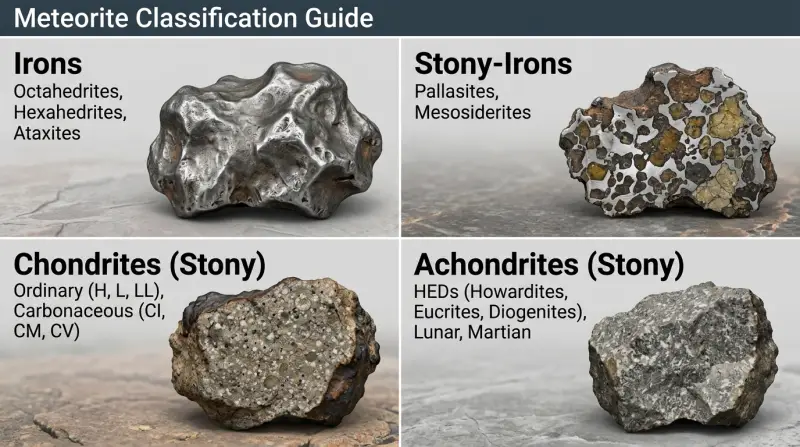
Meteorite Identification Chart
- Magnetic Attraction: The vast majority of meteorites contain an extraterrestrial nickel-iron alloy, causing them to exhibit strong to moderate magnetic attraction.
- Fusion Crust: Atmospheric entry creates extreme frictional heat, melting the exterior into a smooth, dark, micro-thin rind that often displays flow lines or regmaglypts (thumbprints).
- High Density and Weight: Because of their dense metallic composition, meteorites feel noticeably heavier than ordinary Earth rocks of the exact same physical volume.
- Absence of Vesicles: True meteorites do not contain gas bubbles, holes, or vesicular cavities typical of terrestrial volcanic basalts and pumice.
- Terrestrial Imposters: Industrial slag is the #1 “meteorwrong,” frequently featuring internal bubbles, multi-colored glass phases, and irregular weight distribution.
- Interior Matrix: Cutting, grinding, or windowing a stone meteorite often reveals shiny metal flakes or chondrules (small silicate spheres), while irons reveal glowing Widmanstätten patterns when etched with acid.
To successfully navigate the identification process, researchers utilize systematic diagnostic matrices that contrast extraterrestrial properties against terrestrial look-alikes. The following comprehensive reference chart summarizes the core classes of meteorites alongside their defining structural, physical, and chemical traits.
| Meteorite Class | Subtypes & Variants | Major Composition | Magnetic Properties | Visual Appearance & Crust | Interior Characteristics |
|---|---|---|---|---|---|
| Irons | Octahedrites, Hexahedrites, Ataxites | Iron-nickel alloy (90-95% Fe, 5-10% Ni) | Strongly magnetic (deflects compass) | Dark brown/black fusion crust, deep thumbprints (regmaglypts), heavy metallic sheen where weathered. | Solid metal; etching with nitric acid reveals crystalline Widmanstätten patterns. |
| Stony-Irons | Pallasites, Mesosiderites | Rough 50/50 mix of Fe-Ni metal and silicate minerals | Strongly magnetic | Rusty exterior, metal network visible through weathered patches, rounded edges. | Translucent olivine (peridot) crystals suspended in a glowing metal honeycomb matrix. |
| Chondrites (Stony) | Ordinary (H, L, LL), Carbonaceous (CI, CM, CV) | Silicates (olivine, pyroxene) + dispersed metal grains | Moderate to weak magnetic attraction | Matte black or dark brown fusion crust, smooth or slightly faceted, often wind-polished. | Light gray/tan interior showing tiny round silicate spheres (chondrules) and small metal flecks. |
| Achondrites (Stony) | HEDs (Howardites, Eucrites, Diogenites), Lunar, Martian | Magmatic silicates; highly depleted in metal | Non-magnetic to very weakly magnetic | Smooth, glassy fusion crust (sometimes brown/greenish), resembles terrestrial igneous rock. | Brecciated or crystalline rock matrix; completely lacks chondrules and visible metal grains. |
Understanding these fundamental classes is only the first step. When evaluating a rock in the field, every single diagnostic parameter must be checked sequentially. Relying on a single test—such as magnetism alone—frequently leads to false positives, as many common terrestrial iron ores are also magnetic.
The Three Major Meteorite Classifications
All meteorites originating from asteroid parent bodies, the Moon, or Mars are broadly grouped into three primary categories based on their mineralogy and formation history in the early solar system.
1. Irons (Siderites)
Iron meteorites represent the cores of differentiated asteroids that were shattered by catastrophic impacts long ago. Composed almost entirely of an iron-nickel alloy—specifically the minerals kamacite and taenite—they are extraordinarily dense and heavy. Because they lack fragile silicate minerals, they survive atmospheric entry intact more frequently than stony types, making up a disproportionate share of finds in desert recovery regions. When sliced and polished with a mild acid etch, iron meteorites display breathtaking interlocking crystalline structures known as Widmanstätten patterns.
2. Stony-Irons (Lithosiderites)
Considered by many to be the most aesthetically striking of all space rocks, stony-irons are rare transitional materials formed at the core-mantle boundary of differentiated asteroids. Pallasites feature gem-quality olivine crystals trapped within a glowing iron-nickel metal network, while mesosiderites are complex breccias containing mixed silicates and metal fragments. They account for less than 1% of all known meteorite falls.
3. Stones (Chondrites and Achondrites)
Stony meteorites are the most common type to fall to Earth, though they are notoriously difficult for untrained finders to identify because they resemble ordinary terrestrial rocks. They are divided into two main sub-groups:
- Chondrites: Primitive, unaltered rocks containing chondrules—millimeter-sized droplets of molten silicate minerals that condensed in the solar nebula over 4.5 billion years ago. They have never undergone melting or differentiation.
- Achondrites: Igneous rocks that melted and recrystallized on parent bodies large enough to undergo planetary differentiation. This group includes rare meteorite types originating from the Moon and Mars, characterized by unique isotopic signatures and mineral ratios.
Key Physical Diagnostic Tests for Field Identification
Before contacting a laboratory or museum, you can perform several non-destructive diagnostic tests in your workshop or garage. These steps mirror the initial screening protocols used by institutional meteorite curators.
The Magnet Test
Because nearly all meteorites contain free iron-nickel metal (even stony chondrites contain tiny metal flakes), a strong rare-earth magnet (such as a neodymium magnet) should show some degree of attraction. Tie your magnet to a string and use it like a pendulum; if it swings toward the rock and exhibits a noticeable pull, the specimen passes the first major hurdle. Exception: Lunar and Martian achondrites, as well as some highly weathered achondrites, contain virtually no free metal and are non-magnetic.
The Streak Test
Rub your suspected rock across the unglazed underside of a ceramic bathroom tile or porcelain plate.
- Terrestrial Imposter: Minerals like hematite will leave a distinct reddish-brown streak, and magnetite will leave a dark black streak.
- True Meteorite: A genuine meteorite will rarely leave a distinct colored streak because its fusion crust and interior metal-silicate matrix are extremely hard, though weathered stones might leave a faint gray smudge of iron oxide. If you get a vibrant colored streak, the rock is almost certainly a terrestrial mineral ore.
Density and Specific Gravity Calculation
Terrestrial rocks—especially granites, sandstones, and limestones—typically have a specific gravity between 2.0 and 3.0 g/cm³. Iron meteorites, by contrast, have a specific gravity ranging from 7.5 to 8.0 g/cm³, making them feel unnaturally heavy for their size. Even ordinary chondrites sit higher on the density scale, typically falling between 3.3 and 3.7 g/cm³. Calculating specific gravity requires weighing the rock dry, then weighing it suspended in water, and dividing the dry weight by the difference.
Visual Characteristics and Micro-Structures
Visual inspection provides vital clues that separate space rocks from terrestrial geological formations. When a meteoroid plunges through Earth’s upper atmosphere at velocities ranging from 11 to 72 kilometers per second, the immense air pressure creates a shock wave that compresses and heats atmospheric gases to temperatures exceeding 1,600°C (2,900°F). This thermal blast melts the outer shell of the rock instantly.
The Fusion Crust and Regmaglypts
The resulting shell is known as a fusion crust. On a freshly fallen meteorite, this crust is matte black, satin-like, and paper-thin (typically less than 1 millimeter thick). Over time, terrestrial weathering turns this black crust brown or rusty orange as the iron oxidizes.
As the ablation process strips away melting material unevenly, aerodynamic forces sculpt shallow, thumbprint-like depressions across the surface called regmaglypts. These resemble impressions pushed into soft clay by a thumb. While some terrestrial volcanic bombs and weathered limestone formations can develop pitted surfaces, true regmaglypts feature smooth, sweeping edges smoothed by hypersonic airflow.
Internal Features: Chondrules and Metal Flecks
If a rock has a broken corner or has been “windowed” (ground down with a diamond lapidary wheel on a small edge), inspect the interior with a 10x jeweler’s loupe.
- Chondrules: Look for tiny, multicolored spherical grains embedded within a finer matrix. These are chondrules, exclusive to primitive stony meteorites. Terrestrial rocks do not contain isolated silicate spheres.
- Metal Flecks: Look for shining metallic points of nickel-iron. If you can see bright silver flecks embedded directly into the silicate matrix without branching out into veins (which is common in terrestrial ore veins), the rock is a strong candidate for an ordinary chondrite or stony-iron.
Comparative Analysis: Meteorites vs. Terrestrial Imposters
To further sharpen field evaluation, reviewing a direct side-by-side comparison matrix of verified meteorites versus common terrestrial look-alikes helps eliminate ambiguity during initial screenings.
| Diagnostic Feature | True Meteorite | Terrestrial Imposter (Slag / Iron Ore) |
|---|---|---|
| Specific Gravity / Weight | Exceptionally dense (3.3 to 8.0 g/cm³); feels unnaturally heavy for its size. | Varies widely; often feels too light or average for its bulk. |
| Vesicles & Gas Holes | Completely absent; volatile gases boil away in space and during ablation. | Frequently present; internal bubbles and flow-voids are common in industrial slag. |
| Streak Color | No streak or faint gray smudge on unglazed porcelain. | Distinct colored streak (reddish-brown for hematite, dark black for magnetite). |
| External Skin | Matte black or brown fusion crust with smooth ablation flow lines/regmaglypts. | Rough, uneven oxidation rind, glassy multi-phase slag crust, or crystalline faces. |
Common Terrestrial Imposters (“Meteorwrongs”)
More than 99% of suspected meteorites submitted to experts are terrestrial minerals or man-made industrial byproducts. Knowing what these imposters look like saves time and prevents disappointment.
| Meteorwrong Type | Origin / Description | Why It Fools People | How to Distinguish It from a Meteorite |
|---|---|---|---|
| Industrial Slag | Waste byproduct from metal smelting and blast furnaces. | Heavy, metallic, irregularly shaped, and often dark-colored. | Contains internal gas bubbles (vesicles), multi-colored glass phases, and lacks a uniform fusion crust. |
| Magnetite & Hematite | Common iron oxide and iron ore minerals found globally. | Extremely magnetic (magnetite) or heavy with a metallic luster (specular hematite). | Leaves a distinct black (magnetite) or reddish-brown (hematite) streak on unglazed porcelain. |
| Volcanic Basalt / Pumice | Igneous rock formed from cooling lava flows. | Dark crust, heavy, dark-colored groundmass. | Full of vesicular holes and gas cavities; completely non-magnetic; lacks an ablation crust. |
| Pyrite (Fool’s Gold) | Iron sulfide mineral forming brassy, cubic crystals. | Metallic luster, heavy, and glints in the sun. | Leaves a greenish-black streak, has a brittle metallic cleavage, and smells of sulfur when scratched. |
Industrial slag is by far the most frequent culprit. Because historical iron smelting was widespread across North America, Europe, and Asia for centuries, slag chunks are frequently plowed up in farm fields, found along old railway beds, or discovered near riverbanks. Slag often captures air bubbles as it cools in industrial vats, producing round or elongated cavities. True meteorites never contain gas bubbles because volatile gases boil away instantly in the vacuum of space or are stripped during atmospheric entry.
Step-by-Step Field Decision Framework
When you discover a strange rock and want to determine whether it warrants professional review, walk through this rigorous decision checklist:
- Weight and Heft Check: Pick the rock up. Does it feel noticeably heavier than a normal river rock or garden stone of identical size? If it feels exceptionally light or average, downgrade its priority.
- Magnetism Screening: Apply a neodymium magnet. Is there a strong attraction, a weak pull, or zero reaction? (Note: Zero reaction does not automatically disqualify it if it looks like an achondrite, but it reduces the probability).
- Visual Crust Inspection: Examine the exterior under bright natural light. Is there a continuous, dark, ultra-thin skin? Are there flow lines or regmaglypts? Or is it a rough, crystalline matrix lacking a distinct exterior skin?
- Vesicle Check: Look closely with a magnifying glass. Are there any holes, pinpricks, or gas bubbles? If yes, stop—it is industrial slag or volcanic vesicular basalt.
- Streak Test: Scrape the rock on unglazed ceramic. Does it leave a bright red, brown, or black streak? If yes, it is a terrestrial iron ore like hematite or magnetite.
- Window Grinding: If all previous tests point toward a meteorite, use a diamond file to grind a tiny window (2–3 millimeters) on a corner. Do you see shiny metallic grains or tiny round chondrules embedded in a gray matrix?
If your specimen passes every single one of these screening steps, take high-resolution photographs next to a metric scale (such as a ruler or coin), note the precise GPS coordinates of the find location, and contact a university geology department or an authorized registrar at the Meteoritical Society.
Frequently Asked Questions
No. While meteoroids travel through space at hypersonic speeds and experience extreme surface melting during atmospheric entry, the interior of the rock remains bitterly cold (often near absolute zero) due to the short duration of flight (seconds). , ablation strips away the molten outer layer almost instantly upon deceleration, meaning fresh meteorites are typically room temperature or only slightly warm when they hit the ground. They never start fires or remain glowing hot.
Most meteorites containing iron-nickel metal will begin to rust (oxidize) when exposed to Earth’s moisture and oxygen. Iron meteorites and ordinary chondrites develop orange-brown rust stains over months or years, particularly in humid climates. However, carbonaceous chondrites and some desert-find achondrites are more chemically stable, though weathering still alters their fusion crust from matte black to earthy brown.
Do not clean your specimen with water or acid, as this can destroy crucial terrestrial weathering context or delicate fusion crusts. Take clear, well-lit digital photographs next to a ruler for scale, record the exact GPS coordinates or description of where it was found, and perform the non-destructive streak and magnet tests. Once you have gathered these preliminary notes, reach out to an institutional earth sciences department or submit images to recognized meteorite identification forums for expert pre-screening.
Not at all. Many common terrestrial rocks—such as basalt, diabase, gabbro, and dark shales—are naturally black or dark gray. , dark industrial slag and weathered volcanic rocks are frequently mistaken for meteorites simply because of their dark color. Color alone is a poor diagnostic indicator; it must be evaluated alongside density, magnetism, and crust texture.
The market value of a meteorite varies wildly based on its classification, rarity, structural beauty, and provenance. Common ordinary chondrites may sell for $0.50 to $2.00 per gram, whereas rare Martian or lunar meteorites, as well as pristine pallasites with large gem-grade olivine crystals, can command hundreds or even thousands of dollars per gram. Specimens with documented eyewitness accounts of a witnessed fall always command a higher premium than unverified “finds.”
Conclusion
Identifying a meteorite is an exercise in elimination. By moving past the initial excitement of discovering an unusual rock and systematically applying rigorous physical tests—such as magnetism checks, density calculations, streak evaluations, and structural inspections—you can successfully separate genuine messengers from the cosmos from terrestrial imposters. Whether you are sorting through desert gravel or evaluating a curious stone unearthed in your backyard, following a structured identification chart ensures you approach every rock with scientific precision.